
 Welcome to our Summer Blog Series examining the impact of anxiety disorders on church participation and spiritual development in kids. Today…we’ll complete our look at signs church staff, volunteers and parents might observe in the child struggling with anxiety.
On Monday, we began to examine common signs and symptoms associated with clinically significant anxiety in children listed below. Monday, we looked at the first five signs. Today, we’ll examine the last five.
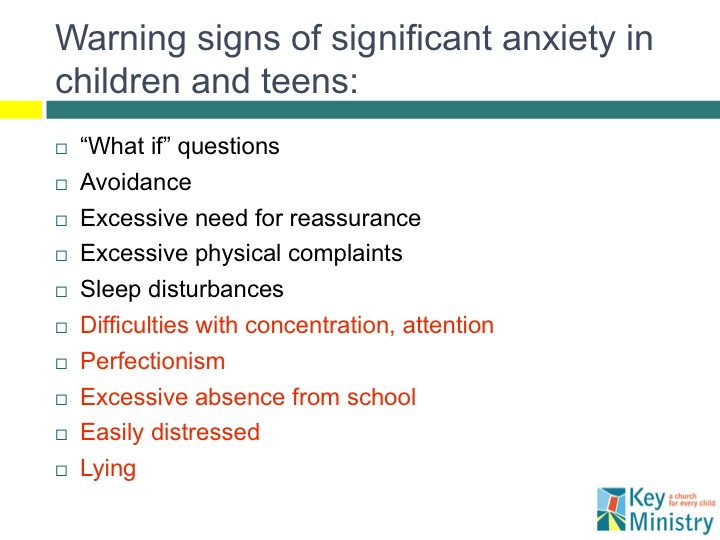
Difficulties with concentration and attention can arise from persistent fears or obsessive thoughts. It is important to distinguish difficulties with focus and concentration that occur acutely in association with specific thoughts, fears or situation from longstanding difficulties with attention that occur across two or more different situations and predate the onset of anxious symptoms as would be in the case among kids with ADHD.
Excessive perfectionism is often a sign of Obsessive-Compulsive Disorder (OCD). The type of perfectionism that helps a child to do their best studying for a test or mastering a skill wouldn’t be cause for concern unless it became counterproductive to accomplishing a specific task or began to interfere with the child’s ability to complete other age-appropriate developmental tasks. Examples of excessive perfectionism would include:
- Rewriting an entire assignment because of a mild flaw in penmanship
- The inability to turn in a less than perfect school project
- Chronic school tardiness from excessive time spent grooming in the morning
Excessive absence from school may occur in conjunction with a variety of anxiety disorders. Kids with separation anxiety are more likely to want to stay home for relatively mild physical complaints, or present to the nurse’s office at school requesting to be sent home. Those with social anxiety may be uncomfortable with peer interactions associated with school. Children predisposed to panic disorder may be more prone to episodes in a confined classroom setting where they experience difficulty leaving without being noticed by peers.
Children who are acutely embarrassed or uncomfortable may lie when directly questioned by a parent or a teacher. In these circumstances, the child may be less concerned with avoiding a specific consequence as opposed to deflecting the conversation away from a topic that evokes feelings of anxiety. Not infrequently, kids will answer such questions by responding “I don’t know.”



 Church4EveryChild