
 Earlier this week, Shannon Dingle had a wonderful post on her blog The Works of God Displayed (I’d highly encourage readers of this blog to subscribe to Shannon’s blog) on perceptions of folks in the church about the diagnosis of ADHD. I’d encourage you to read her post, because I’m challenged to express my opinions as eloquently as she did on her blog. I very much appreciate as well the comments on her blog from a pastor (Carey) who was willing to give voice to some of the thoughts and feelings Shannon was seeking to describe in her post.
Here are three specific quotes from Carey’s comments I’d like to respond to:
“However, as a Pastor, and one who is continually involved in family and marriage counseling, my concern is that some/many/alot (not sure the figure) of the ADHD diagnosis are not hitting the true need the child has – better parenting.”
“My concern is that kids who are mis-diagnosed with ADHD, when they really need better parenting at home are being “drugged” rather than what they really need… and nobody really benefits from that.”
“My comments are not aimed at those parents, so please understand that. I’m concerned about those who are quick to label their child with special needs as a way to side-step their Biblical responsibility as parents. Parenting is not easy, and many shirk it like they do other difficult things in life (conflict, work, etc.). Those children get drugs instead of loving discipline, and they are not served well by it. From my seat it seems all too common.”
The reality is that within the church community, there are some diagnoses that are considered “legitimate” disabilities, autism being the condition getting the most attention at the moment. When we started Key Ministry, our primary reason for being was the firsthand experience of the founding members of our team with families of kids with “hidden disabilities” who stopped attending church because of the responses they experienced from people within the church. It didn’t seem to us that the established disability ministry organizations were attuned to the needs of families with children experiencing primary mental health conditions, presumably because they didn’t fit into the existing construct of “disability” or “special needs.”
Our “marching orders” are to make disciples of all nations…let’s say for the sake of discussion that all of Carey’s assumptions are correct. Given that 9% of all kids of school age in the U.S. have been “drugged” for their ADHD, representing more than 9% of families (because more than 9% of families have at least one child who has been prescribed medication for ADHD), how effective are we likely to be as church in reaching out to and connecting with those parents and building relationships with them that lead to meaningful life change working off the assumptions Carey has shared?
Behavioral therapy is not a particularly effective treatment for kids with uncomplicated ADHD. The landmark study that folks in the field point to in examining this topic is the MTA study (Multimodal Treatment of ADHD), funded by the Federal Government and conducted in the mid 1990s. The premise of the study was to compare the effects of medication alone, an intensive course of behavioral and psychosocial treatment alone, the combination of the two treatment approaches and treatment readily available in the community in kids with uncomplicated ADHD, kids with ADHD and other disruptive behavior disorders (Oppositional Defiant Disorder, Conduct Disorder), kids with ADHD and internalizing disorders (primarily, anxiety) and kids with ADHD plus two or more comorbid conditions.
An overview of the study results is presented below.
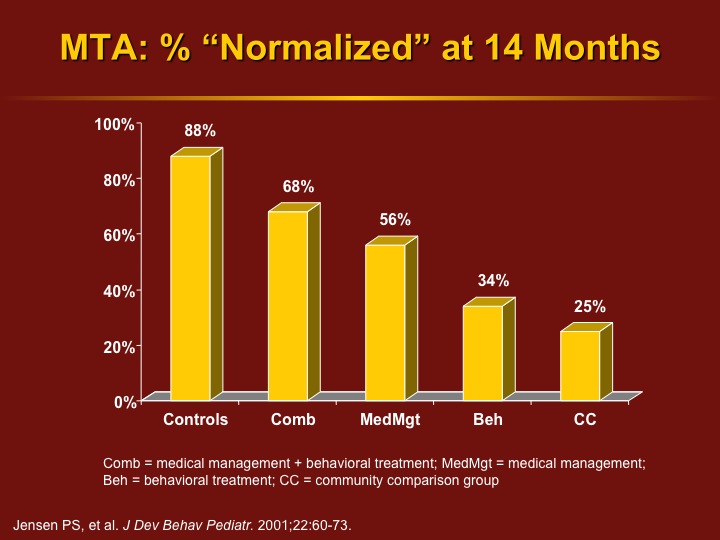
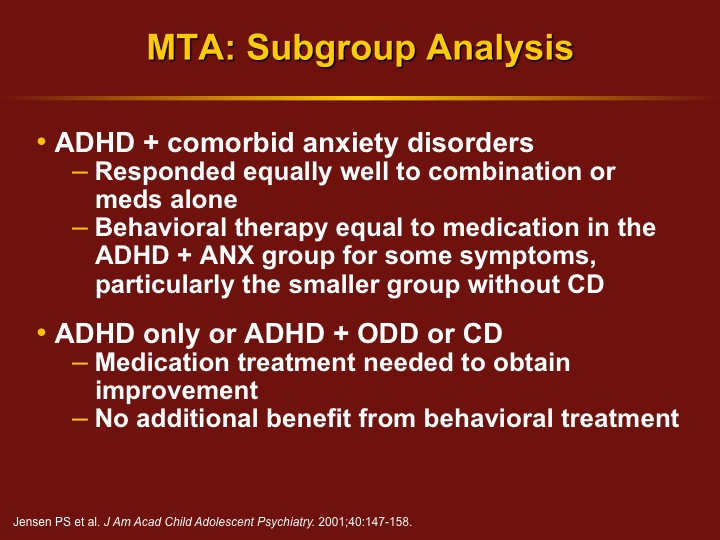
Behavioral/psychosocial therapy was most helpful in situations in which kids had multiple comorbid conditions, along with kids with concomitant anxiety disorder. For kids with uncomplicated ADHD, medicine alone was clearly more effective than the behavioral therapy alone, and the benefits of behavioral/psychosocial treatment were seen only after the kids were also treated with medication. For what it’s worth, if there was a bias in how this study was designed, the bias was in favor of demonstrating the benefits of behavioral interventions. The cost to a parent looking to replicate the counseling, case management and classroom interventions used in the MTA would be well in excess of $30,000/year.
Is it possible that the parents themselves might have a disability that would negatively impact their ability to consistently implement more effective parenting strategies? Literally, the apple doesn’t fall far from the tree. Looking at the data below, can we safely assume that all parents of kids with ADHD are capable of implementing strategies that require great consistency in order to be effective?
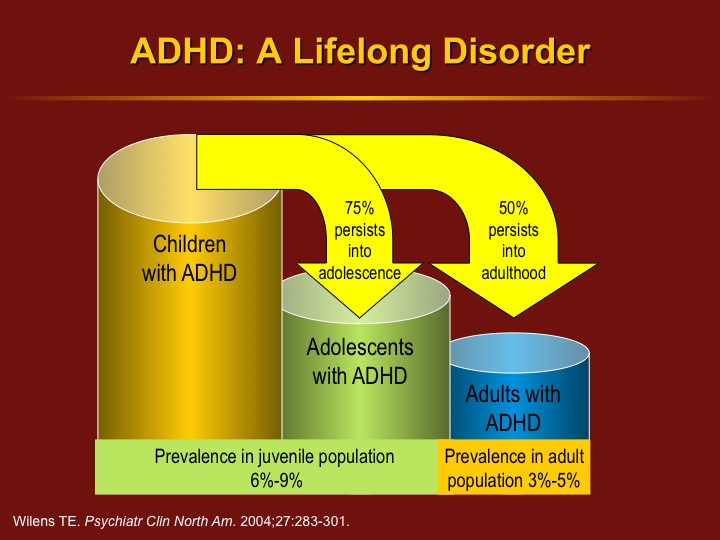
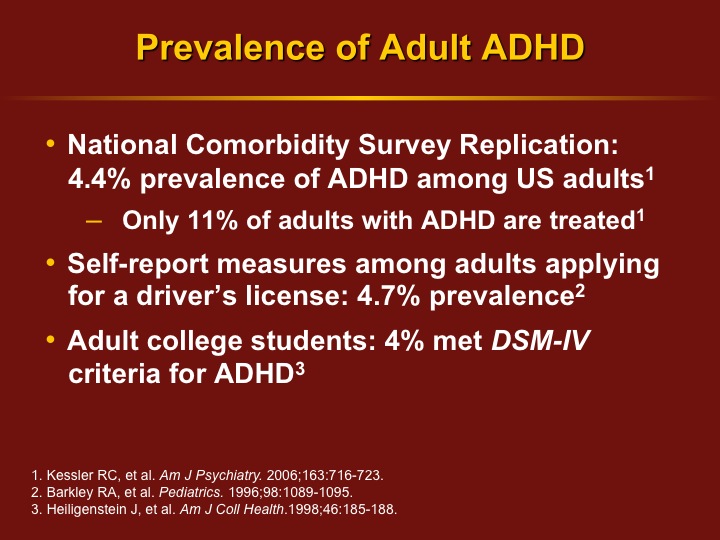
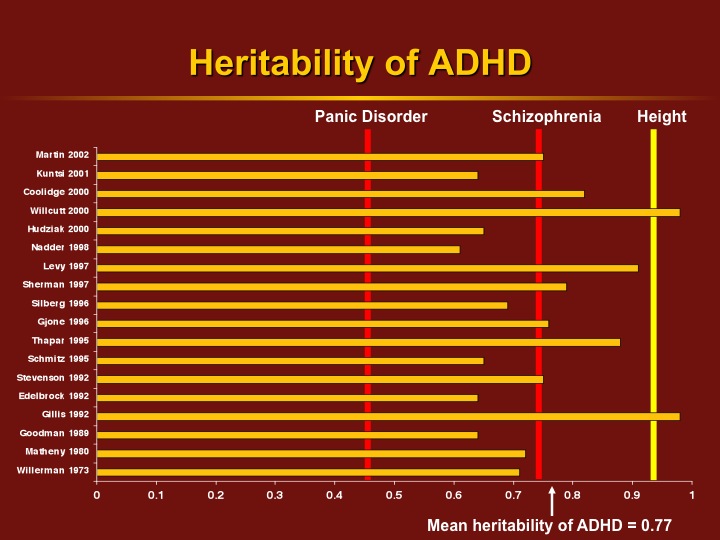
A better question to ponder may be how we as the church can we help such parents more readily bear the burdens associated with their child’s condition? Would it make more sense to err on the side of grace in how we view families of kids with ADHD, at least until we know them well enough to feel we could walk in their shoes?
Where exactly is the evidence that large numbers of kids are inappropriately being treated with medication? The folks at the National Institute of Mental Health did a study looking at this very issue during the time when use of medication for ADHD was rapidly escalating. Here’s what they found. The situation may be different in Perry’s community.
Finally, much to the chagrin of the pharmaceutical industry, there aren’t large numbers of parents beating down the doors to get medication for their kids. Check out the slides below-one is from a study I presented around five years ago looking at information from a large pharmacy database. The average parent of a child with ADHD fills around 4.5 30-day prescriptions per year for medication. The average adult with ADHD fills around three prescriptions per year.
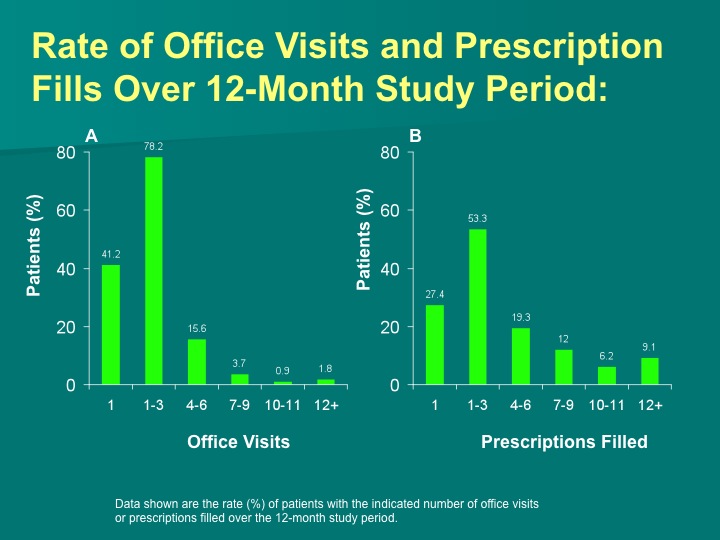
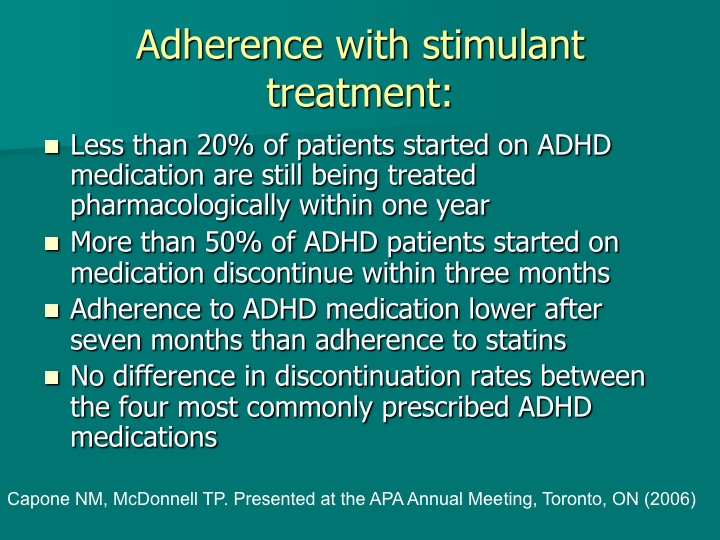
For the majority of patients I see with ADHD, especially those with comorbid conditions, the side effects of this stuff are often a problem. By and large (there are always exceptions to the rule), parents don’t want to give this stuff to their kids unless they absolutely have to. I see more situations in which parents are running the risk of torching their relationships with their kids (and as a result, losing their ability to exercise meaningful influence during their child’s teen years) with all the nagging, badgering and consequencing many have to do in an effort to get them through school.
I’ve seen parents with messed up priorities, looking for quick fixes for problems they may have created for their kids by the poor choices they’ve made to address the emptiness in their lives associated with spiritual poverty. In my experience, they’re clearly the exception as opposed to the norm when it comes to parents of my patients with ADHD. But they too were created in the image of God, and they too (like us) are desperately in need of grace, forgiveness and a relationship with our Savior, Jesus Christ. If our goal is Kingdom-building, I think it’s far better to start with the attitude that we all far short and we should try to let go of thinking that presents a potential obstacle to families connecting with their larger family in Christ.




 Church4EveryChild
excellent post!
As a mother of one son with Autism/ODD/ADHD (medicated) and another son with “just” ADHD (unmedicated) and a neurotypical (hopefully) daughter and a pastor-husband with ADD (also unmedicated) I really appreciate this post… I can’t even begin to list the times we have been judged as crappy parents. People have said it straight to our faces. But once my son with Autism got his “official” label people backed way off. Which was nice. But since he looks “normal” the judgment is certainly still there.
I think people just don’t get it.
And lest anyone think I am the “normal” one in my little family – I have a delightful anxiety/depression disorder (medicated). We are a fun bunch let me tell you lol 🙂
LikeLike
Tara,
Wow! God must have an amazing plan for your family.
As I read your note above it reminded me of when my husband served with Open Doors With Brother Andrew. Visiting persecuted Christians at the height of Communism he was always amazed that they never asked prayer for the persecution to end – they just asked prayer for strength to stand with Jesus.
May the Lord give each one of you strength to stand with Him, may He give you a sense of His presence minute by minute. May He use you mightily in His kingdom.
I don’t know you but I love you. I also like your humor 🙂
LikeLike
Awesome!! Thanks, Steve. As always, you give us the facts and then help us to apply them to the Kingdom.
LikeLike