

Harmony Hensley: Welcoming Ministry Environments for Kids With ADHD (Part Two)

This is the seventeenth post in our Fall Series: ADHD and Spiritual Development: Strategies for Parents and Church Leaders

Harmony Hensley, Pastor and Director of Outreach and Inclusion Ministries at the Vineyard Community Church in Cincinnati, OH., presents Part Two of her guest post on the topic of creating welcoming ministry environments for kids with ADHD. Click here for Part One of her discussion. Today, Harmony discusses use of wall color, wall decor and signage in environments for kids with ADHD, along with thoughts for churches contemplating a new construction project or renovation.

Wall Color: Often when decorating a kid’s space, whether it’s your child’s room or a classroom we tend to go overboard.  We paint murals, and cover the walls with the brightest of colors.  Though our intentions are good this may not be the best thing for all the kids we serve.  For kids with ADHD or autism, for example, this can create a very distracting and overstimulating space.

So you’re probably thinking “does she want me to just paint the space boring beige?”  Not at all!  You can absolutely still use color, in fact I recommend it!  But rather than going with the more primary, saturated colors (like fire engine red, big bird yellow, and kelly green) consider a more muted, jewel tone pallet.

Confused yet?  I know.  There is such a thing as “color theory” and you are looking for a color that has a neutral base.  Many of the folks at your local paint store can help you find what I’m talking about but let me show you an example.

Primary Color Palette:

Jewel Tone Palette:

The color swatches in the links should help to illustrate what I am talking about.  The primary colors are fairly common in terms of kids stuff (think story books, textiles, cartoons, etc.).  However the jewel tones still complements those colors, but they are a bit deeper and easier on the eyes to look at.  Color theory is something that has fascinated me my entire life (I literally used to boycott certain cartoons as a kid because I felt their color palette was off.  I know Dr. Steve can probably help me with some of my issues!) but I understand that it can be overwhelming for some folks.  Try to think of it this way.  When I walk into the room do I find the colors a bit jarring?  Or does it feel like a cozy place to relax and unwind?

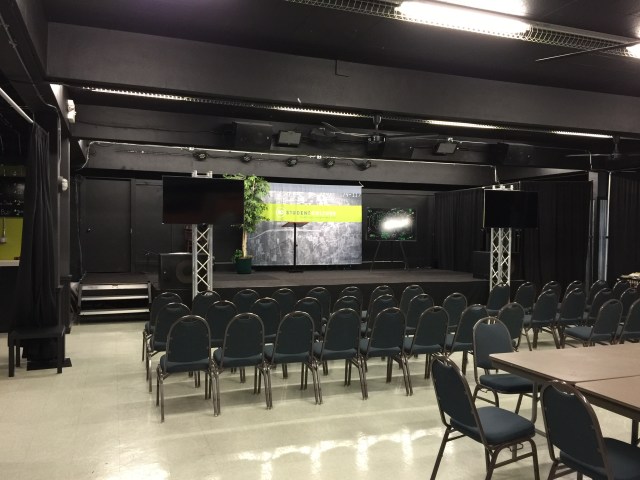
Wall Décor: Be selective about what you put on the walls.  If we fill every last inch of the wall with visual clutter we make it further difficult for our kids to concentrate on the lesson or programming at hand.  Many churches, particularly youth ministry programs, are designing their large area gathering spaces similar to a theater.  In a theater the goal is to direct your attention to the screen.  Where do you want to focus the kid’s attention during the hour they are with you?  If there is a focal point in the room (say where the teacher sits, or where the youth worship band is) design the room to focus kid’s attention to that area of the room.
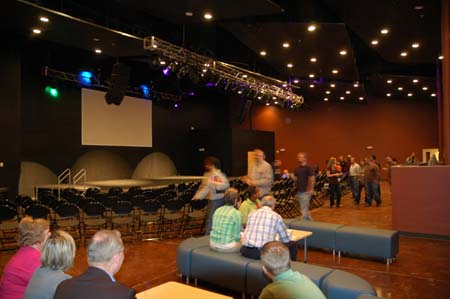
I have seen some churches paint the ceilings black (bringing the eye down), and side walls a deeper jeweled tone (still bringing color, but not a mural that demands attention), and then puts the focus on the front of the room with the colorful banner that reinforces the teaching element for that series (Noah’s Ark, or David & Goliath, etc.).  These simple things really do impact how a child interacts for that hour and can maximize the impact of your programming.  Similar practices are used in the main auditorium where you enjoy your Sunday worship.

Signage: Don’t you hate it when you go somewhere and you can’t figure out where you’re going?  Me too!  Walk through your space as though you’ve never been there before.  Would it be easy to navigate if you were new?  What if you can’t read?  Would you be able to see where you need to go?  Probably not!  Many of the kids we serve are visually cognitive; they think and experience the world through pictures.  Imagine not knowing what is going to happen next and there isn’t anything to signal you what to expect or where to go.  That would be very frustrating and not welcoming at all.  Consider adapting your signage using software such as Boardmaker or Writing with Symbols.  This is software that is largely used in therapies and will make a world of difference in adapting your environment to be fully inclusive.  You likely have a special education teacher or parent in your congregation who has access to this software.  See if they would be willing to help you create signage for your space.  If you don’t have access to this software you can use clip art.  It’s not as universally recognized but will certainly do the trick!  Also consider placing signage at a height that is relevant to the kids you are serving.  For instance, you wouldn’t want all the signs for 4 year olds to be at a 4 foot level.  Put some down at their eye level so they can self-direct as much as possible.

The CLOCK – Don’t forget the CLOCK!!!: The clock isn’t just for your volunteers anymore!  Many of the kids we serve will do much better during the hour if they can see a clock.  Kids with issues are often painfully aware of time and have a lot of anxiety if they don’t know what time it is and when they will transition to the next activity.  A clock is one simple thing that sets them up for success.  I remember one Sunday we had a child who was new and very anxious about this new environment she was in with all these strangers.  We quickly understood that she was counting the minutes until her Mom would return to get her.  One of the volunteers actually went to a storage closet and found an old wall clock.  They put fresh batteries in it and gave it to the little girl.  They explained that when the big hand got to the 6 her Mom would be back.  She held the clock and almost immediately relaxed.  Sometimes it’s the simple things that show God’s love to kids with hidden disabilities.

New Construction?: Many of the things I’ve mentioned above are things you can do to retro a space to be more inclusive.  As churches grow often expansion, renovation, or even new construction occur.  If this is the case for you – FANTASTIC!  A growing church is a wonderful thing – it means people are hearing the gospel and lives are being changed!  But as we create space for more people to experience God be sure we are dreaming about an inclusive space where all of God’s people can be welcomed into the kingdom.  Invite people who have experience working with kids with hidden disabilities into the design process.  This can greatly impact the way that your building takes shape.  If your church is embarking on a construction adventure and you’d like some ideas on ways to make your space inviting for kids with hidden disabilities please feel free to contact us.

Here’s a photo gallery from Cincinnati Vineyard’s Student Union (middle and high school ministry) Open House from 2008:

Clear as mud? Hopefully I haven’t thoroughly confused you.  Creating a welcoming
environment is easy, it just takes a thoughtful eye and a willingness to make changes but the reward is priceless.  So as you digest all these tips just think of how you want your kiddos to interact on Sunday mornings.  Do you want them to come in and immediately get charged up and overstimulated, making for a very busy, very active environment?  Or, would you like them to come in and feel like they can make themselves at home, relax and engage with the amazing activities and lessons you have before them?  I’m guessing you’re hoping for the latter!  Try to think of your classroom as an extension of your home.  What would you do to make people feel welcome?  Try some of these great tips and watch as the behaviors of not only your kids with issues, but the “typical” kids shifts as well.  You’ll find the kids will be calmer and behaviors will be reduced.  Have fun with it and tell us what works for you!

Sunday: Dr. Grcevich returns to summarize the key points of the series on strategies for parents and church leaders for promoting spiritual development in kids with ADHD.

Posted in ADHD, Hidden Disabilities, Inclusion, Key Ministry, Ministry Environments, Spiritual Development | Tagged , , , , , , | 5 Comments

Harmony Hensley: Welcoming Ministry Environments for Kids With ADHD (Part One)

IMG_1232 2

This is the sixteenth post in our Fall Series: ADHD and Spiritual Development: Strategies for Parents and Church Leaders

We’re honored to have Harmony Hensley take over the blog for today and Friday. In addition to serving as consultant to our team at Key Ministry, Harmony is Pastor and Director of Outreach and Inclusion Ministries at the Vineyard Community Church in Cincinnati, OH. The Vineyard has been ranked as one of the 50 most influential churches in America and is known for a strong outward focus and servant culture. Harmony has a background in marketing and design and has leveraged these skills to develop volunteer strategies and creative ministry approaches.

Harmony is a frequent speaker at national conferences on disability ministry, and is well known for her leadership role in Vineyard’s Summer of Service and Prom outreaches.

C4EC: You have a background in interior design and offer advice to churches on strategies for creating more inviting ministry environments inviting for families of kids with ADHD and other hidden disabilities.  What are some of your best tips?

HH: There are a lot of low to no budget things that you can do to foster an inclusive environment that sets everyone up for success.  Take a walk through your ministry environment and consider the following:

Lighting: Many commercial and public spaces utilize fluorescent lighting.  It’s cost effective and floods a space with light.  Unfortunately, though it is often very bright, especially when combined with other finishes (such as shiny waxed linoleum, etc.).  Bright lights can be overstimulating to some of the kids we serve and cause undue anxiety.  There are some easy fixes that allow you to properly light your space and create a more calming environment.

One option is to purchase inexpensive classroom light filters.  These  attach to the ceiling and filter the fluorescent light, creating a softer glow.  To find out more about these awesome accessories you can visit www.therapyshoppe.com and search “Classroom Light Filters”.  They run about $30 for a set of four.  There are lots of options ranging from solid white, colors and clouds so have fun with it!

Another easy fix is to have some of the bulbs removed to cut down on the amount of light.  This combined with traditional lamp light (think floor lamps and table lamps) can create a more soothing environment while still offering plenty of task lighting.

Flooring: What kind of flooring do you have in your classroom?  Is it carpet?  Is it a hard surface floor (tile, polished concrete, hardwood, etc.)?  We often have linoleum or some other hard surface flooring in children’s ministry areas because, as you well know, kiddos can be quite messy.  However, hard surface flooring can affect the acoustics of a room.  Think of it this way – if I have autism and noise or sound  cause me distress and physical pain and I go into a room where the kids are making noise that reverberates off the floor – I want outta there, and FAST!  Consider area rugs to help absorb some of the sound and create more comfortable floor seating for the kiddos during group times.  Window treatments can help but we’ll talk about that in a minute.

Carpet is always a nice option.  It makes for better floor seating space, but churches shy away from carpet because of the care, maintenance and cost of replacement should it become stained.  Carpet is still, generally, my favorite option due to the issue of acoustics.  Consider using carpet tiles.  Carpet tiles look just like regular carpet when installed, but if one area becomes soiled you can simply replace the damaged tiles and you are as good as new.

Window Treatments: Though this may seem silly to even point out I mention it because of some of the things I’ve seen while visiting churches around the country.  Be sure that there are no cords hanging down where the kids can reach them.  It’s not uncommon to think of this in the nursery with the little ones but this can be dangerous for older kids as well.  Cords, strings, etc. are not good if a child becomes agitated or aggressive.  Many psychiatric hospitals eliminate cords in patient rooms as a safety precaution and we are wise to follow suit.  Be conscious of safety risks in a room.  As harsh as it sounds, you have to ask yourself “could a child use this to harm themselves or others?”  Safety is our number one priority in creating a positive ministry environment for everyone.

Window treatments also impact the amount of light in the space.  Blinds are often a good choice because you can control the amount of light in the space.  Just be sure to secure the cords at a level that the kids cannot reach.

If you have a space where acoustics are a problem, window treatments are another place where fabrics can help to buffer the sound.

Coming on Friday: Harmony discusses use of wall color, wall decor and signage in ministry environments for kids with ADHD, along with thoughts for churches contemplating a new construction project or renovation.

Posted in ADHD, Inclusion, Key Ministry, Ministry Environments | 7 Comments

Barb Dittrich: My ADHD Sundays

Editor’s note: While writing a book chapter on the struggles families experience attending church when a child has struggles with self-control, I came across this wonderful article from five years ago from our friend and former colleague Barb Dittrich. I’m not sure how many people read this post three months after we launched our blog, but it is absolutely spot-on in describing the experience of a family attending church when a child has ADHD. Here’s Barb…  

It starts before anyone in church even sees us.  In fact, it starts before the clock rolls over to announce the arrival of Sunday.  We’ve spent yet another night struggling to keep our child with ADHD in her own bed asleep for more than an hour or two at a time.  If others knew that we’re still fighting with an 8-year-old on this issue, they’d probably shake their heads in disdain or report us to Nanny 911.

Once we’re awake for the day, the non-structure of the weekend always proves challenging.  Despite it coming every week at this time, there’s always a struggle to get Li’l Miss ADHD, as she’s fondly known in certain circles, to cooperate with the notion of church.  You see, for her church implies overstimulation with the presence of crowds and loud music, being required to sit still and be quiet for long stretches of time, and the expectations of certain dress and behavior.  Whew!  That’s no small task for a child with her diagnosis!  And when there’s no “Children’s Church” in the summer months, the demand on her is even greater.  No wonder she digs her heels in when we announce that it’s time to get ready for church.

Our Li’l Miss ADHD also happens to have some serious sensory issues, not uncommon in kids with this diagnosis.  This proves to be yet another challenge as we finally get her to buy into the fact that she needs to prepare for our worship service.  In need of soft clothing that doesn’t restrict her or cause her discomfort in any way, she may make three or four clothing changes before finally dressed.  And my husband will lose his cool at least one time in frustration over the fact that she’s not dressed in a manner that’s considered appropriate for church.  Being more selective about my battles, I consider myself victorious to just have her out of last night’s pajamas.  But then it’s on to the battle of the hair.  Getting the snarls out of her fine locks brings greater pain than the average child because of her high sensitivity, so it can’t be done in a hurry.  It is a process that requires barely touching the brush to her head, so forget all the beautiful little primping her peers enjoy.

The crush comes when we see it’s time to depart.  How many times will we have to announce to her that it’s time to go and ask her to put on her shoes?  The tension is palpable.  Now she begins asking what she can or can’t bring with her to church to keep her attention, which of course includes much debate.   Crying commences as we urge her to focus on the shoes and worry about the take-alongs later.

My husband is always thankful that the car ride there is no more than a mile long.  You see, in her impulsivity, Li’l Miss always has to agitate one of her siblings en route.  Nothing says, “I love you, Jesus,” like the bantering, poking, slapping, and general mayhem that needs parental discipline in the car.  Getting these little sinners, who have little tolerance for one another’s behavior regardless of diagnosis, from the car to the church without killing one another is nothing short of a miracle.  Heck, getting them from the house to the church without my husband killing them is nothing short of a miracle!  Is it any wonder we arrive at our house of worship gritting our teeth and forcing a smile?

Once greeted by kind souls at the door, we are submerged in a crowd of chatting people coming and going.  Keeping track of Li’l Miss ADHD is a heroic measure during this transition.  Lord help us if someone wants to speak to us at that time because she will either be dashing off, lost in the crowds or be engaging in some sort of inappropriate form of attention-getting behavior.   It’s so very hard for her to stand still and wait in such a grotesquely stimulating environment.  Since my husband is the physically stronger of the two of us, he manages to push through the crowds with her hanging off of one of his arms as they get her nametag for Sunday School.

Making it in to the worship service in the sanctuary itself is no small accomplishment.  But as we enter, the question assaults us, Do we sit down front where she is more engaged or sit in the back where fewer people see and judge our parenting skills?  Wherever we are seated, she must be sandwiched between her father and I so that no physical tussles with siblings recur.  As the lights dim and the rocking of the contemporary melodies resound, she must grab the pens from each slot of the chair caddies to use them as drumsticks to imitate her favorite percussionist.  To be able to see, her dad must hold her as she stands on the seat back of the chair in front of us.  Fellow worshipers look at her and smile as they sing.  Unfortunately, they’re the same ones that will shake their heads in disgusted judgement once she has run to the bathroom at least twice during the sermon or she’s zipping around the lobby once the service has adjourned.

Thankfully, this year our leaders have decided to have the children dropped off at Children’s Church prior to the service, so if that program is in session, there are no worries about whether she’ll actually make it to her classroom after being dismissed by the pastor.  But then there’s the candy after class.  Offered in loving kindness, it’s really not the best thing for Li’l Miss ADHD, but avoiding tantrums and fist fights over it prompt us to acquiesce.

I’m getting tired just reading what I’ve penned about our ADHD Sundays!  No wonder I’m always eager for that Sunday afternoon nap!  The sheer exhaustion each Sunday service produces makes me want to be like my neighbor who attends “Our Lady of the Puffy Pillow” or “Saint Mattress” while I’m straining through yet another Sabbath.

***********************************************************************************************************

Barb D.Barb Dittrich currently serves as the Executive Director of Snappin’ Ministries, an organization she founded in 2002 with a focus on parents raising children with special needs or chronic illness. Offering a web-based mentor program, quarterly free respite, quarterly fun free family events, and ongoing TLC support for stressed-out parents, Snappin’ Ministries is a Wisconsin-based ministry with a national reach.

Barb and her husband of over 20 years, Steve, are raising 3 effervescent children, each with either special needs or chronic illness. In addition to speaking and writing, she also serves as a Rare Disease Day ambassador, advocating for families living with rare diagnoses. She leads her team with Snappin’s devotional blog at Comfort in the Midst of Chaos, and is a regular contributor to the Not Alone blog.

Posted in ADHD, Families, Hidden Disabilities, Key Ministry, Stories | Tagged , , , , , , , , , , | 7 Comments

Could ADHD be a Blessing to Christ Followers?


shutterstock_31977463

This is the fifteenth post in our Fall Series: ADHD and Spiritual Development: Strategies for Parents and Church Leaders

Take a good look, friends, at who you were when you got called into this life. I don’t see many of “the brightest and the best” among you, not many influential, not many from high-society families. Isn’t it obvious that God deliberately chose men and women that the culture overlooks and exploits and abuses, chose these “nobodies” to expose the hollow pretensions of the “somebodies”?

1 Corinthians 1:26-28 (MSG)

Is it possible that in God’s Kingdom, a condition that causes as much difficulty in day to day functioning as ADHD might actually provide one of His followers with an advantage? Let’s look at how having ADHD might be of benefit to a Christian.

A Christian with ADHD may be more willing to take chances for God. It’s possible that God speaks to many of His followers in a still, small voice. A person with ADHD may be more likely to act on the direction of that voice without first pondering all the reasons why doing so might not be a good idea.

A Christian with ADHD may be very energized by topics or ministry activities that capture their imagination. Many people with ADHD experience the capacity to “hyperfocus” when engaged in an activity they find to be especially interesting. If a kid or an adult with ADHD becomes passionate about a ministry pursuit or activity, they may become extraordinarily productive.

A Christian with ADHD may be very effective in ministry teams when others have complimentary gifts or talents. Because people with ADHD are often capable of entertaining multiple thoughts at once and adept at spotting trends in the culture, many are capable of visionary leadership. Teams can be very successful when such people are paired with good managers. A team with too many folks with ADHD might have great ideas but find itself unable to implement or maintain new initiatives.

A Christian with ADHD may be less inhibited about sharing the Gospel with others. The prospect of sharing one’s faith with other people can be very intimidating, especially in a culture that imposes great pressure not to do so. Here’s one area where a lack of capacity for self-regulation may have some Kingdom benefits.

A Christian with ADHD may be very good at scanning the environment for trends and ideas. I suspect that many Christians active in the blogosphere have some ADHD traits. The capacity to be spot new and interesting ideas is very beneficial for visionary leaders. Why would we be surprised if it turned out that a high percentage of key opinion leaders in the church turned out to have ADHD?

Is ADHD overrepresented among senior pastors? Anecdotally (I’m not mentioning any names), it seems like a higher than expected number of senior pastors I encounter in the work we do with churches through Key Ministry meet more than a few of the symptom criteria for ADHD. For some of the reasons described above, people with ADHD called into ministry may gravitate toward that role. The capacity to chart a ‘big picture” course for the church and the ability to take the risks involved with teaching on a stage or in a pulpit in front of a large audience each week may be adaptive for the person serving as senior pastor.

Throughout the Bible, time and again God made use of His followers who were willing. I could come up with numerous examples of people from the Bible who may have had ADHD, but one in particular comes to mind. Let’s look at who Jesus chose to lead the church:

Impulsiveness: Whacking off the ear of the High Priest’s servant (Malchus) with a sword while surrounded by several hundred enemy soldiers probably wasn’t the best idea in the history of Earth (John 18:10).

Speaking without thinking: Do the words “Get behind me, Satan” ring a bell? (Matthew 16:22-24)

Distractibility: The Son of God was walking across the water toward him on the Sea of Galilee, and this disciple became distracted by the waves. (Matthew 14:22-33)

Difficulty following through on commitments: The encounter with the servant girl in the High Priest’s courtyard didn’t go all that well, either. (Mark 14:66-72)

Despite all of his weaknesses and all of his failures, who did Jesus ultimately select to be the “Rock”, upon whom He built His church? Peter. Shortly after Jesus’ death, Peter, guided by the Holy Spirit, was able to boldly preach the Gospel on the original day of Pentecost, and some pretty amazing stuff has been happening ever since.

Coming Sunday: “My ADHD Sundays.” One parent’s story of trying to “do church” together when a daughter has ADHD


Posted in ADHD, Key Ministry, Spiritual Development | Tagged , , , , , | 6 Comments

What Can Parents Do to Help Kids With ADHD Grow in Faith?

shutterstock_116017678Parents of kids with ADHD have an especially important role to play in the spiritual development of their children. Because kids with ADHD are wired to learn more effectively in 1:1 or small group settings, they may process information presented by a parent more efficiently than in a large group setting with lots of distractions at church.

We’ll talk more about the research examining spiritual development in kids at a future date, but to steal from Libby Peterson, one of our Key Ministry Board members who serves as a Family Life ministry director at a large church in Cleveland, our bottom line is that families who pray together regularly, engage in regular Bible study or devotions, serve together on a regular basis and regularly attend church are more likely to have kids with positive spiritual outcomes. Let’s talk about how parents can positively influence each of these practices in their kids with ADHD:

shutterstock_5067274Pray together regularly: Parents need to establish and maintain routines for regular prayer that are difficult for kids with ADHD to establish for themselves. Praying with a parent or select family member helps kids with ADHD from wandering too much mentally during the process. Kids with ADHD need parents to model appropriate prayer priorities. Parents can share from their personal experiences of how God answers prayer to communicate the relevance of prayer in daily life.

Study the Bible regularly, or engage in regular family devotions: Parents of kids with ADHD have lots of opportunities to talk to their kids about the application of their faith in day to day life. Meal times, bedtime, and time spent riding in the car to practices, activities and appointments are all good teaching opportunities. Something as simple as discussing the content of what everyone in the family learned at church on Sunday can help reinforce the lessons being taught. There are more and more tools available to parents to serve as “discussion starters” for spiritual conversations throughout the week. Parents and family members can have a powerful impact upon kids with ADHD when they’re willing to share their own faith experiences to make Jesus and the teachings of the Bible more real.

Mira ServingServing together: To quote James, faith without works is dead. All of us in the faith have a role to play as God uses the church to re-establish His Kingdom on Earth. For kids with ADHD, service provides an opportunity to develop the self-confidence that comes from the recognition that they have gifts and talents they can use to serve others in a meaningful way. Parents can help their kids to identify service opportunities that are a good fit for they way they’re wired. Many kids with ADHD are gifted musically or artistically. I was speaking to a church staff member not too long ago who directs the team responsible for family worship experiences who reported that every kid or teen from their team who performs on-stage at their church has been diagnosed with ADHD. For other kids, being involved in acts of service that enable them to be active physically (fixing or building things, setting up tables, loading trucks, serving as buddies for younger kids with special needs at respite events) may be rewarding.

Regularly attend church: Kids with ADHD are part of the church, too! It’s important for parents of kids with ADHD to model a routine of regular church attendance. It’s also important for parents of kids with ADHD, whenever possible, to ensure their kids are getting the benefit of prescription medication for church if medication is beneficial during the week in other learning environments. Parents can download this resource to initiate a discussion with their child’s physician about medication for church. Parents also can’t share something with their kids that they don’t already possess. An ongoing connection with a caring and supportive church is an indispensable tool for parents seeking to raise their child with or without a significant disability in the Christian faith.

Updated September 13, 2014

***********************************************************************************************************

abstract yello youtubeWe’re featuring videos of past Inclusion Fusion presentations on Key Ministry’s new YouTube channel!  Viewers can access EVERY VIDEO from past Inclusion Fusion Web Summits ON DEMAND. The videos from past Web Summits have been viewed over 20,000 times…we hope you’ll find them as helpful as many others have!

Posted in ADHD, Families, Key Ministry, Parents, Spiritual Development | Tagged , , , , , , , | 2 Comments

Karen Sunderhaft: Expert Tips on Teaching Kids With ADHD (Part Three)

Nationally recognized educator, author and ADHD expert Karen Sunderhaft will be sharing teaching tips this week for ministry leaders and volunteers serving kids with ADHD. Today, we’ll focus on tips for parents of kids with ADHD. For more information on Karen, click here.

C4EC: Your family is active in a Roman Catholic church. In most Catholic churches, kids with ADHD would be expected to attend Mass (worship services) with their families. What suggestions would you have for parents of a child with ADHD who want to have a meaningful experience at church, but have kids who struggle with self-control when they’re bored in worship services designed for adults?

Karen: Parents can put together a “Bag of Tricks.” This is the same type of bag I bring on airplane rides. Remember what they say there…..give yourself the oxygen first before administering to your child. Think of this bag as being filled with little trinkets of oxygen and dispense one at a time as needed.

The bag, and its contents, will change over the years, but either way it should be filled with some items that don’t make noise, are new and engaging and include something to hold your child’s attention for bursts of time. The bag should only come out during these special times.  In fact you can use puffy paint to have your child decorate their special bag. This makes it more meaningful for them.

Everyone’s magic bag may be different, but mine includes paper and pencil for drawing, silly putty, stickers, small figurines, small books (some churches have their own basket of children’s church books). My favorite books are those with open the flaps. They are great for younger kids. Basically I fill this bag with anything that I can find at the dollar store that fits the criteria for “quiet and engaging” items. Depending upon your church a mini bag of cheerios or gold fish might be good too.

There may be some of you out there who believe that your child should sit still and listen attentively to the homily or sermon, but I would set the goal of asking your child to try to find one thing that they either heard or saw at church that they really liked. Set this expectation up ahead of time, so the child knows what will be happening.  I am a big believer in helping the children establish and expect a routine from experiences, so there are no surprises. Then have them share that with you on the ride home one thing they learned. I believe that even though they may be drawing…..they are still taking in the sights and sounds around them.

C4EC: Many churches expect kids with ADHD to memorize Bible verses, prayers or worship songs. Since kids with ADHD frequently struggle with memory and recall, do you have any pointers for parents or Sunday School teachers to help?

Karen: Set it to music. There is so much research out there about the benefits of using pneumonic devices to remember something.

C4EC: There’s a growing “family ministry” movement, in which church leaders see their role as a support, not a substitute for parents in teaching kids about matters of faith. What advice do you have for moms and dads who want to instruct their child in the family’s faith, but are worn down from the struggles to complete schoolwork common among kids with ADHD?

Karen: PRAY: When my first child was born I went to a mom’s group through my church. I will never forget the one comment the speaker shared. She said that she prays for her kids’ safety and guidance from God, but she also prays even more for the people who will come in contact with her child throughout their life. What an interesting concept, to pray for my daughter’s best friend, or my son’s future wife. How many times can I tell my son to wear a jacket when it is cold, but as soon as his best friend’s mom suggests he wear a jacket, he responds as if it is the first time he heard this brilliant idea. This is one piece of advice I always like to pass on.

The other thought I have is something you have heard before. You are your child’s first teacher and your actions speak louder than words.  You are a role model in your faith.

Try to do one activity a month that gives back to others and talk about that at home. Whenever I make a meal for a sick friend or someone that had a baby we talk about it or deliver it together. I am grateful for the BREATHE events I help run four times a year at my church. My entire family (ages 4, 8 and 9) joins me to help out wherever they can.

PRAY. We pray before meals, even when out in public, or when friends come over for dinner. We pray when we see an ambulance speed by or we pray together when someone is sick. We pray for strength and guidance as we struggle with school work, jobs or friends. We pray to give thanks for a great day, a great friend or a special event.

Family conversations about God will eventually happen on their own, but only when the parents start the praying and doing in God’s name.

C4EC: So why should parents of kids with ADHD  bother going through all the hard work and effort to make it to church each week and to worship with others?

Karen: Check out this great quote that was passed through me by email:

“A Church goer wrote a letter to the editor of a newspaper and complained that it made no sense to go to church every Sunday. ‘I’ve gone for 30 years now,’ he wrote, ‘and in that time I have heard something like 3,000 sermons. But for the life of me, I can’t remember a single one of them. So, I think I’m wasting my time and the pastors are wasting theirs by giving sermons at all.”

This started a great controversy in the “Letters to the Editor’ column, much to the delight of the editor. It went on for weeks until someone wrote this clincher:

“I’ve been married for 30 years now. In that time, my wife has cooked some 32,000 meals. But, for the life of me, I cannot recall the entire menu for a single one of those meals. But I do know this…they all nourished me and gave me the strength I needed to do my work. If my wife had not given me these meals, I would be physically dead today. Likewise, if I had not gone to church for nourishment, I would be spiritually dead today! When you are DOWN to nothing…..God is UP to something! Faith sees the invisible, believes the incredible and receives the impossible! Thank God for our physical AND our spiritual nourishment!

It is the same with everything…you may not remember the exact words of this blog, but I hope that you will come away with a firm feeling of commitment or resolve to do one thing differently.  Be a warrior for God and your family…..both your family at home and your family at church.

C4EC: Thanks, Karen. You’ve been extremely generous in sharing with your time and talent in helping churches and parents to teach kids with ADHD about a God who loves them and has great plans for them!

Posted in ADHD, Families, Key Ministry, Parents, Spiritual Development | Tagged , , , , , , , , | 2 Comments

Karen Sunderhaft: Expert Tips on Teaching Kids With ADHD (Part Two)

shutterstock_432985423

Nationally recognized educator, author and ADHD expert Karen Sunderhaft is sharing teaching tips this week for ministry leaders and volunteers serving kids with ADHD. Today, we’ll focus on tips for pastors and ministry leaders.

C4EC: What are some helpful hints you’d share with children’s pastors or youth pastors for effectively communicating to kids who have ADHD when they’re teaching in a large group setting?

Karen: My first suggestion is to involve children in the teaching and learning process. No one really learns something just by listening. As a teacher, I often remind myself that to be more effective I need to NOT be “The Sage on the Stage, but rather the Guide on the Side”. Standing up and lecturing to a group is not as effective as talking a little and then giving a task to the group to help them engage in the learning process.

Perhaps setting up a play about a passage or a story and allowing members of the group to play a part or to offer feedback, such as a picture or a discussion allows the message to penetrate more effectively.  Even the latest brain research has a formula for how much time should be spent listening and how much time should be spent processing information. By processing information I mean “using it” in a way that allows a learner to move from just listening to something to truly understanding it.

First, much of what is learned cannot be processed consciously; it happens too fast. Second, in order to create new meaning, we need internal time. Meaning is always generated from within, not externally.  Third, after each new learning experience, we need time for the learning to “imprint”.  Harvard studies suggest that cramming more content per minute virtually guarantees that little will be learned or retained.  In fact it leads to more time re-teaching.

  • Change the activity to allow movement if possible. 12-15 minutes is how long a teenager can pay attention to a single activity. (Adults are 30 minutes)
  • 5-7 minutes of direct instruction for grades K-2
  • 8-12 minutes for grades 3-7
  • 12-15 minutes for grades 8-12

Some ideas for processing include the following…

  • Group work – Make a poster or build something together
  • Reflection – verbally to a peer or in a journal
  • Individual work or project
  • Drawing
  • Summarize and review

C4EC: What suggestions would you share with pastors or church leaders who want to design ministry environments where kids with ADHD will have great experiences? Lighting, sound, use of color, room  decorations? What’s the right balance between fun and engaging  vs. too much stimulation for kids with ADHD?

Karen: I love the church I belong to. Holy Angels in Bainbridge, Ohio has plenty of windows and natural light. The pews are comfortable, without the kneelers and the room is large with four big seating sections. There is a small water feature in the center that is soothing, but otherwise there are simple decorations year round and only a few extra plants and decorations for holidays. The homilies, which takes the Bible teachings and relate it to everyday experiences is beautifully done week after week.  Father Dan always seems to start with a witty or profound story that allows each one of us to see how it relates to our own lives. In the middle of his homily he refers back to the Bible teachings and clearly states the message that we need to take away with us for the following week. Finally he ends with another story or pertinent joke, or an example of God’s words working in our church.

The best part of course is the rockin’ music that goes along with the terrific, meaningful homilies.  There are three masses to choose from….8:00, 10:00 and 12:00 on Sunday. We always have music, but at the 10:00 mass, the little children leave during the main homily and are taken downstairs to the nursery, for their own special homily or story. Before they leave the room, they are encouraged to run up the aisle to the priest so that he can bless them and their teachers during this short time.  It allows their little legs (kids as young as 3 and as old as 1st grade) to move and for them to either draw or color while listening to a story downstairs, where they can be a bit louder. Sitting still for an hour is very hard for a child with ADHD, but knowing that there is a break during that whole time, for both parents and children, helps to make the mass more enjoyable for everyone. If your child is too young or afraid to leave you, then I would come with a bag of tricks.

Karen will finish on Sunday with teaching strategies for parents of kids with ADHD. For more info on Karen, click here.

Posted in ADHD, Key Ministry, Ministry Environments, Spiritual Development, Strategies | Tagged , , , , , , , , | 1 Comment

Karen Sunderhaft: Expert Tips on Teaching Kids With ADHD (Part One)

shutterstock_75695695

Nationally recognized educator, author and ADHD expert Karen Sunderhaft will be sharing teaching tips this week for ministry leaders and volunteers serving kids with ADHD. Today, we’ll focus on tips for ministry volunteers.

C4EC: Any ideas for the volunteer Sunday School teacher or small group teacher who has a couple of kids who can’t seem to sit still, keep their hands to themselves or stop talking during the lesson/group?

Karen: What seems to work for some teachers in our Sunday School classes is what I call “front end loading” your efforts. You need to take the time at the beginning of the year to set up some classroom rules and expectations so the rest of the year just flows peacefully and successfully….at least most of the time.

I believe in always beginning the year with a group conversation to create some simple, but clear rules. As the teacher you should have a few rules that are most important for you to keep order, but allow the class to generate the main list. Try to reword any comments so they stay positive. For example, instead of writing down John’s suggestion of, “don’t shout out answers”, you could agree and write down, “raise your hand to speak”.  Create this list and then have everyone in the room sign it….including the teacher.

Our church classes are usually held on Wednesday or Thursday afternoons from 4:45 – 5:45 and from 6:00 – 7:00, so you can imagine how hard it is for my ADHD friends, who are just coming off of their medicine, to keep interested, engaged and focused. It becomes even more important for this time together to be fun. In the spirit of keeping it fun, try to set up some type of simple reward system to give positive, consistent feedback for when you see your students following the rules. This will allow the kids who really want to follow the rules, but sometimes can’t, to know exactly which behaviors get rewarded.

One of my favorite teachers had a stop sign with the big green circle, yellow circle and red circle on a poster board. She had each child’s name on a clothespin. Every one started the class on the green circle. If someone started to break some of the pre-established rules, then they may get a gentle reminder from the assistant, but if that didn’t work, then their clothespin name may move to the yellow circle. Now…there are two ways for this student to go…if they can get it together, then their clothespin can move back to green, but if things get worse it moves to the red circle.

This system only makes sense to the kids if they know the consequences for when the clothespins move. At the end of class, everyone on the green circle gets a small piece of candy, but those on yellow may get a sticker and those on red may have to have a talk with the teacher and parent. Do what will work for your students and families…but try to keep it fun and positive.

I forgot to mention the most important part, my favorite teacher had a secret weapon…..an ASSISTANT. If your church classes can be taught by two people…..then I highly recommend it. Having one person to teach a lesson and one person to go around and assist students, by helping them with a kind word or a gentle redirection, keeps the whole class moving in the right direction.

As noted before, keep the same general routine that works for everyone. Perhaps the time together begins with a quiet, settling coloring activity. Mandalas (see attached) are great for older kids. Native Americans believe that by coloring from the outside in, it can bring focus and clarity. By coloring from the inside out, it can bring creativity and openness.

  • Change in location is the easiest way to get attention
  • Teachers can move to the back or side of the room
  • Go outside when possible
  • Switch classrooms
  • Mini  Field trips….even around your church grounds or to see the inner workings of the building
  • Surprise the group with a piece of music or artifacts
  • Have students present learning to one another
  • Guest speaker
  • Switch it up
  • Overall – provide a rich balance of novelty and ritual. Novelty ensures attention getting, ritual ensures predictable structures for low stress

The most important thing to remember, that if you or a student has a not so successful day, then remind yourself (and them) that next week is another time and a new chance to try again.

On Friday, Karen will focus on tips for pastors and ministry leaders who work with kids with disruptive behavior associated with ADHD. We’ll finish on Sunday with teaching strategies for parents of kids with ADHD. For more info on Karen, click here.

Posted in ADHD, Hidden Disabilities, Key Ministry, Spiritual Development, Strategies | Tagged , , , , , , , | 3 Comments

Talking to your child’s physician about medication for church

shutterstock_536016991

We put together a sheet following Friday’s blog post that parents can download and share with their child’s physician when they would like their child with ADHD to experience the benefits of medication for church activities. The purpose of the sheet is to help parents share their concerns about church activities with the child’s treating physician and provide the physician with the information they’ll need to order the necessary adjustments in the type of medication prescribed and the times when medication should be administered.

Download the form here: Medication Request for Church

Note to church staff and volunteers: Don’t share the existence of this form with parents who have not explicitly disclosed that their child takes prescribed medication for ADHD and expressed interest in using or adjusting medication for church. The use of prescription medication should not be a precondition for a child’s involvement in church activities.

Posted in Uncategorized | 3 Comments

The Taboo Topic: Medication at Church for Kids With ADHD (Part Three)

shutterstock_609515789

This is the ninth post in our Fall Series: ADHD and Spiritual Development: Strategies for Parents and Church Leaders

Today we’re going to look at the issue of medication at church for kids with ADHD from the perspective of the child’s treating physician. If I were serving as a children’s pastor or ministry volunteer and had a kid whose difficulty paying attention and maintaining self- control was creating disruption in the learning environment for other kids and discovered the child takes medication during the week to function in school but not on  weekends at church, I might be a little upset. Why wouldn’t the doctor tell the parents to give the medication to the child on Sundays or in the evening for church?

Maybe the physician felt uncomfortable asking about family religious practices? In our ultra-PC world, more and more physicians are likely to avoid any discussion of religious practices altogether for fear of offending parents.

The physician is so busy that they don’t have time to ask about church. For any of you who’ve been to the doctor in the last few years, you probably recognize that there’s less and less time available to share your concerns with your child’s physician. Families who depend upon managed care to cover the cost of their child’s treatment or families receiving care through large hospital systems may have enough time at a follow-up visit to discuss one aspect of their child’s treatment. I’ll vent on the topic of accessing service through our health care system at a future date.

The physician may not have the cultural competency to understand the importance of church in the life of the child’s family. I’m fascinated by some of the gaps in the range of culture academic physicians are exposed to, especially the lack of exposure to families from more conservative Protestant traditions. Docs tend to train in large, urban hospitals. Evangelicals tend to hang out in the suburbs. There was and issue of the journal Child and Adolescent Psychiatric Clinics of North America devoted to the issue of religion and spirituality a few years back in which there was an article entitled “Cultural Competency with Protestant Christians.” Let’s face it…there’s a really big difference in the values and attitudes of folks involved with the Church of Christ vs. folks in the United Church of Christ and between Presbyterians and Pentecostals. My specialty (child and adolescent psychiatry) includes a significant percentage of foreign medical graduates, many of whom were raised in countries where Christianity is far from the predominant religion. Bottom line: There’s a good possibility your child’s physician may come from a cultural or educational background in which they wouldn’t realize how important church is for some families.

The physician may recommend withholding medication on weekends to minimize the impact of side effects: It’s not uncommon for kids to have difficulty eating or fail to gain weight while taking medication for ADHD. That’s probably the most common reason physicians suggest to parents that they withhold medication on weekends. I won’t digress into a comprehensive review of the research on the long term effects of medication on growth, but it’s not something I frequently worry about with my patients.

The physician may not have the depth of understanding about ADHD that would lead them to individualize the child’s treatment for evening or weekend activities. As with any other field, some docs have a greater level of sophistication in understanding ADHD and the nuances of the medications used to treat it. Educated parents who have done their homework and make well-reasoned suggestions to their child’s physician often get what they want.

In a nutshell, it should be possible to find a solution for church for kids who benefit from medication at school. There are currently 22 different FDA-approved products to treat ADHD. 20 of the 22 approved medications are stimulant products. All of the stimulant products have in common one of two active ingredients. One family of stimulants has as its’ base ingredient some type of amphetamine salt or prodrug (Adderall, Adderall XR, Dexedrine, Dexedrine Spansules, Procentra, Vyvanse). The other family of stimulants contains methylphenidate as its’ base ingredient (Ritalin, Concerta, Metadate, Focalin, Focalin XR, Daytrana). The differences between the products within a given family involve the form the medication comes in (pills, liquid, patch), how the drug is released into the body, and most importantly for this discussion, how long the medication lasts.

While these medications are highly effective (the odds that a kid will respond to a product from at least one of the two families of stimulants is around 90%), a slight majority of kids clearly respond better to products from one stimulant family or another. What this tells us is that kids who take an extended-release form of stimulant (8-12 hours or more) to get through school during the week will probably respond to a short-acting form of the same medication on weekends, or a short-acting booster to extend the duration of medication effects in the late afternoon or evening. For example, a kid who takes Concerta or Focalin XR (pictured left) during the week might take Ritalin or immediate-release Focalin (pictured below) on a Sunday morning to get about 4 hours worth of medication effects. A kid on Adderall XR or Vyvanse might take an immediate release Adderall to get 4-6 hours of effects on weekends. With late afternoon booster doses, the same principle would be true…thepotential drawbacks being medication effects on appetite at dinner or delaying the onset of sleep. Some physicians will use booster doses in the late afternoon that are less potent than the equivalent long-acting stimulant medication in the evening to try to minimize side effects.

I’m not neglecting the two approved non-stimulant medications in this discussion (Strattera and Intuniv), but kids on these medications are usually treated seven days/week and the question of whether to give medication on the weekend typically isn’t an issue. Non-stimulants are generally less effective than stimulants. One observation: Most of my patients on Strattera typically take medication twice daily (first thing in the morning and after school) because I’ve found the effects typically don’t last the entire day. Most of the manufacturer’s clinical trials with Strattera were conducted with medication administered twice daily. Bottom line: Kids who are prescribed Strattera and struggle with evening church activities may need a second dose after school.

We’re finalizing a download for parents interested in discussing the topic of medication for church with their child’s physician. Keep your eyes on the blog this weekend when we’ll post that resource.

Coming Sunday: Discipleship Strategies for Kids and Teens With ADHD


Posted in ADHD, Families, Key Ministry, Parents, Spiritual Development | Tagged , , , , , , , | 1 Comment