
Be Not Anxious…What Can Parents Do to Promote Spiritual Growth?

Welcome to our Summer Blog Series examining the impact of anxiety disorders on church participation and spiritual development in kids. Today, we’ll examine steps parents can take to help promote spiritual growth among children and teens with anxiety disorders. 

A child or teen who maintains an active involvement in the children’s or youth programming at their local church may spend 50-100 hours per year engaged in ministry activities. A parent may have 3,000 hours per year or more in which to influence their child while together at home, in the car, on vacation or over meals. Even if anxiety poses an obstacle to their child’s full participation in church-based activities parents retain the greatest opportunity (and responsibility) for instructing their child in the Christian life.

First and foremost, parents can model for their children the fruits of the spirit: love, joy, peace, patience, kindness, goodness, faithfulness, gentleness and self-control. Actions and attitudes are powerful influences with our kids. The child with ongoing anxiety may be more sensitive to angry or insensitive comments, unintentional slights or approval withheld. Parents who demonstrate Christ-like attributes are most likely to have the quality of relationship with their child to allow them to exert influence once their child reaches the age when their behavior can no longer be easily controlled.

Next, parents can demonstrate to their children how their faith in Christ and use of spiritual disciplines helps them to cope with the day to day fears and anxieties that are part of living in a fallen world. Consider the following verse:

Be anxious for nothing, but in everything by prayer and supplication with thanksgiving let your requests be made known to God. And the peace of God, which surpasses all comprehension, will guard your hearts and your minds in Christ Jesus.

                                                                        Phil 4:6-7 (NKJV)

The child with anxiety might respond to those verses by thinking “I’m anxious because I don’t pray enough and I’m not thankful enough.”

The parent who wishes to model positive coping strategies for their child can be a blessing to their child by allowing them to witness their parent using prayer offered in a spirit of thanksgiving as a tool from God for addressing their own fears and anxieties.

Finally, the parent of a child who struggles with anxiety can seek to partner with the children’s/youth ministry team at their local church. Some churches offer training and curriculum for parents interested in home-based models of religious education. Parents who want to take responsibility for teaching their child about faith may be reluctant to ask for help from church staff or struggle to identify appropriate strategies for taking the next steps without some guidance and direction from staff. Children’s and youth ministry leaders can’t be expected to read the mind of a child with anxiety. Parents need to communicate with church staff when specific activities or situations produce fear or avoidance sufficient to interfere with their child’s church participation. Church staff and volunteers need to keep such information in confidence, ask parents for suggestions for interacting with their child when they exhibit signs of anxiety at church and communicate the love of Christ to the child and their family.

The Lord is my light and my salvation; Whom shall I fear?                                                The Lord is the defense of my life; Whom shall I dread?

                                                                        Psalms 27:1 (NKJV)

Tomorrow: What causes anxiety disorders in children and teens?

Posted in Anxiety Disorders, Families, Hidden Disabilities, Parents | Leave a comment

How Dads are Impacted When Kids Have Disabilities

This post was originally shared  on Father’s Day 2011 and examines some of the ways dads are impacted when they have a child with a serious disability.

Last year, an interesting study was presented at the International Society For Autism Research suggesting that over 30% of fathers of teens and young adults with autism experience symptoms of depression significant enough to warrant clinical attention. That’s a striking finding. For comparison, the National Institute of Mental Health reports that 7% of American men will experience depression in a given year. Examination of contributing factors to the higher rates of depression seen among men with teen or young adult children with autism may help us better appreciate what it’s like to walk in the shoes of a father of a child with a significant disability.

Based upon the experiences shared by fathers of kids treated in our practice, here are four thoughts as to why they may be more vulnerable to depression…

The impact having a child with a disability has upon one’s career. Fathers of kids with disabilities face a conundrum. Their presence at home may be even more important than it would be if their children were “typical,” given the impact that a child with a disability has upon everyone in the family. At the same time, the need to make enough money to pay for necessary treatments that are partially covered or not covered at all by health insurance is often present. They may have to work longer hours to pay for their child’s medical care. They may not be able to risk changing jobs if the new job provides less comprehensive insurance coverage. They may not be able to accept a promotion involving relocation when a move would result in the loss of access to needed educational and treatment services for their child.

The end result for a father of having a child with a disability may be unfulfilled career ambitions along with ongoing pressures to provide adequate financial support over and above what would otherwise be necessary to pay for costly treatments.

The challenge of providing for your family after your work life has ended. In our culture, the construct that we as men accept the responsibility of providing for our families is so much a part of our identity that when we’re unable to do so, the experience can be psychologically devastating. As the father of 15 and 12 year old girls who are “typical,” the challenge of figuring out how I’m going to pay for their education is pretty overwhelming. But I can assume that each of them will grow up to be independent and self-supporting. What if your child is going to require lifelong care and support? What plans do you have to make in the event you or your wife are incapacitated? How will your child be cared for when you’re gone?

Your relationship with your wife may be different than you envisioned. It’s easy for women to invest so much of their time and emotion and energy in caring for and advocating for the needs of their child with a disability that they may not have much left to share with their husbands by the end of the day. You may have very little opportunity to spend quality time with your wife, because of the lack of available child care or the lack of funds for a night out together…hence the need for free respite. You may not get to spend the romantic weekends together that your neighbors and coworkers enjoy. There’s a very good possibility that your sexual relationship with your spouse is going to suffer. There’s also a good possibility that you and your spouse will be more isolated socially that you would be if you didn’t have a child with a disability. Where we live, parents tend to associate with other parents who share a common interest through the activities their kids are engaged in…sports, school, church, scouts, other extracurricular activities. Fathers of kids with disabilities are more likely to lack the networks of supportive relationships that other men enjoy.

You may silently grieve ambitions for your child that be unfulfilled and experiences with your child that you won’t get to share. In my mind, this may be the greatest risk factor contributing to depression for fathers of kids with disabilities and the factor least likely to be recognized and discussed. All of us envision the relationships we hope to have with our kids and the shared experiences we hope to enjoy together. If you have a child with a condition such as autism in which their capacity for social interaction is by definition impacted, that’s a huge loss. Fathers of kids with disabilities may miss out on the experience of walking out on the field with their son or daughter on Senior Night for their sports team, teaching them how to drive, having their child treat them to a round of golf, or having the opportunity to play with their grandkids.

Several years ago, a very successful businessman sat in my office and sobbed when the reality set in that his son wouldn’t enjoy the types of friendships he had enjoyed growing up as a consequence of Asperger’s Disorder. The father was regularly paying for classmates to accompany their son on lavish ski vacations in Colorado or trips to beach resorts for diving and surfing lessons in the hopes that friendships would develop that never developed. Some parents live vicariously through their kids, but we all want our children to experience the things we treasure the most. When they can’t, that hurts.

I wrote this post last year sharing some thoughts on how churches might be able to help. Please check it out. And if you’re able, get off your computer and go spend some time hanging out with your dad today.

The picture on today’s blog was taken on October 3, 1993, when my dad and I had the opportunity to attend the last Tribe game at the old Cleveland Stadium.

Posted in Autism, Families, Key Ministry, Parents | Tagged , , , , , , , , , | 1 Comment

Be Not Anxious…Small Groups, Retreats and Mission Trips

Welcome to our Summer Blog Series examining the impact of anxiety disorders on church participation and spiritual development in kids. Today, we’ll continue our look at challenges church participation poses for children and teens with anxiety disorders by looking at several potentially anxiety-inducing experiences…small groups, retreats and mission trips.

Small group participation will frequently trigger distress among children and teens with anxiety. They will have more difficulty perceiving the small group as a safe place for sharing and disclosure. The child’s expectation of being pressured to participate in groups can result in overwhelming anxiety. Group leaders need to be careful to avoid pressuring kids to participate or call attention to their lack of participation. Kids who are reluctant to contribute to a group can still benefit significantly from the comments and contributions of leaders and peers. Parents who observe their child becoming angry, irritable, argumentative or avoidant when encouraging them to participate in small groups should share their concerns with the child’s group leader or pastor so steps may be taken to make their child’s experience a positive one.

Ministry leaders need to reinforce the value of confidentiality if kids with anxiety are to effectively participate in small groups. Trust may be a significant concern…kids with anxiety may be more concerned than others that their comments and behaviors will be reported back to parents.

Retreats and mission trips are an additional challenge for kids with anxiety disorders. The combination of an unfamiliar location, new experiences and separation from caregivers can be a recipe for disaster for an anxious child. Their willingness to participate in such activities may be contingent upon knowing in advance who their roommate will be. Kids prone to panic attacks may experience great distress during long bus or plane trips. Children with insect or animal phobias will be reluctant to participate in trips to camp sites.  Those with social anxiety may be uncomfortable with mission or service trips involving unfamiliar kids from other churches. A surprising number of kids continue to experience separation anxiety into their teen years. A red flag that a child or teen might struggle on a mission trip is their inability to do sleepovers at friends’ homes or reluctance to do overnight camps during the summer.

Ministry leaders may help by showing sensitivity to parental requests to pair their child with a preferred roommate, putting a good friend in the child’s discussion groups, providing as much information as possible in advance about the site of the retreat and anticipated activities. Pictures and video may be very helpful…when kids can see where they will be staying and visualize the types of activities they’ll be engaged with, unrealistic fears are diminished.

One last comment…I’m aware of churches that place a very high value on the importance of kids doing mission trips in which parents of kids who stay home feel like second-class citizens. It’s important not to criticize parents reluctant to push their kids to participate in the trips. Just this week, I spoke with a parent who felt extremely uncomfortable as a result of the pressure their child was experiencing from church leaders to do a trip. This pressure can be especially acute for kids when their parent has a staff position at the church or serves on the church Board and children/youth ministry leaders have expectations that parents will “support the program.” As we’ll discuss in future posts, the role of parents in guiding the spiritual development of kids may be of even greater importance for children with anxiety…church leaders need to be careful in respecting the judgment of parents as to whether participation in specific ministry activities will be helpful.

Posted in Anxiety Disorders, Inclusion, Ministry Environments, Strategies | Tagged , , , , , , , | 2 Comments

Be Not Anxious…”Doing Church” With Separation Anxiety or Panic Disorder

Welcome to our Summer Blog Series examining the impact of anxiety disorders on church participation and spiritual development in kids. Today, we’ll continue our look at challenges church participation poses for children and teens with anxiety disorders by discussing specific situations likely to cause distress for kids with separation anxiety and panic disorder.

Kids with separation anxiety will have often have difficulty when they and their parents go in different directions for church activities appropriate for their age group. The combination of the child’s internal distress and the anxiety both the child and parent feel when their emotions are on display in a very public place often result in a very unpleasant experience that influences their attitudes about church attendance. Having a quiet area available close to the entrance to the children’s ministry area allows for parents to process the separation through the use of problem-solving strategies with less emotional distress for the child and their family. Training greeters and staff to recognize families in need of extra support and to quickly locate support personnel before and after church services is also critical to avoiding a very negative experience for the child and parents.

Some children with separation anxiety may benefit from the opportunity for a parent accompany them through their worship service or Sunday School experience. If the child is able to separate to go to school, connecting them with familiar peers at church upon arrival may help ease the transition. Allowing the child to see where their parent will be at church and offering (with permission of the parent) to take the child to their parent can help to ease distress associated with separation.

One way to identify kids at risk of separation anxiety disorder is to look for kids from families who regularly attend church sitting with their parents in the worship center or sanctuary while children’s programming is taking place.

Large group worship experiences may be distressing to children and youth prone to panic attacks with agoraphobia. Panic episodes are often triggered in warm, noisy, crowded environments and exacerbated by the person’s distress at not being able to leave the environment without drawing untoward attention. Reserving a few open seats near an exit for families to access after the beginning of the service or the availability of folding chairs in the back of the sanctuary or near video monitors in the lobby allows families of children prone to panic attacks to attend worship without having to explain their situation to an usher.

Children and adults with anxiety often prefer to blend into the background and experience great distress when recognized in front of others.  Sensitivity to this type of attention is often heightened during the middle school years when kids in general are exquisitely sensitive to how they’re perceived by their peer group. The spontaneous, enthusiastic, well-intentioned youth pastor may make a seemingly innocuous comment about a child with anxiety in front of the larger group at church that results in such a sense of embarrassment for the child that they never return to the group.

The middle school pastor at one of our local churches is very enthusiastic and does a terrific job of connecting with kids. The pastor has a policy of “No kid sits alone at church,” which is obviously well-intentioned. I know a fabulous kid (Hannah) who volunteers at this church, is very responsible, has a great heart for God and a number of good friends. Hannah is a little on the shy side but doesn’t have issues of such significance to warrant a diagnosis of Social Anxiety Disorder. One morning when Hannah was sitting by herself at the middle school worship service, the pastor asked several girls to sit with Hannah in front of the entire group. After that morning, Hannah would only go to her large group service when she was assured that one or more of her friends would promise to walk in with her from the beginning of the service.

Next…We continue our look at challenges for kids with anxiety at church by discussing small groups, retreats and mission trips.

Posted in Anxiety Disorders, Inclusion, Key Ministry, Stories, Strategies | Tagged , , , , , , | 1 Comment

Challenges Kids With Anxiety Face in “Doing Church”

Anxious kidIn today’s blog post, we’ll look at some of the challenges church participation poses for children and teens with anxiety disorders.

On Sundays, Joshua would complain of having to use the bathroom just as the family was ready to walk out the door for church, usually emerging twenty minutes after the last service was scheduled to start. When he would attend church, he generally refused to participate in Middle School ministry activities with his sixth grade peers, opting instead to attend the adult worship service with his parents.

A child with significant anxiety will likely face multiple impediments to full participation in the children’s or youth ministry of their local church. The specific thoughts, experiences and situations that create obstacles to participation and growth will be unique to each child, but the list below describes common challenges parents and church staff can anticipate when ministering to children and youth with anxiety. We’ll look at these challenges in more detail over the next week:

Children who may cope reasonably well with fears during the week in a school environment with familiar friends and teachers will often experience physical symptoms of anxiety in anticipation of a less structured environment at church with more unfamiliar people and situations. The child prone to obsessions or perseveration may manifest their anxiety associated with church through severe anger outbursts, irritability, and difficulty transitioning from whatever activity they were engaged in when it’s time to get ready to leave for church. Ministry leaders can help by creating welcoming environments that are pleasant without being too stimulating and chaotic. Kids with anxiety are more likely to become uncomfortable during transition times before and after ministry activities when peers are unsupervised and engaged in impulsive or aggressive play.

Several years ago, Mike (a boy receiving treatment for ADHD and anxiety) was visiting a church with his parents for the third or fourth time. While his parents were speaking with some other adults in the worship center after the service, the children’s ministry staff and volunteers had left their area enabling some older boys to engage in aggressive play. One of the boys, considerably older and larger than Mike, started wrestling with him and shoved his face into the carpet. By the time his parents came to pick him up, Mike had significant abrasions on both sides of his face. Surprisingly enough, his family began to worship regularly at the church, but Mike always insisted on going with his parents to the adult worship service and never again was involved in children’s ministry activities.

Few situations will be more overwhelming for kids (and many adults) than the prospect of visiting a church for the first time. For a child who experiences great anxiety in new situations, the opportunity to visit at a time the church is relatively quiet when they can become familiar with a few people, visit the room or area where their activities will occur, and understand the process  when the family comes to worship is often very helpful in enhancing the likelihood their family’s first experience at the church will be a positive one.  Churches with greater electronic sophistication might consider posting virtual tours of their facility on video, permitting children (and their parents) to visualize every aspect of their weekend worship experience.

Updated August 28, 2014

***********************************************************************************************************

shutterstock_118324816Key Ministry has developed a resource page on the topic of anxiety and spiritual development in children and teens. We share tools to help parents and church leaders recognize signs and symptoms of anxiety disorders in youth, examine the challenges anxiety disorders present to families in establishing and maintaining active engagement at church, review the research on effective treatment strategies and share lots of helpful research links. Click here to check it out today!

Posted in Anxiety Disorders, Hidden Disabilities, Inclusion, Key Ministry, Resources, Stories, Strategies | Tagged , , , , , , , | 2 Comments

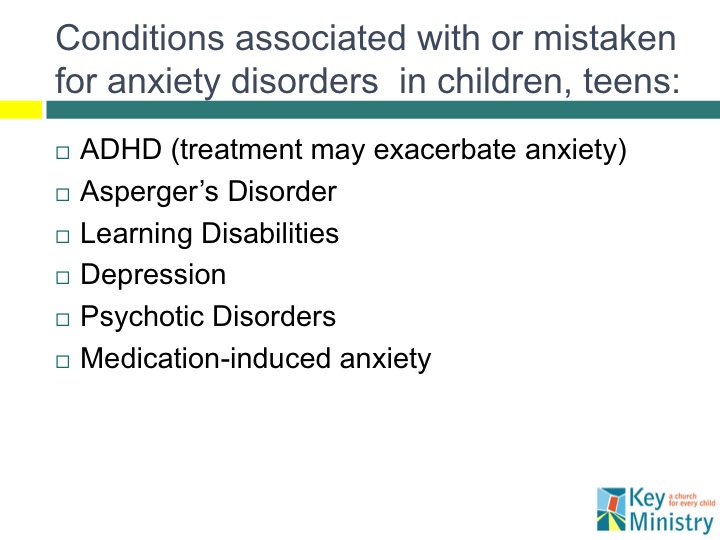
Be Not Anxious…Conditions That Can Mimic Anxiety in Children and Teens

Welcome to our Summer Blog Series examining the impact of anxiety disorders on church participation and spiritual development in kids. Today, we’ll look at other conditions that can mimic signs and symptoms of anxiety in children and teens.

Common conditions that often result in anxiety symptoms or occur in conjunction with anxiety symptoms are listed below.

Attention-Deficit/Hyperactivity Disorder (ADHD) may mimic symptoms of anxiety, or occur concomitantly with one or more anxiety disorders. Up to 30% of children and 50% of adults with ADHD will also be diagnosed with one or more anxiety disorders.  Kids with ADHD may experience anxiety because of difficulties meeting academic expectations in home or in school. They may experience anxiety in social situations because impatience, impulsivity and poor listening skills lead to rejection by peers, avoidance of such situations by the child and delayed development of age-appropriate social skills.

Children and teens with Asperger’s Disorder or non-verbal learning disorder often present with rigidity, inflexibility and obsessive, perseverative anxiety symptoms. The intense preoccupation seen with specific topics or objects in children with Asperger’s disorder is often mistaken for specific obsessions associated with Obsessive-Compulsive Disorder. They may also exhibit avoidance and withdrawal in social situations, repetitive behaviors and significant social skill deficits.

A child with a specific learning disorder such as dyslexia may become very anxious in school or at church when confronted with the expectation of reading aloud. Kids with unrecognized and untreated learning disorders may exhibit significant anxiety when asked to take tests, begin to evidence school refusal and experience signs of separation anxiety or physical symptoms of anxiety, especially on Sunday evenings or following extended breaks from school.

Some children experience anxiety symptoms that occur only during episodes of another mood disorder, such as Major Depression or Bipolar Disorder.  Kids with depression may experience difficulty sleeping, panic and physical symptoms similar to those seen in anxiety disorders. Some researchers have reported increases in obsessive thinking among youth with Bipolar Disorder experiencing manic episodes, along with restlessness, irritability and insomnia. In such cases, it is important to determine whether symptoms of anxiety were present at times when the child wasn’t experiencing an acute mood disturbance in order to arrive at an accurate diagnosis and prognosis.

Youth experiencing symptoms of a psychotic illness (Schizophrenia, Brief Reactive Psychosis) may evidence severe anxiety associated with paranoid thoughts and altered perceptual experiences along with marked social isolation and withdrawal.  In addition, children who have experienced Post-Traumatic Stress Disorder (PTSD) following significant trauma or abuse may experience marked symptoms of anxiety associated with nightmares, flashbacks and vivid recollections associated with the traumatic event(s).

Anxiety symptoms may also be caused by a variety of medical conditions. Parents should consider having their child seen by their pediatrician or family physician to rule out such potential causes of anxiety, even in situations when mental health intervention is being pursued.  Such conditions include, but are not limited to hyperthyroidism, asthma, seizure disorders, migraine headaches and lead intoxication.

Other prescription medications associated with anxiety-like symptoms include medications prescribed for asthma, guanfacine and atomoxetine. Anxiety is a potential side effect associated with many prescription and over-the-counter medications, including cold medications, antihistamines and diet pills. Energy drinks with high caffeine content are an increasingly popular precipitant to anxiety symptoms among teenagers.

Alternatively, anxiety is a common cause of a variety of physical complaints that result in frequent physician visits and school absence.  When symptoms such as a pounding heartbeat, sweating, shaking, difficulty breathing, chest pain or pressure, fear of choking, nausea, chills or dizziness interfere with a child’s ability to function on a day to day basis and can’t be attributed to a specific medical condition or cause, referral to a mental health professional with appropriate training and experience in assessment and treatment of children with anxiety is appropriate.

Posted in Anxiety Disorders, Key Ministry | Tagged , , , | 1 Comment

Be Not Anxious…Signs That a Child Might Struggle With Anxiety (Part Two):

Welcome to our Summer Blog Series examining the impact of anxiety disorders on church participation and spiritual development in kids. Today…we’ll complete our look at signs church staff, volunteers and parents might observe in the child struggling with anxiety.

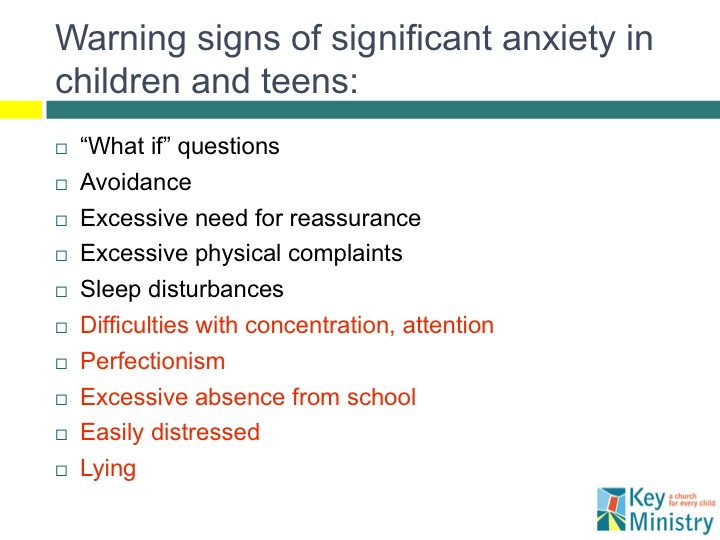
On Monday, we began to examine common signs and symptoms associated with clinically significant anxiety in children listed below. Monday, we looked at the first five signs. Today, we’ll examine the last five.

Difficulties with concentration and attention can arise from persistent fears or obsessive thoughts. It is important to distinguish difficulties with focus and concentration that occur acutely in association with specific thoughts, fears or situation from longstanding difficulties with attention that occur across two or more different situations and predate the onset of anxious symptoms as would be in the case among kids with ADHD.

Excessive perfectionism is often a sign of Obsessive-Compulsive Disorder (OCD).  The type of perfectionism that helps a child to do their best studying for a test or mastering a skill wouldn’t be cause for concern unless it became counterproductive to accomplishing a specific task or began to interfere with the child’s ability to complete other age-appropriate developmental tasks.  Examples of excessive perfectionism would include:

  • Rewriting an entire assignment because of a mild flaw in penmanship
  • The inability to turn in a less than perfect school project
  • Chronic school tardiness from excessive time spent grooming in the morning

Excessive absence from school may occur in conjunction with a variety of anxiety disorders.  Kids with separation anxiety are more likely to want to stay home for relatively mild physical complaints, or present to the nurse’s office at school requesting to be sent home. Those with social anxiety may be uncomfortable with peer interactions associated with school. Children predisposed to panic disorder may be more prone to episodes in a confined classroom setting where they experience difficulty leaving without being noticed by peers.

Children who are acutely embarrassed or uncomfortable may lie when directly questioned by a parent or a teacher. In these circumstances, the child may be less concerned with avoiding a specific consequence as opposed to deflecting the conversation away from a topic that evokes feelings of anxiety. Not infrequently, kids will answer such questions by responding “I don’t know.”

Posted in Anxiety Disorders, Key Ministry | Tagged , , , | Leave a comment

Be Not Anxious…Signs That a Child Might Struggle With Anxiety (Part One):

Welcome to our Summer Blog Series examining the impact of anxiety disorders on church participation and spiritual development in kids. Today…we’ll begin to look at signs church staff, volunteers and parents might observe in the child struggling with anxiety

Common signs and symptoms often associated with clinically significant anxiety in children are listed below. Today, we’ll look at the first five signs. On Wednesday, we’ll examine the last five.

“What if” questions refer to hypothetical situations unlikely to come true that are a cause of ongoing distress to the child.  Some examples would include:

  • “What if my Mom and Dad get into a bad accident on the way home?”
  • “What if there’s a burglar in our house while I’m sleeping?”
  • “What if Jesus isn’t who He claimed to be?”
  • “What if the stuff in the Bible isn’t true?”

Avoidance represents a conscious or unconscious reluctance to engage in age-appropriate tasks and activities associated with feelings of anxiety.  Common situations in which avoidance is demonstrated may include:

  • Riding the school bus
  • Calling a friend to invite them to play
  • Going to dances or sporting events in middle school or high school
  • Large group activities where a child may have been publicly embarrassed (school, youth ministry)

The child in need of constant reassurance may persist in their fears of a serious medical illness despite appropriate examination and testing from a physician, or reassurances from a teacher or principal that an anxiety-provoking situation has been resolved.

Children with excessive physical complaints without an identified cause may be experiencing significant worries that they are unable to communicate or embarrassed to communicate with a parent or caring adult.

Sleep disturbance is a very common symptom of anxiety in children and teenagers. Kids prone to anxiety may cope relatively well during the day when the busyness of school, friends, extracurricular activities, homework and entertainment help take their mind off specific worries or fears.  Without the distractions of the day, children may be most aware of their fears at night and often have more difficulty falling asleep as a result. Those with separation anxiety may need to fall asleep in the presence of a parent, insist upon sleeping in their parents’ room if they awaken during the night or have difficulty sleeping alone in their room.

Posted in Anxiety Disorders, Key Ministry | Tagged , , , , | Leave a comment

Be Not Anxious: The Many Faces of Anxiety in Kids

Welcome to our Summer Blog Series examining the impact of anxiety disorders on church participation and spiritual development in kids. In today’s post, we’ll look at the different ways in which anxiety disorders manifest in kids.

Within our overarching category of anxiety disorders, a number of specific conditions have been described that are characterized by the context in which the child’s anxiety symptoms occur. These conditions are listed below:

Kids with Separation Anxiety Disorder experience excessive fear or distress when away from home or a significant attachment figure, usually a parent. Challenges for such kids may include leaving for school, sleeping alone, spending the night away from home, managing concerns about the health or well-being of parents or caregivers, staying with a babysitter when parents go out or playing alone upstairs or in the basement when a parent or sibling is not present in the room. They may voice a variety of physical complaints on Sunday night or following an extended vacation in anticipation of returning to school and are often frequent visitors of the school nurse.

Kids with a Specific Phobia experience fear of specific objects or situations that leads to avoidance of the object or situation, or great distress if the situation is endured. Common phobias for children might include insects, animals, car or air travel, amusement park rides, or a fear of doing something embarrassing after observing a similar incident with another child. An example of this would be the child who becomes fearful of eating lunch in the school cafeteria after witnessing another child vomit.

Kids with Generalized Anxiety Disorder experience chronic, excessive worry, much of the time, most every day in multiple areas of functioning. Such concerns often involve schoolwork, health, safety, natural disasters, storms, social interactions or world events. They experience at least one chronic physical symptom in association with their fears. Kids with generalized anxiety often exhibit excessive perfectionism and experience more distress than may be evident to parents or teachers.

Kids with Social Anxiety Disorder experience significant fear and distress around unfamiliar peers and in performance situations. They experience great discomfort with social scrutiny and are very fearful of embarrassing themselves in front of peers. Kids with social anxiety may have difficulty ordering food in a restaurant, using the telephone to call a friend or attending a party when they don’t know most of the kids who were invited. Teachers may complain that kids with social anxiety don’t participate enough in class, don’t ask questions or don’t seek out help when they need it. Kids with Selective Mutism persistently fail to speak, read aloud or sing in specific situations (e.g., school, church) despite speaking normally in other situations. They may whisper or communicate selectively with certain peers or teachers. Selective mutism is thought to represent a manifestation or subtype of social anxiety.

Kids with Panic Disorder experience brief, recurrent, unanticipated episodes of intense fear, and may subsequently avoid places or situations associated with the episodes (agoraphobia). Panic disorder is different from panic attacks that occur in response to a specific situation associated with another anxiety disorder, such as separation or social scrutiny. Kids with panic disorder may experience symptoms in classrooms or other places where they might experience difficulty leaving without drawing unwanted attention from others.

Kids with Obsessive-Compulsive Disorder (OCD) will experience recurrent, intrusive thoughts or compulsive, recurrent, repetitive behavior associated with significant mental distress. They may display excessive perfectionism, have difficulty making decisions when asked to choose from several alternatives, fear that they may be drawn to certain actions or behavior against their will, hoard useless items or materials or exhibit time-consuming rituals such as counting, checking, arranging or ordering items, grooming or washing. In school, kids with OCD may read assignments repetitively because of fears of overlooking important information, experience difficulty completing assignments or tests within the required time because of perfectionism or rewrite assignments because of minor errors in penmanship.

This week…we’ll look at signs church staff , volunteers and parents might observe in the child struggling with anxiety

Posted in Anxiety Disorders, Hidden Disabilities, Inclusion, Key Ministry | Tagged , , , , | Leave a comment

What Can the Church Do to Help Families of Kids With Mental Illnesses?

I’ve been doing a brief series of posts over at specialneedsministry.org looking at the ways in which circumstances have (or haven’t) improved over the last 25 years for kids with mental illnesses and their families. I’ll be completing the series on Tuesday…and I could use your help in writing Tuesday’s post.

What would you like to see the church do to better serve families of kids with mental illnesses? Aware of any innovative strategies employed by churches or small group within churches that have helped to demonstrate the love of Christ while meeting immediate needs? Please post comments and links below.

Here are links to the posts on what has improved and hasn’t improved for families over the last 25 years.

Posted in Hidden Disabilities, Inclusion, Key Ministry, Strategies | Tagged , , , , , | Leave a comment