Don’t Waste Your Crisis (A Survival Guide for Parents)

They say you can’t get struck by lightning twice. They were wrong.

We sat silently in the car during the long drive to the University of Michigan Hospital. We’d been in a terrific struggle of care and survival with our disabled son, Calvin, and were struggling to manage his care. All the while I kept noticing our other son, Noah, was not looking well and was complaining of leg pain constantly. After several tests it was discovered that his aorta was narrowed down to the size of a pinhole and the bottom half of his body was hardly receiving blood. He needed to have open heart surgery.

The next weeks were filled with shuffling between the onsite hotel room in the hospital and the ICU and recovery rooms. My husband and I would sit on opposite sides of Noah’s bed with Calvin in our arms, stunned, hardly able to believe this was all happening. Two of our four children were struggling with life-threatening conditions.

crisis survival

Do you have crisis in your life? Ones that leave you unable to catch your breath? Maybe your challenges are coming in waves and you wonder if you can keep your head above the water.

Kara shares some reminders while you are treading in deep water over at Not Alone

Posted in Key Ministry, Parents | 1 Comment

Special needs parents…Do you feel cheated?

shutterstock_54691336_renderedEditor’s note: Here’s the third post in Jeff Davidson’s series… Facing the Elephants in the Room, in which he looks at the overwhelming, but unspoken challenges confronting parents of kids with special needs. The first two posts in the series may be found here and here.

Do you ever feel like you’ve been robbed of the life you had dreamed of or anticipated? It’s so easy to feel discouraged and bitter over how much different our lives are as special-needs dads.

Editor’s note: Here’s the second post in Jeff Davidson’s series… Facing the Elephants in the Room, in which he looks at the overwhelming, but unspoken challenges confronting parents of kids with special needs.

When we start listing the things that we feel special-needs have robbed us of or deprived from us, the list can get pretty lengthy. But we have a choice in how we look at this. We can wallow in the despair, discouragement, and frustration over our circumstances, or we can choose the flip side.

Thievery and Discouragement Elephants:

When I decided to choose the flip side, it changed my perspective completely. I wasted so much time early on feeling like I had been cheated.

“Don’t you feel cheated about the life you imagined for you and your son?”

“Don’t you feel like you have been robbed of so many blessings by having a child who can’t talk, can’t walk, and can’t really do any of the things a typical child can do?”

shutterstock_1844086“Don’t you feel robbed of all the activities a dad and a typical child get to do together?”

The questions come often. Every time the question is raised, I have to make a choice.

Everything in life has a flip side. And with every emotion, every circumstance, every trial, and every situation, a choice has to be made. Choose the flip side.

Every night, the last words my son will hear will be my prayers of God’s blessings over him. Every night he will hear my words of affirmation and love spoken over him. Every night the last two words he will hear from me will be, “Goodnight Superman.”

Every morning, the first words he will hear will be from his mother, who lays down her life every day in sacrifice for him. She will open the door to his room and greet him affectionately with pride saying, “There’s my buddy boy!”

We will never have to worry about who is influencing him. We will never have to worry about who he is with or what is he doing.

I used to dread the thought that my son may have to live with me all of my life. Now, I am choosing to embrace that thought. I choose the flip side. I will have an opportunity to make new memories every day. I will have an opportunity to express my love for my son every day.

Even though he is completely non-verbal, I will get a chance to talk to him and engage with him every day. I get to see, feel, and experience the essence of God in my house every day.

I have been denied a life of never grasping God’s mercy, God’s strength, God’s power, God’s grace, and God’s plan for our lives.

So I have a new answer now to the question of “Do you feel cheated?”

Yes, I do.

My walk with a profoundly handicapped child has indeed cheated me of so many things.
Image00008I have been cheated out of having to worry about my son walking away from God. I have been cheated out of never comprehending God’s unconditional love. I have been robbed of worrying that my son will make wrong decisions in his life. 

Cheated? Oh, yea. But who’s cheating whom?

Everything in this journey, every struggle, every challenge, and every trial will present you with a choice. Every choice will present you with a chance to choose the flip side and change your perspective.

After I learned that the power over every circumstance depended upon my choice in perspective, I decided to write my son’s disabilities the following letter.

Dear autism and cerebral palsy,

I’ve been meaning to write to you for quite some time but thanks to you two, I’ve been pretty busy as you can imagine.

Over the years I have cursed at you, yelled at you, cried about you, and tried my best to understand you. The more I have learned about you, the more I realize how little I know.

But there is one thing I haven’t done. I have never stopped to thank you.

That’s right. I need to stop and thank you for a few things today. 

You probably don’t get a lot of thank you notes mixed in with all your hate mail, so let me try to explain why I’m writing. 

You see you robbed my son of his speech. Because of you he is non-verbal and has no language, even though he is seventeen years old.

But when you robbed my son of his speech, God decided to give him a voice and a platform. 

He may not speak, but God used his life to inspire, bless, and teach others around him.

Hey autism, do you remember that cave you tried to lure us and other autistic families into for the rest of their lives? You know, the isolated dreary cave where you want all autistic families to live in without hope?

We tried it. It just wasn’t for us. So now we do search and rescue, returning to the cave over and over to show others the way out of the cave and to a better place.

Guys, there are so many other things you’ve robbed me from for which I need to thank you. 

You’ve robbed me from my own pride, selfishness, and greed.

You’ve robbed me from my tendency to put my work above my family. 

You’ve robbed me from living for myself instead of in service to others. 

You’ve robbed me of only caring about those who are just like me.

You’ve robbed me of believing there are some struggles just too big for us.

You’ve robbed me of never finding out what God’s plan and purpose is for my life. 

Since you came into my life, I have met some amazing people because of our common association with you.

Therapists, teachers, assistants, service providers—dedicated and passionate people who have crossed our path and have become part of our story—people I might never have met if it weren’t for you. Thanks to you two, I’ve also met some amazing parents raising their own heroes with special needs who inspire and encourage me.

What you don’t know, autism and cerebral palsy, is that God didn’t take away the struggles, the pain, or the challenges. He just simply used them in ways I never dreamed and you never expected.

He has used them to teach me unconditional love

He has used them to teach me the essence of grace.

He has used them to teach me to find joy in all things.

He has used them to show me how to be content in the little things.

Really, you can say He has simply used them to draw me closer to Him, help me understand Him, and make me stronger through Him.

In trying to destroy us, all you did was prepare a stage for God to show His glory.

You really helped me take my relationship with God to a much higher and deeper level, so thank you so much! I’m so grateful! Now I rely and lean on Him more than ever. 

I also want to thank you for drawing my wife and me closer together in our relationship. We have learned to cry together, laugh together, grieve together, and stand strong together because of you.

So you see autism and cerebral palsy, I have quite a bit of gratitude for you. Of all the things I’ve said to you and about you, I’ve never thanked you.

Who knew that out of my seeds of hate for you, could grow such love for my son!

So consider this my thanks to you. 

But let’s be clear, just so you know. I still loathe and despise you with everything in me.

Regards,

Jeff Davidson

***********************************************************************************************************

IMG_8478Jeff Davidson is an author and pastor who enjoys speaking at churches, conferences, events and to groups, ministering to special needs families and individuals. Jeff and his wife Becky started Rising Above Ministries when they realized the incredible gift and blessing their own son with special needs (Jon Alex) was to them. Jeff’s book, No More Peanut Butter Sandwiches, is available through Crosslink Publishing, Barnes and Noble and Amazon.
 

Posted in Families, Intellectual Disabilities, Key Ministry, Special Needs Ministry | Tagged , , , , , , , , , , , , | 1 Comment

What are the stats on disability and church?

shutterstock_264896012

Editor’s Note: Shannon Dingle is compiling the data examining, disability, adoption, mental illness and church. Here’s what she found in terms of research on persons with disabilities in the church.

Last week I opened a three-part series of posts on statistics and ministry by sharing general figures about the prevalence of disability and mental illness in the US. I challenged you to consider how your church can better represent those numbers, that all people may hear and know the truth of the gospel. Today I want us to zoom in a little closer, looking specifically at research pertaining to people with disabilities in the church.

Please feel free to share the information in this post and the other two in my series. If you do so, I’d encourage you to include the sources so that others can be like Bereans and not just believe what we say but verify it for themselves. Whenever I am a main stage or workshop speaker, I consider it my responsibility as an ambassador of Christ to present only the research I can document as being true and not just hearsay. (For example, the oft-quoted stat that 85-95% of special needs families are unchurched isn’t supported by any research, so I really think we – as people of the Truth – ought to stop repeating it.) This series of posts is the first time I have posted my speaking statistics online, but I realize many more people can be equipped this way than in person.

(If you’ll be at the Refresh Conference in Seattle this month, A Church For Everyone in McAllen, TX in April, the Accessibility Summit in DC in April, or the Christian Alliance For Orphans Summit in Orlando in May, though, I would love to meet you face to face!)

Now let’s look at the facts! What does research indicate about people with disabilities and their involvement in faith communities? I invite you to add any figures I might have overlook in the comments. As we verify anything you share with us, we’ll add to this piece so it can be a growing, collaborative tool for all of us!

At church in general,

  • People with disabilities are less likely to attend worship services, Bible studies, and other church activities than those without disabilities.[i] Between 2000 and 2010, however, that gap narrowed,[ii] which we at Key Ministry believe is the result of more churches becoming aware of the need and actively welcoming people of all abilities. We are thankful for progress, but let’s keep working to close that gap for the glory of God and the good of his people.
  • People with autism are more likely to be atheists and more likely to reject organized religion.[iii]
  • More inclusive faith communities were described in one study as having five common characteristics. They “(i) featured faith leaders who were more committed to inclusion; (ii) used educational resources to address disability-related issues; (iii) portrayed people with disabilities positively in their religious teachings; (iv) had stronger ties to disability organizations; and (v) had a stronger orientation towards promoting social justice.”[iv]

For children with disabilities and their families,

  • In one study, more than half of special needs parents reported that their child with a disability had been excluded at church.[v]
  • Erik W. Carter, a noted researcher in this area, and his colleagues noted in one study that “the considerable diversity in parental needs reflected… should challenge congregations to avoid a one-size-fits-all approach to supporting families and instead consider avenues for individualizing their efforts to meet felt needs among the individuals and families present within their community.”[vi]
  • More than 90% of church-going special needs parents cited the most helpful support to be a “welcoming attitude toward people with disabilities.” Meanwhile, only about 80% of those parents said that welcoming attitude was present at their church.[vii] (This and the rest of the bullet points in this section are drawn from Melinda Jones Ault’s doctoral dissertation, which included a sample of more than 400 special needs parents involved in faith communities. I am deeply thankful for her excellent contribution in this area.)
  • Welcoming church behaviors, described by parents in one study, included “having persons in the faith community take time to speak directly to their child, approach them and ask them what supports they may need, offer to sit with or watch their child, visit them and provide food at times of crisis, call and check on them when they were absent, and sustain the support over time when a chronic condition existed.”
  • More than 60% of special needs parents regularly attending church described church inclusion for their child as participation with same-aged peers, with or without supports, while only about 12% and 6% respectively described having their child included with younger children or segregated with only other children with disabilities.
  • Almost 1/3 (32.3%) of special needs families said they had left at least one church because their child was not included or welcomed.
  • Nearly 50% (46.6%) of special needs parents said they refrained from participating in a religious activity because their child was not included or welcomed.
  • More than half of special needs parents reported that they had kept their child from participating in a religious activity because support was not provided (55.8%) or been expected to stay with your child at a religious activity so your child could participate (55.3%).
  • shutterstock_192514547Families affected by disability who regularly attended church were “significantly more likely to respond that their son or daughter was supported in the place of worship than was not supported.” Other factors, including the specific kind of supports (i.e. inclusion with same-aged peers vs. separate classes for kids with disabilities) offered and the size of the congregation, did not impact attendance in the same way.
  • Among church-attending special needs families, 86.5% said that their church needs more education and training about disability.
  • Specifically, parents identified a need for this training in “general awareness of the characteristics of disabilities, how to be inclusive, and how to work with a variety of individuals and include them across a range of ability levels” as well as “behavioral characteristics of their sons’ or daughters’ disability, modes of communication, and how to care for individuals with complex needs” and “reaching out to families of children with disabilities, knowing how individuals with disabilities are viewed and treated by the church, and how to bridge social gaps and include all persons.”
  • When special needs parents described positive attitudes toward their family at church, they used words like “welcoming, supportive, willingness to be inclusive, accommodating, accepting, loving, willing to try, showing a genuine interest, understanding, kind, thoughtful, nice, caring, and tolerant.”
  • When parents described negative attitudes they had encountered toward their special needs at church, they said things like “unwilling to try to involve, unhelpful, intolerant of differences, anxious about the presence of the child, impatient, unsupportive, unfriendly, and uncompassionate.” These parents “indicated that they often received stares from other congregants, were treated like a missions project, had ‘horrendous’ experiences with faith communities related to their child’s disability, and felt rejected and isolated.” Among other children, some mentioned “negative attitudes of the child’s peers where parents noted the children made faces at their daughter and mocked her, were mean to their child, and were not willing to accept the child.”
  • One parent of an upper elementary child with a significant health impairment said, “Churches are only buildings. The people who attend those churches are what make the difference. Their attitudes make all the difference.”
  • Pros and cons were found for both large and small faith communities. In small churches, “parents indicated that although they did not have specialized programs or personnel, their family was well-known there, people loved and cared for their child, and they were willing to adapt and provide programs.” Meanwhile, large churches were more likely to have experience with and knowledge about autism as well as already-established specialized programs and proactive planning for inclusion.
  • Parents indicated that special needs inclusion and participation in faith communities was easier when children were younger and became more difficult as the child grow older.
  • Parents described the following child behaviors as challenges for church participation: being “noisy in church, having complex needs, not being able to sit still, touching others, overwhelmed by the noise and chaos, loud and unpredictable, aggressive with others, unable to understand religious education lessons, and over stimulated. These behaviors resulted in parents feeling embarrassed in services, receiving stares from others, refraining from participating in services, removing their child from activities, attending activities with their child to provide assistance, and being told not to bring their child back to services or activities.”
  • Fatigue was a common parental characteristic cited as preventing inclusion of a child at church. Many parents indicated a strong desire for a church community but, as one put it, because of our child’s needs “we have not had the time or energy to seek-out and prepare (educate) a new spiritual home for ourselves. Therefore, we do not attend regular weekly services anywhere, as much as we could really use the support and spiritual community.”

For youth and adults with intellectual and developmental disabilities and their families,

  • One qualitative study[i] of youth with intellectual and developmental disabilities (IDD) concluded that “an essential element of supporting inclusion in faith communities involves fostering friendships and other supportive relationships. Efforts to increase architectural and attitudinal accessibility—while necessary—are usually insufficient for promoting the development of personal relationships between young people with IDD and other members of a congregation… Intentional planning and thoughtful supports are likely needed to create contexts in which people with and without IDD are likely to meet, spend time together, and develop new relationships.”
  • Adults with IDD are less likely to attend church than other adults, and adults with IDD who report their level of disability as somewhat or very severe attend at lower rates than those who report their disability level as slight or moderate.[ii]
  • In the same study cited in the last bullet, adults with Down syndrome were considerably more likely to attend church than adults with other disabilities, while adults with autism spectrum disorders, behavioral challenges, or psychiatric disabilities were less likely to do so.
  • Furthermore, “adults with IDD who attended religious services within the past month also tended to participate more frequently in other forms of community involvement (e.g., going out to eat, shopping, going out to exercise). This finding may reflect the fact that individuals who attend religious services also have fewer physical, cognitive, or behavioral limitations, as well as have greater access to supports and services than those individuals who do not attend religious services, and that these same variables also contribute to greater participation in other measures of community involvement.”

The biggest takeaway for all three of the posts in this series?

Church, we have a great opportunity to show love! The need is great. Kids are hurting. Adults are too. Families are struggling. The first step in being able to help is understanding the need.

Jesus met people where they were, and so can we.

***********************************************************************************************************

References:

[i] Liu, Eleanor X; Carter, Erik WBoehm, Thomas LAnnandale, Naomi HTaylor, Courtney E. In Their Own Words: The Place of Faith in the Lives of Young People With Autism and Intellectual Disability. Intellectual and Developmental Disabilities52.5 (Oct 2014): 388-404.

[ii] Carter, Erik; Kleinert, Harold L; LoBianco, Tony F; Sheppard-Jones, Kathleen; Butler, Laura N; et al. Congregational Participation of a National Sample of Adults With Intellectual and Developmental Disabilities. Intellectual and Developmental Disabilities. 53.6 (Dec 2015): 381-393,441,443.

[i] The National Organization on Disability. Religious Participation: Facts and Statistics. http://www.nod.org/religion/index.cfm

[ii] The ADA, 20 Years Later Executive Summary. July 2010. Kessler Foundation/The National Organization on Disability. http://www.2010disabilitysurveys.org/pdfs/surveysummary.pdf

[iii] Caldwell-Harris, C., Murphy, C.F., Velasquez, T., & McNamara, P. (Unpublished). Religious Belief Systems of Persons with High Functioning Autism. Research paper from the Departments of Psychology and Neurology at Boston University. Available at http://csjarchive.cogsci.rpi.edu/proceedings/2011/papers/0782/paper0782.pdf

[iv] Griffin, M. M., Kane, L. W., Taylor, C., Francis, S. H. and Hodapp, R. M. (2012), Characteristics of Inclusive Faith Communities: A Preliminary Survey of Inclusive Practices in the United States. Journal of Applied Research in Intellectual Disabilities, 25: 383–391.

[v] O’Hanlon, Elizabeth. Religion and Disability: The Experiences of Families of Children with Special Needs. Journal of Religion, Disability & Health. Vol. 17, Iss. 1, 2013

[vi] Erik W. Carter, Thomas L. Boehm, Naomi H. Annandale, and Courtney E. Taylor. Supporting Congregational Inclusion for Children and Youth With Disabilities and Their Families. Exceptional Children 0014402915598773, first published on September 8, 2015.

[vii] Ault, M. J. (2010). Participation of families of children with disabilities in their faith communities: A survey of parents (Order No. 3492795). Available from ProQuest Central; ProQuest Dissertations & Theses Global. (919088298).

Posted in Advocacy, Families, Inclusion, Intellectual Disabilities, Key Ministry, Parents, Special Needs Ministry | Tagged , , , , , , , , , , | 61 Comments

Join us for our Key Ministry Video Roundtable!

Key Ministry Video RoundtableWe’re going to be trying something new…and we’d be delighted to have anyone serving in disability ministry join us!

Our team at Key Ministry will be launching our Disability Ministry Video Roundtable…a fully interactive, monthly gathering of ministry leaders and key volunteers. The first video roundtable will take place on Wednesday, February 17th from 12:00 rwolfe2PM to 1:30 PM EST, and will be hosted by Ryan Wolfe, Pastor of Developmental Disabilities from First Christian Church in Canton, OH and a Key Ministry church consultant.

So…what exactly is a video roundtable and how is it different from a podcast?

I don’t know about the rest of you, but one of the best reasons to attend live ministry conferences is the opportunity to informally hang out with friends and colleagues to share stories and experiences. Everyone involved with special needs or mental health inclusion… from a beginner to the folks from the conference circuit – will experience unique challenges in ministry with the individuals and families served by your church. We’re offering a platform for ministry leaders and volunteers of all experience levels to partake of – or contribute to the collective wisdom.

This is a conversation for potentially up to fifty leaders and volunteers at any one time. We don’t have a set agenda for these roundtables, but at the time of registration, participants will have the opportunity to share topics with our host for the month that they’s like to discuss. For those who are unable to join us “live and in cyberspace,” we’ll be posting the video of each Roundtable on Key Ministry’s Vimeo page.

Unlike a podcast…

  • You have the opportunity to help set the agenda.
  • You have the opportunity to interact with the host(s) and any other participant(s) in real time.
  • You have an opportunity to tap into the wisdom of the entire audience when looking for help with your ministry challenges.

We’re going to try this in February, March and April and evaluate at that time how we might enhance the experience for all participants. Here’s our schedule…

  • Wednesday, February 17th: Ryan Wolfe hosting
  • Wednesday, March 16th: Shannon Dingle hosting
  • Wednesday, April 20th: I’ll be hosting, accompanied by a special guest host.

There’s no charge involved with joining us for the roundtable, but we do require participants to register. Registration is capped at up to fifty guests, and each guest will receive an e-mail upon registration with a link to join the conference.

What will you need technology-wise to join us? A computer, tablet or smartphone with a video camera and a microphone. We use Zoom for our videoconferencing…we encourage you to register for Zoom (free) and download the free app before joining the roundtable.

Interested? Click here to register for our first Disability Ministry Video Roundtable at noon Eastern on Wednesday, February 17th!

Reading this on a mobile device? Click here for a registration form optimized for mobile phone users.

***********************************************************************************************************

shutterstock_24510829Key Ministry is pleased to make available our FREE consultation service to pastors, church leaders and ministry volunteers. Got questions about launching a ministry that you can’t answer…here we are! Have a kid you’re struggling to serve? Contact us! Want to kick around a problem with someone who’s “been there and done that?” Click here to submit a request!

Posted in Inclusion, Key Ministry, Leadership, Resources, Training Events | Tagged , , , , , , , , | Leave a comment

God’s Plan for His Church Includes All of Us

From Emily Colson …

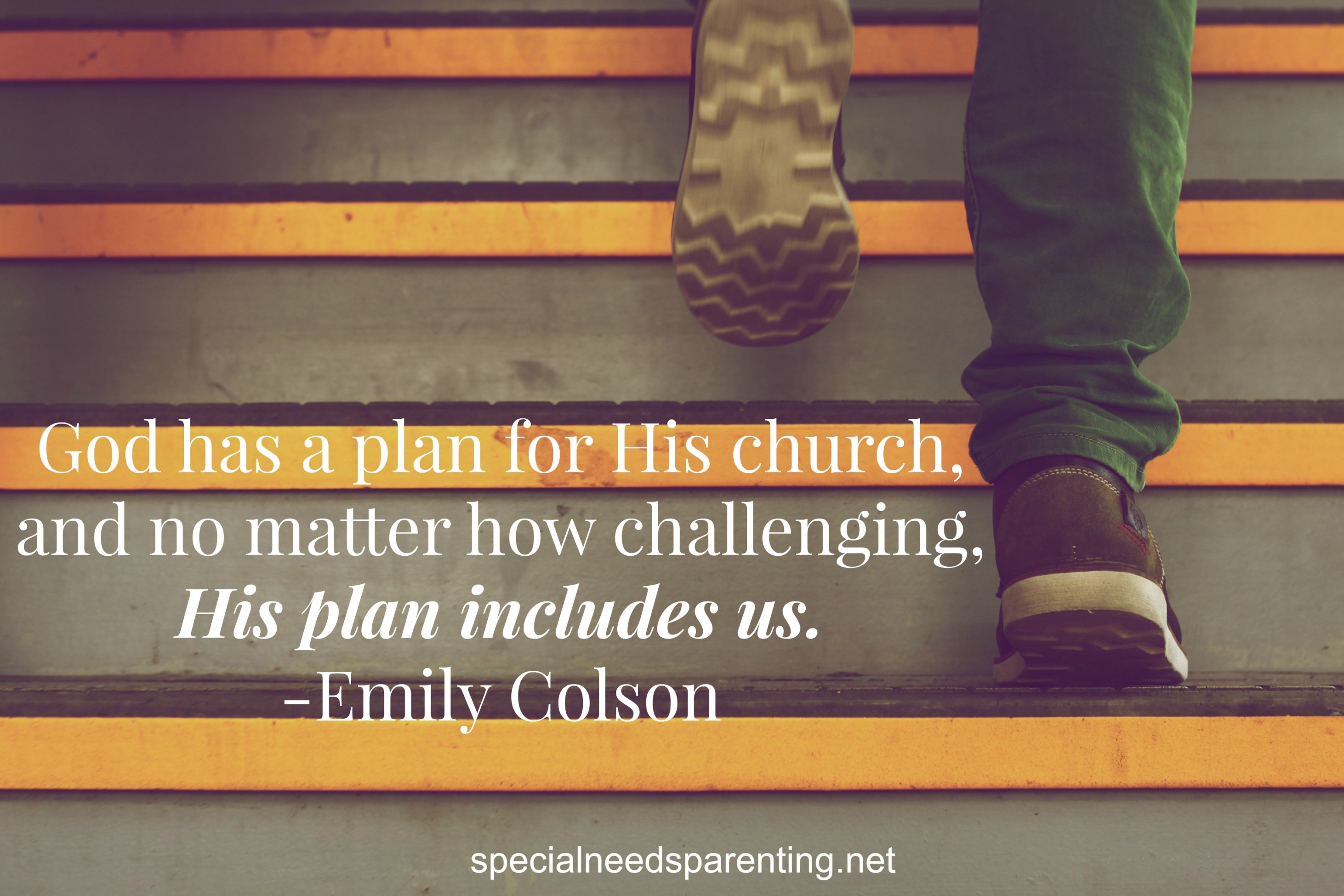
God has a plan for His church, and no matter how challenging, His plan includes us.

One night at church, I lost 190 pounds. Fortunately, I found all of it in the toddler room. There was my hulk of a son, hunched over the Brio train table, next to a little child who looked like a garden gnome beside Max. A kindly volunteer was standing over my son, looking a little baffled and holding a Brio bridge that had clearly been ripped off the table King Kong style. “I’ll take that,” I said, knowing full well that my son works quickly when redesigning a train track, and that the nails protruding from the bottom of the bridge were really no match for my 25 year old.

I tucked the bridge under my arm, and Max was off again, tearing down the hall toward the sanctuary. I chased after him, hoping not to lose him this time, praying his anxiety and bulk would not flatten anyone who might stray into his path. This night just wasn’t working—church was different. The lights in the lobby were dimmed. The service had a slower pace. New people had come in droves filling the sanctuary to its limit. There was even a live goat. No, we don’t do animal sacrifices at our church, at least not any more. “Billy” was part of the play being acted out for our Christmas Eve service.

I tried to make Max laugh by pointing to the life-sized camel strutting through the lobby, with two pairs of khaki pants visible from beneath. But Max ran into the stairwell, dropped to the floor like a stuntman, and pressed his fingers over his ears and eyes to block out the world. Every muscle ached as I chased after him. “You should have worn a pedometer, Emily,” someone smiled, “just to see how many steps you’ve taken tonight.” I laughed and called back, “I’m not sure it can count that high.”

Read what happened next at Not Alone …

Posted in Autism, Key Ministry, Special Needs Ministry | Leave a comment

The Milestone Elephant

shutterstock_348054278

Editor’s note: Here’s the second post in Jeff Davidson’s series… Facing the Elephants in the Room, in which he looks at the overwhelming, but unspoken challenges confronting parents of kids with special needs. Last week’s post on The Anger Elephant may be found here. Today’s post from Jeff…

You keep track of all my sorrows. You have collected all my tears in your bottle. You have recorded each one in your book.

Psalms 56:8 (NLT)

Some of the biggest struggles for so many special-needs parents are the emotions we experience when our children don’t reach typical milestones in the manner or time of other children.

We can begin to experience grief, sorrow, disappointment, sadness, and lament each time another milestone is missed. I once wrote these words about my own feelings:

“Secretly, I fantasized about building a massive bonfire out of those baby milestone books and having a giant book-burning party. I could see myself silhouetted against the shadows of this massive fire and I would invite all parents of children with special needs to come throw their milestone books on the fire as it stretched towards a blood-red sky. We would feel the glow of the fire against our faces as we shook our fists and raged at an unseen God.”

shutterstock_370768415If we are not careful, we can slip into feelings of loneliness, despair, and begin to isolate our families and ourselves.

In our struggle watching other children, we began to withdraw from attending other children’s parties or social outings because watching the other kids do things my son couldn’t do became unbearable. Withdrawal is a dangerous way of coping.

Grieving is a very natural response, and nothing we should feel guilty about or any shame over. But we should always remind ourselves of the flip side and find the little things in the journey that we can celebrate, find joy in, and focus our thoughts on.

This journey as special-needs parents will produce a roller coaster of emotions. The decision of how we handle the ride is up to us.

Joy can be found in the simple things.

Contentment can be found in the small things.

We should always in every situation remind ourselves that God sees our pain and grief. It does not go unnoticed. That’s why I love the Scripture above from Psalm 56:8 so much. It speaks of a God who notices every little bit of pain and sorrow in our lives.

It’s a reminder that we do not go on this journey alone. God is always watching over us. He is always with us.

And the day will come when there will be no more mourning, crying, or pain.

Revelation 21:4 (NLT)

shutterstock_360293516
***********************************************************************************************************

IMG_8478Jeff Davidson is an author and pastor who enjoys speaking at churches, conferences, events and to groups, ministering to special needs families and individuals. Jeff and his wife Becky started Rising Above Ministries when they realized the incredible gift and blessing their own son with special needs (Jon Alex) was to them. Jeff’s book, No More Peanut Butter Sandwiches, is available through Crosslink Publishing, Barnes and Noble and Amazon.
 

Posted in Advocacy, Families, Inclusion, Parents, Special Needs Ministry | Tagged , , , , , , , , , | Leave a comment

What are the stats on disability, adoption, and church? (Post 1 of 3)

Shannon at Evangelicals for LifeEvery time I speak, I bring handouts. I joke that I’m like I’m Charlie Brown’s friend Linus who carries his blanket as a security item; for me, it’s a packet of helpful tools. Knowing most special needs ministry leaders never attend a conference, though, I’ve decided to freely offer what I can. After all, our desire at Key Ministry is to equip churches to welcome families like mine! If these statistics can help more churches offer their first yes, then I’m glad to help.

In today’s post, I want to share some general statistics about people with disabilities and mental illness. (Meanwhile, I’ll share about the participation of those individuals and their families in faith communities in my next post, and then I’ll share research pertaining to the intersection between disability and adoption in the final post.) As you read these, as yourself these questions?

  1. Does our church represent these figures?
  2. If not, what can we do to become a more welcoming place?
  3. If so, what can we do to step up what we’re doing to fill the gap of other churches in our area who aren’t welcoming yet, so that all families might have the opportunity to engage in church community?

shutterstock_370105220Now let’s look at the facts! If I’ve left out one you find compelling, please add it in the comments, and we’ll edit this piece so it can be a growing, collaborative tool for all of us!

For families and children in the general population,

  • Nearly one in six children has a developmental disability.[i]
  • Approximately 1 in 68 children has an autism spectrum disorder.[ii]
  • When a couple has a child with autism or ADHD, some research indicates that (a) the rate of divorce may be nearly twice as high and (b) the risk of divorce lasts longer into adolescence/adulthood as for other parents.[iii] This doesn’t hold true for other disabilities, though, with parents of children with Down syndrome, for example, having lower rates of divorce.[iv] (For more on this, see Steve’s post here.)
  • Mothers of adolescent and adult children with autism have stress hormone levels similar to combat soldiers and Holocaust survivors.[v]

Based on US Census data from 2008[vi] [vii],

  • 5% of the American population lives with a severe level of disability (38.3 million people, which is roughly the same number of people who live in California).
  • 3 million people in the US (4.4% of the population over the age of 6) need assistance with everyday tasks due to their disabilities.

shutterstock_369770717According to the CDC[viii],

  • 1 in 5 adults (or over 53 million people) in the United States have a disability of one form or another, with state-level estimates ranging from 1 in 6 (16.4%; Minnesota) to nearly 1 in 3 (31.5%; Alabama).
  • The two most common areas of disability for adults in the US are mobility (13.6% of adults impacted) and cognition (10.6% of adults affected).

According to the National Institute on Mental Health[ix],

  • 1% of the U.S. adult population had a current mental illness diagnosis in 2014.
  • One in five children either currently have or previously have had a seriously debilitating mental disorder. (If this seems high to you, please be mindful that the stigma around mental illness often silences families. In our experience, families often don’t tell church leaders about a child’s mental health diagnosis out of fear of judgment.)

The biggest takeaway for this post (and the other two to come) in this series?

Church, we have a great opportunity to show love! The need is great. Kids are hurting. Adults are too. Families are struggling. The first step in being able to help is understanding the need.

Jesus met people where they were, and so can we

Photo of Shannon Dingle courtesy of Chad Barlett, Ethics & Religious Liberty Commission 

***********************************************************************************************************

[i] Boyle CA, Boulet S, Schieve LA, et al. Trends in the prevalence of developmental disabilities in US children, 1997-2008. Pediatrics. 2011. http://pediatrics.aappublications.org/content/early/2011/05/19/peds.2010-2989.abstract?sid=ab290d14-2d60-411d-bf0c-00bb150716aa#cited-by

[ii] Center for Disease Control and Prevention. Prevalence of Autism Spectrum Disorders — Autism and Developmental Disabilities Monitoring Network, 11 Sites, United States, 2010. http://www.cdc.gov/mmwr/preview/mmwrhtml/ss6302a1.htm?s_cid=ss6302a1_w

[iii] Wymbs, B. T. et al (2008). Rate and predictors of divorce among parents of youth with ADHD. Journal of Consulting and Clinical Psychology. 76(5); 735–744.

Hartley, S.L., Barker, E.T., Seltzer, M.M., Floyd, F., Greenberg, J., Orsmond, G., & Bolt, D. (2010). The relative risk and timing of divorce in families of children with an autism spectrum disorder. Journal of Family Psychology. 24(4); 449-57.

[iv] Urbano, R.C, and Hodapp, R.M. (2007). Divorce in families with Down syndrome: A population-based study. American Journal on Mental Retardation. 112(4); 261-274.

[v] Seltzer, M.M. et al. (2010). Maternal cortisol levels and behavior problems in adolescents and adults with ASD. Journal of Autism and Developmental Disorders. 40(4). 457-469.

[vi] Americans with Disabilities. U.S. Census Bureau, 2010: http://www.census.gov/prod/2012pubs/p70-131.pdf

[vii] Adopted Children and Stepchildren: 2010. U.S. Census Bureau. https://www.census.gov/prod/2014pubs/p20-572.pdf

[viii] http://www.cdc.gov/ncbddd/disabilityandhealth/infographic-disability-impacts-all.html accessed 2/1/2016

[ix] http://www.nimh.nih.gov/health/statistics/index.shtml accessed 2/1/2016

Posted in Inclusion, Key Ministry, Resources | Tagged , , , , , , , | 2 Comments

Making church irresistible for kids with the most common disabilities…

shutterstock_291556127Editor’s note…We’re very pleased that our colleagues at Joni and Friends have launched Irresistible Church, a new site with lots of free resources and tools to help churches offer “authentic community built on the hope of Christ that compels people affected by disability to fully belong.” Ryan Wolfe from our team will be a featured author at their site. We’re “co-publishing” today to introduce our followers to their team and resources. 

When most people ponder disability, the first image that comes to mind are children or adults with obvious physical or cognitive limitations that result in difficulty functioning 24/7/365. People who need preferential parking spaces near the door of the grocery store or medical clinic. Kids with cerebral palsy who require a chair lift when transported to school. Kids with Down Syndrome.

Within the church, Joni has probably been the most visible (and impactful) champion for inclusion of persons with disability. She’s extraordinarily talented as an artist, an author and as a musician. When we think of Joni, our mental image is of her overcoming her physical limitations…a woman with a paint brush in her mouth, seated in a wheelchair with quadriplegia from a diving accident as a teenager. The success of the Wheels for the World outreach has further cemented the way in which many pastors and church leaders conceptualize disability. But what if the church is just seeing the “tip of the iceberg” when it comes to sharing the love of Christ with families impacted by disability?

Kids with mental health conditions account for the vast preponderance of the one in six U.S. kids identified with a developmental disability. One in five teens in the U.S. have experienced an episode of “severe” mental illness, and 18.5% of adults experienced one or more mental health conditions in the past year. According to the National Institute of Mental Health, neuropsychiatric disorders are the leading cause of disability in the U.S.

As a physician specializing in child and adolescent psychiatry, I all too often meet families who lack meaningful involvement with a local church because the environments in which we “do church” present unique challenges to kids with common mental health conditions. Here are some examples of how specific mental illnesses interfere with the ability to attend church in kids who otherwise function at a reasonably high level in other life activities…

Continue reading at The Irresistible Church…

Irresistible Church

Posted in ADHD, Advocacy, Anxiety Disorders, Hidden Disabilities, Inclusion, Key Ministry, Mental Health, Resources | Tagged , , , , , , , , , | 2 Comments

Inviting our friends and neighbors to the party…

shutterstock_292039478Sitting in church this morning, I heard some teaching on Luke 5:27-32 (the story of Jesus calling Levi the tax collector to become Matthew the disciple) that led to me to ponder what we do through our ministry.

Here’s verse 29…

And Levi made him a great feast in his house, and there was a large company of tax collectors and others reclining at table with them.

When Levi discovered Jesus, his first response to the change that had taken place in his life and the joy he experienced was to throw a party and share his joy with his friends. And Matthew’s circle of friends was composed of people who were very much outsiders in the context of their culture. They were so despised that tax collectors and their family members could not enter the Temple in Jerusalem or their local …they couldn’t pay the temple tax because their money (or donations) weren’t accepted.

shutterstock_363497867When God calls us to himself, he also calls us to pursue others. Think about your kids when something happens in their lives that makes them very happy…they can’t wait to share their good news with their friends and they can’t wait to tell you.

That’s how our ministry team is with our faith. Life’s hard. For me, figuring out how to keep our practice going, how to find the money to get our girls through college and how to have enough mental energy left at the end of the day to be a good husband and a good dad gets more and more difficult every day. During an election year, we face constant reminders of all the reasons for viewing the future as scary and threatening. As a psychiatrist, I’m surprised there aren’t more hopeless people than there already are wanting their lives to end.

Because of Jesus, I have reason to be hopeful about the future. I have something to fall back on when life doesn’t make sense…when I’m tired, when I don’t have much hope that I’ll be able to continue to do my job with excellence, when I worry about my kids. I have firsthand experience of God opening doors and providing for me in ways that I could have never imagined for myself. In a job in which I encounter many kids and many parents who struggle with anxiety, depression or hopelessness, I wonder how they can make it through the day without the foundation of a relationship with Jesus. Why would I not want to share that hope with the people I encounter in the course of my day?

I know Shannon feels the same way about families she encounters with kids with special education needs, or families wrestling with the challenges associated with parenting kids who have been adopted or kids who end up in the foster care system. And Ryan feels the same way about families of the young adults with developmental disabilities he encounters in the course of his work. Sandra and her husband recently picked up and moved their family halfway across the country because of their call to start a church in which families impacted by disability will be welcomed from day one.

In our postmodern culture, we’ve been conditioned to view our personal faith as a private matter. We’re not to “impose” our beliefs upon others. But is that the right thing to do? Is it wrong when we choose to withhold Jesus from the people whose paths we cross?  From 2 Corinthians 5: 18-20…

All this is from God, who through Christ reconciled us to himself and gave us the ministry of reconciliation; that is, in Christ God was reconciling the world to himself, not counting their trespasses against them, and entrusting to us the message of reconciliation. Therefore, we are ambassadors for Christ, God making his appeal through us. We implore you on behalf of Christ, be reconciled to God.

If our sickness is sin, our call is to be the hands and feet of Jesus in sharing the cure for sin…forgiveness and reconciliation. If we have something to share that can make a profound difference in the lives of the people around us that will comfort them now and make a difference in their lives for all eternity, how do we justify keeping our faith to ourselves?

Our team at Key is working to create resources and a social network to help families impacted by disability to connect with churches where they might experience the hope and joy that each of us has experienced resulting from the faith we have in Jesus.

shutterstock_342597431This blog has had around 55,000 visitors this past month. I’d like to give each of our readers the following challenge during the coming month… You almost certainly know at least one family impacted by disability that doesn’t have a connection to a local church. We’re all called to “be the church” and you may the only church they ever experience. I’d ask that you’d pray for God to direct you to one family with whom you might develop a relationship so that you might share with them the reason for the hope you have in Jesus. Imagine the impact if all of us could share our faith with one family!

Jesus calls us to a party. We’re called to invite our friends and neighbors to the party.

Thanks to Mike Vonderau for the inspiration for today’s post.

***********************************************************************************************************

shutterstock_58760644Many of our 8,500+ friends who access this blog through the Key Ministry Facebook page see a small percentage of the content we post. In the event you missed something that was quite popular among your fellow readers, check out our ten most popular blog posts of 2015. Adoption, trauma and ADHD were quite the hot topics this past year!

Our team at Key Ministry is honored to be able to serve you, your church and your family in 2016!


Posted in Advocacy, Inclusion, Key Ministry, Strategies | Tagged , , , , , , , , , , | 2 Comments

When You’re Living Someone Else’s Worst Case Scenario

worst case

Last week my husband and I went to an autism support group meeting in the town we moved to a few months ago. Fourteen of us sat around a table, introducing ourselves and telling our stories.

One of the moms couldn’t get through her story without crying. Her son had only been diagnosed two months ago. I teared up with her, remember those early weeks of not even being able to say the word “autism” without feeling overwhelmed.

“He lines up toys.”

“He never stops moving.”

“He can’t tell me what he wants. He can’t even point to things.”

“He runs away from me when we go places.”

The rest of us nod our heads in empathy again and again.

James was diagnosed five years ago. I read the books, consulted Dr. Google (and real doctors, some of whom were less help than Dr. Google), and started all the therapies that were recommended. I saw autism as a problem to solve, an enemy to defeat. Jenny McCarthy would call me for advice. We were going to be one of the miracle cases.

james 2011

The mom who had just become a special-needs mom asked questions about what our kids could do. Can they talk? Can they read? Do they sleep at night? Do they eat a variety of foods? Are they out of diapers? She wanted us to assure her everything would be ok. That the worst case scenario she was creating in her head wasn’t her future. She would be a miracle case mom.

But I couldn’t honestly paint that picture for her. James’s words are mostly echolalia. He can’t read. He doesn’t always sleep through the night. He doesn’t eat meat (except for Chick fil A nuggets but who can blame him for that favorite?). He still wears diapers.

Her worst case scenario is my normal.

To read the rest, click over to Not Alone …

kids-toy-chalk-colored smaller

Posted in Autism, Families, Hidden Disabilities, Key Ministry | Leave a comment