
 I’ll return tomorrow to our series on ADHD and Spiritual Development, but I wanted to share some thoughts on a movement that’s dominating the children’s and student ministry blogosphere for the next week.
Setting aside for a moment my volunteer position as President of Key Ministry, I’m a husband, father of two girls of whom I’m very proud, a member of the Board of Elders in my local church and a physician specializing in child and adolescent psychiatry in an upper middle class “exurb” of Cleveland. My job affords me a view of the kids and families in our community that most people, including our children’s and student ministry leaders never get to see. And I can’t accept what I’m seeing.
I’ve had this burden for several years that the kids and families in our community won’t get healthy until and unless our churches take the lead in becoming the catalysts for change. Chagrin Falls, Ohio is the type of place parents move to with the interests of their kids in mind. We have outstanding public and private schools and a rich array of athletic, artistic and intellectual opportunities for kids. It’s a place where parents don’t want to deny their kids any experiences that could help them grow. The problem is that far too many of our kids live lives that are experience-rich and relationship-poor with parents who have no idea of how to teach their kids about the things that matter most.
I became familiar with Reggie Joiner about five or six years ago when I used a video series he developed with Andy Stanley (“Parental Guidance Required”) with a small group I led. I came across his book “Think Orange” the summer before last while poking around the local Christian bookstore and knocked it off in two days. The principles that Reggie articulated in the book have led to a movement among church leaders to reconsider the strategies used to help kids grow spiritually, emphasizing the importance of partnering with parents and merging the heart of a caring family (red) with the light of a faith community (yellow), resulting in a combined influence (orange) that will have greater impact than either influence alone.
Here’s my source of frustration. We know that there are lots of things that parents can do to significantly enhance the likelihood that their kids will grow up to be passionate followers of Christ who are actively engaged in a faith community with fellow Christians and intentional in using their gifts and talents to serve others. Most parents would want that for their kids. They just need someone to show them what to do. Apologies to the ministry staff at my church, but I get very impatient that that we’re not doing enough to help the families in our community fast enough because of the volume of kids and parents who show up in my office crashing and burning.
My first thought after reading the book was to question whether our church staff would also need someone to show them what to do. I’ve found from personal experience that my entire style of communication has to change when I’m speaking in a church as opposed to doing a lecture for 200 physicians. There’s an entirely different skill set involved in communicating with high school kids at a worship service compared to the skills involved in first building credibility with parents and then equipping them. I know how difficult change can be from working in the medical field. As a leader in my church, I want our staff to have the best support we can provide to help them navigate the change.
Last Spring, I had the opportunity to attend the Orange Conference with our Senior Pastor, Executive Pastor, Elementary and Middle School Pastors, along with the person now serving as our Small Groups coordinator. I left with the impression that, like our work with Key Ministry, leaders in the Orange movement are still sorting out the “best practices” those serving in the ministry trenches need to know. The value of the conversations occurring across the blogosphere and at conferences like Orange is in increasing the slope of the learning curve for leaders in children’s, student and family ministry who need to implement the change. I’d anticipate the content of next year’s conference will represent a vast increase in collective ministry wisdom that’s resulted from the Orange movement.
I’ll be devoting the first two weeks of November to a series of blog posts discussing the importance of the Orange principles and strategies for churches seeking to serve families of kids with disabilities. The role of parents in guiding the spiritual development of their children is even more vital in families where one or more kids have conditions that may impact their style of learning and social interaction while the challenges to staff and volunteers in overcoming the barriers that exist between church and family are more imposing.
Keep up the good work, guys! The kids who cross my path have great need for what parents can offer in partnership with their church.








 For many kids with ADHD, especially those with the “H” component, the mental energy required to maintain self-control for an extended period of time takes away from their ability to get the desired “take away” from their church experience. They don’t like sitting for extended periods of time. Many educators are starting to catch on to the
  Here’s another consideration…there are a lot of kids with ADHD who need to take medication to have a successful school experience during the week who don’t have that option available to them on the weekend because of concerns their treating physician or parents have about the effects of medication on appetite and growth. You’ll see more on this topic later in the series, but think about this: If many kids with ADHD require medication for school during the week despite accommodation plans and assistance from teachers with special training, how do you think they’re going to do at church on the weekend without medication and a volunteer leader who lacks a teaching degree
 One final word on the issue of environments…there is such a thing as too much stimulation for kids with ADHD. When kids are struggling with sensory overload…too noisy, too many kids talking, lighting is too bright-they don’t learn and may experience the environment as unpleasant or aversive. Let me share an example from a nearby church we occasionally attend.
 Jake: When I go into my church service, there are too many kids yelling and screaming and talking and pushing…I can’t concentrate on what’s going on. Do you have any suggestions for what I can do?
 Key Ministry is pleased to make available our FREE consultation service to pastors, church leaders and ministry volunteers. Got questions about launching a ministry that you can’t answer…here we are! Have a kid you’re struggling to serve? Contact us! Want to kick around a problem with someone who’s “been there and done that?”
 Finally, we have the issue of parents who themselves have ADHD. They’re more likely to have difficulty following through on good intentions. They may want to come to church, they may know it’s important for their kids to be involved at church, but they have a hard time pulling things together to make it to church. They’re more likely to suffer from insomnia, or be “night owls” themselves, and struggle to get themselves up in the morning, much less their kids. They have more difficulty with establishing priorities and managing time. I can spot the families affected by ADHD in our church parking lot ten minutes after the start of the last service with Mom hopping across the parking lot putting her shoes on with three kids in tow.
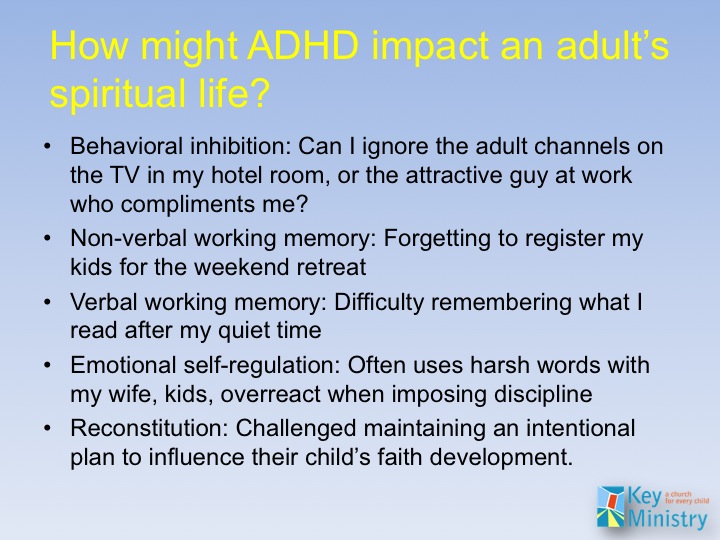


 Kids with weaknesses in nonverbal working memory will evoke great frustration from parents when they make the family late for church by forgetting where they put their Bible as Dad backs out of the garage. They may have a harder time remembering where they’re supposed to go or what they’re supposed to do when they get to church. They might get angry or frustrated when they have a hard time learning the hand movements and gestures that accompany the music at worship time. Kids with ADHD may also have a harder time accessing and remembering experiences of others demonstrating essential Christian attitudes and virtues, and more difficulty modeling such behavior in their daily interactions.
 Kids who struggle with emotional self-regulation will often demonstrate patterns of behavior that represent direct violations of Biblical teaching. They are likely to have a more difficult time maintaining an attitude of respect toward parents and leaders in the church. They’ll want to stay home and watch their favorite TV show instead of going to Sunday School, or have great difficulty ignoring the urge to send Facebook messages when they’re pretending to use the You Version Bible on their cell phones at youth group. In a later post, we’ll go into some depth about the impact of ADHD on spiritual growth, but a lack of capacity for emotional self-regulation will likely have an enormous impact on a person’s ability to make use of spiritual disciplines as well as their capacity to avoid temptation.
 Finally, I’ll share a not so pleasant episode from my practice reflecting a total and complete lack of understanding of kids with ADHD in a local church. A number of years ago, a physician in another state called me to request a consult for the kindergarten-age son of his former pastor. The boy’s father was the pastor of a small-town Baptist church, and he and his wife had felt led, after considerable time and prayer, to adopt a child (my patient). As is often the case in kids available for adoption, this boy met diagnostic criteria for ADHD. Unfortunately, the dad was the physician’s FORMER pastor because his son punched a boy at a church event whose father was chairman of the Elder board. The father was dismissed from his position after the church board arrived at an extremely literal interpretation of







 Church4EveryChild