How to join us for this month’s Inclusion Fusion…

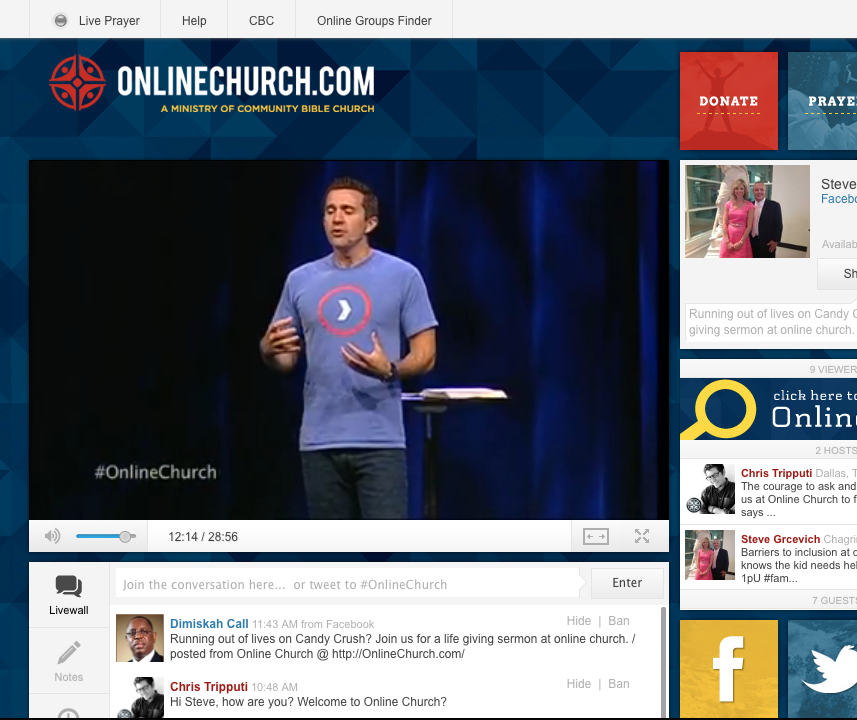
Inclusion Fusion updatedPlease join us on Thursday, March 6 for our first Inclusion Fusion Web Symposium as Nils Smith and I discuss the topic… Is Online Christian Community Really Community. The interview with Nils was prerecorded and will be available every hour on the hour from 7:00 AM Eastern Time on Thursday until midnight Eastern Time on Friday. Nils will be available for an interactive chat from 12:00 PM-2:00 PM Eastern (11:00 AM-1:00 PM Central) and from 9:00 PM-10:00 PM Eastern (8:00 PM Central, 6:00 PM Pacific). We’re going to be talking about his experiences as an online church pastor, and initiating a lively discussion about how online church campuses might be used as a tool for local churches to reach out into their local communities to make connections with families impacted by disabilities.

We’ve made some changes to make it as easy as possible for pastors, church staff, volunteers and families to join us for Inclusion Fusion…

No preregistration is required! Simply click on this link, or head over to http://go.mediasocial.tv/keyministry

Once you’re on our site, you can update your Facebook status and invite your friends who might be interested in joining our conversation without ever leaving the site…it’s that easy!

578524_10151266419728410_502320352_nWe’re very blessed to have Nils join us for this conversation! He truly is among the world’s leading experts in online church experiences. His wisdom and expertise is sought out by churches nearly everyone would recognize, and his experience in serving Life Without Limbs affords him a unique perspective on the application of technology in disability ministry.

Please join us on Thursday, March 6 for a preview of our Inclusion Fusion Web Symposium and a thought-provoking discussion with Nils Smith!

Posted in Inclusion Fusion, Key Ministry, Resources, Strategies, Training Events | Tagged , , , , , , , , | Leave a comment

Kids don’t want to be seen as “different”

shutterstock_81693892Following a brief interlude, we offer the sixth segment of our Winter 2014 blog series Including Kids and Teens With Mental Illness at Church, examining the challenge presented by the propensity of kids and teens to reject help that (in their minds) increases the risk they’ll be perceived differently by their peers.

Stigma is a very real concern for children and teens diagnosed with mental illness. Research demonstrates that kids between the ages of 8-18 are more likely to distance themselves socially from a peer with either depression or ADHD and perceive peers with those conditions as more likely to engage in antisocial or violent behavior. Kids are more likely to attribute depression or ADHD in peers to a lack of effort, poor parenting or substance use. We also know that kids who are perceived as different by their peers are more likely to be victims of bullying, especially kids with more subtle signs of disability.

In my practice, this concern often plays out when kids are in need of special education services or accommodations related to a learning disorder or mental health condition. It’s very common for kids who might benefit from small group instruction or testing accommodations to refuse potentially helpful supports because of their concern for the opinions of their peers.

What do we have to offer kids with significant mental health conditions and their families who could benefit from disability inclusion when they come to church? We have BUDDIES. We have stand-alone classrooms and programming for kids with significant developmental disabilities. We have Young Life Capernaum for teens and young adults with intellectual disabilities. I can’t think of many things that make a child with anxiety more uncomfortable than being singled out for special attention or treatment. Our standard disability ministry programming is likely to reinforce the propensity of kids with mental illness to self-stigmatize…if their families see any benefit from disability ministry programming in general.

The best possible solutions for including kids with mental illness at church would include those offering potential benefits to all children and families without drawing attention to any particular child, those that help kids to prepare privately for participation in church activities outside the scrutiny of peers and solutions that offer necessary supports without requiring children or families to self-identify in order to receive help.

Next: When kids have parents with mental illness

***********************************************************************************************************

Emotional girlConfused about all the changes in diagnostic terminology for kids with mental heath disorders? Key Ministry has a resource page summarizing our recent blog series examining the impact of the DSM-5 on kidsClick this link for summary articles describing the changes in diagnostic criteria for conditions common among children and teens, along with links to other helpful resources!

Posted in Families, Hidden Disabilities, Inclusion, Key Ministry, Mental Health, Ministry Environments | Tagged , , , , , , , , | 1 Comment

Experiencing Genuine Community Online…Nils Smith

578524_10151266419728410_502320352_nNils Smith has graciously agreed to share with our readers today on the blog and to serve as our guest for March’s Inclusion Fusion Disability Ministry Web Symposium. Nils is the Web Pastor at Community Bible Church in San Antonio, TX and author of The Social Media Guide for Ministry., available through Group Publishing and in both hard copy and e-book for the Kindle at Amazon. Today, Nils shares on the topic Experiencing Genuine Community Online

Have you ever felt like trying to build community online isn’t real community? That virtual friends aren’t real friends? Maybe you are even completely resolved that the only way to have genuine community is face-to-face. Today I want to encourage you that your online relationships can be just as full, deep and meaningful as your face-to-face relationships. Our world is moving online and instead of trying to fight that inevitable shift, what we should instead focus on is how can we build the relationships we want in our lives, both online and in person.

Here are 5 tips to how you can experience genuine community online through social media (and you will probably find these will be helpful in your face-to-face relationships as well):

1)   Focus on one network at a time- many people decide to get online and they jump on Facebook, Twitter, LinkedIn, YouTube, Instagram, Vine, and on and on.  They spend so much time setting up accounts that they never actually connect with anyone.  Choose one platform to focus on building relationships and then expand from there, as you are comfortable.  Don’t try and build relationships everywhere!

2)   Spend more time actively listening– too many people get online to voice their opinions, promote their business, and communicate their message.  Genuine community has two directions and we all need to spend more time listening than we do speaking.  When you do talk let it be more commenting and liking other people’s posts than writing your own.

3)   Be yourself– too many people try to be something they aren’t online.  They post pictures from ten years ago and communicate much different than they do face to face.

4)   Manage your time– Do you find yourself losing hours online or never getting online?  Commit to getting online consistently and set limits to how long you will be on.  It’s okay to get lost in community at times, but it’s not okay to spend all of your time online and disconnect from your face-to-face relationship and responsibilities.

5)   Share what’s important to you– if it’s important to you it will likely be important to those who care about you.  Share your personal highlights, favorite places, inspiring articles/videos, funny moments, etc.  You don’t have to share everything, but you should share some things.

Now that I think about it, this same list applies to our face-to-face relationships too.  Maybe they’re not so different, we’re just more familiar with one than we are with the other.  What do you think?

Community Bible Church in San Antonio is one of the largest and fastest growing churches in the United States.  As Web Pastor, Nils Smith oversees CBC’s web presence including CommunityBible.com, CBC’s mobile app, Online Church, and all future online ministry initiatives.  He launched the ministry of Online Church reaching over 35,000 people each week from more than 400 different cities around the world.  Online Church offers online worship services in both English and Spanish as well as Online LifeGroups and has a growing Facebook Community of over 420,000 people.

In addition to Nils’ ministry at CBC, he serves as a consultant to Life Without Limbs, helping to expand the online presence of the ministry of Nick Vujicic. Nils has also been serving as a consultant to Key Ministry since last Fall, advising our Board and staff on applications of social media and online technology to ministry with families impacted by disability.

***********************************************************************************************************

Social Media Guide to MinistryIn his book, Social Media Guide For Ministry, Nils Smith presents an excellent overview of applications for social media in ministry. Nils’ book is an excellent resource for church or parachurch teams and Board members considering social media as a tool for expanding the impact of their ministry. It’s an easy read in an hour or less and provides just the right amount of information most leaders need to move forward. Available through Group Publishing and at Amazon.
Posted in Key Ministry, Strategies | Tagged , , , , , , , | 1 Comment

What Perry Noble’s admission says about mental illness, stigma and church

Perry NoblePerry Noble is a very influential pastor of a rapidly growing, multisite church (New Spring) based in Greenville, South Carolina and frequently serves as a featured speaker at major conferences attended by thousands of pastors across the U.S. and beyond. I’ve had the opportunity to hear him speak live…he’s very charismatic and an excellent communicator.

Over the last two years, Perry has become more open in speaking about his personal experiences with depression and anxiety. He has a book coming out in April with the title Overwhelmed: Winning the War against WorryHe had some very interesting comments in his blog post this past Monday on the topic of Christians, medication and mental illness. In the post, he describes his experiences while writing the book…

However, as I began the writing process the feelings of anxiety and worry began to slowly slither back into my life like a snake sneaking up on it’s prey. I remember writing a chapter in the book, driving home and having a panic attack in my living room.

About three days later I took my daughter to a restaurant for lunch and found myself feeling like I could not breathe and that the walls were closing in on me.

What was going on?

I thought I was done with this, that I had whipped it and that I was going to be able to tell my story and inspire other people to do the same.

But…that wasn’t the case. Anxiety was a fight, and I was losing.

I called my doctor and we had a long talk about my options. He spoke to me honestly and openly about anti-depressants. When he first mentioned them I blew him off; after all, I had defeated this one time without the “drugs for weaklings” and figured I could do it again.

However, the anxiety in my life continued to increase to such an extent that I distinctly remember calling him one afternoon and telling him I could not take it anymore and that I needed something to help me.

I can honestly say that making the decision to take an anti-depressant during this time period in my life has been one of THE BEST decisions I have ever made. It really has clarified my thinking, made me way less of an emotional basket case and allowed me to make better decisions.

What’s fascinating (from a psychiatrist’s perspective) about Perry’s experiences is the progression he went through over a period of years in his attitudes regarding mental illness and what they may have to say about levels of stigma in the church related to mental health treatment.

Perry went from believing that mental illness resulted from a lack of faith until his own personal experiences with depression and suicidal thinking. He responded to an intensive course of Biblical counseling. He and his personal physician gave serious consideration to a trial of antidepressant medication, which he declined. Perry spoke of this in his blog post…

I secretly held this as a badge of honor, that I was somehow a better person because “I did not need medication” to defeat depression!

Perry was able to change his perceptions about the cause of mental illness and gain insight as to God’s purposes in allowing people to experience depression. He was able to get up onstage in front of thousands at his church and speak of his personal experiences as an abuse victim and as someone who struggled with depression and suicidal thoughts. He was comfortable enough with his experiences to sign a book contract in which he would share his experiences with the entire world. But the LAST stigma he ultimately overcame was the attitude he had toward using medication as a treatment for his condition. Where in the world did so many people in the church develop twisted and distorted ideas about the causes and treatment of mental illness that aren’t based on anything in Scripture?

We in the church frequently communicate powerful attitudes in subtle ways. One morning, I was being gently admonished by my former pastor for some things I had said through social media. One of the ideas he shared was that while he personally held some very strong positions on the moral issues of the day, he was aware of the near statistical certainty that among those present at any worship service there were many who were still dealing with intense emotions related to the choices they had made. He was very conscious of not wanting to say anything with the potential of distracting from the message of the grace God makes available through faith as a result of the death and resurrection of His Son, Jesus Christ. We need to demonstrate a similar sensitivity when speaking at church about people who struggle with significant manifestations of mental illness.

I’m very much looking forward to how Perry’s upcoming book may help advance the discussion.

Here’s the video of Perry’s message from February 2012 in which he discusses his own experience with mental illness…

***********************************************************************************************************

Anxious kidKey Ministry has developed a resource page on the topic of anxiety and spiritual development in children and teens. We share tools to help parents and church leaders recognize signs and symptoms of anxiety disorders in youth, examine the challenges anxiety disorders present to families in establishing and maintaining active engagement at church, review the research on effective treatment strategies and share lots of helpful research links. Click here to check it out today!

Posted in Anxiety Disorders, Depression, Key Ministry, Stories | Tagged , , , , , , , , | 3 Comments

One Family’s Journey in the Bible Belt…guest post from Stephanie Prosser

pic for blogA couple of weeks ago, I had the opportunity to speak with with Stephanie Prosser and Sara Collins of Reach For A Difference in Abilene, TX. Reach for a Difference exists to support individual, family & community actions to address identified needs and issues of persons with autism spectrum disorders and other developmental delays in the West Central Texas area surrounding Abilene. Stephanie and Sara had contacted us because they were working with the West Central Texas Council of Governments and the Texas Council for Developmental Disabilities on a program to help those with special needs and their families find an inclusive church home, and to encourage faith based organizations to promote inclusion.

This past Tuesday (the day after we offered a training in Northeast Ohio attended by representatives of eleven different churches), Stephanie’s organization offered a symposium titled Bridging the Gap to link families impacted by disabilities and faith-based organizations in Abilene.  The event was considered a “great success” because of the large turnout.  But in contrast to our event this past Monday, the turnout in Abilene was “all disability organizations and little to no churches.”

Stephanie offered to share her family’s story with our readers. It serves as a stark reminder that while great strides are being made in opening more churches to families of kids with special medical, behavioral, emotional and developmental needs, there continue to be cities of substantial size here in the U.S. where families impacted by disability have nowhere to go on Sunday mornings if they wish to worship as a family. Here’s Stephanie…

It’s a weird world this Autism world that our little family has now embraced as our own!

As Christian parents we know the importance of spirituality in our lives, of connection and of growth. As autism parents we also know the importance of safety, patience, routine, and experimentation. My husband (Timothy) is 37 and has only in the past two years found out that he is on the spectrum, along with our four year old son, Sebastian. We discovered Timothy’s diagnosis through genetic testing while going through the process of finding our son’s diagnosis. This new information explained a lot while leaving much needing to be explained. It gave us answers without solutions, opened many doors to us, and seemed to close just as many. It was an unknown world in which the only thing we knew for certain was that it was going to affect many things in our lives, and we were going to have to make many changes.

We have always been connected to the church somehow through our entire lives. My parents were routine churchgoers, my father studied ministry, and my mother served in various departments in the church. My husband’s parents are missionaries, both as preachers and evangelists. My husband went to Christ of the Nations Bible College and received his degree in ministry. He then went on to work on his church’s production team.

On my end while growing up, my family had grown apart from the church and I stepped away for some time, but like Joseph I made my way back for my prodigal return. When my husband and I became a couple one of the things we most enjoyed together was attending service. His faith and obedience to the Lord was what attracted me to him when we first met, and still does!

It was exciting doing church together as a new couple, laying a foundation for our marriage, and growing close to God and each other. We had a few glitches in first finding a church home, but in the end we found our niche, and had found a church family to call our own.

After a year, we were pregnant and that imposed some stress on our church life. It’s so much easier to hit the snooze button than to try to button up your jeans and waddle into a room full of uncomfortable pews while eight months pregnant! After Sebastian was born, we’d drag him into church with 40 pounds of baby gear, including my breast pump and I’d spend most of my time in the seclusion of the wet nursery feeding my child and listening to the sermon through the overhead intercom. My husband and I missed one another in that environment, getting to share Jesus together. We were young but we were exhausted. Going to church was becoming a chore, and we were ready for Sebastian to grow up just enough to go into the regular nursery so we could be reunited!

Well, our son grew up, but our idea of being together in a church service was slowly being pushed out of the window. As my son grew from baby to toddler he became harder to please and was more work for the church volunteers. He was prone to crying or screaming, and didn’t have any interest in the activities the other kids were doing. He was clingy and hard to drop off. We couldn’t get through more than a few minutes of service before my husband and I became tag team babysitters. We never enjoyed a service together. I began resenting the process of going to church.

We struggled to get to church on time, and opted for separate cars, in lieu of arguing the whole way to the chapel. We’d get frustrated with our son for not being more like the other kids. We would get frustrated at one another for not listening well enough to tell the other what happened while they were gone! We’d get frustrated at the church staff for the minute reasons we were being paged over and over again. Our son was throwing tantrums and we were throwing tantrums right there beside him! It became too much for us, so we began to “church shop” for the holy grail of churches in our community that would be able to care for our son and allow us to get through a solid service! We figured it shouldn’t be that hard. We were familiar with people in many churches and were a part of church circles. We live in the Bible Belt and Abilene is the church capital of our State and possibly the nation. Finding a place to go to church should not be an issue…and it wasn’t! Finding a place to stay WAS.

We were getting similar results in all of the churches we went to. So we began to settle for churches that didn’t really meet our spiritual needs but met our son’s needs. We found a very small church two minutes away from our home. It’s population was largely adults over the age of 60 and there were very few (if any) kids on Sunday. The classrooms weren’t very well-decorated or furnished, the atmosphere was quiet and the children’s areas were well-staffed. It was perfect for Sebastian and not so great for us. We were missing the connection.

But all things happen for a reason and work for good for those who love Christ Jesus! At this little church, my son was able to get through a service in the children’s church and that made us happy. Sebastian loved to go, and would even ask to go on weekdays. He began to pester us about church! “When is it church time?” was the song that played like a broken record from my kid’s lips, over and over. It was easy to find solace in that for a while because as a mother, one of the things that I want to ensure most is that my child is raised around a spiritual atmosphere. He will need those roots as he grows older and steps out into adulthood. I want him to have that foundational opportunity and experience. So his enthusiasm became my enthusiasm!

It ended up being a very fleeting form of enthusiasm. As we just “attended” church successfully, I could tell our spirits were dwindling. The more my husband steps away from church the more “lost” he appears in his eyes and in his decision making and I became more fearful and woeful. This is not a state I like to be in, and through some of the complacency haze I could see that we were going the easy route via our new excuse- “autism”. We both longed for more and wanted more for our family. This posed a new question-How? How are we going to do this? In the back of my mind I thought to myself, “Please do not let this be a series of bad experiences for my child.” I don’t want to see him hurt, and I definitely do not want to see his attitude change toward going to church!

Around that time we had the privilege of getting away via an out of town car trip to film  as our friend Pastor Brandon become consecrated as a bishop. We stayed the weekend and were visitors at his church service and in his home. Church went wonderfully. The volunteers were very open to hearing about and adapting for our son’s disability. Their attitudes towards us were glowing and their compassion for my son was genuine. After dining with the bishop and gleaning some of his wisdom, we vowed to return to an old church that we had loved but where Sebastian had a difficult time.

There are many things that went into us returning to one of the churches we had attended for some time. Sebastian was now older and had gone through a year of extensive therapy (speech, behavioral, occupational, physical, and food therapies). He was also enrolled in a special education program at school and had adjusted to the classroom experience. The church had changed. Volunteers and the new leaders were familiar with the special needs world; there were other autistic children in Children’s church and Sebastian is high-functioning. His needs aren’t as great or his behavior as disruptive as other children. We had some plusses on our side in attending. We had also changed. We were more familiar with our son’s disability and what made him tick. We were more vocal about his needs, and more able to help instead of “babysitting”. We opened up communication, allowing us and the church to work together. We had grown and while we were gone, the church had too!

This was a perfect return for us, but not without snags. Sebastian has left church several times injured. Not a new thing for us. He’s clumsy and accident-prone. Probably not new to the church, but I could see the fear in the eyes of the volunteers as they hand over our injured boy! It’s a process. We are all learning and growing through the experience. Growth is always a good thing!

While going through the process of learning, accepting, and embracing my child’s disability, I became an advocate and leader of a local non-profit called REACH for a Difference, The Autism Spectrum Partnership Network here in Abilene. We connect persons on the spectrum and their families with resources in the community and create programs to fill in the gaps where families’ needs are not being met. We are currently working with another disability organization in Abilene on a program to promote inclusion in our area churches. We are “Bridging the Gap” between those with disabilities and our local faith based organizations. Our program promotes education, awareness, inclusion, and the empowerment of people with disabilities within the church. We want to see people with disabilities not only be able to attend church, but to plug in and grow. We want to see friendships built, communication paths opened, people serving, and people finding a home away from home. I have met many families through this program with experiences similar to mine and many more who have been asked to leave a church or turned away from a church because of their disability. We have made it our mission help build the necessary bridge that it will take so that no one is turned away from the church and ultimately away from God.

I was ecstatic to discover Key Ministry! I am excited that there is a program already in existence doing this great work and thankful to them for taking the time to Skype with our organization. With the information they gave us and the great example Key Ministry has set, I know that we can be a success story as well!

***********************************************************************************************************

Square Peg Round HoleKey Ministry has assembled a helpful resource on the topic of Asperger’s Disorder and Spiritual Development. This page includes the blog series Dr. Grcevich and Mike Woods developed for Key Ministry, links to lots of helpful resources from other like-minded organizations, and Dr. Grcevich’s presentation on the topic from the 2012 Children’s Ministry Web Summit. Click here to access the page!

Posted in Advocacy, Autism, Families, Inclusion, Key Ministry, Stories | Tagged , , , , , , , , , | 4 Comments

A great night at Parkside Church!

IMG_0497 - Version 2A great big thank you is in order for Carolyn Arny and her team at the Parkside Church-Green Campus for putting together a wonderful training event last night! Thanks to the efforts of Carolyn and her team, we had approximately 75 attendees for our training last night on Helping Kids With Hidden Disabilities, representing eleven churches from five different Northeast Ohio counties…Lorain, Cuyahoga, Geauga, Stark and Summit.

Chief Mum 2A special thank you also goes out to Carrie Lupoli, putting in a strong bid for Key Ministry’s “Rookie of the Year” award in translating her work as a special educator for Teach For America to the challenges church staff and volunteers encounter when including kids with disabilities in ministry environments.

photo

For those who weren’t able to attend last night, here are the slides from our presentation… including a number of slides examining challenges for kids with hidden disabilities related to spiritual development to supplement the materials we covered.

I came away from our time last night impressed with the need for church leaders seeking to serve families impacted by disability to have someone to whom they can turn for practical advice and support when they experience challenges related to inclusion. It’s my hope that those serving in the field will feel confident turning to Key Ministry for that advice and support.

***********************************************************************************************************

cropped-key-ministry-door.pngOur Key Ministry website is a resource through which church staff, volunteers, family members and caregivers can register for upcoming training events, request access to our library of downloadable ministry resources, contact our staff with training or consultation requests, access the content of our official ministry blog, or contribute their time, talent and treasure to the expansion of God’s Kingdom through the work of Key Ministry. In addition to our downloadable resources, those who register for our resource kit can view any presentation from our Inclusion Fusion Disability Ministry Web Summits “on-demand”. All of these resources are made available free of charge. Check out our website today!

Posted in Hidden Disabilities, Inclusion, Key Ministry, Resources, Spiritual Development | Tagged , , , , , , , , | Leave a comment

Updated…Why your kid’s Concerta hasn’t been working lately

shutterstock_68372575_2Editor’s Notes: The FDA announced plans to rescind the approval of generic versions of Concerta manufactured by Kremers Urban Pharmaceuticals and Mallinckrodt Pharmaceuticals. The drug companies have until mid-November to file a request for a hearing to appeal the decision. Thanks to all of our readers who contacted the FDA to share their experiences with these products.

Below is our original post explaining why the two most recent versions of generic Concerta are less effective than the original product and the generic version sold by Actavis Pharmaceuticals.

I’d ask our regular blog readers to allow me to digress today while I share about a medication issue that is greatly impacting many of the kids and families we serve.

ConcertaConcerta is the most commonly prescribed medication to teens in the United States. When  the product first hit the market in 2000, it revolutionized the treatment of ADHD because Concerta offered the first truly effective method for prolonging the effects of methylphenidate (the active ingredient in Ritalin and many other stimulant preparations) so that kids no longer needed to go to the principal’s office or nurses’ office in the middle of the school day. When Adderall XR followed in 2001 and Strattera in 2002, a vast increase ensued in the number of children and teens identified with and treated for ADHD. Out of the roughly 25 medications approved for ADHD, Concerta remained very popular because of the consistency of its’ effects throughout the school day into the time immediately following school. It is widely used in teenagers because of its’ beneficial effects on driving performance.

A basic principle in understanding how extended-release stimulant products work is that the manner in which the drug is released into the body (the drug delivery system) has profound effects on the pharmacodynamics (the observed benefits/response to the drug). We have quite a number of approved medications for ADHD in which methylphenidate is the active ingredient. In addition to Concerta, Ritalin LA, Metadate CD, Daytrana, Quillivant and Focalin XR are all extended-release methylphenidate products. The effects of the medication at specific times throughout the day result from the differences in how the medication is released and absorbed into the body with each unique delivery system, and form the basis of how we decide which product we choose for an individual child. Allow me to illustrate…

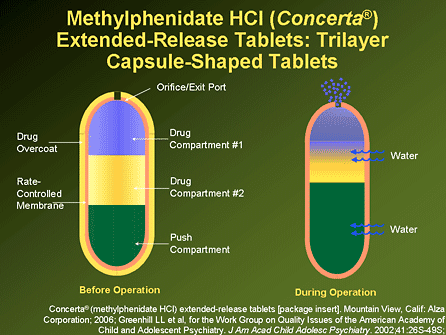
Concerta utilizes something called the OROS delivery system (see featured picture at the top of this blog post) to release methylphenidate into the body. It was developed by a team of scientists in California who observed a phenomena referred to as “tachyphylaxis” with earlier attempts to develop long-acting methylphenidate-based stimulants. Essentially, people taking stimulants develop some degree of tolerance to the drug acutely in response to an individual dose. While the absolute level of the drug in someone’s system matters, whether the blood level is rising or falling also matters, since a rising blood level contributes to the ability of a stimulant to sustain beneficial effects over the course of a school or work day.

Concerta was designed to release an initial dose of stimulant within the first two hours of ingestion…22% of the active drug is contained within the coating of the pill. After this overcoat dissolves, a laser-drilled hole in the end of pill is uncovered. As the pill passes through the stomach and the gastrointestinal track, water taken up into the pill results in changes in internal pressure that leads to a “pulse release” of small amounts of medication as it passes through the gut. The effects of Concerta were tested in a laboratory classroom setting, in which raters blinded to whether kids received active drug or placebo scored the observable behavior of kids throughout a twelve hour day, and an age-appropriate mini-math test (PERMP) was administered at intervals throughout the day to measure the effects of medication on cognitive performance. The results are pictured below. A significant benefit of Concerta is the consistency of improvement in cognitive performance throughout the day.

OROS Lab Classroom

In contrast, Focalin XR utilizes a “beaded” delivery system to release methylphenidate into the body. Focalin XR is a capsule containing two types of beads. The outer coating of the capsule dissolves very quickly (within ten minutes) upon ingestion. 50% of the beads inside Focalin XR release almost immediately after the coating of the outer capsule dissolve, while another 50% have a different coating designed to dissolve approximately four hours after the capsule is swallowed. One advantage of Focalin XR is that parents can crack open the capsule and sprinkle the contents in yogurt or applesauce when kids can’t swallow pills, whereas Concerta won’t work if the pill isn’t swallowed intact. Another advantage with 50% of the medication released immediately is that the medication kicks in very quickly in the morning with demonstrable benefits at 30 minutes (see below). In practice, Focalin XR has a pronounced peak effect in late morning and is very effective for most kids throughout the school day. At the same time, the cognitive effects of the drug fall off much more quickly during the latter part of the day compared to Concerta, and drug company marketing claims aside, I find in my patients that Focalin XR is a good choice for kids who need medication to cover the duration of their school day, but not much longer.

Focalin XR Lab Classroom

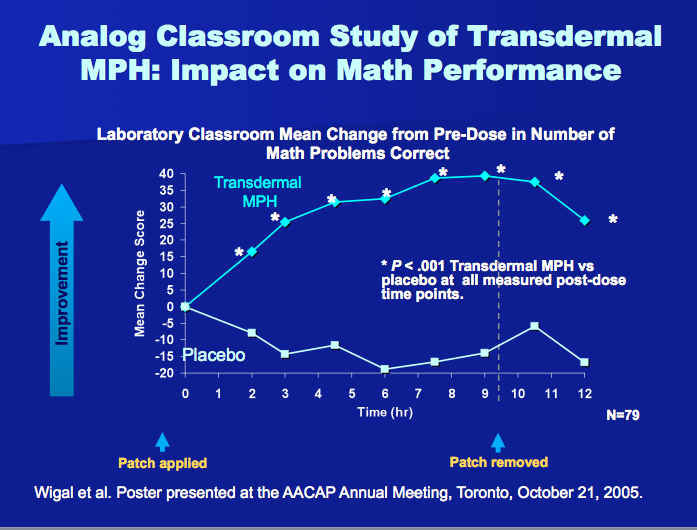
Daytrana is a patch worn on the hip in which methylphenidate is absorbed through the skin as a result of an osmotic gradient…the difference in the concentration of methylphenidate in the patch vs. the difference in the concentration of methylphenidate in the capillaries supplying blood to the skin. A unique benefit of Daytrana is that it will last longer than any of the other stimulant products on the market…it was originally developed to be a 16-18 hour drug. Because the testing required for approval by the FDA examined the effects of the product over a twelve hour period, the company that manufactures Daytrana isn’t permitted to share that information with prescribers. The cognitive effects of Daytrana also peak later in the day than with other products (see below), making Daytrana very helpful for many kids who struggle with homework after school. Comparing the laboratory classroom studies of Daytrana to Concerta and Focalin XR, an obvious downside to Daytrana is that it doesn’t work as well during the first half of the school day. Many parents resort to either putting the patch on their child very early in the morning while they’re still sleeping to overcome this effect, or give their child a small dose of immediate-release methylphenidate (Ritalin or immediate-release Focalin) when they first put the patch on in the morning.

Daytrana Lab Classroom

My point is that what makes Concerta work like Concerta is the OROS delivery system. The same drug (methylphenidate) released through a different delivery system produces a VERY different response.

The arrival of generic Concerta was delayed for a number of reasons…the makers of Concerta fought the lawsuits of the generic manufacturers aggressively, and pursued a legal strategy involving what’s referred to as a “Citizen’s Petition” requiring generic companies seeking to copy Concerta to demonstrate a similar pattern of ascending blood levels throughout the day. Because Johnson & Johnson (the parent company that owned the rights to Concerta) owned the patent on the OROS release system, companies seeking to make a generic version had to do so with a different delivery system.

Concerta 27Concerta 18Ultimately, Watson Pharmaceuticals (subsequently acquired by Actavis) was approved to manufacture a generic equivalent of Concerta. As often occurs in these situations, the lawyers for Johnson & Johnson  and Watson worked out a deal to avoid years of legal battles in Concerta 54Concerta 36which J & J would continue to manufacture Concerta through their Alza subsidiary that Watson would sell at a discount as an “authorized generic,” with the two companies splitting the profits. The brand Concerta and the Activis version of Concerta are equivalent…they are manufactured in the same factory, using the same equipment and the same drug delivery system as in the original Concerta. Pictures of the “authorized generic” using the OROS system are shown above:

The last two versions of versions of generic Concerta (manufactured by Mallinkcrodt and by Kremers Urban) each use very different drug delivery systems (release mechanisms) in an effort to replicate the therapeutic effect of Concerta.

M54 M36 M27In the case of the Mallinkcrodt product (pictured at right), an overcoat containing immediate-release methylphenidate that dissolves within the first hour after ingestion. The core of the pill contains a diffusion-controlling membrane that releases methylphenidate as water in the gastrointestinal tract passes through the membrane. The membrane is designed to release methylphenidate over a period of time roughly corresponding to the release period resulting from the OROS delivery system in Concerta.

KU 27KU 18The Kremers Urban generic (pictured at right) uses an extended-release bead technology to release methylphenidate at a controlled rate. The pill resembles a conventional tablet in appearance, featuring an overcoat containing immediate release stimulant that releases during the first hour as the tablet disintegrates and a core of extended-release stimulant beads operating with a similar mechanism as those in Focalin XR.

So, how do these products compare to the original Concerta? We don’t know! Here are links to the FDA-required product information or “labels” for Concerta, the Mallinkcrodt generic version and the Kremers Urban generic version that are being substituted for Concerta. It appears that the FDA allowed the generic manufacturers to “cut and paste” the data from Concerta’s pharmacokinetic studies and clinical trials and present this information as if it represented trials each company conducted with their own unique product. It’s EXTREMELY UNLIKELY that different drug delivery systems would produce EXACTLY the same results in terms of drug metabolism (pharmacokinetics) and drug effects (pharmacodynamics) as the brand name drug.

The absorption of the original Concerta depends to some degree on an individual’s GI transit time…i.e., how long it takes for the pill to pass through the gut. Bead release systems (as in the Kremers Urban version) typically depend upon the acidity of the contents of the stomach at the time the extended-release bolus of medicine is needed. One would anticipate an individual child or teen might absorb significantly more (or less) medicine at different times during the day when two products that on average deliver roughly the same amount of medication over the same time period depend upon different physiologic processes.

When the FDA requires generic companies to do studies demonstrating “equivalency” to a brand medication, the amount of medication taken up into the body (measured by what we refer to as the “area under the curve” or AUC) is required to be within 80-125% of that observed with brand name drug. With some types of medication, that variability makes little difference. With stimulants, small differences in either the rate at which the medicine is absorbed or the time at which the medicine is absorbed make a PROFOUND difference in the benefits or side effects experienced by an individual child or adult. The FDA doesn’t require generic companies to conduct comparison studies showing that the products work as well in practice as the brand name drugs they’re intended to replace. Neither Mallinkcrodt nor Kremers Urban has been required by the FDA to conduct a study showing that their drug works as well in practice as the brand or authorized generic versions of Concerta.

Restating my earlier point, what makes Concerta work like Concerta is the OROS delivery system. The same drug (methylphenidate) released through a different delivery system produces a VERY different response.

In my mind, this is an utter and complete outrage when we’re talking about the most commonly prescribed drug for teenagers in the United States. I’d argue that this is a social justice issue. I’ve now had over ten kids come into my office for follow-up since the first of the year who have reported a significant decline in the effectiveness of their medication in the last couple of months. One nationwide drug store chain began ordering the Kudco product (the version many of my families have found to be less effective…the two main complaints being it doesn’t work as well or last as long as the original) in large quantities several months ago and substituting it for the authorized generic version of Concerta. What put me over the edge was an experience yesterday when I saw a mother and her daughter who reported problems with her medication since the appearance of her pill had changed. I sent them to the drugstore with new prescriptions for the brand Concerta or the authorized generic version. The mother was told by the pharmacy that it was illegal for them to fill the prescription for the original product even though she was willing to pay for the prescription “out of pocket” and that they would call the police if she insisted on having the prescription filled.

I’m at the end of my rope as a result of the administrative hassles involved with getting the kids in my practice the medications and educational support services they need to thrive in school, at home, with their friends and in community activities. I can’t even imagine what life must be like when parents have little money and need to depend upon our systems of care for support.

UPDATE #1: A small, randomized study has been published in Clinical Pediatrics demonstrating the superiority of the “brand” Concerta and generic Concerta using the OROS delivery system marketed by Actavis, compared to the Kudco and Mallinckrodt versions of generic Concerta using non-OROS delivery systems. Here’s the abstract:

Treatment effectiveness between equivalent doses of non-OROS (osmotic controlled release oral delivery system) methylphenidate ER and OROS methylphenidate ER (brand name Concerta) was examined in a clinical case series of children and adolescents followed for treatment of attention-deficit/hyperactivity disorder (ADHD). The Conners-Third Edition: Parent Rating Scale was used to compare ADHD symptoms when patients were taking non-OROS versus OROS at follow-up visits. A repeated-measures mixed-model approach was used to compare treatment effectiveness. The entire sample (N = 14) demonstrated a reduction in the mean score on the Inattention Scale from clinically significant (T-score > 65) to not clinically significant (T-score < 65) when patients were changed from non-OROS to OROS at the same dosage (mean T-score reduction = 23, p < .0001). The reduction in mean T-score after changing from non-OROS to OROS at the same dosage is indicative of improvement in symptoms of ADHD. Results provide empirical support for US Food and Drug Administration concerns regarding the therapeutic equivalence of non-OROS versus OROS for the treatment of ADHD.

UPDATE #2: The FDA did subsequently demand that each company submit additional data demonstrating their products to be equivalent to Concerta. Mallinckrodt did not comply with the request, while data submitted by Kremers Urban was deemed insufficient.

Most recently updated on October 19, 2016

***********************************************************************************************************

ADHD Series LogoKey Ministry has assembled a helpful resource page for church leaders and parents addressing the topic of ADHD and spiritual development. This page includes our blog series on the topic and links to helpful videos and resources for pastors, church staff, volunteers and parents. Access the resource page here.

Posted in ADHD, Controversies, Mental Health | Tagged , , , , , , , | 10 Comments

Introducing Nils Smith…our featured presenter for Inclusion Fusion in March

578524_10151266419728410_502320352_nWe’re honored to have Nils Smith serve as our guest for the first of our monthly Inclusion Fusion Disability Ministry Web Symposia, on Thursday, March 6. Nils will be engaging in a discussion on the topic “Is Online Christian Community Really Community?”

Nils is the Web Pastor at Community Bible Church in San Antonio, TX and author of The Social Media Guide for Ministry., available through Group Publishing and in both hard copy and e-book for the Kindle at Amazon.

CBC is one of the largest and fastest growing churches in the United States.  As Web Pastor, Nils oversees CBC’s web presence including CommunityBible.com, CBC’s mobile app, Online Church, and all future online ministry initiatives.  He launched the ministry of Online Church reaching over 35,000 people each week from more than 400 different cities around the world.  Online Church offers online worship services in both English and Spanish as well as Online LifeGroups and has a growing Facebook Community of over 420,000 people.

Online ChurchIn addition to Nils’ ministry at CBC, he serves as a consultant to Life Without Limbs, helping to expand the online presence of the ministry of Nick Vujicic. Nils has also been serving as a consultant to Key Ministry since last Fall, advising our Board and staff on applications of social media and online technology to ministry with families impacted by disability.

In Nils’ interview, he plans to address a variety of topics, including, but not limited to…

  • How he came to pastor an online church campus.
  • If online church can be “real church?”
  • Concerns that online ministry has the potential for reinforcing the social isolation experienced by many families of kids and teens with disabilities. 
  • Does online ministry compete with more traditional church experiences?
  • His experience with online groups. 
  • Whether people experience spiritual growth online?
  • How people connecting through online church use their gifts and talents in serving others? 
  • Can authentic Christian relationships develop online?
  • How online church campuses could minister to families impacted by disability.
  • How churches may use their existing online resources to minister to families of kids with disabilities.

We’ll be announcing opportunities for all of you to join us online to interact with Nils and share your questions and comments as part of the Web Symposium.

We look forward to you joining us on March 6 for a very thought-provoking discussion with Nils as we relaunch Inclusion Fusion!

***********************************************************************************************************

Social Media Guide to MinistryIn his book, Social Media Guide For Ministry, Nils Smith presents an excellent overview of applications for social media in ministry. Nils’ book is an excellent resource for church or parachurch teams and Board members considering social media as a tool for expanding the impact of their ministry. It’s an easy read in an hour or less and provides just the right amount of information most leaders need to move forward. Available through Group Publishing and at Amazon.

Posted in Inclusion Fusion, Key Ministry, Leadership, Strategies | Tagged , , , , , , | Leave a comment

Barriers to inclusion…What if nobody knows the kid needs help?

shutterstock_49401919In the fifth segment of our Winter 2014 blog series Including Kids and Teens With Mental Illness at Church, we’ll explore the challenges involved in helping families of kids and teens attend regularly when church staff, volunteers, parents and even the kids themselves may not be aware of the presence of conditions that interfere with their ability to thrive in our ministry environments.   

Our existing disability ministries typically do a very good job of meeting the needs of families of children easily identifiable physical disabilities, or obvious weaknesses weaknesses in intellectual capacity or adaptive functioning.  But what happens when the disability isn’t so obvious? What we came to describe early in our ministry as “hidden disabilities?”

It’s not unusual in our practice for us to see kids who struggled for many years in school with specific learning or processing disorders despite being in the daily presence of trained professionals. The vast preponderance of children’s ministry and youth ministry staff and volunteers are serving kids at church without any specialized education or training. After 28 years in my current gig, I’ll read or observe things when I meet a kid that raise red flags for dyslexia, sensory processing difficulties or struggles with social communication. It’s not reasonable to expect folks who volunteer for a few hours a week at church to recognize issues that trained professionals regularly miss.

I’ll share three hypotheses for why kids with hidden disabilities, including mental illnesses and learning disorders don’t get readily available supports to enhance participation at church…

shutterstock_131188397Parents of kids with mental illness or learning disorders may not be aware that their child has a disability. Consider this…based upon readily available statistics (8-12% prevalence of youth of anxiety disorders, less than 20% receive any treatment), we have more kids and teens in the U.S. with clinically significant anxiety disorders that go untreated than we do kids with disabilities involving vision, hearing, cognitive, ambulatory and self-care difficulties added together! Parents with untreated anxiety may not recognize that the struggles their children experience are atypical or treatable.

Parents, pastors, church staff and volunteers may fail to recognize that children may benefit from simple, non-intrusive accommodations or supports at church. They may not recognize that their child’s defiance around attending Sunday School may stem from their fear of being called upon to read in front of their peers resulting from dyslexia or social anxiety. They may not be aware that minor environmental modifications involving color, lighting and sound may enhance the experience of kids who struggle with sensory processing, or kids who struggle with self-regulation when overstimulated. They may simply fail to follow up or inquire when kids disappear from children’s or youth ministry programming without explanation.

Parents may be reluctant to disclose their child’s condition to church staff/volunteers. I’ve heard rumors that some churches can be hotbeds of gossip. That couldn’t possibly be true! Unfortunately, churches all too frequently remain bastions of stigma around mental illness. While we’re making progress on that front thanks to the efforts of many determined church leaders, we need to recognize that many families won’t disclose information about significant mental health conditions because of the attitudes regarding mental illness they’ve encountered at church. Church leaders need to be sensitive when commenting (especially during worship services and in social media) about mental illness because of the way families impacted may perceive such comments.

Here are links to resource pages we developed on the topics of including kids with ADHD, anxiety disorders, Asperger’s Disorder, depression, bipolar disorder, trauma and aggressive behavior at church.

Coming Sunday: Barrier #6. The desire of kids to not be seen as “different”

Posted in Hidden Disabilities, Inclusion, Key Ministry, Ministry Environments, Resources | Tagged , , , , , , , | 1 Comment

Inclusion Fusion returns on March 6…

Inclusion Fusion updatedWe’re baaaack!

In November of 2011 and 2012, Key Ministry put on our first and second Inclusion Fusion Disability Ministry Web Summits. Inclusion Fusion was a worldwide web conference to equip churches to more effectively minister to families of kids with disabilities. It was designed as an opportunity for Christ followers everywhere to come together to share ideas and resources to advance the movement among Christ-honoring churches to serve, welcome and include families of kids with disabilities. Inclusion Fusion was made available free of charge, to ensure the participation of as many church leaders, volunteers and families as possible. Staff transitions made it impossible for us to offer Inclusion Fusion in 2013, but we’re back now…and we’ve made some improvements we think will be helpful to everyone involved.

DSCN7752Here’s what’s different…

In addition to our online Summit in November, Inclusion Fusion will be offered as a monthly disability ministry symposium on the first Thursday of each month with a focus on either one headline speaker or one topic of interest to those involved with the disability ministry movement. Participants will be able to watch the featured presentation(s) throughout the day, and our featured speaker will be available for interactive chat at designated times during the day. Some of the topics we plan to feature during 2014 include…

  • Autism
  • Inclusion of teens with disabilities in youth ministry
  • Including medically fragile kids at church
  • Inclusion of kids with disabilities in Christian schools
  • Web-based strategies for connecting churches and families

In addition, no preregistration will be required for Inclusion Fusion. The technology we’re using is designed to make it as easy as possible for participants to invite their friends, neighbors or pastors through integration with Facebook or Twitter. Discover a new idea you’d like to share? Tell all your friends on Facebook or tweet it to your followers immediately!

Here’s what won’t change with Inclusion Fusion 2.0…

Inclusion Fusion will still be free.

Gillian MarchenkoInclusion Fusion will still seek to provide ideas and content that bring together pastors, church staff, volunteers and families around the cause of fully including persons with disabilities and their families into the life of the local church.

Inclusion Fusion will still be open to anyone with great ideas to share with the disability ministry movement and excellent video presentation skills. You need not have a book deal or excellent connections with everybody on the speaker circuit to have an opportunity here.

Inclusion Fusion will still feature a Web Summit in the fall with 20-30 speakers. Many of the presentations may be ten minutes in length or less (based upon research on web viewing habits), with a handful of longer featured presentations.

On Thursday, we’ll be announcing our speakers for March and April. We don’t think you’ll be disappointed.

***********************************************************************************************************

ADHD Series LogoKey Ministry has assembled a helpful resource page for church leaders and parents addressing the topic of ADHD and spiritual development. This page includes our blog series on the topic and links to helpful videos and resources for pastors, church staff, volunteers and parents. Access the resource page here.

Posted in Key Ministry | Tagged , , , , , , , , | Leave a comment