No Labels…Tying it All Together

This post marks the conclusion of our four part series: No Labels…Should Diagnosis Matter at Church? Today, I’ll toss out a few final thoughts on the table for church staff and volunteers on the utility of diagnostic labels at church.

The New York Times has certainly been a helpful resource in generating content for the blog the past few days. Dr. Gary Greenberg (a clinical psychologist) wrote an op-ed piece today on the controversies around the update of the DSM-V, the manual psychiatrists, therapists, educators and the government use to categorize mental disorders. He raised a couple of points that are relevant to our discussion…

“But as all those Diagnostic and Statistical Manuals have stated clearly in their introductions, while the book seems to name the mental illnesses found in nature, it actually makes “no assumption that each category of mental disorder is a completely discrete entity with absolute boundaries dividing it from other mental disorders or no mental disorder.” And as any psychiatrist involved in the making of the D.S.M. will freely tell you, the disorders listed in the book are not “real diseases,” at least not like measles or hepatitis. Instead, they are useful constructs that capture the ways that people commonly suffer.”

We also need to consider this…

“Psychiatrists would like the book to deserve a more serious take, and thus to be less subject to these embarrassing diagnostic squabbles. But this is going to require them to have what the rest of medicine already possesses: the biochemical markers that allow doctors to sort the staph from the strep, the malignant from the benign. And they don’t have these yet. They aren’t even close. The human brain, after all, may be the most complex object in the universe. And the few markers, the genes and the neural networks, that have been implicated in mental disorders do not map well onto the D.S.M.’s categories.”

One of the challenges of our diagnostic system is that the DSM isn’t really grounded in anything. Our diagnostic system is a set of descriptors and checklists that doesn’t really tell us a whole lot about the underlying causes of the problems presented by the people we serve.

This problem is compounded by the reality that there are too many clinicians who aren’t particularly conscientious about sticking to the criteria as written. A terrific example of this phenomena is the explosion in the number of kids diagnosed with bipolar disorder. As a result, I see lots of kids who are just flat out incorrectly diagnosed, and kids with diagnoses that change frequently over time. You don’t want to base your entire strategy on serving a family upon something that is highly subjective, open to wide interpretation and constantly shifting.

Here’s something else to consider…We see many kids and adults diagnosed with specific disorders who begin to derive part of their identity from their diagnosis. This phenomena has been discussed during the debate about whether Asperger’s Disorder should be eliminated as a stand-alone condition separate and apart from autism. Shouldn’t our identity at church (and everywhere else) be defined by who we are in Christ as opposed to  the diagnostic labels employed to serve us?

One last thought that may have crossed your mind in reading this series. In the “Let he who is without sin cast the first stone” department, you may have wondered why the guy who is criticizing church folks for getting hung up on diagnosis has a resource center link on ADHD and Spiritual Development. Just a wee bit hypocritical, don’t you think?

Ultimately, what we’re all about is helping churches reach families affected by disabilities. We have lots of parents who are also pastors or church staff members who discover our resources on the Web by entering search terms like “anxiety” “ADHD” “Bipolar Disorder” “Church” or “Special Needs.” We’re simply trying to disseminate our resources to as many churches as can use them. Parents who search for resources by googling their child’s diagnosis (because the diagnosis has meaning to them) will often forward our info to church staff or volunteers.

Bottom line…We can minister effectively to kids with disabilities and their families without requiring knowledge of diagnoses that may or may not be accurate or by defining children and their adults by their disability as opposed to by who they are in God’s Kingdom.

Posted in Controversies, Inclusion, Key Ministry, Strategies | Tagged , , , , , , , , | Leave a comment

Ritalin Gone Wrong? What’s a Parent to Believe?

IMG_0905I’m postponing the scheduled conclusion of our series on diagnosis until Tuesday to address the commentary from L. Alan Sroufe in the New York Times, Ritalin Gone Wrong.

Because the folks in the media who produce the vast majority of news content consumed in the U.S. will have read this piece over breakfast this morning, the claims raised in this article will be widely circulated. Some of Dr. Sroufe’s statements I agree with. But many of his assertions are misleading or inaccurate. Here’s what he got right…

We don’t have long-term controlled studies demonstrating continued effectiveness of stimulant medication for ADHD over many years. This is true. But the absence of long-term studies demonstrating that short-term benefits of ADHD medication are maintained doesn’t mean that long-term benefits don’t exist for many patients. The methodology involved in conducting such studies is extremely challenging and extremely expensive. You can’t keep kids in a randomized study for years on end because families want to be able to choose alternative treatments if their child isn’t making as much progress as is desired. Parents divorce, families move, kids are lost to follow-up.

Problems with attention, self-regulation and behavior can be caused by factors present prior to, during and after birth. In my mind, there’s no doubt that trauma, chaotic stress and early experience contribute to the development of symptoms that can be characterized as ADHD. I worked for a number of years in a large, inner-city children’s mental health clinic. I can personally attest that kids exposed to trauma in homes I referred to as “psychosocial train wrecks” experienced a quantitatively and qualitatively different response to ADHD medication than kids from my suburban private practice.

There will never be a single solution for all kids with learning or behavioral problems. More complex solutions than medication are necessary for most kids we see. Kids need loving parents who provide consistent discipline and safe, supportive living environments. They need schools flexible enough to address their unique learning styles and needs. They need positive role models and relationships outside their extended families. Unfortunately, doctors can’t fix all of that and are left to address what we can.

Here’s where I’d question Dr. Sroufe’s statements…

The drugs can also have serious side effects, including stunting growth.” Here’s what the American Academy of Pediatrics had to say about this topic in their Clinical Practice Guidelines for ADHD (updated this past October):

The results of the Multimodal Therapy of ADHD (MTA) study revealed a more persistent effect of stimulants on decreasing growth velocity than have most previous studies, particularly when children were on higher and more consistently administered doses. The effects diminished by the third year of treatment, but no compensatory rebound effects were found. However, diminished growth was in the range of 1 to 2 cm. (0.4-0.8 inches)

Unless your kid is entering the NBA draft, I’m hard-pressed to see how a difference in their ultimate stature of a half-inch can be construed as a “serious” side effect. We don’t have to do blood tests for kids on ADHD medication, nor do we have to check EKG tests. The first randomized study of stimulant medication for what we now know refer to as ADHD was published 79 years ago. Given that 9.5% of the school-age population in the U.S. has received at least one prescription for ADHD medication (predominantly stimulants) and millions have taken medication for years, it’s rather hard to believe there are serious side effects that we wouldn’t yet be aware of.
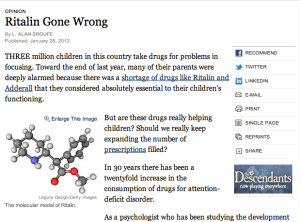
Ritalin Gone WrongThe effects of stimulants on children with attention problems fade after prolonged use.” There’s simply no evidence to support Dr. Sroufe’s claim.

The study that Dr. Sroufe references throughout his opinion piece is the MTA study. Here’s a summary of the study design and results of the MTA from the National Institute of Mental Health (funders of the study) and a link to the paper examining eight year follow-up data of kids enrolled in the study.

His conclusions are based upon a long-term study in which relatively few kids remained on medication throughout the study. From the MTA:

Across time, 17.2% (70/406) of the children were medicated at every assessment beginning with 14-month reports, 20.4% (83/406) were not medicated at any of these assessments, and 62.3% (253/406) were medicated at least once but not every time. Of the total pool of children medicated at 14 months (n = 257), 61.5% (158) had stopped medication some time after 14 months and were not medicated at the 8-year follow-up.

The challenge we see as clinicians over time is that kids often stop taking their medication during the tween or early teen years because of the continued effects of the drugs. From the MTA study:

At 8 years, only 32.5% (132/406 with complete medication data) were medicated over 50% of days in the past year (versus 63.3% or 257/406 at 14 months). Treatment was still predominantly with stimulants (83%) or stimulants plus nonstimulant treatment (8%) with few reporting nonstimulant treatments alone (9%);

In a five-year follow-up study of kids prescribed stimulants at Toronto’s Hospital for Sick Children, only 36% of kids continued to take medication by the end of the study period. The conclusion of the authors:

Psychostimulants improve ADHD symptoms for up to 5 years, but adverse effects persist.

shutterstock_409637815They apparently develop a tolerance to the drug, and thus its efficacy “disappears.” There is no evidence that large numbers of kids develop tolerance to the effects of stimulants. I’ve seen a few older kids who had been misusing stimulants by dosing their medication in such a manner as to achieve around the clock effects develop tolerance to the beneficial effects. It’s also possible that some individuals on long-acting stimulants may develop some transient reduction in benefit from accumulating the drug in their system. Most patients who notice such an effect also notice the return of a robust response to medication if they don’t take their medication for a day or two.

Dose increases over time in kids who continued on medication certainly weren’t striking in the MTA study, considering that the average age of participants when the study began was 8.5, and 16.8 at the end:

Average total daily dose of those taking stimulants at both assessments was 43.36 mg (SD 24.33) at 8 years and 30.68 mg (SD 13.94) at 14 months. Thus, stimulant medication at 8 years more often reflected continued treatment, with increased dosage, rather than newly initiated medication.

Kids occasionally need increases in medication dose as they get older, but in my experience, the changes occur because of increases in demands for academic productivity in middle school and high school and not from any loss of effectiveness of medication.

“But in 2009, findings were published from a well-controlled study that had been going on for more than a decade, and the results were very clear.” The results of the eight year follow up from the MTA study were anything but clear. Here’s what we know, in the words of the study authors:

“After 14 months, the MTA became an uncontrolled naturalistic follow-up study, and inferences about potential advantages that might have occurred with continued long-term study-provided treatment are speculation.”

You can’t compare the results of the MTA to short-term, randomized, controlled studies of stimulants because the MTA wasn’t a randomized study with kids receiving comparable treatments under comparable conditions. In fact, by definition, the kids in the MTA study all received “routine community care,” the least effective treatment in the randomized phase of the study.

“These findings provide evidence that the differential effects of the ADHD treatments, evident when the interventions were delivered, attenuated when the intensity of treatment was relaxed.”

The study demonstrates that kids didn’t do as well when the frequency and intensity of their treatment decreased, regardless of whether the treatment was medication alone, intensive behavioral treatment alone, or a combination of both.

“Our results suggest that the initial clinical presentation in childhood, including severity of ADHD symptoms, conduct problems, intellect, and social advantage, and strength of ADHD symptom response to any treatment, are better predictors of later adolescent functioning than the type of treatment received in childhood for 14 months.”

The smarter you are, the more stable your family is, and the less severe your symptoms of ADHD are when initially diagnosed predict how well you might do in the long run as opposed to your medication status.

“Taken together, these 8-year findings point to a crucial need for development of treatments that are efficacious, accessible, and lasting for high school—aged youths with ADHD and their parents.”

The problem with many of the short-term stimulant studies is that they don’t take into account other concomitant conditions frequently experienced by kids with ADHD. Stimulants may exacerbate obsessive thinking, compulsive behavior and social anxiety. Many kids develop patterns of interaction around their verbal impulsivity and don’t like the feeling of being less impulsive. I hear comments daily from kids with ADHD who stopped taking medication because “I didn’t feel like myself” or “My friends said I was too serious.” Many kids stop taking medication because of negative effects on appetite and sleep.

“Children with combined-type ADHD, despite having received 14 months of intensive state-of-the-art behavior therapy or medication management, are functioning less well than their non-ADHD age-mates across most indices of functioning.”

Kids with ADHD continue to struggle relative to their peers without ADHD over time. They need lots of ongoing help and support. They need access to cognitive therapy and behavioral therapy from competent and effective clinicians. They need schools with the flexibility to provide accommodations to help all kids maximize their potential. They need stable environments and supportive families. They don’t need stories in the news media unnecessarily fueling the fears of parents about the safety or effectiveness of medication they give to their kids struggling with a significant disability. You can’t use a study that wasn’t designed to demonstrate the long-term effectiveness of stimulant medication to claim that such medication is ineffective.

Click here for the Key Ministry resource page on ADHD and Spiritual Development.

Disclosures: I’ve done no promotional speaking for pharmaceutical companies in the last ten years. 100% of honoraria for industry consulting in 2008 and 2009 were contributed to Key Ministry. In 2015, I served as a consultant for Ironshore Pharmaceuticals and have agreed to serve as a consultant for Shire U.S. All research funding since 2007 has been from the National Institute of Mental Health through our practice’s participation in the CAPTN (Child and Adolescent Psychiatry Trials Network) Network, in partnership with Duke University. 

Updated June 7, 2016

Posted in ADHD, Controversies | Tagged , , , , , , , | 3 Comments

Communication Breakdown…Doing Ministry Together Without Diagnostic Labels

This is the third post of a four part series: No Labels…Should Diagnosis Matter at Church? Today, we look at how church staff and volunteers in disability ministry can communicate with one another and effectively serve kids and families without depending upon diagnostic labels.

When we began this series of posts last Sunday, we examined the importance of diagnostic criteria for facilitating communication between clinicians and for helping them organize their thoughts in the service of developing a plan to “treat” the patient/client. This process is very necessary in treating diseases or disorders, but seems very much out of place when it comes to welcoming kids and families into communities of faith, sharing Christ’s love with them, and including them in activities and practices to help them grow to be more like Christ.

Using diagnostic language works in hospitals, clinics and physician offices, where nearly all the staff involved with direct service has been through rigorous professional training and a licensure process that ensures that everyone knows the common language. When professional people with experience in caring for persons with disabilities volunteer at church (this includes medical and mental health personnel, but also teachers with experience in special education) they can easily slip into the language they use at work. It’s easy to see the problem such language could create at church…everyone at work may know what they’re talking about when they use the words “bipolar disorder,” dyslexia or Tourette’s syndrome, but not everyone volunteering in a church will understand those terms.

If we decide not to use a medical-based model as a common language around which to serve kids and families in churches, we need a common language for communication with one another that can be readily understood by every staff person and every volunteer at church. I’ll argue that it’s best to to use everyday language while guided by a set of communication principles.

My Key Ministry colleague Katie Wetherbee (pictured with kids) is in the middle of an outstanding series on confidentiality and communication at church. I’m going to encourage you to check out her posts on a thought process to guide written and verbal communication at church, strategies for maintaining confidentiality, and describing behavior in a non-judgmental manner. In addition to Katie’s excellent resources, I’d encourage church staff and volunteers to be intentional in using “people-first language.

None of this is to say that there isn’t an incredibly vital role for trained clinicians in your church’s inclusion ministry. If you’re fortunate to have physicians, psychologists, speech and language pathologists or special education teachers available to you who can borrow from their training and experience in ways that inform the rest of the team how to more effectively administer to kids and families, by all means, take advantage of their expertise!

On several occasions, I’ve done observations and assessments of individual kids presenting challenges to churches served by Key Ministry. When I’ve been asked to do this, I’ve made it clear to parents that we’re not performing a clinical service, although I will call the child’s pediatrician or treating clinician at the parents’ request to share my observations. A consultation is unlikely to be effective if I’m unable to communicate my thoughts and ideas to the ministry team in clear and practical language.

Coming Sunday: Tying it All Together

Posted in Controversies, Inclusion, Key Ministry, Strategies | Tagged , , , , , , , | Leave a comment

Do We Put People in Boxes?

This is the second post of a four part series: No Labels…Should Diagnosis Matter at Church? Today, we look at the propensity of  church members to make judgments based upon diagnostic labels and the risks of creating ministry programs for people who fit specific diagnostic categories. 

I’ve seen two practices in the church that cause me to worry about emphasizing clinical diagnoses among those doing ministry with families of kids with disabilities…

Don’t get me wrong…It’s great that there are thousands of churches in the U.S. and beyond launching special needs ministries. Our team at Key Ministry is helping to promote the trend. But something bothers me about some of the ministries we see taking root.

As imperfect people, Christians are all too often quick to judge other people. We make lots of value judgments, including judgments about the causes of the disabilities experienced by kids who come (but are all too often missing) from our churches. We have “good” disabilities and bad disabilities!

Look at the focus of many of our “special needs” ministries…kids with wheelchairs, kids with Down’s Syndrome, kids with cerebral palsy and kids with autism…as long as they have severe challenges with communication and significant intellectual disability. The kids served by our “special needs” ministries are almost exclusively those with disabilities for which there is nearly universal agreement that parents bear no culpability.

Most people “get” what autism is about because of some fabulous public education initiatives. But way too many people think that ADHD is caused by poor discipline at home, anxiety is produced by a lack of faith and that depression persists because the person afflicted doesn’t pray enough. If we get hung up on diagnoses, the value judgments of too many people in our churches becomes an impediment to creating welcoming ministry environments for all kids and families.

The second practice I’m concerned about is the propensity of churches to address the need by starting programs led by people who develop expertise in “special needs” ministry that aren’t fully integrated into the most vital ministries of the church. After all, churches have lots of “silo” ministries…men’s ministries, women’s ministries, singles ministries, children’s ministries, youth ministries, family ministries and sports ministries. It may seem easier to train a team of people to serve kids and families with a defined range of disabilities than to create a culture of inclusion across all ministries that becomes part of a church’s DNA. The challenge is that no two people meeting criteria for a specific disability have the exact same gifts, talents or needs. If you’ve seen one kid with autism, you’ve seen one kid with autism.

I’ve been in psychiatry for 26 years, with a primary focus in child and adolescent psychiatry for 23 years. Figuring out what to do for individual kids and families is getting harder as I get older. I develop an increased appreciation on a daily basis of the complexity of the problems my patients and their families struggle with. The National Institute of Mental Health has a strategic plan focusing on research to make possible personalized medicine in treating people with neuropsychiatric disorders. We need personalized ministry at least as much as we need personalized treatment.

Inclusion ministry is ultimately about sharing the love of Christ with people who were created to be unique. It’s not about putting people into programs…it’s about offering the love of Christ in response to need. Assigning people to diagnostic categories at church doesn’t help us make progress toward that goal.

Addendum: Our friend and colleague Shannon Dingle posted on the topic of how much does a special needs diagnosis matter at church. She expressed what I was thinking as well or better than I did. Check out her post.

Thursday: Communication Breakdown…How Do We Talk to One Another Without Discussing Diagnostic Labels?

Posted in Controversies, Inclusion | Tagged , , , , , , | 1 Comment

The Purpose of Diagnostic Criteria

This post begins a four part series: No Labels…Should Diagnosis Matter at Church? Today, we look at the purpose of diagnostic criteria…and whether they serve the purpose of the church.

Dr. Fred Volkmar, chief of Child and Adolescent Psychiatry at Yale-New Haven Children’s Hospital and Chair of the Yale Child Study Center created quite a stir within the special needs community this past week when he presented findings from a study demonstrating that 55% of persons currently diagnosed with autism (and 75% of persons with Asperger’s Disorder) will no longer meet the revised criteria for the diagnosis proposed in the DSM-5, the manual used to diagnose mental disorders.

From time to time, leading researchers and clinicians in the mental health field come together to review the appropriateness of the diagnostic criteria we use, consider the evidence for including additional conditions in the DSM-5 and eliminate others, in a process that often generates great controversy. There are three primary purposes served by establishing common criteria…

Common criteria help ensure that our diagnoses are both accurate and consistent. They’re essential for communication between clinicians throughout the world. If one of my patients with ADHD moves to Paris, the physician assuming responsibility for their care needs to be working from the same understanding of the criteria for ADHD that I do.

Common criteria that are consistent and reliable are essential for meaningful research into the underlying causes and risk factors for psychiatric disorders, determination of the incidence and prevalence of specific disorders and the comparative effectiveness of different treatments.

The process of establishing a clinical diagnosis and case formulation helps us to organize our thoughts about how to best treat our patients. When we have residents and medical students rotating through our practice, one of my admonitions to them is “I don’t care what you call it, as long as you know what to do about it.”

Changes in our diagnostic criteria are a big deal because the criteria are used for a multitude of other reasons other than those for which they were originally intended. Consider a few of the ways in which the criteria are used…

  • Practitioners and hospitals use diagnoses on the claim forms they submit in order to be paid for their services. Insurance companies and pharmacy benefit managers all too often use diagnostic codes to avoid having to pay for specific treatments.
  • Pharmaceutical companies need to conduct research trials demonstrating the effectiveness of their products for specific psychiatric diagnoses in order to market their products legally in the U.S. and receive payment from government-funded health care programs. As you might imagine, changes in diagnostic criteria producing increases or decreases in the pool of potential customers is of great interest to the pharmaceutical industry.
  • Diagnoses are required by law for children with disabilities to receive accommodations in public education, and help determine eligibility for special education services.
  • Diagnoses are used in determination of eligibility for disability benefits.
  • The presence of a diagnosis often contributes significantly to the identity of persons with disabilities. Many “Aspies” (as they refer to themselves) have vociferously protested the proposed elimination of Asperger’s Disorder from the DSM-5 in favor of inclusion into a broader classification of autism spectrum disorders.

Think about this…Diagnosis is ultimately used as a tool to facilitate the treatment of patients/clients with identifiable medical/psychiatric disorders.

Does the church treat kids with disabilities? Or do we disciple them?

Tuesday: Do We Put People in Boxes?

Posted in Autism, Controversies, Key Ministry | Tagged , , , , , , | 4 Comments

Mini-Series: No Labels…Should Diagnosis Matter at Church?

At this week’s Key Ministry planning meeting (Rebecca, Katie, Harmony, and myself), one of our tasks involved assigning content for our blogs in the coming year. One of my assigned topics is to discuss the importance (or unimportance) of diagnoses for churches seeking to connect with and minister to families of kids with disabilities.

This past Friday, news reports surfaced of a chart review study suggesting that proposed changes to the diagnostic criteria for autism would result in a 55% reduction in the number of children and adults who would qualify for the disorder.

Given the interest in the special needs community about the impact of changes in the criteria for autism, along with proposed changes in diagnostic criteria for ADHD and mood disorders in children, there seemed to be no better time than the present to examine the topic of diagnosis in serving families touched by disability.

This coming week, we’ll take a closer look at the topic No Labels…Should Diagnosis Matter at Church? Here’s a preview:

Sunday, January 22: The Purpose of Diagnostic Criteria

Tuesday, January 24: Do We Put People in Boxes?

Thursday, January 26: Communication Breakdown?

Sunday, January 29th: Tying it All Together

Posted in Resources | Tagged , , , , , , | Leave a comment

Klout…What’s a Good Christian to Do?

When Jesus noticed that all who had come to the dinner were trying to sit in the seats of honor near the head of the table, he gave them this advice: “When you are invited to a wedding feast, don’t sit in the seat of honor. What if someone who is more distinguished than you has also been invited? The host will come and say, ‘Give this person your seat.’ Then you will be embarrassed, and you will have to take whatever seat is left at the foot of the table! “Instead, take the lowest place at the foot of the table. Then when your host sees you, he will come and say, ‘Friend, we have a better place for you!’ Then you will be honored in front of all the other guests. For those who exalt themselves will be humbled, and those who humble themselves will be exalted.”

Luke 14:7-11 (NLT)

Is there any encouragement from belonging to Christ? Any comfort from his love? Any fellowship together in the Spirit? Are your hearts tender and compassionate? Then make me truly happy by agreeing wholeheartedly with each other, loving one another, and working together with one mind and purpose. Don’t be selfish; don’t try to impress others. Be humble, thinking of others as better than yourselves. Don’t look out only for your own interests, but take an interest in others, too.

Philippians 2:1-4 (NLT)

From time to time, I get messages in my Twitter account or e-mail notifying me that I’ve been “awarded a K+” on Klout by a wonderful colleague and friend of our ministry.  Every time I get one of these messages, I contend with a great ambivalence about responding. I either need to be all-in or all-out. Feel free to share a little wisdom and discernment.

What’s Klout you ask? Here’s a description from the company’s Facebook page:

Klout measures influence across the social web.

Klout tracks the impact of your opinions, links and recommendations across your social graph. We collect data about the content you create, how people interact with that content and the size and composition of your network. From there, we analyze the data to find indicators of influence and then provide you with innovative tools to interact with and interpret the data.

That doesn’t sound too bad. Except that everyone is assigned a Klout “score” that is very prominently displayed when one clicks a link to their site. And the site is basically designed to promote competition and foster self-promotion. So…why bother?

Conference organizers, publishers, bloggers and other folks in old and new media are very interested in Klout scores, because leaders with high Klout scores have a demonstrable ability to influence other people to view and respond to their content.

One of the biggest surprises I encountered in the process of shifting more of my time and energy from the medical world to the ministry world was a level of narcissistic self-promotion in ministry that would shame my most competitive colleagues in medicine. Would you like an example? Enter the following terms in Google: ministry blog march madness. I came up with 2.76 million results.

I served three terms on the Program Committee for the American Academy of Child and Adolescent Psychiatry. In order to speak at the Academy’s meeting, we actually required all of our presenters to have done something of interest or significance. In most instances in ministry world, it appears you either have to be pastor of a big, cool church, have the capacity to sell lots of books or have the demonstrated ability to get the attention of lots of people in order to obtain a platform to influence others.

So here’s the dilemma…We have a fabulous team of speakers and trainers at Key Ministry and friends and colleagues in other ministries with wonderful ideas and strategies and resources that I want to get in front of as many pastors, church staff and volunteers as possible so that they can help connect families of kids with disabilities to churches. There are certain rules in place that guide who gets access to platforms of influence. I think we’re doing this for the right reason if we use resources like Klout, but…

I come back to the Scripture verses above, and many others like them. How do we serve the purposes of God without reflecting the character traits of God? The temptation for self-promotion through social media seems great. And we’re supposed to flee from temptation, right?

What’s a good Christian to do?

Posted in Controversies, Key Ministry, Strategies | Tagged , , , , | 1 Comment

Some weekend reading…and a request for input

This past week, our core team at Key Ministry spent a day putting together our game plan for approaching the year ahead. We discussed some potential features and series we might present during 2012. I’d like to offer you the opportunity to help choose our next series and lend some input to the content being developed for 2012. after all, our reason for doing this is to help the churches served by our readers to more effectively minister to families of kids with disabilities in the year ahead. Please take the one question poll below and feel free to leave additional suggestions there or in the comments section below…

I’ve also been working on ways to make it easier for new followers of the blog to find and reference teaching series we’ve produced in the past. We’ve put together a summary page with links to all of our blog posts from our most popular series… The Impact of ADHD on Spiritual Development. We now have a summary page with links to every post from our most popular series of 2011… Thinking “Orange”…Family Ministry Strategies When Families Have Special Needs. Feel free to share the links to friends or colleagues interested in these topics.

Let us know of other tools or resources we can develop to assist you or your church in ministering to families of kids with disabilities. We’re honored to serve.

Pajama Conference is able to support FREE ministry training and conferences such as Inclusion Fusion through selling advertising on their websites and conference recordings. Your purchase of the videos from Inclusion Fusion will help to support the costs involved with producing Inclusion Fusion, but other valuable training events including the 2012 Children’s Ministry Web Summit and Youth Ministry Web SummitClick here to order the complete 2011 Inclusion Fusion DVD collection!

Posted in Families, Key Ministry, Resources | Tagged , , , , , , | Leave a comment

New Tool: ADHD Resource Page

We’ve made lots of new friends through this blog since we launched in September of 2010. When analyzing the utilization of the blog, we found that our most-viewed teaching series of 2011 was our series from 2010 on ADHD and Spiritual Development.

In order to make it easy for new friends to find what appears to have been a useful resource for blog readers, we’ve created a page containing links to the entire blog series along with two very useful resources for ministry leaders and parents…links to the American Academy of Child and Adolescent Psychiatry’s ADHD Resource Center and a video by Dr. Russell Barkley, one of the world’s leading experts in the area of brain functioning and ADHD.

Check out our new resource page on ADHD and Spiritual Development!

Pajama Conference is able to support FREE ministry training and conferences such as Inclusion Fusion through selling advertising on their websites and conference recordings. Your purchase of the videos from Inclusion Fusion will help to support the costs involved with producing Inclusion Fusion, but other valuable training events including the 2012 Children’s Ministry Web Summit and Youth Ministry Web SummitClick here to order the complete 2011 Inclusion Fusion DVD collection!

Posted in ADHD, Key Ministry, Parents, Resources, Spiritual Development | Tagged , , , , , , | Leave a comment

Kids With Aggressive Behavior…Is it Ever OK for a Church to Say No?

shutterstock_114356413This is the tenth post in our Fall series When Kids Become Aggressive at ChurchToday, we’ll look at the question of whether it’s ever appropriate for ministry leaders to encourage parents not to bring their child or teen to worship services or church activities because of their history of aggressive behavior.

Where in the Great Commission or the New Testament does it say anything about a requirement that all followers of Christ keep the Sabbath by being physically present inside an identified church building for worship or instruction?

In my humble opinion, no children’s ministry or youth ministry is going to be able to successfully include 100% of kids with disabilities 100% of the time. Our team at Key Ministry would certainly encourage churches to attempt to include as many kids and teens with as broad a range of disabilities as possible into as much of their age and developmentally appropriate worship and church programming as they possibly can. But there will be kids who will have times when participation in activities at church doesn’t represent the “least restrictive environment” for that child to grow as a follower of Christ. Kids with a history of severe aggressive behavior may fall into this category.

So when should kids at risk for severe aggression be asked to stay home? Schools have guidelines for parents about when they should keep children home to prevent other kids from getting sick. When are other kids, church staff and volunteers at risk of being harmed by kids prone to aggression?

  • If the parent(s) can’t manage the child’s behavior safely at home
  • When a foreseeable event has transpired at home (changes/lapses in medication used to control aggressive behavior, marked escalation of behavior while transitioning/preparing to leave for church) or at church (changes from the norm in environment/availability of appropriately trained staff or volunteers familiar to the child) increasing the child’s risk of aggressive behavior.

The church isn’t off the hook for its’ responsibility to help the child and their family to come to faith or grow in faith. What can (and should) the congregation do to support the rest of the family in attending church and participating in activities vital to spiritual growth?

  • Could the church provide relational respite in the child’s home to allow the adults in the family to attend worship or participate in other activities? If the child’s needs are severe enough, what about paying for specially trained, in-home child care providers?
  • Could the church schedule activities (small groups, Bible studies, service opportunities) during times of day/seasons of the year when the needs of the child at risk of severe aggression are being met through the educational system?
  • Can the church arrange for transportation for the other children in the home to attend age-appropriate programming on Sunday…and during the week?
  • Can the church become a resource provider to parents of tools to support them in their role as primary faith trainer of their children…with and without special needs?

Updated August 8, 2014

***********************************************************************************************************

KM Logo UpdatedKey Ministry is pleased to make available our FREE consultation service to pastors, church leaders and ministry volunteers. Got questions about launching a ministry that you can’t answer…here we are! Have a kid you’re struggling to serve? Contact us! Want to kick around a problem with someone who’s “been there and done that?” Click here to submit a request!

Posted in Controversies, Spiritual Development | Tagged , , , , , , , | 8 Comments