

Our team at Key Ministry has been tirelessly working to develop web-based resources and user-friendly social media to advance the cause of connecting families of kids with hidden disabilities to churches. We have a new website, two blogs, a Facebook page, my Twitter feed and an “official” Key Ministry Twitter feed maintained by Rebecca Hamilton, our Executive Director. Since research has suggested that too much time spent staring at a computer screen can contribute to ADHD, I thought I’d share some suggestions to help friends new to Key Ministry quickly find the most relevant content based upon their experiences and interests.
Diving for Pearls 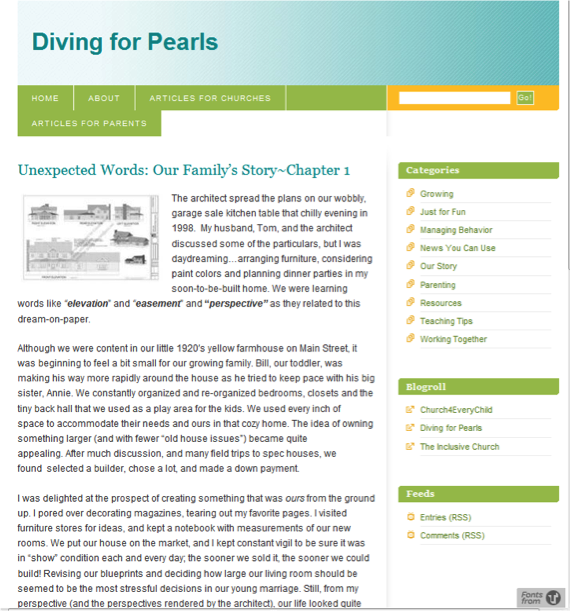 is the complementary Key Ministry blog authored by Katie Wetherbee, KM’s Director of Education. Katie’s blog will offer lots of practical, “how-to” information for church staff, volunteers and parents doing the hands-on stuff of ministry for kids with hidden disabilities and their families. Katie places a very high value on relationships, is lighthearted in her style of communicating, and shares freely from her personal experiences with the issues we address, both as an expert in special education methods and strategies and as a parent of a child with a disability.
Church4EveryChild  (the blog you’re currently reading) is designed to be the “voice of the movement.” This blog is written for pastors, thought leaders and influencers within the church, with content that will also interest parents and professionals. If Katie’s blog addresses the “how to” component of our ministry, my goal is to help you understand the “what”…the nature of the problems experienced by kids with hidden disabilities when it comes to participating in church and growing in faith, along with the “why” of this ministry…the reason it’s so important for churches to respond to this need when resources are inadequate to respond to all the worthwhile ministry opportunities they’re presented.
Key Ministry’s Facebook page  is a tool to help us provide day to day updates on the work of the ministry…notifications of live training, communicating success stories and calling attention to new resources (blog posts, video, downloads) as they are made available. We provide general information about our ministry in a format that makes it easy for our “fans” to pass along stuff that may be of interest to friends. We also use our Facebook page as a tool to draw attention to the resources offered by other like-minded ministries and to spotlight successes of churches we serve.
My personal Twitter feed highlights new research of interest to families of kids with mental disorders and those who serve them. I’ll occasionally feature links to other stuff I’m reading or leaders with interesting perspectives. If you’re a parent or a professional interested in the stuff we address, or you’re not involved with leading or serving in a local church, my Twitter feed will probably be the best way to keep up with Key Ministry. I promise not to Tweet every time I sit down at Panera, one of my kids does something impressive or my wife wears something that looks nice. Warning! If you become my Facebook friend you will be subjected to my venting about the futility of Cleveland sports or the parallels between the descent of our society and Jerusalem pre-Nebuchadnezzar. Key Ministry’s Twitter feed will feature content similar to our Facebook fan page.
Finally, our new website 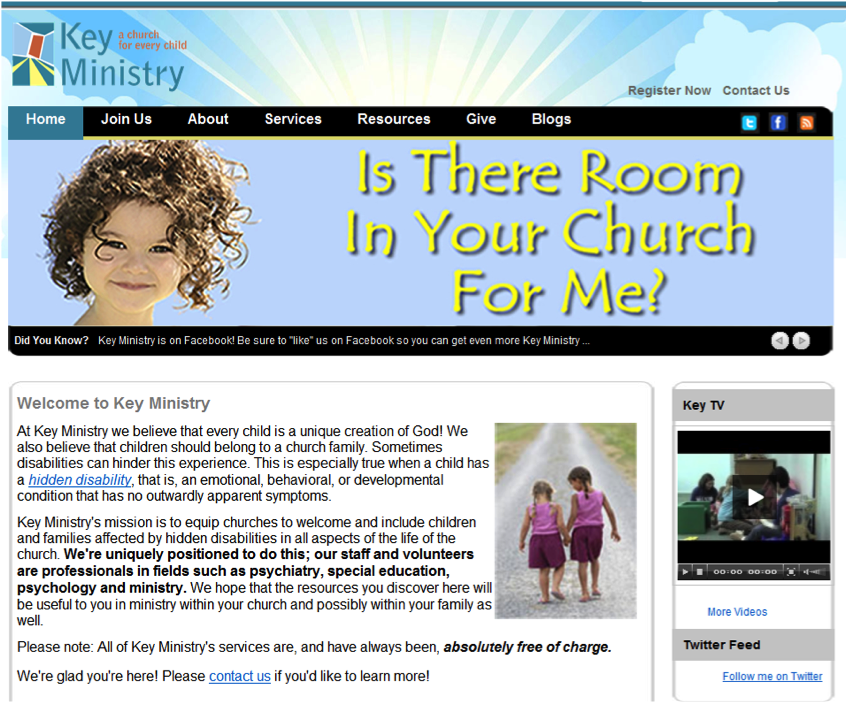 was designed to be a “one-stop shop” offering all of the content and resources provided by Key Ministry in one place. Through the website, pastors, volunteers and parents will be able to request consultation or live training and access print materials, including our “Key Ring Binder”…representing Version 2.0 of the “toolkit” we previously distributed containing all the necessary resources to launch a ministry outreach at a local church. We’ll also be posting video at the Key Ministry Channel on You Tube in which we’ll share some of the stories of families touched by the churches we serve along with brief training videos developed to answer frequently asked questions from church staff and volunteers. If you’re interested in ministry resources, the website will be the best place for you to start.

 This is the sixth and final installment of our series, Pediatric Bipolar Disorder: A Guide for Children’s and Youth Pastors and Volunteers

 This is the fifth post in a six-part series: Pediatric Bipolar Disorder: A Guide for Children’s and Youth Pastors and Volunteers.
  Middle and high school ministry leaders can identify spiritually mature kids with the respect of their peers to look out for kids with bipolar disorder (and other conditions such as Social Anxiety Disorder or Asperger’s Disorder) who are prone to struggle with relationships and consistent participation in church activities.
 Dave and his mother were connected to a very caring church, but a church that didn’t hold psychiatry or psychiatrists in high regard. Dave began exhibiting some of the same behavior that his father displayed during arguments with his mother, and I recommended medication. Dave’s mother insisted I speak to her their pastor before she’d agree to give him medication.
 Because of the cyclical nature of their difficulties with mood, attention and capacity for self-control, kids with bipolar disorder may have a much more difficult time maintaining a consistent practice of spiritual disciplines, compared even to a peer with ADHD. During more acute cycles, they may have a much harder time remembering Bible verses they’ve memorized, sustaining the concentration to pray, or maintaining the self-awareness to know when they need God’s help or support from Christian friends. Their inability to maintain a train of thought may make meditation or reflection on Scripture impossible. They may be more prone to distort or misinterpret teaching during mood episodes. They may have a harder time than their peers finding a church or a youth group willing to accept them. If the child or teenager is involved in a small group their participation in the group is likely to be more inconsistent. Because of the actions they engage in or the anxiety they experience associated with their mood disorder, they may be more prone to question the authenticity of their salvation or have others in the church question the depth of their faith.
 This post is the third in a six-part series: Pediatric Bipolar Disorder: A Guide for Children’s and Youth Pastors and Volunteers
 Parents of kids with bipolar disorder become tired of having to manage their child’s behavior—and explaining their behavior to others in new settings. If you’re shopping in Walmart and you see a child with Down Syndrome, a child with cerebral palsy or a child in a wheelchair having a meltdown, you’re not likely to give it a second thought. If the child looks and appears perfectly normal and the parent is flustered and overwhelmed, you might arrive at a different conclusion. While we’re on the subject, how do you think the people who attend your church would respond to a family in such a situation?
 This post is Part Two of a six-part series: Pediatric Bipolar Disorder: A Guide for Children’s and Youth Pastors and Volunteers
 Bipolar disorder has nothing to do with intelligence. But kids with bipolar disorder often have more difficulties sustaining their concentration in school. Problems with sleep lead to forgetfulness. They may miss more school than other kids because of disciplinary actions or with exacerbations of their illness. 30-40% will have specific learning disabilities. School often presents another challenge to overcome as opposed to representing a strength they can build from.
 “I’m very sensitive and emotional and things upset me and makeme feel like not functioning or dealing with people… I went to a clinic, thinking it would help my moods. The only thing I did was to take one 500 question test – ya know, filling in the little black dots. All of a sudden I’m diagnosed manic-depressive. ‘Let’s put Axl on medication.’ Well, the medication doesn’t help me deal with the stress. The only thing it does is help keep people off my back because they figure I’m on medication.”
 This post is Part One of a six-part series: Pediatric Bipolar Disorder: A Guide for Children’s and Youth Pastors and Volunteers
 Inflated self esteem, grandiosity:
 Involvement with pleasurable behaviors with the potential for painful consequences:
  Bipolar Disorder is probably the most controversial topic in the field of child and adolescent mental health. A
  I’m going to present a six-part series to help children’s pastors, youth pastors and ministry volunteers better understand and serve kids with bipolar disorder and their families. Consider this as a “prequel” to the official launch of this blog on September 12. The schedule for this week:
 Getting to the root cause when kids experience the behaviors listed above can be pretty challenging. That’s why I had to do four years of med school, three years of general psychiatry residency and a two year child psychiatry fellowship in preparation for my job. There are all kinds of developmental, environmental, biological, genetic, psychosocial and spiritual issues at play in kids with issues. Is it possible that “scripturally unsound parenting” could contribute to the behaviors listed above? Absolutely. How might a parent of a child being treated for ADHD, depression, Bipolar Disorder or Reactive Attachment Disorder hear the message described in the post? If that parent is exploring Christianity, would they experience grace in the teaching they experienced?



 Church4EveryChild