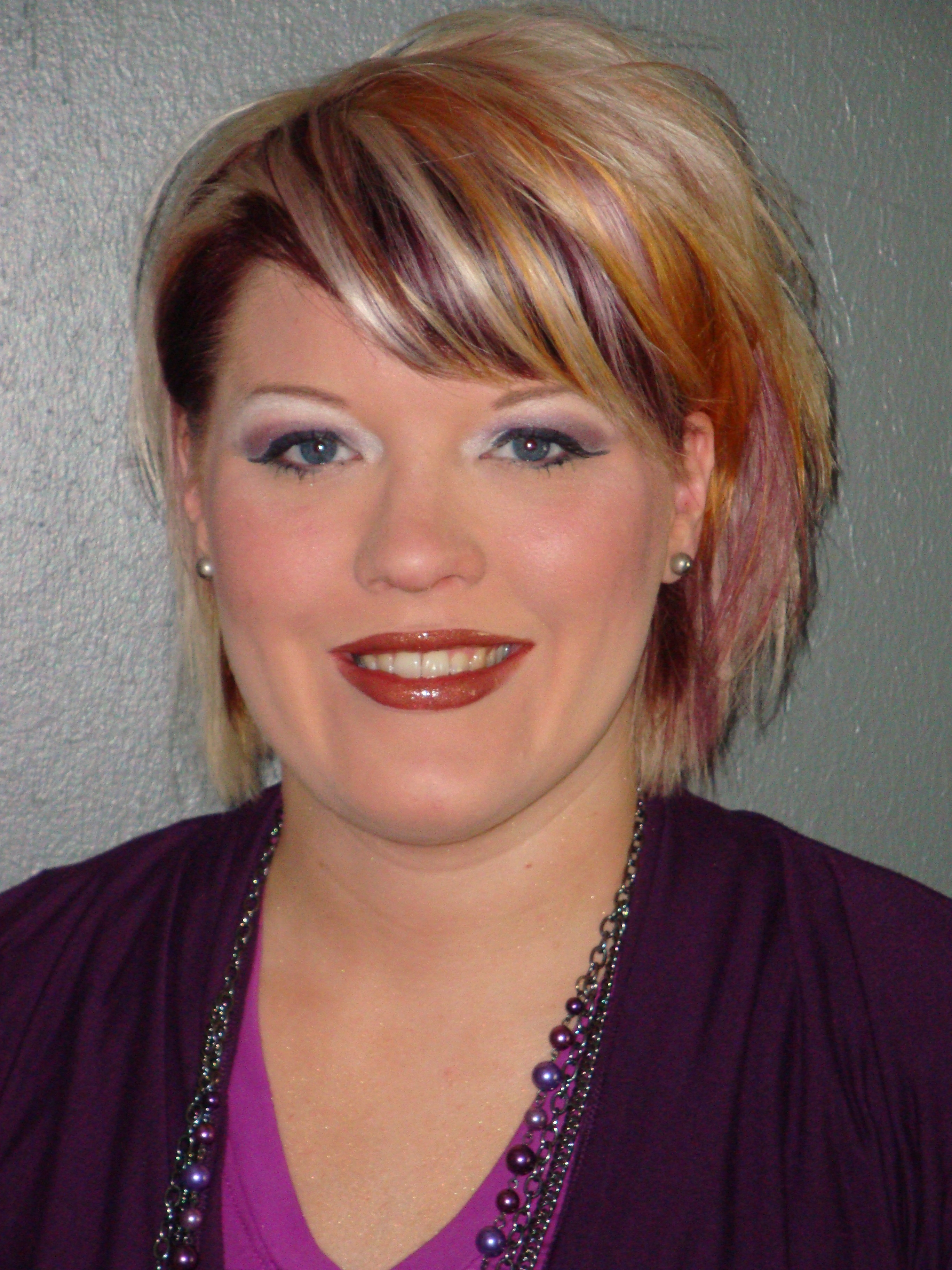
Guest Post: Harmony Hensley…Prom Thoughts

Editor’s Note: Tomorrow night (September 30, 2011), a team of nearly 1,500 volunteers from one of our favorite churches will be welcoming over 1,000 special guests who will get to experience a party providing a taste of what it’s like to be a son or daughter of the King.

The appropriately named “Team Big” from Vineyard Community Church in Cincinnati has been preparing for the fourth Annual “Prom” while their leader, our friend and colleague Harmony Hensley, has been preoccupied with other responsibilities. Harmony gave us permission to share this note from her Facebook page. You’ll get to hear more from Harmony next week as she contributes to our current series on welcoming families of kids with aggressive behavior to church.

Here’s a video from 2008 to give you a little taste of the Vineyard Prom:

My house is quiet this morning.  My precious boy is napping peacefully and I decided to just spend some time with God; to thank him for trusting us with this incredible boy, and to ask him to bless him with an incredible part to play in the Kingdom of God.  I know he has amazing plans for Ransom, because God keeps his promises.  I am constantly blown away that the God of the universe would choose to advance his mighty kingdom through everyday people like you and me.

I’m struck lately by the fact that I don’t deserve this incredible life that God blessed me with.  I’m overwhelmed pretty much on a daily basis.  In a world ravaged by war, poverty, and unspeakable injustices, I sit here typing in my comfortable house, next to my beautiful son, writing about the ridiculous blessings that have been showered on me.  It’s not “fair” but I’m deeply thankful.

This morning I found myself praying for The Prom coming up this Friday.  It’s been very surreal to be on maternity leave and away during the Prom season.  Though I am cherishing each sweet moment with Ransom, I find myself thinking a lot about the 1,000 guests who will grace the red carpet in just three days.

In this new role as a “Mommy” I find myself praying a lot about the people who will cross paths with Ransom over the course of his life.  I pray daily that there will be countless other believers, warriors in the Kingdom of God, who will come alongside him and speak life into him.  That they will enter into his story and see God at work in his life.  I imagine for every smiling face that is greeted curbside there is a Mom or Dad out there who hopes and prays for the same thing for their child with special needs.  And I know that God is looking down on each of them beaming with pride “That’s my kid!” (I can just hear him say it!)

I once had a divine encounter with a parent of an incredible young boy who happened to have autism.  As she shared with me her hopes and dreams for her son she explained that her greatest fear would be that one day he would grow up and that he wouldn’t be “cute” anymore.  That no one would love him.  Those words stung my heart then and are even more crushing to me now as I think about my own son.

Each guest that dances with us on Friday night is precious in the eyes of God, like you and I.  And they each have an incredible part to play in advancing the Kingdom.  Frankly, without them – we (the Body of Christ) are incomplete.  So as you dust off your fancy clothes (which in the Vineyard world is pretty much anything above jeans and a t-shirt; Gotta LOVE it!) to serve, think of the person you will meet that night.  Pray that they see God in YOU and that they come in to relationship with the one who treasures all of his people, just as they are.  Because sometimes seeking justice, loving mercy, and walking humbly (Micah 6:8) involves sequins, a tie, and some dancing.

Hope to see you all there…. And to those of you who feel forgotten – hold fast – God’s people are coming for you – and they’ve got a disco ball.  🙂

***********************************************************************************************************
KM_ForFamilies_Logo_Color_RGBKey Ministry helps connect churches and families of kids with disabilities for the purpose of making disciples of Jesus Christ. In order to provide the free training, consultation, resources and support we offer every day to church leaders and family members, we depend upon the prayers and generous financial support of readers like you. Please pray for the work of our ministry and consider, if able, to support us financially!
Posted in Stories, Strategies | Tagged , , , , | 1 Comment

Inclusion Fusion: Joe and Cindi Ferrini

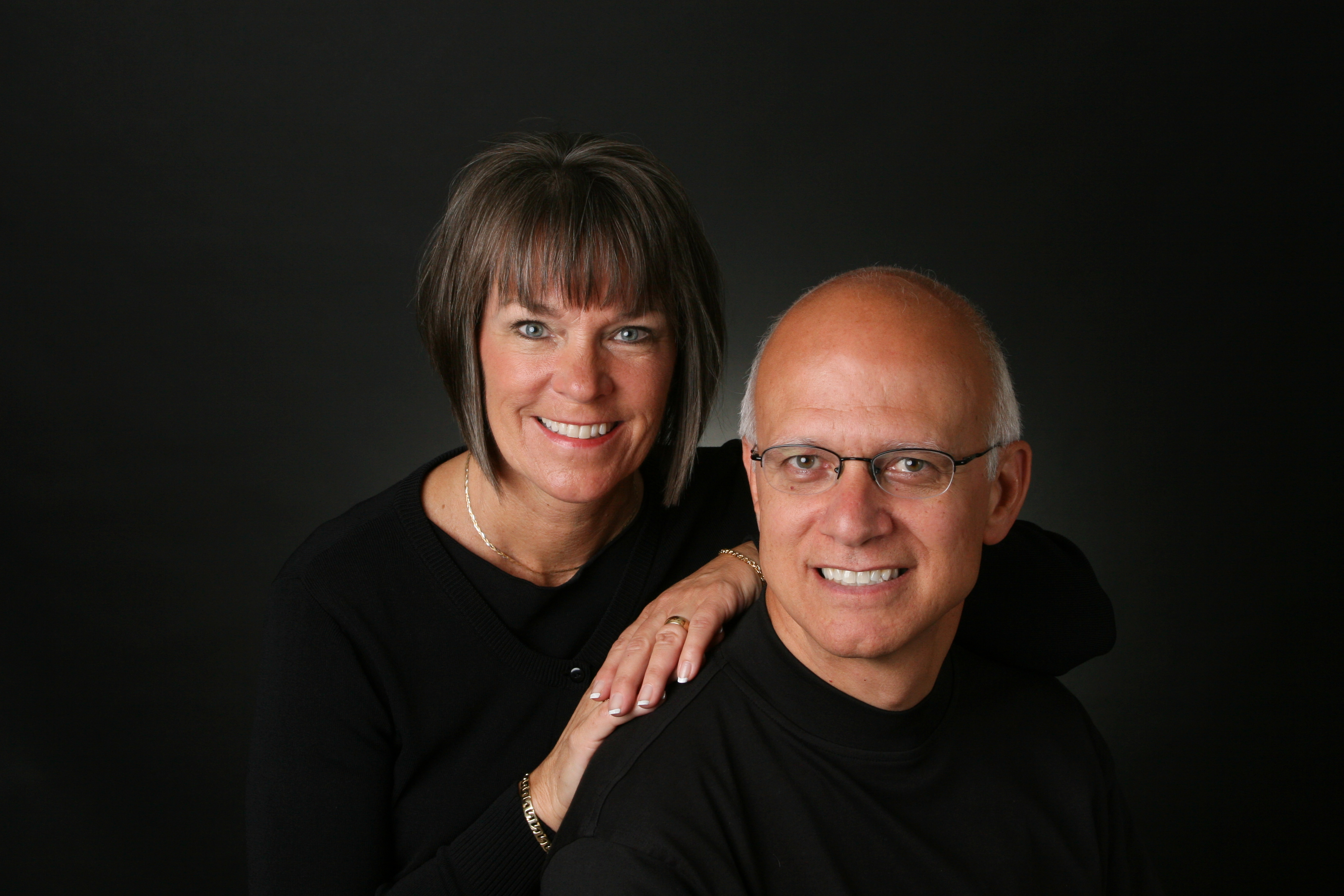
Noted authors, speakers and parents Joe and Cindi Ferrini have graciously agreed to join us for Inclusion Fusion. Joe and Cindi will be speaking on the topic…The Unexpected Journey of Relationships – When Special Needs Change Our Course! Relationships matter – marriage, children, friendships, teachers, doctors, everyone! In their presentation, the Ferrini’s will share ideas to strengthen and deepen relationships that will help us enjoy our Unexpected Journey for the long haul.

The Ferrini’s have been married for 32 years and have raised three grown children…a son with special needs currently living at their home in Ohio, a daughter, son-in-law and grandson in Florida and a daughter enrolled in her senior year at Wright State University.

Joe and Cindi speak nationally for FamilyLife at “Weekend to Remember Marriage” Conferences. They have spoken for churches, conferences, retreats and ministries around the country. We saw them two weeks ago at the Through The Roof Summit at Cedarville University. Cindi has been interviewed nationally on Midday Connection (Moody Radio), and together they have been interviewed on FamilyLife Today, and various radio and television shows, and their recent interview with Focus On The Family is scheduled to air in January 2012 for Sanctity of Life month. Cindi coordinates and participates in Pause For Prayer for WCRF radio in Cleveland.

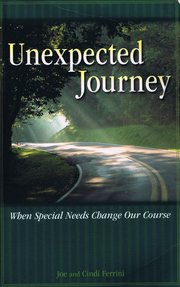
They have written for the popular online and hard copy magazines including FamilyLife Today, Focus On The Family, and others. Cindi has authored a bible study, organizational planners and most recently wrote with Joe: Unexpected Journey, When Special Needs Change Our Course (February 2009).

Through their ministry, Joe and Cindi have focused on helping and informing those who are caregivers to those with special needs….children, adults, and yes, even those caring for parents! AND to inform those who don’t have a special needs situation how to UNDERSTAND, help, care, pray for, and love those who are.

Over 20 of the church’s leading experts in children’s ministry and disability ministry are joining with us this November 3rd-5th to put on a FREE Special Needs Ministry Web Summit for church staff, volunteers, family members and caregivers everywhere. That’s Inclusion Fusion, Key Ministry’s First Annual Special Needs Ministry Web Summit, featuring this year’s Keynote Speaker, Chuck Swindoll, along with Harmony Hensley, Marie Kuch, Amy Dolan, Jeremy Collins, Shannon Dingle, Katie Wetherbee, Jeff McNair and many others.  Register here for the Special Needs Ministry Web Summit, coming this November 3rd-5th.


Posted in Inclusion Fusion, Uncategorized | Tagged , , , , , , , , , | 1 Comment

When Mood Dysregulation Heightens Risk for Aggression at Church

In Part Five of our series on including kids with aggressive behavior at church, we’ll look at ministry activities and environments posing the greatest risk of aggression for kids with mood dysregulation or sensory processing issues.

Kids who demonstrate irritability as their predominant mood state will often experience severe temper outbursts in response to common, everyday stressors. When such behavior is accompanied by cyclical changes in speech (talking more, talking louder, talking faster), impulse control (less), difficulty maintaining a train of thought, diminished attention span and increased distractibility, all of the difficulties we discussed on Sunday associated with executive functioning deficits come into play. Click here for the beginning of a series from the Summer of 2010 on the impact of Bipolar Disorder on spiritual development in kids.

The larger group of kids with mood dysregulation will also experience executive functioning weaknesses, but lack the cyclical changes in mood observed in the kids described above. Their mood and patterns of behavior will vary less from week to week, but they remain very much at risk for verbal rages or physical aggression toward people or property. The risk for rages may be heightened when…

Transitions occur that violate their locus of control. Aggressive behavior often occurs when the child or teen is asked to stop doing something they enjoy. Parents will typically encounter such behavior when they’re trying to get their child to stop playing their video games to get ready for church. Visual timers may help kids to prepare for the need to transition from activity to activity.

When they encounter too many choices. Kids with this type of mood dysregulation often experience difficulty coming to a resolution when making decisions, because they think too much and question their own decisions. Their outbursts are more likely when they get “stuck.” Something as innocuous as picking out of a prize box after successfully answering a series of Bible questions cal lead to frustration.

They don’t do well with “down time.” Busy tends to be better…kids who tend to become frustrated and experience a “slow build” until experiencing a crescendo of aggressive behavior can often de-escalate relatively early in the cycle if they’re distracted by something more interesting before becoming too frustrated. An astute Sunday School teacher or group leader upon recognizing the pattern will have enough material or activities prepared to engage the child prone to aggression when their irritability starts to escalate.

Here’s a general rule of thumb…When a child or teen is demonstrating aggressive behavior that appears to be predominantly impulsive in nature, decreasing the sensory stimulation in the environment is generally helpful. When a child or teen demonstrates aggressive behavior resulting primarily from perseveration on a perceived hurt or frustration, distracting the child as early as possible in the cycle is generally helpful.

***********************************************************************************************************

KM_ForFamilies_Logo_Color_RGBKey Ministry helps connect churches and families of kids with disabilities for the purpose of making disciples of Jesus Christ. In order to provide the free training, consultation, resources and support we offer every day to church leaders and family members, we depend upon the prayers and generous financial support of readers like you. Please pray for the work of our ministry and consider, if able, to support us financially!

Posted in Inclusion, Key Ministry, Strategies | Tagged , , , , , | Leave a comment

Inclusion Fusion Speakers: Harmony Hensley on Inclusive Ministry Environments

Harmony Hensley’s posts last Fall (here and here) on welcoming ministry environments for kids with ADHD have been among the most viewed on this blog over the past year. I’m very pleased to announce that Harmony has been added to our lineup for Inclusion Fusion. She’ll be presenting on the topic of Inclusive Ministry Environments.

Harmony currently serves as Pastor and Director of Outreach and Inclusion Ministries at Vineyard Cincinnati. The Vineyard has been ranked as one of the 50 most influential churches in America and is known for a strong outward focus and servant culture. Harmony has a Bachelor of Arts Degree from Cincinnati Christian University with a double major in Ministry Leadership and Biblical Studies. She is currently pursuing her Graduate degree majoring in Church Growth and Planting.

Harmony has a background in marketing and design and has leveraged these skills to develop volunteer strategies and creative ministry approaches. She has a personal interest in ministering to individuals with disabilities as she spent four years in high school in the Special Education system. These experiences have shaped her systemic inclusion ministry approach.

In Harmony’s workshop,  she’ll explore ways to create inclusive ministry environments that engage and empower children with hidden disabilities. Participants will learn practical tips to make your ministry area a magnet for families of kids with special needs.

We’ve been honored to have Harmony serving as a part of our Key Ministry team over the past year. She’s spearheaded efforts in developing a church-based network offering free respite care to families of kids with disabilities in the Tri-State area (Southwest Ohio, Southeast Indiana, Northern Kentucky). She’s spoken on behalf of Key Ministry this past year at the McLean Bible Church Accessibility Summit, the Orange Conference and the Children’s Ministry Telesummit.

Harmony will be making one of her first appearances since she and her husband Skyler welcomed Ransom Levi Hensley to their family on August 26th. We’re glad that Ransom and Skyler are making Harmony available to us for Inclusion Fusion!

Over 20 of the church’s leading experts in children’s ministry and disability ministry are joining with us this November 3rd-5th to put on a FREE Special Needs Ministry Web Summit for church staff, volunteers, family members and caregivers everywhere. That’s Inclusion Fusion, Key Ministry’s First Annual Special Needs Ministry Web Summit, featuring this year’s Keynote Speaker, Chuck Swindoll, along with Harmony Hensley, Marie Kuch, Amy Dolan, Jeremy Collins, Shannon Dingle, Katie Wetherbee, Jeff McNair and many others.  Register here for the Special Needs Ministry Web Summit, coming this November 3rd-5th.


Posted in Inclusion Fusion | Tagged , , , , , , , , , , , | Leave a comment

When are kids most at risk of aggressive behavior at church?

shutterstock_114356413Most kids who display aggressive behavior serious enough in terms of frequency and/or severity to be of concern to church staff and volunteers will meet the criteria for one or more mental health or developmental disorders. Nevertheless, children’s and youth ministry staff and volunteers need to take steps to minimize antecedents to aggressive behavior without specific information about a child’s diagnosis or treatment.  Many kids who are prone to aggressive behavior have never been evaluated or treated. Some who have been evaluated may not have been diagnosed correctly. Many parents will be reluctant to share detailed information with church staff about their child’s diagnosis or treatment because they fear the possibility of being stigmatized or don’t trust that information shared will remain confidential.

With that said, we may still be able to make educated guesses for individual kids as to what church activities or environments carry the greatest risk of aggressive behavior based upon general observations that can be made by staff or volunteers with little formal training in serving kids with disabilities.

We’ll examine higher-risk situations for kids with:

  • Executive functioning deficits: Difficulties inhibiting behavior, regulating emotions, sustaining attention/focus, following directions
  • Mood dysregulation: Irritability, frequent tantrums, meltdowns
  • Sensory issues: excessive reactivity to light, sound, touch, smells, taste
  • Anxiety
  • Social relatedness

Today, we’ll look at higher risk ministry environments for kids with executive functioning deficits, and address kids with mood dysregulation, sensory issues, anxiety and social relatedness during the upcoming week.

As a general rule of thumb, kids who struggle with executive functioning are capable of controlling their behavior and managing the ways in which they express emotions-it just requires much more mental effort for them to do so than it would for another child of the same age. You’ll hear parents and teachers throw around the concept that kids like this need “structure.” I’d define “structure” as clear and predictable rules, expectations and routines for task completion and interpersonal relationships. What “structure” does for kids who struggle to demonstrate self-control is that it allows them to devote cognitive resources and energy to the task at hand as opposed to having to expend those resources thinking through how to navigate the immediate demands of their environment.

f77fc902f0ffff8a9dc080bff842bdddLet’s apply this concept to ministry environments…For kids with executive functioning weaknesses, their risk for becoming aggressive will be reduced during predictable and familiar routines. As their environment becomes more chaotic, noisy, disorganized and unpredictable, their resources for maintaining self-control become more limited. Your staff and volunteers will want to address:

Transition times before, during and after scheduled children’s or youth ministry activities. If kids with executive functioning weaknesses walk into a room where peers are yelling, jumping, wrestling or becoming physical with one another, their ability to maintain self-control will become more limited. These are the kids who “don’t know when to stop.” Having adults in ministry environments well in advance of the scheduled start times for scheduled activities to maintain fun with order will help reduce risk of aggressive behavior. This supervision is especially important at drop-off and pick-up times. Another high-risk environment can be transition times between large group worship and small group breakouts or activities. Dismissing kids to their assigned area of the church building in as organized a manner as possible helps kids with self-control deficits to maintain appropriate behavior.

Participation in high-energy activities: Most kids experience multisensory, high energy worship and ministry activities as engaging and fun, and learn well in those ministry environments. Such environments are more of a challenge for kids with executive weaknesses because they can deplete the child’s cognitive resources for maintaining control. Having kids predisposed to aggressive behavior doesn’t necessarily mean you have to change the environment for everyone. But you might consider alternate activities for kids with weaknesses in their capacity for self-regulation during those times in your programming. One of my patients became a highly valued member of his church’s parking team. Around the time he was done helping to park cars, the light and sound show with worship was completed, and he’d go back in the church for his large group teaching and small group discussion.

Evening activities: Because kids with executive functioning weaknesses expend more cognitive resources to maintain self-control, they may experience mental fatigue more quickly than their peers. As a result, kids who do OK during the day at church or school in managing their behavior and emotions might have a more difficult time doing so under similar circumstances later in the day. A kid who does OK on Sunday morning in age-appropriate programming may need more individualized support in order to maintain self-control in the evening.

Next: When are kids with mood and/or sensory issues most at risk of aggressive behavior at church?

Updated February 21, 2014

***********************************************************************************************************

ADHD Series LogoKey Ministry has assembled a helpful resource page for church leaders and parents addressing the topic of ADHD and spiritual development. This page includes our blog series on the topic and links to helpful videos and resources for pastors, church staff, volunteers and parents. Access the resource page here.

Posted in Hidden Disabilities, Inclusion, Ministry Environments, Strategies | Tagged , , , , , , , , , , , , , , | 3 Comments

Inclusion Fusion Speakers…Amanda Mooney

The movement among churches seeking to become more inclusive to families of kids with special needs is not confined to Mainline Protestant, Baptist, Pentecostal and non-denominational congregations. Amanda Mooney shares her expertise in ministry to kids in a large Catholic church in her presentation, “We know we should…but HOW?”

Amanda received her Bachelor’s degree, majoring in Multi-handicapped Education from Bowling Green State University, along with a Master’s Degree in Education, with a concentration on Early Education of the Handicapped. Amanda spent five years as a Special Needs Preschool Teacher in Ashtabula and Wood Counties in Ohio, and was honored as Teacher of the Year in 1998 by the Northeast Ohio Special Education Resource Center.

Amanda has been a member of St. Gabriel’s Parish in Concord, OH for 33 years, and has served on staff as the Principal of St. Gabriel’s Parish School of Religion (PSR) since 2008. In her staff position, Amanda oversees a team of 40 volunteers offering programming for 300 children in grades 1-5 on a weekly basis, along with a comprehensive Special Needs ministry serving members of the church of all ages. This past summer, her team completed their second “One Day Voyage,” a unique event in which Vacation Bible School was used as a model to create a “mini version” that would be compatible and comfortable for kids with disabilities and offer a respite experience for the families. This was made possible because of the partnership and training of her team by Key Ministry.

Amanda employs a visionary approach to religious education to more fully involve parents as the lead teachers in their child’s faith journey. She lives in Concord, OH with her husband, Dave and their two kids, Tommy, 9 and Lilly, 6.

Amanda’s presentation is designed to help you get “unstuck” when the task of getting started on this new important journey seems too big! Once you have gotten on board with the mission of serving ALL the children and families in your church, it can still be overwhelming to think about HOW to get started. This session will help participants see and explore ways to include children with special needs in existing church programs, develop action steps for launching new programming while working within the curriculum or catechesis requirements of their church or Diocese. Participants will come away with concrete ideas, action steps and resources to start ministry in their local church.

Interested in joining a bunch of folks who are passionate about families of kids with special needs coming to know and love Jesus Christ?  An event in which any church leader, volunteer or parent anywhere in the world who shares the same passion and has access to the Internet through a computer, tablet or smart phone can join in? That’s Inclusion Fusion, Key Ministry’s First Annual Special Needs Ministry Web Summit, featuring this year’s Keynote Speaker, Chuck Swindoll. And it’s all available to you for free! Register here for the Special Needs Ministry Web Summit, coming this November 3rd-5th.

Posted in Inclusion Fusion | Tagged , , , | Leave a comment

Batting Second for Inclusion Fusion: Katie Wetherbee

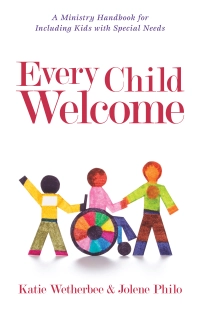
We currently have two dozen experts and leaders committed to present for this year’s inaugural Inclusion Fusion Special Needs Ministry Web Summit, scheduled for November 3-5. On Monday, we introduced Libby Peterson. Today, I’m delighted to announce that Katie Wetherbee, Key Ministry’s Director of Education will be presenting on the topic of Advocating for Your Child at Church.

Parents of children with special needs spend countless hours advocating for health and educational support. Advocating for a child at church presents a whole new set of challenges…and some parents find that by Sunday, they’re just too worn out…it’s just easier to stay home. In Katie’s session, she’ll examine ways to understand a church’s culture, discuss methods of positive, proactive communication, and identify strategies for making church a successful experience for all involved.

Katie completed her undergraduate work at Vanderbilt University, where she majored in Special Education and Human & Organizational Development. She holds a master’s degree in education from Hood College, where she served on the adjunct faculty for the Reading Specialist program. Katie began her teaching career in the Washington, DC, area working at a public school. She has worked in a variety of settings, including a hospital, a community college, and as the director of a learning center.

In her role with Key Ministry, Katie helps churches learn how to understand and welcome families affected by disabilities. Her own experiences as a teacher and also a mother of a child with a disability provide Katie with a unique perspective that she hopes will help families and churches work togther.

Katie and her husband (Tom) live in Chagrin Falls, OH with their two teenagers, and their quirky mutt named Mitzie. She enjoys travelling, cooking, and reading.

Interested in joining a bunch of folks who are passionate about families of kids with special needs coming to know and love Jesus Christ?  An event in which any church leader, volunteer or parent anywhere in the world who shares the same passion and has access to the Internet through a computer, tablet or smart phone can join in? That’s Inclusion Fusion, Key Ministry’s First Annual Special Needs Ministry Web Summit, featuring this year’s Keynote Speaker, Chuck Swindoll. And it’s all available to you for free! Register here for the Special Needs Ministry Web Summit, coming this November 3rd-5th.

Posted in Inclusion Fusion | Tagged , , , | Leave a comment

Why do kids become aggressive?

shutterstock_343101839There’s been an ongoing debate in child mental health research circles for at least fifteen years about the nature of aggressive behavior and the best way to treat kids who exhibit such behavior.

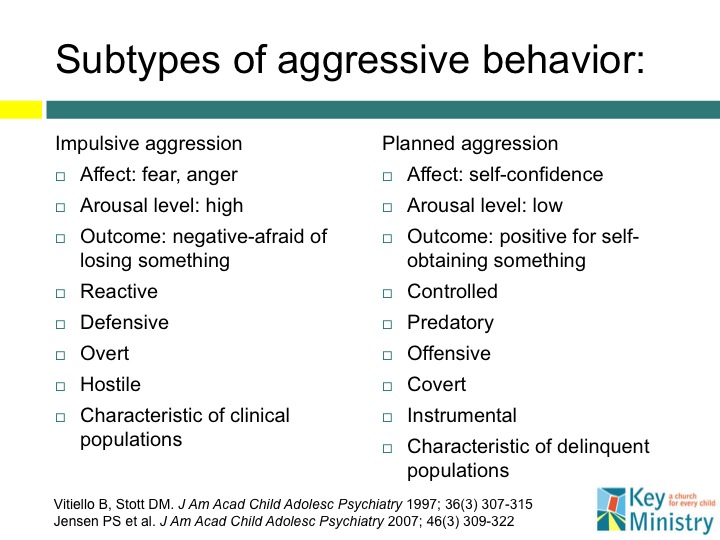
The research suggests that two distinct subtypes of aggressive behaviors occur…impulsive aggression and planned (or predatory) aggression. See the summary slide below for a comparison of the two patterns of aggressive behavior seen in kids:

Allow me to make some observations…

Kids with maladaptive, impulsive aggression are very likely to have some brain-based condition that contributes to their difficulties with behavioral inhibition and emotional self-regulation. They tend to experience high levels of physiologic arousal. Kids with planned aggression have been demonstrated to experience decreased levels of physiologic arousal and have been hypothesized to respond preferentially to behavioral interventions.

There’s not one single underlying cause for aggressive behavior in kids. While aggressive behavior is far more frequent in kids with specific emotional and behavioral disorders than in the general population (ADHD, autism, bipolar disorder, intellectual disabilities, anxiety, depression, some anxiety disorders), aggression is not a defining feature of any specific disorder. The determinants of aggressive behavior in any individual child are likely to involve the expression of hundreds of specific genes, the child’s lifetime of experiences, the child’s subjective interpretations of their experiences and the qualities of the environment they’re in at any given point in time.

f77fc902f0ffff8a9dc080bff842bdddKids with impulsive aggression are more likely to struggle with behavioral inhibition and emotional self-regulation. Their high levels of arousal are known to negatively impact upon their cognitive functioning. Experiences that induce arousal…loud noises, bright lights, aggressive play etc. may not cause a child to behave aggressively, but may impede their ability to demonstrate age-appropriate self-control if their capacity for self-control has already been compromised by some other condition.

Kids who lack the capacity of their peers for emotional self-regulation and behavioral inhibition are going to be more susceptible to negative influences in their environment (peers, adults who make poor decisions, media, availability of substances).

We’ll continue to examine the topic of aggressive behavior in great depth over the course of this series, but here are two take home points for church leaders and volunteers to ponder:

Kids with an identified “special need” or hidden disability are at greater risk of experiencing aggressive behavior at church, but this problem is not confined to kids with known conditions. You probably won’t know in most instances whether the child has an identified condition contributing to their risk of aggressive behavior because of the reluctance of parents to self-report, and what you do to address the risk won’t be contingent upon having to know the child’s specific condition. The challenge is not confined to kids served by your special needs or disability ministry.

As a ministry leader, you have some control over the environments where your kids worship, learn and serve at church. Consider how you might create environments that help all kids to maximize their capacity to use all of their cognitive resources for the best possible experience at church.

Most recently updated June 5, 2014

***********************************************************************************************************

Key Ministry has assembled resources to help churches more effectively minister to children and adults with ADHD, anxiety disorders, Asperger’s Disorder, Bipolar Disorder, depression and trauma. Please share our resources with any pastors, church staff, volunteers or families looking to learn more about the influence these conditions can exert upon spiritual development in kids, and what churches can do to help!

Posted in Mental Health, Ministry Environments, Strategies | Tagged , , , , , , , , | 2 Comments

Introducing our Inclusion Fusion Speakers: Libby Peterson

We’ll be introducing you to some of the outstanding speakers and leaders taking part in this year’s inaugural Inclusion Fusion in the weeks leading up to the Special Needs Ministry Web Summit. Today, it’s my pleasure to introduce Libby Peterson, Director of Family Ministries at Bay Presbyterian Church in Bay Village, Ohio.

Libby received both her BS and MS degrees in Speech Pathology from Miami University in Oxford, Ohio. She spent the early part of her career as a speech pathologist practicing with a pediatric population and providing oversight in geriatric settings. The Lord called her to a role in ministry and Libby has served as the Director of Family Ministries at Bay Presbyterian Church in Bay Village OH for over 20 years. Together with other BPC volunteers and staff, she was instrumental in helping the church begin its Special Needs Ministry, Circle of Friends, which now serves over 30 children and their families. Libby and her husband Eric have been married for 30 years and are blessed by twin daughters who now work in Washington, DC and Michigan.

Libby’s presentation  is titled Relational Respite – a “go to them” approach. Here’s a description:

Building relationship should be a central goal of all we do in ministry because ministry typically travels along relational lines. God works through relationships!

Many churches are considering or currently offering respite events at significant manpower and resource cost. What if our focus shifted from event to relationship, from program to people? What if volunteers began to personally invest in building relationship with families with children with special needs – offering help on their turf where they need it most? We’ll explore ministry to kids and families offered in ways that maximize the potential for life changing relationships! 

Libby authored one of our most popular blog posts of the past year as part of our “Thinking Orange” series on family-based ministry approaches for kids with disabilities on the topic of Partnering with Parents.

We’re delighted that Libby will be part of Inclusion Fusion!

Interested in joining a bunch of folks who are passionate about families of kids with special needs coming to know and love Jesus Christ?  An event in which any church leader, volunteer or parent anywhere in the world who shares the same passion and has access to the Internet through a computer, tablet or smart phone can join in? That’s Inclusion Fusion, Key Ministry’s First Annual Special Needs Ministry Web Summit, featuring this year’s Keynote Speaker, Chuck Swindoll. And it’s all available to you for free! Register here for the Special Needs Ministry Web Summit, coming this November 3rd-5th.

Posted in Inclusion Fusion | Tagged , , , | 1 Comment

More thoughts on disruptive kids

The post from last Wednesday on the topic of disruptive kids prompted some very thoughtful discussion via e-mail exchange. I recognized that clarification of some statements I made would be helpful.

I didn’t mean to imply that all kids with chronically disruptive behavior at church have “special needs” or some identifiable disability. In fact, I would guess that very few would be thought of by themselves or by their families as having “special needs. Some might have attention or learning issues that require some educational support or professional intervention. but demonstrate a less than expected level of spiritual maturity. It doesn’t matter whether a kid has a diagnosis or not, because our job as a church is to help ALL kids to grow spiritually.

There are far, far more kids who struggle with ‘doing church” because of disruptive behavior than there are kids recognized with a special need who struggle to do church. Some of the kids have no diagnosable condition that would interfere with their ability to participate and aren’t interested in learning more about Jesus or growing in faith. Some are growing in faith but have a condition(s) that impact their ability to maintain age appropriate self-regulation and involvement at church. And some have conditions that have negatively impacted their ability to participate in church activities or make use of age-appropriate spiritual disciplines and don’t “have a heart for the Lord” as a result.

I think it’s easy for volunteers to conceptualize kids with disruptive behavior as not “having a heart for the Lord.” Given that 22% of kids in the U.S. have diagnosable mental health conditions, I’d put the question on the table as to whether there might be other factors at work when large groups of kids appears to be struggling spiritually, and work from the assumption that our kids want to be successful at school, at church and in other learning environments until proven otherwise.

After rereading the post from Wednesday, I also think I was a little harsh in some of the observations I shared in the last post. The volunteer in question is a tireless advocate for kids in the church who does an outstanding job as a teacher and a role model. I want adults who invest their time and energy and heart in our kids to feel valued. But we can’t be afraid to say hard things to one another from time to time as long as our comments are rooted in a genuine desire to do the best job we possibly can to help our kids to know Jesus and to grow in spiritual maturity.

On Tuesday, we’ll return to our discussion of why kids might behave aggressively at church.


***********************************************************************************************************

KM_ForFamilies_Logo_Color_RGBKey Ministry helps connect churches and families of kids with disabilities for the purpose of making disciples of Jesus Christ. In order to provide the free training, consultation, resources and support we offer every day to church leaders and family members, we depend upon the prayers and generous financial support of readers like you. Please pray for the work of our ministry and consider, if able, to support us financially!

Posted in Hidden Disabilities, Uncategorized | Tagged , , , , | 1 Comment