If churches knew how many people mental illness impacts, they’d be more interested in reaching them

shutterstock_2621157Here’s the second segment in our series for Mental Health Month… Ten things I wish church leaders knew about families and mental illness. Today, we’ll share some information about the prevalence of mental illness in children and adults, and look at why the numbers should move church leaders to respond.

In a candid moment, most church leaders are willing to express that they monitor church attendance figures and that the numbers of people attending church are a significant ongoing concern among pastors and church staff. Nationwide, statistics examining church attendance likely overreport the numbers of Americans who come to church. Several recent estimates suggest only 18-25% of the U.S. population regularly attend a Christian church on weekends. Lower attendance may suggest that fewer people are being impacted by a church’s ministry activities and suggests less money and volunteers will be available to support the church’s mission. Outreach to the community and inclusion of new attendees are generally high on the list of priorities of the typical pastor or church board.

Families impacted by disability, especially families impacted by mental illness, trauma and developmental disabilities, would in my mind represent a largely underserved population for local churches for the following reasons…

  • There are lots of individuals and families impacted by common mental health conditions living in close proximity to local churches who don’t currently attend church, in part because their conditions present subtle, but real barriers to church involvement, as we discussed here last week.
  • Most children and adults with mental illness can be successfully assimilated at church without the need to create new programs or ministries.
  • In addition to the value of the Gospel, churches can offer opportunities for relationship and practical supports that many families impacted by mental health concerns would find helpful.

Let’s focus today on the size of the “mission field next door” and look at some statistics from the National Institute of Mental Health about common conditions that present barriers to church attendance…

Here are some statistics on anxiety prevalence and treatment in adults…I’d suggest that it is highly unlikely that an adult with severe anxiety is regularly attending church, and significantly less likely that adults who meet criteria for an anxiety disorder attend regularly. Of note…the peak in anxiety prevalence occurs in 30-44 year old women…the very people we depend on to bring children to church!

NCS-R_AnxietyDisorders-Chart1-360-2

NCS-R_AnxietyDisorders-Chart2-360-2

Here are the statistics looking at anxiety prevalence in teens…we’re almost certainly missing most of the 5.9% of teens with “severe” anxiety and a significant chunk of the one in four teens who have experienced an anxiety disorder in their lifetimes…
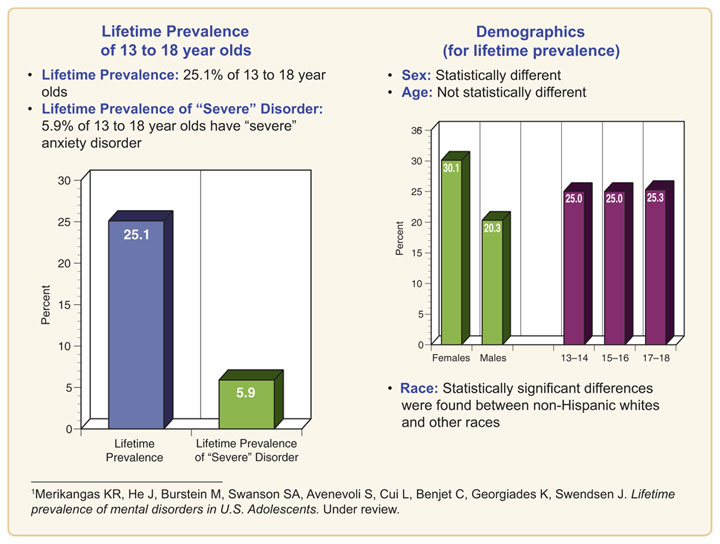
NCS-A_data-AnyAnxietyDisorder_720

Let’s look at agoraphobia specifically, because attending a weekend worship service in a reasonably crowded church is probably the most challenging activity for the kids in our practice we treat with the condition. Again…if the child or adult with agoraphobia can’t attend church, there’s a very good possibility that no one in the family is attending church!
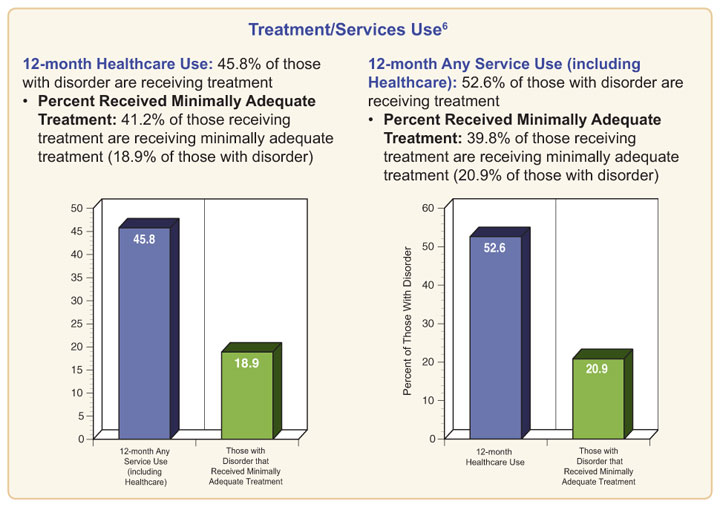
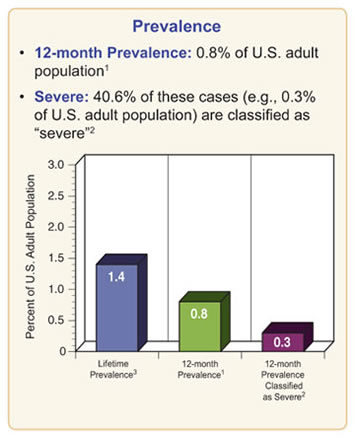
NCS-R_Agoraphobia_Chart4_720NCS-R_Agoraphobia_Chart1_360-1


Now…let’s look at mood disorders in adults…keeping in mind that roughly 50% receive treatment, 45% are classified as “severe” and that only 38.5% receive “minimally adequate treatment.” These conditions are likely to impede church attendance during periods when symptoms are more severe…

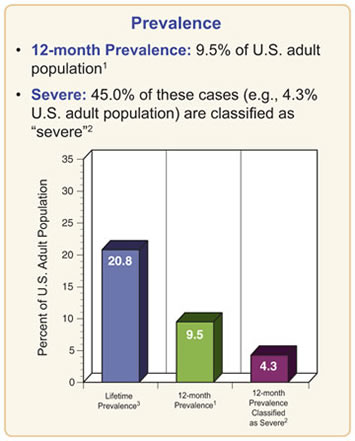
NCS-R_MoodDisorders-Chart2-360-1NCS-R_MoodDisorders-Chart1-360-1


And mood disorders in teens…

NCS-A_data-AnyMoodDisorder-720-1


Finally, let’s look at ADHD in adults. They’re likely to have more difficulty making church a priority, getting up on time, and organizing themselves (and their children) to get to church on time…
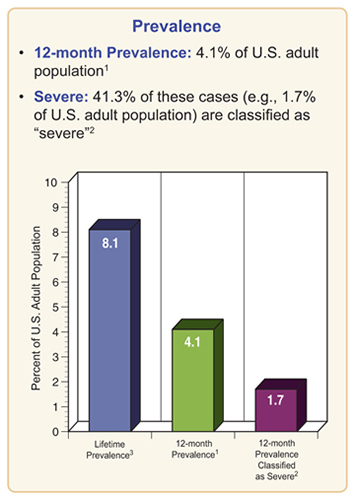
NCS-R_data-ADHD_Chart1_360-1

And ADHD in kids…those who struggle with impulse control and emotional self-regulation will experience significant difficulty in the typical children’s ministry environment or large group worship services, while teens with ADHD will experience challenges similar to adults with ADHD…
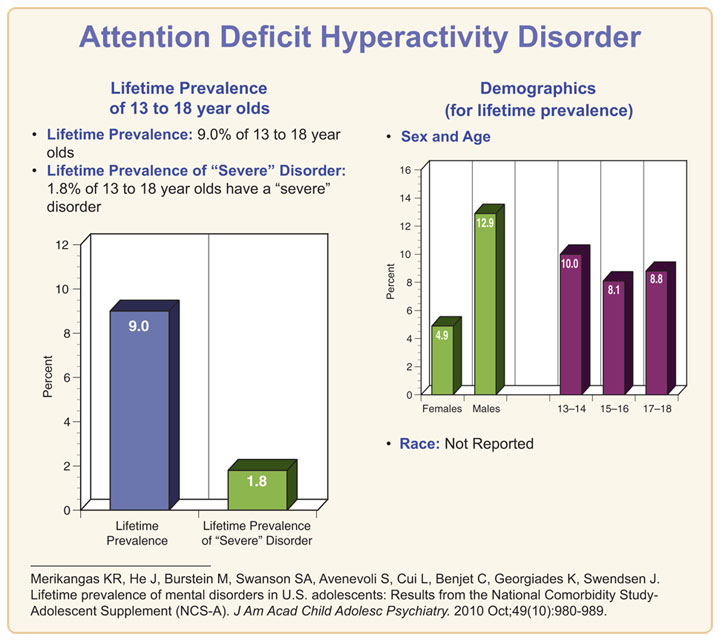
NCS-A_data-ADHD-720-2

So church…we have literally hundreds of kids and hundreds of families living in close proximity to our churches with conditions that pose barriers to church attendance that can be addressed with some intentionality at relatively little cost without an excessive drain on staffing or volunteer resources! What are we waiting for?

Updated January 12, 2018

***********************************************************************************************************

Key Ministry has assembled resources to help churches more effectively minister to children and adults with ADHD, anxiety disorders, Asperger’s Disorder, Bipolar Disorder, depression and trauma. Please share our resources with any pastors, church staff, volunteers or families looking to learn more about the influence these conditions can exert upon spiritual development in kids, and what churches can do to help!


Posted in ADHD, Anxiety Disorders, Bipolar Disorder, Depression, Families, Hidden Disabilities, Mental Health, Resources | Tagged , , , , , , , , | 2 Comments

The secret to launching a missional special needs ministry

Think SmallYesterday I came across something that caught my eye:  Think small.  “Think small” according to Advertising Age, was the No. 1 advertising campaign of the 20th century.   Of course, no discussion of the greatest ad campaign is complete without mention of some truly great ones throughout the past 10 decades.  There’s Nike’s “Just do it,” the U.S. Army’s “Be all that you can be,” Campbell Soup’s “Mmm mmm good.” The list goes on and on.

However, no other ad campaign did more to boost sales and build a lifetime of brand loyalty than “Think small.”  It was the 1960s ad campaign for the Volkswagen Beetle.  Unless you’re old enough to remember you probably don’t know much about the advertising campaign for the first Volkswagen Beetle.

What made the first Volkswagen Beetle ad campaign so radical that it still stands as the number one ad campaign in the history of advertising?  Well, back in the last 50’s/early 60’s, competing American automakers were building ever bigger cars for growing families with baby boomer children. The Beetle, on the other hand, was tiny and, well, ugly. Who would buy it?  So, at a time when the US consumers were being urged, cajoled and ‘persuaded’ to “think big” along comes this one ad suggesting the opposite:

Think Small.

The thing that struck me about the slogan “Think small” was the realization that I have a tendency to think BIG.  I try to come up with BIG ideas as we implement the 4 phases of a missional special needs ministry. I make all kinds of plans to grow and our presence in the Orlando community. I want Special Friends to be the biggest and the best special needs ministry in all of Orlando…okay, why not just say it: I want it to be the biggest and best in all of Florida!

But BIG is not always better…or most effective for creating a missional movement into the disability community.  

The SecretThe challenge with my inclination to think BIG is that when I read the Gospels I find a Savior who had a tendency to think small.  Jesus launched His missional movement with a small group of followers. He used the parable of leaven to show how small things can make a big impact. He also referred to the smallest of seeds as having massive potential for earthshaking results. Jesus is the original creator of “Think Small.”

In Church 3.0, Neil Cole champions the power of small things:

“Why is small so big? Small does not cost a lot. Small is easy to reproduce. Small is more easily changed and exchanged. Small is mobile. Small is harder to stop. Small is intimate. Small is simple. Small infiltrates easier. Small is something people think they can do. Big doesn’t do any of these things. We can change the world more quickly by becoming much smaller.”

Let me leave you with a quote from someone who started a ministry that is now operating 600 missions, schools, and shelters in 120 countries around the world.  She accomplished some very big things for the Kingdom because she made it a point to “Think small” on a daily basis:

“In the West we have a tendency to be outcome-oriented, where everything is measured according to results and we get caught up in being more and more active to generate bigger results.  I do not agree with the BIG way of doing things–love needs to start small, with an individual.  To love a person, to make a difference, you must start with one person at a time…” Mother Teresa

I’ve been spending a lot of time these last several weeks contemplating this statement and reflecting on the small but deliberate strategy of Jesus as He set about changing the world. I’m convinced that I need to refocus my attention back to Jesus and shape our missional engagement on His ways…not mine. In order to do that, I need to “Think Small.”

How might the concept of “think small” change your approach to missional special needs ministry? How might “Think Small” help a church to get involved in their special needs community?

Michael Woods

Mike WoodsIn addition to serving as a Key Ministry consultant, Mike Woods currently works as the Director for the Special Friends Ministry at First Baptist Orlando.

Prior to joining First Baptist Orlando, Mike worked for nine years as the Autism and Inclusion Specialist for a large St. Louis school district. Mike has also worked as a Parent Training Specialist for the nationally known Easter Seals agency: LifeSkills. He’s a Board Certified Associate Behavior Analyst (BCABA) and senior-level certified Crisis Prevention Instructor. Mike has conducted workshops for a variety of churches, several national level autism conferences, and various annual state conferences on topics pertaining to autism.

Christ-follower, husband, dad, choco-holic, and peanut-butter lover! Mike is passionate about faith and special needs. Mike is happily married to his lovely wife Linda and is the father of three wonderful boys, all three of whom are on the autism spectrum (yes, all three!).

***********************************************************************************************************

Front Door LogoThe Front Door is a pilot project of Key Ministry to provide church online for families of kids with disabilities who are not currently able to “do church.” We seek to promote relationships between families and local churches for the purpose of working toward families being able to worship in the physical presence of other Christ followers as full participants in a local church. Beginning this coming week, we’ll have online church services available on Sunday, Monday, Wednesday and Thursday evenings. Join us this coming week!

Posted in Inclusion, Key Ministry, Strategies | Tagged , , , , , , , , | 2 Comments

This Week at The Front Door…May 11-17, 2014

Front Door CrossAs we begin our fourth week of offering church for families of kids with disabilities at The Front Door, we’re expanding our worship schedule to four evenings per week.

This week, we’ll  have six opportunities to worship online, with each worship hour featuring two great messages. As of this week, we’ll have worship available at 9:00 PM and 10:00 PM Eastern on Sunday, 9:00 PM Eastern on Monday, 9:00 PM Eastern on Wednesday and 8:00 PM and 9:00 PM Eastern on Thursday. Welcome to our newest worship host Susan Southcott Noiseax of St. Catharine’s, ON who will be engaging our guests every Thursday night.

Robert Emmitt leads off at each worship hour with his message on the topic Walking into FearChris Emmitt follows with a brief message on the topic Why Should I Pray?

As Mental Health Month continues, we’ll have some video features available throughout the week on our Front Door/CBC channel

shutterstock_110076620Confused about all the changes in diagnostic terminology for kids with mental heath disorders? Key Ministry has a resource page summarizing our blog series examining the impact of changes in the DSM-5 on kidsClick this link for summary articles describing the changes in diagnostic criteria for conditions common among children and teens, along with links to other helpful resources!

See you tonight for worship at 9:00 PM and 10:00 PM Eastern! If your mom has a computer, a tablet or a phone, invite her to join you…and us…for church tonight!

Steve

One more thing…if those worship times don’t work for you, you can find Online Church here, 24-7-365!

Posted in Resources | Tagged , , , , , | Leave a comment

Thinking differently about kids and mental illness…

shutterstock_110076620As a parent of two teens and a physician specializing in child and adolescent psychiatry, I’m frequently asked my opinion about the explosion of kids in our society who have been identified with mental health disorders…11% of school-age kids in the U.S. and 20% of teen boys have received a diagnosis of ADHD. 8-12% of kids on any given day meet the criteria for one or more anxiety disorders. According to the Centers for Disease Control, one in 68 kids in the U.S. has been diagnosed with an autism spectrum disorder. We even have a new diagnosis (Disruptive Mood Dysregulation Disorder)  that came about largely in response to a 40-fold increase in the frequency with which kids are being diagnosed with bipolar disorder. How does a parent, a teacher, a professional or a ministry leader make sense of this epidemic of mental illness?

Ben_Conner_11Ben Conner is a theologian in Western Michigan who has led groups of teens with developmental disabilities organized through Young Life Capernaum. He wrote a wonderful little book in which he puts forth the hypothesis that it is our culture that “disables.” He asserts…

We “live in an ‘ableist’ culture that rarely affords them (people with disabilities) the space or opportunity to make their unique contribution to society and does not lift up the value of choosing them as friends.”

One of the challenges in understanding the epidemic of mental illness in kids is that conditions such as anxiety disorders and ADHD may be disabling in some environments, but not others. In fact, some mental health conditions that we identify as disabilities may actually provide kids with advantages at performing specific tasks. Here’s an example…

In our practice, the average age of kids we diagnose for the first time with ADHD is 13, even though people think of ADHD as a problem for younger kids. Kids with the inattentive presentation of ADHD either outgrew their issues with impulse control and hyperactivity or never had them to begin with. Kids with the inattentive presentation struggle to maintain their focus and avoid distraction, especially when tasks are uninteresting…they can be riveted to Call of Duty on their Xbox yet struggle to remain focused in their Social Studies class. They’re often disorganized, misplacing papers and mismanaging time. They underestimate the length of time necessary to write papers or prepare for tests and struggle to meet deadlines. Constant reminders from parents go unheeded.

shutterstock_98689610For many of our kids with ADHD, their most difficult time in live occurs from 7th to 12th grade. Prior to that time, most bright kids can compensate for their organizational difficulties through sheer intelligence. In college, kids get to pick their major…presumably 70-80% of their classes are in a subject they’ve professed interest in or are relevant to a future career interest. Adults can pick jobs that suit the way their brains are wired.

Anecdotally, I meet lots of fathers of my kids with ADHD who are entrepreneurs… they’re good socially, visionary leaders, and big picture thinkers who don’t do well with other people telling them what to do. If they’re smart enough to hire a really good manager who is very compulsive and attend to detail, they’re often very successful. Many find jobs involving travel…they get restless and are bored with seeing the same people in the same office every day. At the same time, I wouldn’t hire one of my former patients with ADHD to do my taxes…they might continue to be “disabled” if confronted with the need to juggle multiple projects, attend to detail and meet deadlines in an accounting firm.

When we see statistics that 20% of high school age boys have been diagnosed with ADHD, we have to ask if the problem is with the kids, or the environments in which we expect them to function.

Let’s think about church for a minute and consider the reality that folks with mental illnesses have disabilities that cause them difficulty in some environments but not others. There are lots of things about the environments in which we “do church” that pose major barriers for a parent or child struggling with common mental health disorders.

What if a family has a child with an anxiety disorder? How might that effect…

  • Their willingness (and the family’s ability) to leave the house to come to church?
  • Their ability to separate from their parents to participate in age-appropriate ministry activities?
  • Their comfort in reading aloud in front of unfamiliar peers, or willingness to participate in church plays and pageants?
  • Their ability to participate in overnight events held in unfamiliar places?
  • Their ability to transition to large group environments with lots of (older) unfamiliar kids moving from children’s to middle school ministry or middle school to high school ministry?
  • Their comfort level with participation in mission trips, especially if a parent is unable to attend?

Church pewsWhat if the environments in which we “do church” are distressing to large segments of our population who struggle with common mental illnesses? And what about the family members of a child or adult with a mental illness who miss out on learning about Jesus or growing in faith in Jesus because attending church or belonging to a small group or participating in a service ministry is too overwhelming to their brother or mother? It’s not unreasonable to assume that a significant chunk of people in any given community have some experience of church but don’t regularly attend because of the subtle, yet real ways in which mental illness presents a barrier to the environments in which we do ministry. If the church is to come alongside families of kids with mental illnesses and build relationships with them, we first have to ensure that the environments in which we do church don’t create unintentional but real impediments to the active participation of all family members.

To reach people no one else is reaching, the church will need to try stuff no one else is trying. The more church leaders understand about the experience of kids and adults with mental illness, the better equipped the church will be to create ministry environments where all people can come to investigate the claims of Jesus and grow in faith in Him.

***********************************************************************************************************

Front Door LogoThe Front Door is a pilot project of Key Ministry to provide church online for families of kids with disabilities who are not currently able to “do church.” We seek to promote relationships between families and local churches for the purpose of working toward families being able to worship in the physical presence of other Christ followers as full participants in a local church. Beginning this coming week, we’ll have online church services available on Sunday, Monday, Wednesday and Thursday evenings. Join us this coming week!

Posted in ADHD, Anxiety Disorders, Autism, Controversies, Hidden Disabilities, Key Ministry, Mental Health | Tagged , , , , , , , , , | Leave a comment

The struggles families face to find good mental health services…

shutterstock_162382229Parents of kids with significant mental health disorders all too frequently experience great frustration in negotiating the confusing maze that constitutes our mental health care system.  When services are available, families then confront our extraordinarily complex system of paying for professional services, therapy, medication and other recommended treatments.

Quite frequently, pastors and ministry leaders are sought out as trusted resources by parents of kids in crisis. My professional society encourages parents seeking help for their kids to look to their spiritual leaders for referrals. In recognition of Children’s Mental Health Day on May 8th, our team at Key Ministry seeks to help ministry leaders better appreciate the challenges families face in finding the proper help for their kids with emotional or behavioral disorders and offer resources when parents turn to churches in search of help.

Several major challenges families face include:

2014AD_WebBadge_240x350Access to appropriate mental health professionals with the training and experience to effectively treat kids and teens. I’m a child and adolescent psychiatrist by training…after medical school, I did a three year residency in general psychiatry at Cleveland Clinic prior to two additional years of training with kids at University Hospitals of Cleveland. According to a 2009 article, there are 7418 child psychiatrists actively practicing in a country with approximately 75 million children and teens. The vast preponderance of child psychiatrists are clustered in major cities, and docs who do what I do are especially rare in areas of the South or Midwest where the church tends to have more influence in the lives of families.

Finding professionals who will see kids and know what they’re doing can be a challenge. One difference between child psychiatrists and non-physician clinicians who see kids involves the variability of training experiences and supervision prior to entering practice among the non-physicians. Child psychiatrists have a minimum of five years of training and supervision following med school. In contrast, psychologists have the option of doing a one year internship in child psychology. Counselors in our state who identify children as an area of concentration would have a minimum of 1500 supervised contact hours of treatment with kids

Here’s one example of the challenges families face…Cognitive-Behavioral therapy (CBT) has been shown to be an effective alternative to medication in the treatment of kids with anxiety disorders or depression. In a city recognized to be in the top five in the U.S. for medical resources, there are only a handful of therapists I would feel confident in sending my child to with the expectation that their treatment will be of the quality of that offered to kids in the research studies.

Getting an appointment in a timely manner. Because professionals with the training and experience to work with kids are in short supply, getting an appointment with the best people (assuming you have people in your area) can take a very long time. Even in large cities such as Boston and Washington D.C. with a relatively larger supply of professionals, appointment wait times have reached crisis proportions. In areas such as rural Wisconsin, waits for an appointment can reach two years!

Finding affordable care of high quality. In Northeast Ohio, we have a three-tiered healthcare system. Kids who qualify for Medicaid can access services through our teaching hospitals and community mental health centers. In some counties the available services for kids are outstanding and far exceed anything families with private insurance can access. In other counties, services are available, but child psychiatry access is limited to very brief appointments focused entirely upon prescribing of medication and counseling provided by inexperienced trainees.

The most highly regarded clinicians in private practice (child psychiatrists, psychologists, some counselors) are able to practice without having to accept insurance payments. Waiting lists are generally shorter, but such practices are becoming fewer and fewer in number as the hours spent in uncompensated tasks (phone calls, emails, paperwork, coordinating care with other professionals, working with schools, dealing with pharmacy benefit managers) become so overwhelming that many clinicians have had to close their practices and accept salaried positions. A couple of years ago, we couldn’t hire child psychiatrists for our practice because we can’t compete with the salaries offered by our publicly funded mental health centers. Now, we’re reluctant to hire another child psychiatrist because the volume of administrative support we need to handle the blizzard of bureaucracy and micromanagement we encounter each time we give a family a prescription or send a bill an insurance company is growing so quickly that we can’t hire enough staff to meet the need without making our services unaffordable for most families.

Moody boyMiddle class families who depend upon their health insurance benefits may be in the most difficult situation of all. From a psychiatry perspective, the only way a physician can earn a salary comparable with those offered by public agencies while accepting insurance is to run an “assembly-line” practice composed of seeing high volumes of patients for very brief appointments. The billing codes used by psychiatry were changed last year to more closely resemble those used by primary care physicians. The large teaching hospitals in our area who contract with the big insurance companies won’t hire an adequate supply of clinicians to see kids with mental health issues because it’s impossible for those clinicians to see enough kids to generate the revenue necessary to cover the costs of their salaries, benefits and overhead on the reimbursement rates they get from insurance. Increasingly, hospitals in our region are replacing child psychiatrists with nurse practitioners…families may only see the doctor briefly, if at all. Parents obtain names of clinicians who are allegedly “in-network” from insurance company websites only to find that they’re not taking new patients, they don’t see kids, their offices are closed, they don’t accept the insurance in question, or that they’re scheduling six months in advance. Appointment times are frequently unavailable outside of work or school hours.

These are just a few of the struggles experienced by the parents of the kids who are acting out in Sunday School or dropping out of youth group. What can the church do?

Pastors and ministry leaders can become familiar with the resources available in their immediate communities to help kids and families in crisis. Many churches will have members and attendees who are pediatricians, psychologists or counselors who might make recommendations as to local resources for families in need. The local chapter of NAMI may be an excellent resource for church leaders in search of resources for kids and families.

One way in which a church could provide a much-needed service to families in their immediate area would be to make available advocates or consultants who would help parents seeking mental health care for their kids to connect with resources offered through other churches, community agencies, schools, private clinics and their health insurer…people willing to come alongside families and help them to find their way through the maze. Another way churches can help is through providing practical assistance to families in need. Respite care is greatly appreciated by families of kids with mental illness. Tutoring help, transportation assistance and money to help meet emergency medical needs can be immensely helpful to families in crisis.

The church can also provide a powerful demonstration of the love of Christ by creating ministry environments in which families of kids with mental health disorders are welcomed and valued.

***********************************************************************************************************

Today’s Resource: Facts for Families…The AACAP developed Facts for Families to provide concise and up-to-date information on issues that affect children, teenagers, and their families. The AACAP provides this important information as a public service and the Facts for Families may be duplicated and distributed free of charge as long as the American Academy of Child and Adolescent Psychiatry is properly credited and no profit is gained from their use. Here are links to information on When to Seek Help for Your Child, Where to Find Help for Your Child and Understanding Your Mental Health Insurance.

Posted in Advocacy, Families, Key Ministry, Mental Health, Resources | Tagged , , , , , , , , , | 1 Comment

What’s causing the epidemic of mental illness in kids?

Speak Up For KidsKey Ministry is participating in “Speak Up for Kids,” a nationwide education campaign during National Children’s Mental Health Awareness Week (May 4-10, 2014). Follow the campaign by using the hashtag #ISpeakUp.

As a child and adolescent psychiatrist, I frequently encounter parents and skeptics who freely share their opinions that much of the reported crisis in children’s mental health is fabricated…a marketing scheme of the pharmaceutical industry, a consequence of poor parenting or misplaced priorities on the part of families.

Opinions such as these endure because anecdotal data in support of  them can be relatively easy to find. There’s an argument to be made that drug company marketing in support of long-acting ADHD medications led to a spike in the number of kids being diagnosed in the early years of the last decade. I see parents who come looking for the “magic pill” to fix their child’s problems and recoil when family-based or behavioral interventions appear more appropriate. I spoke to a colleague yesterday who quit her job in a publicly-funded clinic because she was sick of parents who needed her to declare their kids sick so that they could obtain disability payments from the government. But these situations are by far the exceptions as opposed to the rule. I spend my days dealing with kids with real disabilities accompanied by well-meaning parents who more so than anything desire the best for their kids and are willing to try the strategies our practice team recommends.

In an earlier post, I shared data from a recent study examining the prevalence of mental health disorders among kids entering the first grade. Here are some of my hypotheses as to why over 20% of U.S. kids meet criteria for at least one mental disorder:

2014AD_WebBadge_240x350Rates of mental illness are a reflection of the struggle kids and families face in responding to the external demands placed upon them by our culture. I have a very hard time with the concept of first graders carrying planners. One of the biggest changes I’ve seen in my 25+ years as a doc is the increase in the productivity expectations schools place upon kids. My youngest daughter had about the same volume of homework in the first grade that I had in the seventh grade in what was then an elite public school system in Ohio. Most kids that I see with ADHD come to my office because of problems with organizational skills and work completion. Kids getting diagnosed with the condition have genuine difficulty keeping up in school. The biggest change I’ve seen in the composition of my practice involves the number of kids struggling with anxiety. The pressures to succeed both academically and socially are unprecedented.

The general breakdown of the family…the maladaptive choices parents make in seeking to fill the emptiness in their lives have consequences for kids. This is the primary reason I quit doing community mental health eight years ago. My typical referral…Single mom comes in (five kids by four different guys, currently living with a boyfriend unrelated to any of the kids who beats her on a nightly basis in front of the children) with her seven year old who was suspended for fighting on the playground. I was far more overwhelmed by the level of spiritual poverty working in the city than the economic poverty that existed. I concluded that many of the families I was working with needed a pastor more than they needed a psychiatrist. That observation also holds true with lots of affluent families from the suburbs.

1 in 5 kids

The consequences of a post-modern culture with an emphasis upon relative values and the lack of moral absolutes. I spend much of my time talking with children and teens who may be anxious, depressed or suicidal. Just to be clear, I’m absolutely convicted that God’s way works and the rules and standards for living in the Bible exist for our own protection. With that said, I’m probably not going to get very far making that argument with a teenager, even (in most instances) kids from Christian families. The lack of standards make things worse for kids with vulnerabilities to anxiety or impulsive behavior. What I do tell kids is that they fail to appreciate the intensity of emotions they’ll experience when sexual boundaries are crossed, they don’t yet have the necessary tools or experience to manage such intense emotions. Kids who tend to obsess are more vulnerable to symptoms of depression and/or self-injurious behavior in response to the ups and downs of relationships. The breakdown of standards of absolute right and wrong has resulted in kids (and parents) exposed to problems and situations that they’re not equipped to deal with, not infrequently resulting in symptoms of mental illness.

Better recognition of symptoms of mental illness among educators and professionals. Unquestionably, this is a big factor…except for autism, where studies have suggested that only a small percentage of the increased prevalence of the condition can be attributed to better diagnosis. Pediatricians in particular have become much more proficient at identifying kids at risk for conditions such as ADHD and depression.

The interplay of environment and genetics. We know that kids exposed to alcohol and tobacco in utero are likely to develop ADHD and experience learning disabilities. A landmark study demonstrated that exposure to tobacco smoke during the third trimester of pregnancy appears to be especially toxic for children with two identical copies of a specific gene associated with ADHD, resulting in an 8-fold greater risk of the condition. 

We’ll most likely discover the existence of multiple environmental toxins associated with the increased prevalence of autism spectrum disorders. This is pure speculation on my part, but I suspect that part of the reason why it’s so hard to demonstrate a link to any given toxin is that chemicals found in the environment may activate one of many genes contributing to traits found in kids with autism.

Here’s what I do know:

  • Every kid and every family needs to know Jesus
  • The church is called to make disciples
  • As the church, we’re called to share God’s love with kids with mental illnesses and their families, REGARDLESS OF THE CAUSE.

Featured Resource: The Child Mind Institute is improving the lives of children and teens struggling with psychiatric and learning disorders by integrating the following elements:

  • Accessible, evidence-based clinical care for children and their families
  • Visionary, collaborative research engaging scientists from around the world in the discovery of more effective treatments and the exploration of new frontiers in the science of healthy brain development
  • Trustworthy, comprehensive information and resources to educate and empower parents
  • Passionate, focused advocacy to destigmatize childhood psychiatric disorders and bring effective care to families around the globe
Posted in Key Ministry, Mental Health | Tagged , , , , , , , , | 1 Comment

Common mental health conditions can be MAJOR barriers to church involvement

shutterstock_104388902We’re starting a new series for Mental Health Month… Ten things I wish church leaders knew about families and mental illness. Today, we’ll look at how mental health conditions commonly occurring in children and adults can present substantial obstacles to church attendance and participation. 

I’ve observed that folks who regularly attend church…and especially folks who serve in church staff positions struggle to conceptualize why attending worship services and actively engaging in church programs and activities is difficult for families impacted by mental illness. It’s particularly difficult to understand why parents who might be able to maintain a job and a household or kids who are able to school without one-on-one aides or lots of support services aren’t able to attend church. I’ll try to explain why in today’s post…and give churches a conceptual framework for anticipating the obstacles kids and adults might experience in attending church and addressing them so they no longer remain obstacles.

The key to eliminating as many obstacles to attendance and participation as possible is to understand the attributes and skills required to have a great experience in the environments in which we “do church.”

ADHD Series LogoFor example, adults who continue to require treatment for ADHD are often very creative, entrepreneurial, competitive and thrive in jobs that don’t require them to be tied to a desk…they’re the sales guys who earn large commissions and are selected for the year-end President’s Club trips. On the other hand, their carelessness, disorganization, lack of careful attention to detail and propensity to procrastinate are likely to become major problems if they’re working in an accounting firm and responsible for doing my taxes. In the right situation with performance expectations matching their strengths…no problem.

The same is true of church! We make lots of assumptions about the ability of kids and adults to thrive in our environments because we see them navigate other common environments on a daily basis…but there may be subtle differences in expectations between church and other environments that make a BIG difference.

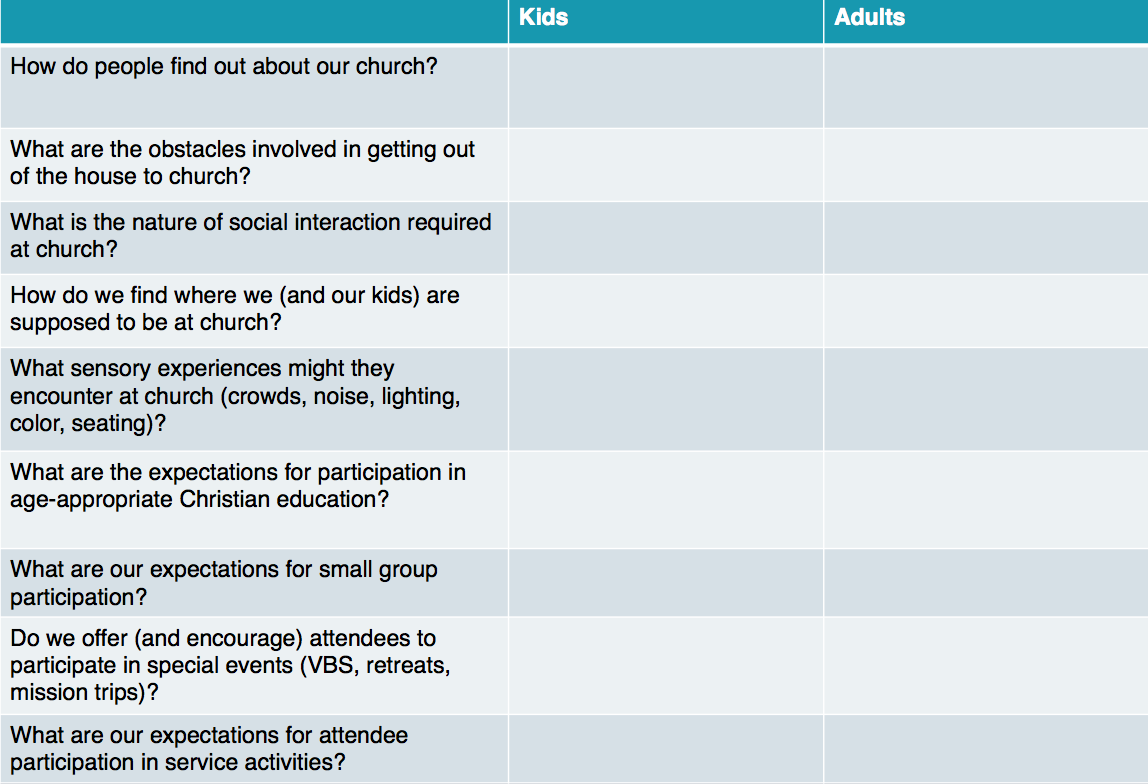
Here’s a chart I put together for a ministry training event listing some of the different environments kids or parents with common mental illnesses are likely to experience at church…

Church Environments

Let’s walk through this model with a hypothetical family that lives near your church…

Mrs. X is a divorced mom in her early 40’s who works from home for a company providing an electronic billing service for small medical practices. She lives down the street from your church with her 14 year-old son Bradley, who has a superior IQ but extremely limited social skills (and is on an IEP at school for support related to his diagnosis of Asperger’s Disorder), her 11 year-old daughter Lauren, who is being treated for separation anxiety disorder, and her 9 year-old son Adam (entirely neurotypical). Adam is invited to Vacation Bible School over the summer by a friend, has a great time, and begins to ask his mother if they can come to church every Sunday. Mrs X has tried several different medications for social anxiety disorder, achieving only a partial response and is predisposed to panic attacks in noisy, crowded places.

What are all the potential barriers Mrs. X and her two older children would face in attending worship services and becoming engaged in activities seen as critical to spiritual growth by your church?

Let’s start with Mrs. X…

  • Is she less likely because of her social anxiety to know someone at the church who could accompany her on her first few visits?
  • How busy or crowded is your church? Is she likely to become anxious in the rush before or after services, or if she can’t find an aisle seat near an exit?
  • Is she likely to experience conflict with her middle daughter when she suggests going to church?
  • How easy will it be for her to navigate all the interactions required to get herself and each of her kids registered and where they need to be on the first few visits?
  • If your church encourages adults to be in small groups, how will she get connected to a group, and how uncomfortable might she be if expected to self-disclose in a group?

With Bradley…

  • How comfortable is he likely to be coming to a large room filled with kids he doesn’t know who already know one another when he doesn’t intuitively process social cues?
  • How will he interact with other kids who don’t share the same interests as his?
  • Will he become resistant to attending if he sees kids at church who made fun of him at school?

With Lauren…

  • What happens when she arrives the first day and encounters the expectation that she leave her mom to join her age-appropriate group in a different part of the campus?
  • How likely is it that she’ll participate in an overnight retreat or short-term mission trip with other middle school kids?

shutterstock_145410157Everyone in this family is likely to function fairly well with some bumps in the road in their day-to-day roles and expectations. Mrs. X probably interfaces by phone with a relatively small number of office staff and insurance company support staff by phone and can handle most of her work by computer with little social interaction. Bradley may get reasonably good grades and have a few kids he’s comfortable with on the robotics team, the Science Olympiad team or computer club. Lauren may miss more school or end up in the nurses’ office more than other kids her age, but she likely has some good friends and may have very good grades. Nevertheless, three people in this family may struggle to adapt to a relatively unfamiliar environment for several hours each week. Church leaders can help to minimize potential obstacles by anticipating the struggles kids and adults with common mental health conditions are likely to experience at each step in the engagement process.

What if Mom could e-mail a “concierge” from the welcome team prior to the family’s first visit to church to arrange for all the necessary registrations, greeted the family at the main entrance and helped everyone in the family to get to the right place?

What if your website made clear that Mrs. X and Lauren could visit in advance of their first visit to become familiar with where one another will be when they attend?

What if Bradley had the opportunity by two or three men on the media/tech team as an alternative to attending a small group in an unfamiliar home with 8-12 other teens?

Every church can do something to make it easier for families impacted by mental illness to attend church once the potential pitfalls are understood.

***********************************************************************************************************

shutterstock_80344798Confused about all the changes in diagnostic terminology for kids with mental heath disorders? Key Ministry has a resource page summarizing our recent blog series examining the impact of changes in the DSM-5 on kidsClick this link for summary articles describing the changes in diagnostic criteria for conditions common among children and teens, along with links to other helpful resources!

Posted in Anxiety Disorders, Autism, Families, Hidden Disabilities, Inclusion, Key Ministry, Mental Health, Ministry Environments, Strategies | Tagged , , , , , , , , , | 3 Comments

This week at The Front Door…

Front Door CrossAs we enter our third week of offering church for families of kids with disabilities at The Front Door, we’re seeking to establish a little rhythm and routine to our schedule.

This week, we’re going to have four different opportunities to worship online, each featuring two great messages. We’re also beginning the practice of having regular worship hours three evenings each week, supported by wonderful hosts who have agreed to be available to our attendees for chat and prayer at the same worship hour every week.

As of this week, we’ll have worship available at 8:00 PM and 9:00 PM Eastern on Sunday, 9:00 PM Eastern on Monday, and 9:00 PM Eastern on Wednesday. As we train new worship hosts, our top priority will be adding worship opportunities on Sunday mornings and Saturday evenings.

This week, we introduce two new speakers at our Front Door/CBC campus…

Ryan Callahan leads off by sharing how he and his wife were led by God to pursue orphan care and adoption in his message, Filling in the Blanks. His message encourages us to consider the plans God may have for each of us. Ken Freeman will also be reminding us that in Christianity, It’s all about the Heart. Both messages will be available at each worship hour.

2014AD_WebBadge_240x350Today is the beginning of Children’s Mental Health Week, and we have some featured resources we’ll be making available on our Front Door/CBC channel

Nationally recognized author, commentator and Key Ministry Board member Rhonda Martin did an interview with Katie Wetherbee on Nurturing Spiritual Growth in Kids With Anxiety that will air daily at 11:00 AM. Rhett Smith, author of The Anxious Christian will be featured in a video discussion of how the church can better include and minister to adults with anxiety disorders daily at 12:00 PM and 10:45 PM Eastern. Disability ministry advocate and mother Gillian Marchenko will be discussing grief and loss in special needs parenting daily at 12:25 PM Eastern and 10:20 PM Eastern. We’ll also have featured presentations all week at our Key Ministry training site.

See you tonight for worship at 9:00 PM and 10:00 PM Eastern!

Steve

One more thing…if those worship times don’t work for you, you can find Online Church here, 24-7-365!

Posted in Advocacy, Anxiety Disorders, Families, Inclusion, Key Ministry, Resources | Tagged , , , , , , , , , | Leave a comment

Thinking “Orange”: Things every kids need…with or without disabilities

Today, we’ll examine ways in which the Orange approach to family ministry addresses unmet needs of kids with disabilities and their siblings.

This week’s discussion covers pages 97-106 in Think Orange.

In the Orange model, Reggie Joiner outlines five critical needs of kids that may be addressed through strategies that promote partnership between parents and churches. The needs (as listed on page 98 of Think Orange) include:

  • A really big God they can trust no matter what
  • Someone else who believes what they believe
  • Another voice saying the same things parents say
  • Uncommon sense to help them make wise choices
  • Nosy parents who know where their kids are spiritually

One reason I found the Orange approach appealing for churches intentional about ministry to families impacted by disabilities is all of the needs listed above tend to be more acute for kids with disabilities and their siblings, and parents of kids with disabilities have fewer places to go outside of the church where they can receive help in meeting those needs. Let’s look at the five needs again:

shutterstock_5067274A really big God they can trust no matter what… Kids with disabilities often have questions about God’s power or God’s intentions that other Christians don’t need to sort out until they’re older or more mature. Why did God make me this way? Why are other kids so mean to me? I’m dumb, I’m stupid. If God cared about me, why is He letting this happen to me? For siblings of kids with disabilities, the questions involve Why did God do this to my family? I don’t get to do anything on the weekend because I have to watch my little brother. Our family never gets to go on vacation or doesn’t have the money to do cool stuff. My parents don’t have time for me. Why doesn’t God make my brother or sister better?

Parents need a church that can help them to personally experience God’s love and provision, and help them to communicate those truths to their kids with and without disabilities.

shutterstock_113814862Someone else who believes what they believe… Parents of kids with disabilities who want them to have Christian friends often don’t have the option of enrolling their child in a Christian school. Private schools in general have fewer resources (special education teachers, speech and language pathologists, occupational therapists, psychologists, etc.) to meet the needs of kids with disabilities with complex educational needs. The cost of treatment means there’s less money available to send any of the kids in the family to private school. There may be no other option beside the church for kids with disabilities to experience a Christian peer group.

Another voice saying the same things parents say… Kids with hidden disabilities often lag behind their peers in developing motor coordination and are less likely to be actively involved in organized sports, making them less likely to have coaches who can help to reinforce their family’s values. Issues with emotional self-regulation, impulse control and the ability to accurately process social cues results in kids with fewer friends and fewer opportunities to form relationships with parents of friends.

shutterstock_161639993Uncommon sense to help them make wise choices… Kids with many hidden disabilities have an increased vulnerability to negative environmental influences…drugs, alcohol, casual sex, risk-taking, antisocial behavior. They need more help from more adults more frequently in order to make good decisions.

Nosy parents who know where their kids are spiritually… The one question parents have the most difficulty responding to during my clinical evaluations is when I ask them to discuss their child’s spiritual development. In my experience, most parents in the church rarely contemplate any type of strategy or plan to foster their child’s spiritual development. What’s the likelihood that a parent would start to think about spiritual development in the same way as academic or athletic or artistic development outside of a place where they’ll encounter other parents with similar values?

Why do I want churches to rethink their approach to ministry for all families, but especially families in which one or more kids has a disability? Kids with disabilities, their siblings and their parents are frequently starving for relationships because of the social isolation that results from the functional limitations of the disabilities in question, both hidden and visible.

For families of kids with disabilities, what better place could there be for them to get their spiritual and relational needs met than the church? It’s an extraordinary opportunity for the church to radically expand its’ influence with our current generation of families, and to the generation to come.

***********************************************************************************************************

Key Ministry-NewEver wonder if the often-quoted statistics about divorce rates in families impacted by disability are true? Check out Key Ministry’s resource: Special Needs and Divorce…What Does the Data Say? In this article, Dr. Steve Grcevich reviews the available research literature on the topic of disability and divorce…and draws some surprising conclusions! Check it out…and share with your friends!

Posted in Families, Hidden Disabilities, Inclusion, Spiritual Development, Strategies | Tagged , , , , , | Leave a comment

Thinking Orange…Partnering with parents when kids have disabilities

In today’s post, we’re going to look at the “Orange” definition of family ministry, the principles that form the foundation of the Orange approach to family ministry and challenges that arise in seeking to partner with parents of kids with disabilities.

This discussion covers pages 78-96 in Think Orange.

On Sunday and Monday of this past week, we looked at five values that are foundational for the role of the family in promoting the spiritual development of kids. Today, we’ll build upon that discussion by looking at Reggie Joiner’s definition of family ministry, the principles upon which the Orange approach to family ministry is built, and how the principles come into play in ministry to families of kids with disabilities, especially hidden disabilities.

shutterstock_96949784It’s important to start with a universal definition of what we mean when we use the term “family ministry.” Here’s the Orange definition of family ministry: An effort to synchronize church leaders and parents around a master strategy to build faith and character in their sons and daughters. Reggie goes on to explain that a family ministry should develop the process that drives how both the church and the home combine their efforts to influence the next generation.

The principles that the Orange approach is built upon include:

  • Nothing is more important than someone’s relationship with God
  • No one has more potential to influence a child’s relationship with God than a parent
  • No one has more potential to influence a parent than the church
  • The church’s potential to influence a child dramatically increases when it partners with a parent
  • The parent’s potential to influence a child dramatically increases when that parent partners with the church

Let’s look at how some of these principles may be applied in ministry to families of kids with hidden disabilities.

shutterstock_5067274Principle 1: Nothing is more important than someone’s relationship with God Think of how challenging this principle is to implement on a daily basis for folks in vocational ministry. Imagine how hard this is for parents of kids with disabilities! Based upon the limited data in the research literature, parents of kids with hidden disabilities are more likely to be single parents. Their kids are likely to require far more of their time and attention. Recommended treatments are time consuming and often expensive. In addition to all of the other “idols” that distract us from God in modern life, the day to day needs of kids with hidden disabilities leave parents with less “margin” to pursue their relationship with God.

Parent Child PrayingPrinciple 2: No one has more potential to influence a child’s relationship with God than a parent. In Think Orange, Reggie introduces the 3000/40 principle. The 3000/40 principle is based upon the observation that a typical kid spends 3,000 hours per year with their parents and 40 hours per year in church-related activities. If we’re trying to build a master strategy to build faith and character in our kids, it makes a great deal of sense to leverage the 3,000 hours a year kids have with their parents as opposed to putting all of our resources into the 40 hours kids spend at church.  This approach is especially relevant in working with families of kids with hidden disabilities, because parents may have more opportunities to interact with their kids compared to families where no disability is present. Let’s just look at our “Big Four” in terms of hidden disabilities in kids:

  • ADHD (11% of kids ages 5-17 are being treated for ADHD)
  • Anxiety disorders (8-12%)
  • Mood disorders…Disruptive Mood Dysregulation Disorder, Bipolar Disorder (3-5%)
  • Autism Spectrum Disorders (1-1.5%)

Each of those conditions imposes either a significant barrier to social interaction outside the home, requires more 1:1 supervision or attention from a parent, or both. That’s why equipping parents of kids with disabilities with the resources they need to use their time to build faith and character in their kids is so important.

shutterstock_79177156Principle 3: No one has more potential to influence a parent than the church. Earlier in this series, we discussed the importance of families of kids with disabilities having a relationship with a local church and Key Ministry’s role in helping churches to make the connection. Once the connection has been made with a local church, some unique challenges arise in partnering with the families we help churches to serve:

  • Parents of kids with disabilities are likely to be more diverse in their spiritual maturity than parents in the general population. Among the families who come through a practice like ours, we see lots of parents who are quite mature in their faith. Some home-school their kids with disabilities because that approach works better for them educationally and home-school their kids without disabilities because of the obstacles in teaching on matters of faith and values in public and secular private schools. At the other extreme, we see parents who may be more lacking in spiritual maturity. They may have stopped attending church when they were ten years old after being kicked out of VBS at the First Baptist Church…today’s reminder of the “apple doesn’t fall far from the tree” principle.
  • Parents of kids with disabilities may have more baggage from negative church experiences in the past resulting from their child’s condition that leaders need to overcome. More so than with parents in the general population, church leaders may need to do more to earn the right to partner with parents from families affected by disabilities.
  • Building influence with families of kids with disabilities may require more energy and effort. They’re often messy. Mom and Dad (if Dad’s in the picture) are often dealing with their own issues. Inconsistency in maintaining the habits that help promote faith development is often an issue when kids are going back and forth between two households, as is likely to be the case for kids with disabilities.

Principle 4: The church’s potential to influence a child dramatically increases when it partners with a parent. See comments in Principle 2 about the 3,000/40 principle.

Principle 5: The parent’s potential to influence a child dramatically increases when that parent partners with the church. It takes a church, working in partnership with a family to raise a child.

***********************************************************************************************************

shutterstock_80344798Confused about all the changes in diagnostic terminology for kids with mental heath disorders? Key Ministry has a resource page summarizing our recent blog series examining the impact of changes in the DSM-5 on kidsClick this link for summary articles describing the changes in diagnostic criteria for conditions common among children and teens, along with links to other helpful resources!

Posted in ADHD, Anxiety Disorders, Autism, Bipolar Disorder, Hidden Disabilities, Inclusion, Key Ministry, Resources, Strategies | Tagged , , , , , , , | 1 Comment