The anger elephant…

shutterstock_24761470

Editor’s note: Jeff Davidson launches a series today… Facing the Elephants in the Room, in which he looks at the overwhelming, but unspoken challenges confronting parents of kids with special needs. Here’s Jeff… 

When you walk down the path of a special-needs dad, you’ll soon find elephants in every room and around every corner. The elephants all have names: anger, blame, discouragement, jealousy, dreams, milestones, and thievery (just to name some of the larger elephants you will encounter).

Time after time as I meet and talk with other special-needs dads, these are the elephants we mention. The phrase “elephant in the room” is used to describe an unspoken yet obvious truth that is being ignored. If we are going to live the life God has purposed for us and be the best special-needs dads we can be to our families, we’ve got to address these elephants before we go any further.

As long as we pretend they don’t exist, we will let these elephants destroy us.

So let’s talk about some of the more common and biggest elephants for a minute.

The Anger Elephant:

So many special needs parents, including myself, wrestle with anger all throughout our journey.

Anger is a natural part of the grief process. As we experience the various aspects of life in our special-needs world, we will always find ourselves at different stages in dealing with our emotions and grief. Anger is one such emotion and stage.

I personally made the near-fatal mistake of letting anger and denial destroy me in the early years after receiving our diagnoses. I was acting out of my anger and l let it affect my relationship with my spouse, my family, and my friends.

Ultimately though, uncontrolled anger hurts ourselves as much, if not more, than others around us. Unbridled anger over our circumstances can lead to bitterness, despair, and chronic sorrow. If anger were a road, it would be a dead-end, leading us to nowhere.

Anger is a response, and we have a choice in how we respond to all situations. We can choose to act, speak, and live out of anger. Or, we can choose to act out of joy, acceptance, and determination to rise above our circumstances.

When we choose the latter, our perspective shifts and changes. God opens our eyes to his purposes, his presence, and his character. God can channel our anger into a holy discontent that he can actually use in our lives.

Our prayers will become more about asking God to use our circumstances than they are about asking him to change our circumstances.

Everything in our lives can be perceived as a burden or a blessing. How we respond ultimately determines the choice we make in our perception. Uncontrolled or chronic anger robs us of the ability to make the right choices when determining how we react and respond to our circumstances.

Surrender and confess your anger problems to God and ask Him for help. Don’t let anger rob you of your joy, peace, and contentment as you go along the journey of being a special-needs parent.

I have seen more special-needs dads destroyed by their inability to let go of anger than perhaps anything else.

shutterstock_336966764Anger also becomes one of the biggest obstacles in our relationships with our spouses as well. Often times our wives don’t wrestle with anger as much as we dads struggle with it. So they have difficulty grasping and relating to our anger at the situation.

Dads have a tendency to transfer or direct that anger to our spouses and other family members, often lashing out with predictable results. Anger leads to bitterness. Bitterness leads to loneliness. And loneliness will lead to destruction and isolation. Anger will rob you of any hope for a positive relationship with your children.

We have to realize early in this journey that men and women grieve differently. You and your spouse may not be at the same stage or on the same page along the way. We must allow room for that and understand we may not be at the same stage at the same time.
***********************************************************************************************************

IMG_8478Jeff Davidson is an author and pastor who enjoys speaking at churches, conferences, events and to groups, ministering to special needs families and individuals. Jeff and his wife Becky started Rising Above Ministries when they realized the incredible gift and blessing their own son with special needs (Jon Alex) was to them. Jeff’s book, No More Peanut Butter Sandwiches, is available through Crosslink Publishing, Barnes and Noble and Amazon.

Posted in Advocacy, Families, Key Ministry, Strategies | Tagged , , , , , , , , | 2 Comments

Do You Feel Like You’ve Achieved Dr. Mom Status?

dreamstime_m_29660790-824x547

Have you ever had a commercial slogan or jingle stuck in your head? Of course you have!

I’m dating myself, I know, but back in the early ‘90’s there was a commercial that used to tout a certain cough syrup’s superiority by boasting that it was not only prescribed by physicians and pharmacists, but it was also recommended by “Doctor Mom.”  It stuck with me.  The implication was that because of their endless involvement in the lives of their offspring, mothers quickly develop wise discernment when it comes to best choices for their children.

Although the advertisement was a bit hokey, it seems an apt description for parents thrust into the role of special caregiver. While the “experts” often look down at us as mere maintenance workers in the home, no one knows a child as well as the one raising them. It is that nuanced learning of the day-in and day-out that creates an amazing skill set in us.

It seems that there are personal phases of study and comprehension to raising our children with challenges:

Read about them at Not Alone …

Posted in Advocacy, Parents | Tagged | Leave a comment

Jeff Davidson…Embracing the brokenness with unconditional love

shutterstock_301534991You have a choice, Dads. You can be like me and wallow in anger, denial, blame, and your own obsession to fix the brokenness. Or you can embrace the brokenness with unconditional love. Embrace your child with special needs just the way God created your child, and love him or her unconditionally and passionately with all your heart.

When you make that choice, you will realize that God has called and chosen you for a unique mission. God has placed you on a mission for your life and He desires to equip you for one of the most amazing experiences you could ever imagine.

I have seen dads never recover from their initial anger. I have seen dads wrestle all their lives with the blame question, and I have observed dads struggling with acceptance because of their denial of their children’s issues. Anger, blame, and denial will keep you from embracing your situation, accepting your child, and choosing to love and parent unconditionally.

shutterstock_301535015When you lay down your personal issues, you will realize there is nothing your child can do or achieve that will ever make you love him any more than you already do. You will love him simply because he is your child.

I’ve been the dad of a child with profound special needs for over eighteen years now. I’ve come to treasure the sometimes small but exceedingly joyful moments that this journey has to offer. I’ve also learned to weather the walks on the dark side and recognize the triggers that set me off on that journey.

But to this day, I regret the early years when I allowed my anger, denial, and obsession with fixing my son to rob me of the sheer joy of just being my son’s dad. Eventually I came to understand the only statistic that really mattered; I have one son—and he had autism.

So I made a decision. A choice. I chose to love my son unconditionally just the way he was—autistic. I chose to embrace his differences, accept his challenges, and love him for who he was—my son. I chose to go into his world and engage with him without reservation and qualification.

Autism is just a label. Just like the word son. The former word describes him, but the latter word defines him.

My son is completely dependent on me for everything in his life. From the moment he wakes up until the moment he drifts off to sleep at night, my wife and I have to provide for his every need. He is incapable of surviving this world without us. He’s utterly helpless on his own. Without me in his life, he cannot survive; he won’t survive.

I love him because he is my son. Not because he has done anything to deserve or earn my love. In fact, there is nothing he can do or achieve that will make me love him more than I already love him. He is my son. I created him. He belongs to me.

shutterstock_233976841_renderedThat’s why I love him. I love him simply because he is mine. I challenge him, I teach him, and I pour myself into him daily. All throughout the day I encourage him, affirm him, and express my unconditional love for him. I think about him all day long. I know his thoughts, his mannerisms, and his needs so well.

Even though there is nothing that could make me love him more than I already do, I love him too much to leave him the way he is. Like all sons, there are times he makes a real mess out of things. That’s when I have to step in and clean up his mess. That’s what fathers do for their sons; they help them clean up their messes.

That’s called Grace.

I believe in him despite his challenges.

I embrace his differences because that’s how he was created.

I believe he is fearfully and wonderfully made, created for a plan and a purpose, and that he is destined to glorify God.

He is my son. So I am his warrior, protector, provider, encourager and equipper. God has created and equipped you to become the warrior, protector, provide, encourager, and equipper for your children and your family too.

The first step in becoming the special needs dad God calls you to be is understanding that God has called you and placed you on a unique mission for your life.

***********************************************************************************************************

IMG_8478Jeff Davidson is an author and pastor who enjoys speaking at churches, conferences, events and to groups, ministering to special needs families and individuals. Jeff and his wife Becky started Rising Above Ministries when they realized the incredible gift and blessing their own son with special needs (Jon Alex) was to them. Jeff’s book, No More Peanut Butter Sandwiches, is available through Crosslink Publishing, Barnes and Noble and Amazon.

Posted in Parents, Special Needs Ministry | Tagged , , , , , , , | Leave a comment

We had no casseroles…

Casseroles60 Minutes presented a remarkable segment on the topic of kids with mental illness in crisis.

I was searching online for the video earlier today and came across some additional footage the producers of the segment were unable to use in the segment. In this footage, Scott Pelley (the correspondent who presented the segment), the producers, and a group of mothers of children at Yale-New Haven Children’s Hospital discuss the stigma of raising a mentally  ill child…

Shortly after the 4:00 mark in this video, Scott tossed out this question…

SP: What is the difference between being the mother of a child who has mental illness and the mother of a child who has heart disease or cancer?

Mothers: Sympathy…empathy…empathy…casseroles.

SP: Casseroles? What do you mean?

Mothers: Somebody needs to share the casserole story.

My daughter, when she was thirteen was hit by a car and fortunately was fine, except for a very bad broken leg. The church organized a brigade of casserole makers, the neighbors brought casseroles, friends, families, everybody. Six months before that, Christina had spent two months on a psychiatric ward, and we had no casseroles. And I’m not blaming the church or the neighbors or anything…because of the stigma, we didn’t tell people.

We can’t allow the enemy to use the stigma of mental illness to keep families out of church! We, as church, also have a remarkable opportunity to share the love of Christ with many families who, because of stigma, may be too embarrassed to let us know when they are in need.

Here’s the entire segment…

Editor’s note: Originally published in 2014 under the title Casseroles, Church and the Stigma of Mental Illness…we were blocked from publicizing the article through Facebook because they considered the original title “offensive.”

Updated February 23, 2018

***********************************************************************************************************

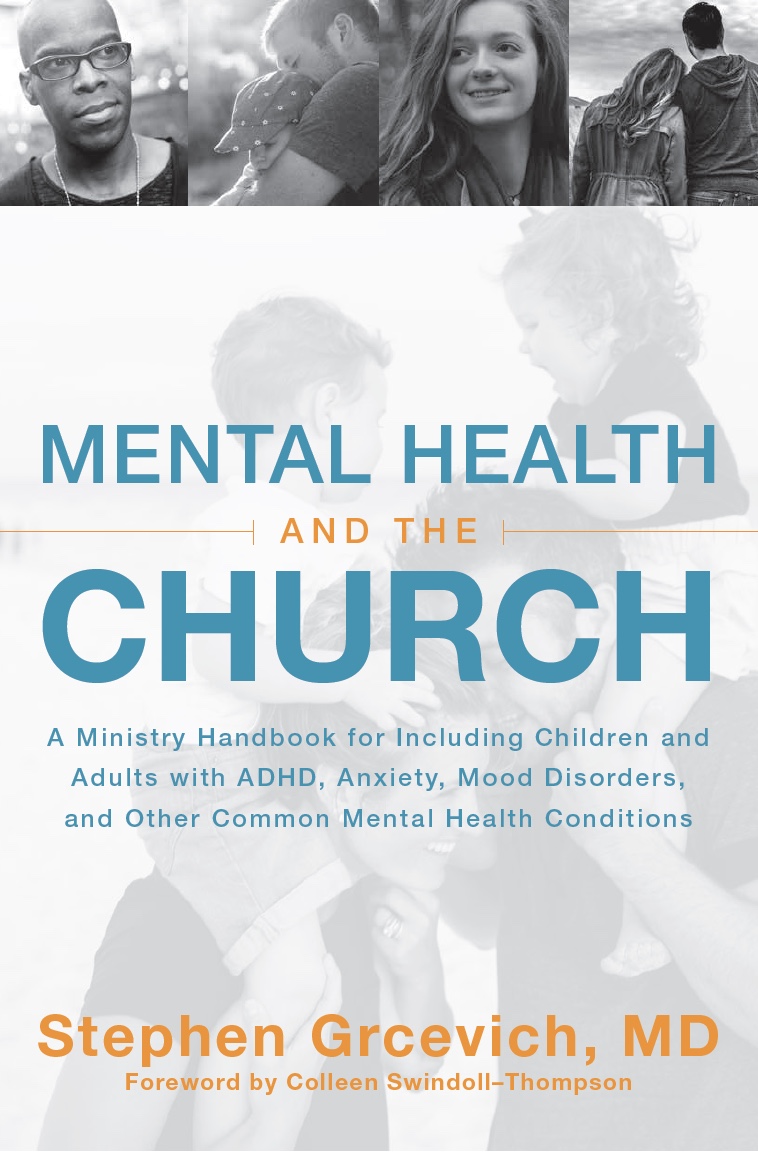
600817_10200479396001791_905419060_nConfused about all the changes in diagnostic terminology for kids with mental heath disorders? Key Ministry has a resource page summarizing our recent blog series examining the impact of the DSM-5 on kidsClick this link for summary articles describing the changes in diagnostic criteria for conditions common among children and teens, along with links to other helpful resources!


Posted in Controversies, Families, Key Ministry, Mental Health | Tagged , , , , , , , , | 2 Comments

Getting to Know Sandra Peoples and Her Mission

10371434_10152421424908704_299004431024602814_nSandra Peoples, our new Social Community and Family Support Manager, is introducing herself today so we can learn more about her and her mission. Welcome to the team, Sandra! 

Eight years ago when my husband and I graduated from seminary, we had big dreams for our future in ministry. Special-needs ministry wouldn’t have made the list back then, but now we see the special-needs community as our mission field, our ministry focus.

My ministry to the special-needs community officially started in 2011 when I wrote an e-book, Speechless: Finding God’s Grace in My Son’s Autism. The book is about my son’s autism and the spiritual journey his diagnosis took me on. Writing that book was one of the hardest things I’ve done. I wanted to put it behind me and say, “Well, that was therapeutic. Let’s do something fun now.” But around the book grew a tribe. A community who loves and supports each other. Who teaches and encourages. Who rejoices and mourns. My community. My ministry.

After that experience my mission became reaching special-needs families to make sure they know they aren’t alone on this journey.

I live out this mission through the opportunities God has given me, like running a collaborative site for parents like me—Not Alone. I took over a couple years ago for the founder, Mike Woods. Our team of special-needs parents has reached thousands of families, helping them find faith and friendship on the special-needs journey.

This site is now part of the Key Ministry family, and my team is so excited to encourage even more people. You’ll find hundreds of articles on our site on topics like special-needs adoption, autism, grief, Down syndrome, self-care, and more. Here are links to some of our top posts if you want to check us out:

10408645_10153192962083704_7752190506023203258_n

Making sure special-needs families don’t feel alone isn’t just my online mission, it’s also our family’s mission. After eight years of pastoring in Pennsylvania, we’ve moved to Pearland, Texas, the fastest growing suburb of Houston. Our goal is to plant a new church that welcomes special-needs families from day one. We’re working hard to meet families and build relationships. We would love for you to pray for us!

Even though this isn’t the ministry I thought I would be called to almost a decade ago, I’m so thankful God’s plans prevailed. One passage that guides my ministry is 2 Corinthians 1:3-5:

“Blessed be the God and Father of our Lord Jesus Christ, the Father of mercies and God of all comfort, who comforts us in all our affliction, so that we may be able to comfort those who are in any affliction, with the comfort with which we ourselves are comforted by God. For as we share abundantly in Christ’s sufferings, so through Christ we share abundantly in comfort too.”

I pray God uses my experiences to encourage others. I look forward to serving families and churches in my new role with Key Ministry!

Where you can find Sandra online:

More resources from Sandra: (affiliate links included)

Posted in Autism, Inclusion, Key Ministry, Special Needs Ministry | Tagged , , , , , , , , , | 1 Comment

Share Your Resolution So You Get Help and God Gets Glory

“What’s your New Year’s Resolution?” It’s that time again. Everyone is asking. Some of us ignore them. Some of us have different ones every year. And some of us, who shall remain nameless, have the same one lose weight year after year.

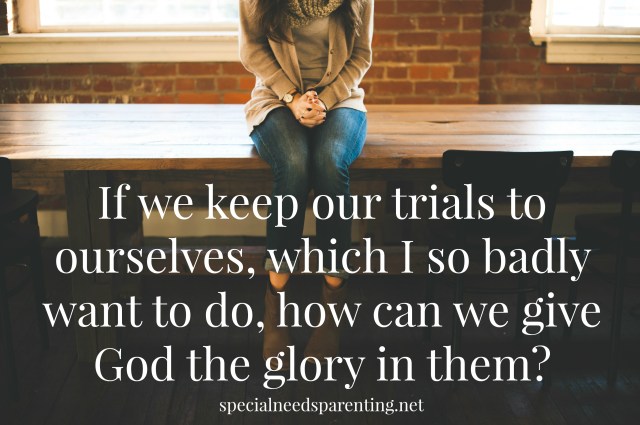
trials

In the last couple of years we really struggled with some behavior issues with our son, Evan. We had no choice but to become quite open about them. People were starting to notice we weren’t coming to the parties, church, Target, or even leaving the house much at all. Our behavior as a family had to change dramatically. In that openness, we asked for prayer. We began praying. It was really a constant prayer every day and night pleading for God to change Evan’s demeanor. We prayed, searched, asked, and let others know of our situation.

It has been a slow change, but Evan has come to a place of living without so much disagreement, to put it mildly. What was the cure, you ask? The magic pill? I have to wonder if opening our need up to others was part of the answer. By asking others to go before God in prayer on our behalf we give God the opportunity to show his glory. John Piper said it well here. He reminds us our whole purpose is to draw attention to God. 1 Peter 2:9-10 says it so well: “… that you may proclaim the excellencies of him who called you out of darkness into his marvelous light … once you had not received mercy, but now you have received mercy.” What better way to tell people about this than how God has worked in our trials. And we can’t do that if we keep quiet about our trials.

Read the rest at Not Alone

Posted in Key Ministry | 1 Comment

Jeff Davidson…How do you overcome becoming a vacant dad?

shutterstock_276490835I thought I was ready to be a dad. My own father had been a great role model in my life and I had many mentors and friends who had experienced the joys of fatherhood.

But I didn’t know anyone who was the dad of a child with profound special needs.

I wasn’t ready.

When my own son—Jon Alex—was born, I went into a tailspin of despair, blame, denial, anger, and confusion. I was lost.

It’s no wonder we have an epidemic of dads walking out on their families in the special needs community. A couple of years ago I began using the phrase “vacant dads” to describe this phenomenon occurring within the special needs community: an entire generation of children with special needs are being raised by moms and grandmothers.

Where are the dads?

More and more often, we are losing the dads of children with special needs within just a few years of diagnosis. But there are two types of vacant dads. One is the dad who walks out on his family and responsibilities, leaving his spouse to raise their child or children alone.

shutterstock_198987524But there is another type of vacant dad. And he is just as dangerous and as likely to occur. That’s the dad who is still in the household, but he is not engaged, he’s not involved, and he’s not actively fulfilling his roles and responsibilities to his family. He’s a vacant dad too. And he’s just as guilty as the dad who walks out on his family. He’s walked out as well, in every way but physically.

Spotting vacant dads is pretty easy. I just have to look in the mirror and remind myself of what it was like for me when I first began this journey as a special needs dad. I had no plan. No plan at all. I had always prided myself on the belief that, given enough time, I could solve any problem, fix any circumstance, and overcome any obstacle. Now I had no idea what to do.

I couldn’t even bring myself to admit there was a challenge in the first place. My son had autism and cerebral palsy, but if I didn’t say it out loud, perhaps over time it would go away. As long as I didn’t say the word “autism,” then my son really didn’t have it. I nuanced it for years.

“He’ll outgrow it. He’s just a little delayed.”

“He’s on the spectrum, but he’s not autistic.”

“He has sensory processing issues, but he’s not autistic.”

I was an ostrich-dad, sticking my head in the sand to avoid reality and to avoid noticing the obvious. I lived in denial and anger for the first couple of years. I almost let them destroy me.

Now after all these years I realize I was a typical dad stuck in denial and emotionally paralyzed by my fear and lack of understanding and acceptance. I was dangerously close to becoming a vacant dad.

We knew so little about autism sixteen years ago. We didn’t know that by 2015, one in sixty-eight children would be diagnosed on the autism spectrum, according to the Centers for Disease Control. We didn’t know it would affect one in forty-two boys by this time. We didn’t anticipate that, if the current growth rate continues unabated, one in every two boys could be affected by 2025.

So I lived in denial. I see it so often now with dads. Rather than embrace the challenge, we flee from the fight. Rather than admit our children are not what we expected, we rationalize and attempt to dismiss the very idea that our child may have challenges.

As a dad, your natural first response is, “I can fix this.” I was constantly researching therapies, dietary intervention, treatments, and medications. I relentlessly poured myself into solving this puzzle of a child with which I had been presented.

I was too busy fixing my son to just be his dad. When I ultimately realized I was not going to fix my son overnight, I made the mistake so many other dads make, taking the first slippery step toward the cliff of becoming a vacant dad; I retreated to something I could fix and master. I retreated and threw myself back into something I could control and that I was good at.

shutterstock_200735750For me, it was work. Every night I would hole up in my basement home office and work until everyone else went to bed. I invented tasks and responsibilities that couldn’t wait until the next day and had to be addressed at night. My wife would actually call me on my home office line to tell me everyone was going to bed.

I hid in plain sight behind my desk and with my job. I justified it by believing I was doing what is required of a dad by providing financially for my family. But that was just an excuse. Just like some dads who choose to hide on the golf course, in the woods or on the lake, in their garage, workshop, or basement with a favorite hobby.

I tried to escape. And you will be tempted to do so as well.

But that’s what vacant dads do. We try to escape. We crawl into the cave of denial and anger and we wander among its stalagmites.

I was also angry and searching for someone to blame. Had God caused this to happen? Was God punishing us? Had we done something wrong? I was mad at God, mad at the world, and mad at my circumstances.

My search for someone to blame just led to more bitterness, frustration, confusion, and anger. Almost every new special needs dad I meet goes through four distinct seasons of emotions:

  • Denial
  • Blame
  • Anger
  • Obsession with “fixing” his child.

I remember resenting going to other kid’s birthday parties or talking to other dads. I loathed watching other children play or hear their parents discussing their growth and development. I wrote these words in my first book, No More Peanut Butter Sandwiches:

“Secretly, I fantasized about building a massive bonfire out of those baby milestone books and having a giant book-burning party. I could see myself silhouetted against the shadows of this massive fire and I would invite all parents of children with special needs to come throw their milestone books on the fire as it stretched towards a blood-red sky. We would feel the glow of the fire against our faces as we shook our fists and raged at an unseen God.”

I wasted the first six years of my son’s life becoming a vacant dad because I wasn’t ready.

Next week I will share my personal story of how I overcame being a vacant dad, and what steps you can take in your life to become the special needs dad God has called you to be.

***********************************************************************************************************

DavidsonJeff Davidson is an author and pastor who enjoys speaking at churches, conferences, events and to groups, ministering to special needs families and individuals. Jeff and his wife Becky started Rising Above Ministries when they realized the incredible gift and blessing their own son with special needs (Jon Alex) was to them. Jeff’s book, No More Peanut Butter Sandwiches, is available through Crosslink Publishing, Barnes and Noble and Amazon.

Posted in Parents, Special Needs Ministry | Tagged , , , , , , , , , , | Leave a comment

What is child abuse: Definitions, signs, and symptoms

shutterstock_116109028

Editor’s Note: Shannon Dingle begins a series for pastors, church staff, volunteers and parents today on recognizing and responding to suspected child abuse. Here’s Shannon.

Last week’s anonymous post by one of our readers was powerful. While difficult to read, children’s ministry leaders and others who work with kids need to be reminded that we will encounter some who are being abused or neglected and need our help. As she wrote last week,..

If someone had taken action when I first disclosed my circumstances instead of dismissing my words because my family seemed fine, I believe it would have made a world of difference in my life. Maybe if someone took my words and signs of abuse seriously, I could have been rescued before the abuse escalated and my abuser started coming to my room at night.

Following the post, our readers had three common responses:

  1. Me too. Several brave women and men commented on our Facebook page (see here and here), sharing that the post resonated with them because they also had been little kids in similar situations. Their stories were heartbreaking but underscore the importance of this topic.
  2. What are the signs of abuse? This post aims to answer that question.
  3. How does mandatory reporting work? In the near future, we will be sharing a post on this topic. For now, I’ll say that reporting should be done officially to those involved in child welfare or law enforcement, not simply to a pastor or friend.

Before we dive into the signs of abuse, how often does it happen, anyway? Well, the CDC offers the research-based estimate that 1 in 4 children experience some form of child maltreatment in their lifetimes. Unfortunately, child abuse and neglect isn’t rare, even if we wish it were. This matters.

So let’s start with some definitions. The federal government’s Child Welfare Information Gateway provides the following primary categories and definitions, found in full here:

  • Physical abuse is nonaccidental physical injury (ranging from minor bruises to severe fractures or death) as a result of punching, beating, kicking, biting, shaking, throwing, stabbing, choking, hitting (with a hand, stick, strap, or other object), burning, or otherwise harming a child, that is inflicted by a parent, caregiver, or other person who has responsibility for the child. Such injury is considered abuse regardless of whether the caregiver intended to hurt the child. Physical discipline, such as spanking or paddling, is not considered abuse as long as it is reasonable and causes no bodily injury to the child.
  • Neglect is the failure of a parent, guardian, or other caregiver to provide for a child’s basic needs. Neglect may be:
    • Physical (e.g., failure to provide necessary food or shelter, or lack of appropriate supervision)
    • Medical (e.g., failure to provide necessary medical or mental health treatment)
    • Educational (e.g., failure to educate a child or attend to special education needs)
    • Emotional (e.g., inattention to a child’s emotional needs, failure to provide psychological care, or permitting the child to use alcohol or other drugs)
  • Sexual abuse includes activities by a parent or caregiver such as fondling a child’s genitals, penetration, incest, rape, sodomy, indecent exposure, and exploitation through prostitution or the production of pornographic materials…
  • Emotional abuse (or psychological abuse) is a pattern of behavior that impairs a child’s emotional development or sense of self-worth. This may include constant criticism, threats, or rejection, as well as withholding love, support, or guidance. Emotional abuse is often difficult to prove, and therefore, child protective services may not be able to intervene without evidence of harm or mental injury to the child. Emotional abuse is almost always present when other types of maltreatment are identified.

shutterstock_1641958So what signs might indicate that a child is being abused? We curated this list from a few sources, including both the Child Welfare Information Gateway, Safe Horizons, and Mending The Soul:

  • Behavior changes such as new fear, anxiety, depression, aggression or withdrawal, not wanting to go home, running away, or appearing afraid of certain individuals
  • Overly sexualized behavior or use of explicit sexual language that’s inappropriate for the child’s age
  • Changes in sleeping patterns including frequent nightmares, difficulty falling asleep. Both may result in the child appearing tired or fatigued
  • Sudden refusal to change for gym or to participate in physical activities
  • Changes in school performance and attendance, such as being unable to concentrate in class or frequent absences
  • Trouble walking or sitting
  • Eating habits that lead to extreme weight gain or loss
  • Visible unexplained injuries such as burns, bruises, or broken bones
  • Noticeable fading bruises or other marks noticeable after an absence from school
  • Evidence of self harm (including but not limited to cutting, which we’ll address in a post here later this month)
  • Use of drugs or alcohol

The biggest sign of abuse, though, is a child’s disclosure to you as a trusted adult (either directly or to a friend who comes to you on his or her behalf). In most cases, the journey of healing begins for a victim of childhood trauma when he or she tells someone and is believed. The best response you can give is, “I believe you, and I’m so sorry that happened to you.” The pain doesn’t end then, but trust and belief can be precious gifts for vulnerable kids in need of adult allies.

Let’s commit to being those allies.

Next week we’ll post about what comes next after the child’s disclosure, in terms of reporting the abuse and connecting the child and family to needed supports for safety and healing.

In addition to serving as a Key Ministry Church Consultant, Shannon Dingle is a co-founder of the Access Ministry at Providence Baptist Church in Raleigh, NC.

***********************************************************************************************************

shutterstock_185745920Key Ministry has produced a number of resources to help church leaders respond more effectively to kids and families impacted by trauma. Dr. Grcevich did this series on trauma and kids. Jolene Philo, author of Does My Child Have PTSD?, authored this series on PTSD in children.
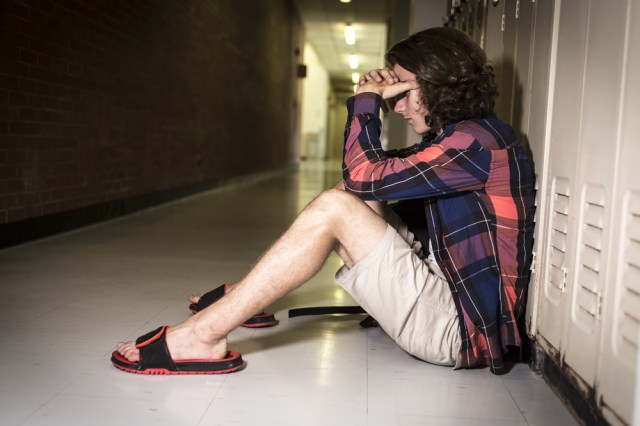
We also recommend resources from the National Child Traumatic Stress Network as well as resources for adoptive and foster parents developed by Dr. Karyn Purvis and Michael & Amy Monroe at Empowered to Connect.

Posted in Advocacy, PTSD, Resources | Tagged , , , , , , , , , , , , | 2 Comments

Is the drive for success in Christian families making our kids sick?

shutterstock_310788722Last weekend, I read a very thought-provoking article from in the New York Times addressing the question… Is the drive for success making our children sick? The findings in the article support what I observe in both my peer group and my practice.

Stuart Slavin, a pediatrician and professor at the St. Louis University School of Medicine, knows something about the impact of stress. After uncovering alarming rates of anxiety and depression among his medical students, Dr. Slavin and his colleagues remade the program: implementing pass/fail grading in introductory classes, instituting a half-day off every other week, and creating small learning groups to strengthen connections among students. Over the course of six years, the students’ rates of depression and anxiety dropped considerably.

But even Dr. Slavin seemed unprepared for the results of testing he did in cooperation with Irvington High School in Fremont, Calif., a once-working-class city that is increasingly in Silicon Valley’s orbit. He had anonymously surveyed two-thirds of Irvington’s 2,100 students last spring, using two standard measures, the Center for Epidemiologic Studies Depression Scale and the State-Trait Anxiety Inventory. The results were stunning: 54 percent of students showed moderate to severe symptoms of depression. More alarming, 80 percent suffered moderate to severe symptoms of anxiety.

“This is so far beyond what you would typically see in an adolescent population,” he told the school’s faculty at a meeting just before the fall semester began. “It’s unprecedented.” Worse, those alarming figures were probably an underestimation; some students had missed the survey while taking Advanced Placement exams.

Vicki Abeles offered this hypothesis to explain the levels of anxiety and discouragement expressed by far too many children and teens in 2016 America…

Expectations surrounding education have spun out of control. On top of a seven-hour school day, our kids march through hours of nightly homework, daily sports practices and band rehearsals, and weekend-consuming assignments and tournaments. Each activity is seen as a step on the ladder to a top college, an enviable job and a successful life. Children living in poverty who aspire to college face the same daunting admissions arms race, as well as the burden of competing for scholarships, with less support than their privileged peers. Even those not bound for college are ground down by the constant measurement in schools under pressure to push through mountains of rote, impersonal material as early as preschool.

Yet instead of empowering them to thrive, this drive for success is eroding children’s health and undermining their potential. Modern education is actually making them sick.

Nearly one in three teenagers told the American Psychological Association that stress drove them to sadness or depression — and their single biggest source of stress was school. According to the Centers for Disease Control and Prevention, a vast majority of American teenagers get at least two hours less sleep each night than recommended — and research shows the more homework they do, the fewer hours they sleep. At the university level, 94 percent of college counseling directors in a survey from last year said they were seeing rising numbers of students with severe psychological problems.

shutterstock_284570393Read the entire article. As the father of two teenage girls, I find myself questioning my role in contributing to the stress my daughters experience on a daily basis and my culpability in shaping values that contribute to unhealthy patterns of thinking and behavior. I was reading this passage of Scripture yesterday afternoon, pondering the disconnect between Jesus’ words and the experience of so many kids and families I’ve come to know…

Therefore I tell you, do not be anxious about your life, what you will eat or what you will drink, nor about your body, what you will put on. Is not life more than food, and the body more than clothing? Look at the birds of the air: they neither sow nor reap nor gather into barns, and yet your heavenly Father feeds them. Are you not of more value than they? And which of you by being anxious can add a single hour to his span of life? And why are you anxious about clothing? Consider the lilies of the field, how they grow: they neither toil nor spin, yet I tell you, even Solomon in all his glory was not arrayed like one of these. But if God so clothes the grass of the field, which today is alive and tomorrow is thrown into the oven, will he not much more clothe you, O you of little faith? Therefore do not be anxious, saying, ‘What shall we eat?’ or ‘What shall we drink?’ or ‘What shall we wear?’ For the Gentiles seek after all these things, and your heavenly Father knows that you need them all. But seek first the kingdom of God and his righteousness, and all these things will be added to you.

Therefore do not be anxious about tomorrow, for tomorrow will be anxious for itself. Sufficient for the day is its own trouble.

 Matthew 6:25-34 (ESV)

From where I sit, four societal developments have contributed to the heightened levels of anxiety, frustration and hopelessness evident in so many children, teens and parents in recent years…

The 2008 financial crisis: When I think back to when the makeup of our practice changed, the number of kids we’re asked to see with anxiety-related symptoms spiked during the aftermath of the crash and has never returned to pre-2008 levels. People who lost their jobs or businesses (or saw their friends and neighbors lose jobs or homes) wanted to protect their children from economic vulnerability through positions contingent upon academic success.

The escalating cost (and competitiveness) of our higher education system: The article I referenced from the Times discussed the steps a medical school professor implemented to relieve excessive stress among students. That stress is NOTHING compared to the stress of getting into medical school.  Kids trying to get into many healthcare-related fields face daily reminders that their ability to pursue what they’ve discerned to be their calling is dependent upon near-perfect grades.

College is outrageously expensive…including Christian schools. My daughter attends a Jesuit university where much emphasis is placed upon extending the love of Christ to the poor and marginalized in society. Her tuition, room and board for her first year of college (after her significant academic scholarship) exceeded the combined cost of med school and my undergraduate education. Kids know they’re placing a huge burden on their families by attending college, and place great pressure on themselves to lessen the cost to their families.

shutterstock_212733064_renderedThe culture of testing in the schools: Thanks to last year’s Common Core tests, I broke my personal productivity record in the office during the two weeks leading up to the exams. While we all want our schools to offer our kids a high-quality education, when we seek to measure quality based upon performance on “one size fits all” standardized tests and tie the compensation of our educators to the scores kids achieve on the tests, we’re exposing our kids to unhealthy levels of stress.

The impact of social media on the insecurities of kids and parents: I work with lots of high schoolers. More so than ever, they find themselves wrestling with questions about where they plan to attend college and what they hope to study because there’s more chatter on social media. When parents see and hear about other people’s kids getting into prestigious schools, earning fabulous grades or getting scholarships, it’s easy to kids to question their own ability and parents to question whether they have done everything they can to avail their children of similar opportunities.

As Christians, we’re increasingly called to lead countercultural lives in embracing values very different than those embraced in the society in which we live. Shouldn’t our kids be “different” in their prevalence of anxiety-related illness and disability compared to their peers? Here are some of the challenges I find myself…and parents of kids I know wrestling with…

  • How do I teach my kids to put their faith and trust in God’s provision as opposed to trusting in their own ability or academic pedigree?
  • How do I trust in God’s provision and not drive my kids too hard to earn scholarships when doing so would ease the burden our family faces from tuition? 
  • When do I tell my kids to let things go in school when they have more demanded of them than is healthy?
  • What do I tell the parents of kids with learning differences who see their kids experiencing more struggles than others in the current environment?

How can we as Christians be “in” but not “of” the world in communicating to our kids how to live healthy and impactful lives in the context of our culture?

***********************************************************************************************************

Not Alone logoKey Ministry is delighted to partner with Not Alone, one of the top resources available for parents of kids with disabilities. Not Alone was developed by a group of special-needs parents who know the heartache of getting a diagnosis and the joy found in the smallest of accomplishments. We speak the same language. We’ve sat in IEPs, hospital waiting rooms, and in the hall during the church service. We push wheelchairs, prepare GF/CF foods, calm night terrors, and plan for our children’s futures. We’re here to help parents find faith and friendship for the special needs journey. Check out Not Alone today!

Posted in Advocacy, Anxiety Disorders, Families, Key Ministry | Tagged , , , , , , , , , , , , , , | 1 Comment

When Those with Disabilities Are Included (and not just tolerated) at Church, Redemption Happens

candle words

Our pastor’s wife, Kim, approached Joel before the service. “Joel, it’s your job to blow out the Advent candles today, OK? So, when it’s time, you and I will walk up front together.”

Joel grinned. Instead of doing what he “knows” he shouldn’t do—but because of the perseverative part of his personality, just can’t help doing—Kim made it his job to do it!

The Advent candles were lit, and the scriptures read. Kim and Joel stood off to the side, waiting, Kim’s arm around Joel’s shoulders.

Becky, the candle-lighter, began to pray. And pray. And pray.

Waiting is not Joel’s forte. Kim tightened her one-armed hug around Joel, whispering in his ear, determined to hold him in place until the right moment.

Read what happened next at Not Alone …

Posted in Autism, Inclusion, Key Ministry, Special Needs Ministry | Leave a comment