Families impacted by depression…How can the church help?

shutterstock_145410157This is the eleventh post in our Winter 2013 blog series Understanding Depression in Kids and Teens…A Primer for Pastors, Church Staff and Christian Parents. Today, we’ll offer some specific strategies for churches seeking to serve and welcome kids (and adults) with depression and their families.

How can churches help families impacted by depression to experience the love of Christ? Here are some thoughts…

Give those with depression permission to talk about it. Steve Scroggin, President of Care Net (a network of pastoral counseling centers in North Carolina) made the following observation about depression in a USA Today story on pastoral suicide…

“Clergy do not talk about it because it violates their understanding of their faith,” said Scoggin. “They believe they are not supposed to have those kinds of thoughts.”

Our friend Matthew Stanford from Mental Health Grace Alliance was quoted in the same article…

Stanford, who studies how the Christian community deals with mental illness, said depression in Christian culture carries “a double stigmatization.”

Society still places a stigma on mental illness, but Christians make it worse, he said, by “over-spiritualizing” depression and other disorders — dismissing them as a lack of faith or a sign of weakness.

When church leaders are willing to talk about depression, they send a clear signal that they’ve likely worked through the stigma associated with the condition in the church. Given the statistics suggesting that depression is more common among pastors than in the general population, lots of leaders have firsthand experience with the topic. It also demonstrates to persons in the church with depression that it’s safe to be authentic about their pain and struggles in the context of Christian community.

Consider offering faith-based support groups. Mental Health Grace Alliance has an excellent model for such groups. In our concluding post in this series, I’ll touch on the theme that God may use the pain and suffering associated with depression to draw people into a closer relationship with Him. We have the hope of the world in Jesus. Who better to share with people who struggle with hopelessness!

Provide them with tangible help. As we’ve discussed in previous posts, high quality mental health services that are also affordable are in very short supply. Several churches in our area offer excellent short term counseling…in some instances, the counseling is made available for free. Knowledgeable advocates within the church willing to assist parents and families in accessing mental health care through their health insurance or local agencies provide an invaluable service. Free respite care for parents struggling with depression can be an incredible blessing. Churches prepared to include kids with special emotional, behavioral and healthcare needs will likely serve a disproportionate number of parents suffering from depression…the condition being more common among parents of children suffering from anxiety, depression, ADHD and other disruptive behavior disorders.

Perry NobleI’ll conclude with a link to a remarkable video from Perry Noble…Perry is a very prominent pastor from NewSpring Church in South Carolina who is much in demand on the conference circuit. Two years ago, he preached a sermon on the topic of depression during which he shared from his personal experiences. This is lengthy, but well worth it. Please share with your friends who are impacted by depression…Perry subsequently wrote a book describing his experiences with depression and anxiety, along with a thought-provoking blog post that we discussed here.

Updated July 18, 2014

***********************************************************************************************************

shutterstock_24510829Key Ministry is pleased to make available our FREE consultation service to pastors, church leaders and ministry volunteers. Got questions about launching a ministry that you can’t answer…here we are! Have a kid you’re struggling to serve? Contact us! Want to kick around a problem with someone who’s “been there and done that?” Click here to submit a request!

Posted in Advocacy, Depression, Families, Key Ministry, Mental Health, Strategies | Tagged , , , , , , , , , | 1 Comment

If this were your kid, would you give them an antidepressant?

Sad boyThis is the tenth post in our Winter 2013 blog series Understanding Depression in Kids and Teens…A Primer for Pastors, Church Staff and Christian Parents. Today, we’ll answer the question parents are most likely to ask…If this were your kid, would you give them an antidepressant?

Few topics in child and adolescent mental health have generated as much controversy over the last decade as the debate about the safety of antidepressant medication given to kids. In 2004, the FDA issued a “black box” warning claiming that antidepressant use in children and teenagers is associated with increases in suicidal thinking and behavior, which was expanded in 2007 to include adults between the ages of 18 and 24. In my opinion, the larger controversy about antidepressant use in children and teens is not “are they safe?” but “do they work?” and if they work, what do they work for? Some of those questions were addressed here.

In an effort to help parents make sense of what they read and hear, we’ll examine the findings of two large studies.

The first study (funded by the National Institute of Mental Health) was conducted by Dr. Jeff Bridge and his team at the University of Pittsburgh, analyzing results of 27 clinical trials of antidepressants…fifteen studies involved kids with depression, six with Obsessive-Compulsive Disorder (OCD) and six with non-OCD anxiety…encompassing 5,310 patients under the age of 19.

Important take-home points…

No child or adolescent patient to date in any trial of antidepressant medication submitted to the FDA or included in Dr. Bridge’s analysis actually committed suicide.

The number of patients who must receive a specific treatment for one to benefit (Number Needed to Treat-NNT) or for one patient to be harmed (Number Needed to Harm-NNH) varied for antidepressants depending upon the condition the child or teen was receiving treatment for in the study.

Major DepressionNumber Needed to Treat=10     Number Needed to Harm=112

OCDNumber Needed to Treat=6     Number Needed to Harm=200

Non-OCD AnxietyNumber Needed to Treat=4     Number Needed to Harm=143

To clarify, patients with depression were eleven times more likely to experience significant benefit from antidepressant medication than to experience medication-related suicidal thinking or behavior.

The second study (also funded by the National Institute of Mental Health) was conducted by researchers at the University of Chicago examined suicidal thoughts and behaviors in 9,165 patients (including 708 youth) treated with fluoxetine or venlafaxine for depression (all of the youth were treated with fluoxetine). In the four studies of youth on fluoxetine, the medication was effective in treating symptoms of depression, and no evidence of increased suicide risk was seen. At the same time, there was no evidence that a reduction in depressive symptoms produced a decrease in suicide risk in youth, as is the case with adults. The author of the study has speculated that other factors beyond depressed mood likely contribute to suicidal thinking and behavior in kids.

So…what advice do I give to parents around use of antidepressant medication when they ask “What would you do if this was your kid?”

ID-100105042First, I’d point out that the potential benefits of medication appear to outweigh the potential risks, especially for kids with anxiety, but in my experience the risk of an increase in suicidal thoughts/behavior associated with antidepressant medication appears to be greater than zero. In fact, if I had to guess, the risk may be a little higher than what the data has led us to believe up to now. I would be most concerned about an increased risk in  kids with some other condition (in addition to depression or anxiety) that interferes with emotional self-regulation and/or impulse control (ADHD, trauma, kids with behaviors similar to those seen in Borderline Personality Disorder). One hypothesis put forth to explain a possible increase in risk involves the suggestion that antidepressants might cause disinhibition in a subset of patients…evidence supporting this hypothesis includes the observation that the pathways in the prefrontal cortex of the brain modulating impulse control don’t fully mature for most people until their early to mid-20s, coinciding with the time after which antidepressants are no longer associated with increased suicidal risk.

Second, since cognitive-behavioral therapy (CBT) appears to be an effective alternative to medication for kids with anxiety and depression, kids with mild to moderate symptoms should probably receive a trial of CBT from the best therapist you can find prior to a trial of medication. If my kid had significant functional impairment from anxiety prior to the onset of depression, prominent physical symptoms (sleep and appetite disturbances) or persistent suicidal thinking, I’d be more inclined to start with a combination of medication and therapy.

Photos courtesy of  freedigitalphotos.net

***********************************************************************************************************

Key CatalogOur Key Ministry team is very much in need of your support if we are to continue to provide free training, consultation and resources to churches. Please consider either an online donation or a sponsorship from the Key Catalog. You can sponsor anything from an on-site consultation at a local church, the addition of a new site for church-based respite care, to a “JAM Session” to help multiple churches launch special needs ministries in your metropolitan area. Click the icon on the right to explore the Key Catalog!

Posted in Depression, Key Ministry, Mental Health | Tagged , , , , , , , , , | 2 Comments

“Thinking Orange”…A Parent’s Perspective-Mike Woods

I’m delighted to introduce today’s guest blogger, Mike Woods from Making Room. As part of our series on “Thinking Orange,” I asked Mike to provide a perspective on what parents of kids with hidden disabilities need from their local church.

Mike received his Masters Degree in Conflict Management from Trinity College and Theological Seminary. He is a certified Crisis Prevention Instructor. In his previous position, Mike worked for the largest school district in St. Louis as an Autism and Inclusion Specialist and is a Board Certified Associate Behavior Analyst. Prior to joining Rockwood, he served as a Master Training Specialist for the Judevine Center for Autism and as an Early Interventionist for the Missouri First Steps Program. He also taught continuing education courses on autism at Coastal Carolina College in North Carolina. He’s currently serving as the Director of Special Needs Ministry at First Baptist Church in Orlando, Florida.

Mike has conducted workshops for a variety of churches, several national level autism conferences, and various annual state conferences.

He is happily married and the father of three wonderful boys, all three of whom are on the autism spectrum. He and his family attended Grace Church while living in St. Louis.  Grace has a wonderful group of people who graciously provide a ministry (“Special Edition”) to families of children with special needs!

You Are God’s Gift to Families

When I moved to Saint Louis with my boys back in 2002 one of the first things on my “to do” list was to find a place of worship.  At first glance it seems like a fairly easy process because you can open a phone book and look under the listing “Churches.” In a town the size of Saint Louis you will find hundreds of churches listed.  No problem, right?  Wrong.

The search for a church poses a big challenge for me.  Why?  Because I have three boys who are on the autism spectrum.   Taking a child with autism to church can be a source of stress for many parents.  People often stare, make comments or fail to understand any mishaps or behaviors that may occur. For example, out of the blue, my son Joshua will frequently kneel down and rub the carpet on the floor briskly with his fingertips.  He is seeking sensory input as a result of sensory integration difficulty which is not uncommon for someone with autism.  To a casual observer, however, the sight of a 13-year old boy kneeling on the ground and rapidly rubbing the carpet appears very strange.  As a result of similar types of experiences, families often feel uncomfortable taking their child to places where people gather together such as church.  Feeling like they cannot socialize or relate to others due to the behaviors of their child, parents of children with autism start to experience a sense of isolation from a community of faith.

Did you know that statistics show that only about 17% of families who have a child with autism belong to a family of faith?  That means that only 2 out of 10 families who have a child with autism know what it’s like to have a church that they can call “home.”  A big reason for this is that many churches do not have a ministry to meet the needs of families who have a child or adult with intellectual disabilities.   For most places of worship, the lack of special need considerations is not intentional, it is simply a matter of not having familiarity with the intellectual disability/special need environment.  So I knew that when I started calling the list of local churches in the yellow pages one-by-one to ask, “Do you have a special needs ministry?” the majority of the answers were going to be, “No.”  And they were.  I called 37 churches that first day, no luck.  Weary, I decided to try again another day.

Some parents would give up searching for a church after awhile.  It’s easy to do when you’ve been told “no” enough times no matter how polite the person on the other end of the phone sounds.  Feelings of rejection/isolation can start to creep in.    It often arises when you start to feel that you and your family have little importance or value in other people’s lives.   Social psychologists tell us that feelings of isolation begin to occur when a person begins to feel excluded from interpersonal relationships.  Isolation from relationships can either be an active process in which an individual or group intentionally excludes someone.  More often than not, however, isolation is usually a passive process by which people simply do nothing when needs are expressed by individuals who are experiencing major life challenges.

Scripture reminds us that we were never meant to live in a state of isolation.  We were created to be relational beings.  None of us was meant to live alone, away from meaningful connection.  Spend one minute looking at Genesis 2:18 and the words “not good” ring out.  “It is not good for man to live alone.”  Living an isolated life does not accurately reflect the One whose image we bear.  “Alone” and “isolated” were never to be used to describe His children.  Henry Cloud said it well, “God created us with a hunger for relationship—for relationship with Him and with our fellow human beings.”  At our core we are relational beings.  Cloud goes on to say, “The human soul cannot prosper without being connected to others.”

Do you want to know the one thing that keeps me going in search of a church?  People like you.  I firmly believe that the odds are good that if you are reading this blog it’s because you have an interest in special needs ministry.  If so, you’ve come to the right place because that’s the focus of Key Ministry.  And here’s one thing that I know about you from the Holy Scriptures:  You are God’s gift to families who have a child with autism. God calls people just like you to Himself, and then blesses you with the purpose of becoming part of a community of Christ-followers focused on helping “the least of these” (Matt. 25:40).  In Scripture God calls his people to live out the gospel pattern of welcome and generosity.  “Therefore, “ Paul says, “welcome one another as Christ has welcomed you, for the glory of God” (Ro.15:7).

I could list a handful of wonderful gifts that you give my children by providing a special needs ministry.  Today, however, I’d like to share with you four wonderful gifts that you bless my wife Linda and I with by providing a special needs ministry to our children and by being a welcoming church:

Gift #1:  The opportunity to express our love for God. Going to church is a visible, tangible expression of our love and worship toward God. It is where Linda and I can gather with other believers to publicly bear witness of our faith and trust in God.  It is where I can bring Him offerings of praise, thanks, and honor, which are pleasing to Him. Indeed, the Lord is deserving of our time and energy to honor Him with our service of devotion. “You are worthy, O Lord, To receive glory and honor and power; For You created all things, And by Your will they exist and were created” (Rev. 4:11).

Gift #2:  The opportunity to fellowship with God. Life can be confusing and at times overwhelming for me as I try to sift through and sort out right from wrong, truth from error, acceptance of things that I cannot change from the courage to change the things that I can.  All the more reason to go to church regularly.  It is in church that the voice of God speaks to me through sermon, Scripture, liturgy, and hymns.  His is a voice of strength and comfort, the voice of healing that I need to desperately to hear.

Gift #3:  The opportunity to be loved and encouraged. All of us face dilemmas and disappointments.  We all wrestle with discouragement and heartache.  Being a part of a loving, caring community is an important ingredient in my quality of life and good health maintenance. Coming to church gives my wife and I an opportunity to receive an encouraging word, a hug and a smile.  It means having someone who will listen and speak the words of comfort and direction that we need to hear.  How often a timely word of Gospel spoken from the heart of one believer to another makes the heart joyful!

Gift #4:  The opportunity to build up our spiritual strength. Receiving the preaching and teaching of the Word of God increases our faith and builds us up spiritually.  Every believer knows what it is to face spiritual conflicts to their faith, and realizes the importance of being fed spiritually so that they can overcome the challenges. Paul states that Christians must put on spiritual armor for protection, as it will take everything at our disposal to stand (Eph. 6:10-18). How important then that parents of children with special needs be given every opportunity available to receive ministry and strength from God’s Word. “So then faith comes by hearing, and hearing by the word of God” (Rom. 10:17).

I may have not had any luck on that first day of calling churches.  However, on my second day of making phone calls to churches I finally did hear, “Yes…yes we have a ministry for families of children with special needs!”  That group of people, people just like you, have been God’s gift to my family for the last two years.

I would encourage you today to look for those families in your community who need a “gift.”  They’re out there and they need to know that someone cares.  Perhaps you’re not sure of where or how to start.  If that’s the case then call Key Ministry today.  They are here to help you help families just like mine.

Originally published March 23, 2011.

Special Friends MinistryMike has been involved in the development of Not Alone, a blog written by parents of faith who have children with special needs. They have in excess of 7,500 followers within their first two months of operation. Check it out, along with the free Special Friends Ministry app First Baptist has made available through the iTunes store (available by clicking the link in the sidebar on this page).


Posted in Autism, Families, Hidden Disabilities, Inclusion, Key Ministry, Parents | Tagged , , , , , , , , , , | 1 Comment

Cognitive-Behavioral Therapy for kids with depression…pros and cons

ID-10072756This is the ninth post in our Winter 2013 blog series Understanding Depression in Kids and Teens…A Primer for Pastors, Church Staff and Christian Parents. Today, we’ll look at the data on the non-pharmacologic treatment with the best supporting evidence in the treatment of children and teens with depression…Cognitive-Behavioral Therapy.

Do not conform to the pattern of this world, but be transformed by the renewing of your mind. Then you will be able to test and approve what God’s will is—his good, pleasing and perfect will.

Romans 12:2 (NIV)

Along with medication, Cognitive-Behavioral therapy (CBT) represents one of the two primary, evidence-based treatments for children and adolescents with Major Depression. Interpersonal Therapy (IPT) also has supporting evidence for effectiveness in pediatric depression, but far less than CBT.

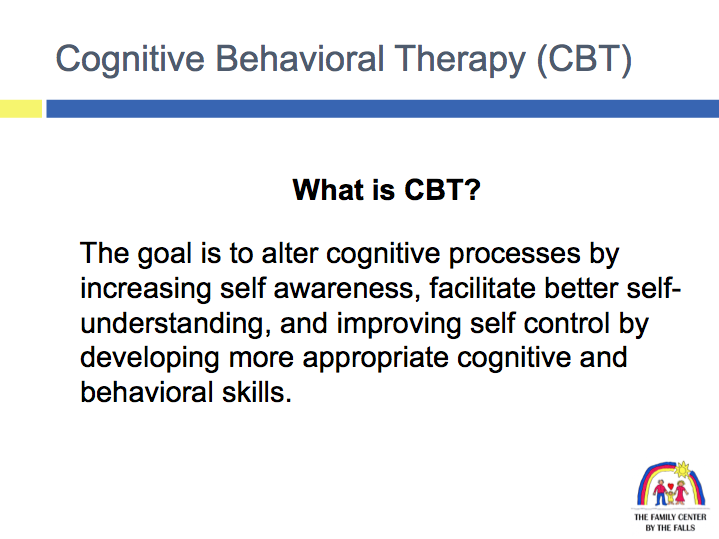
CBT 1What exactly are we trying to do with kids through CBT? I’m including a slide (right) from a presentation Dr. Sherri McClurg from our practice uses to explain CBT in lectures with parents. Kids who experience depression and/or anxiety are especially vulnerable to “thinking errors.” The kids I treat are prone to what one of our therapists refers to as “stinking thinking”…automatic, irrational thoughts pop into their heads in the course of day-to- day living that trigger negative emotions and lead to patterns of self-defeating behavior. These patterns of self-defeating behaviors often reinforce their cognitive misperceptions and lead to a downward spiral resulting in symptoms of anxiety, depression, and sometimes, suicidal thoughts or plans. The job of the therapist is to help kids recognize the irrational thoughts and maladaptive patterns of behavior that contribute to negative emotions and help them to identify and implement alternative patterns of thinking and behavior in those situations when they’re most vulnerable to thinking errors. We’ll describe this to kids by telling them that we’re teaching them coping strategies or tools in order to give them the power to manage their emotions…helping them to develop a sense of competency.

Here’s an excellent review article for parents summarizing the research and application of CBT in children and teens with depression from the journal Child and Adolescent Psychiatric Clinics of North America. One of the challenges in interpreting the data on CBT in kids involves the highly variable estimates of the effect size of the treatment (how much better do they get?) in kids with depression. This also points out the major functional limitation of a treatment plan for a child with depression that incorporates CBT- The child’s response is highly dependent upon the skill level and experience of the clinician providing the treatment.

We have a policy in our practice of not accepting referrals of kids who are involved in ongoing treatment with a clinician we don’t know. One reason I feel strongly about this is that I need to know what kids are getting if I’m being held responsible for their care. Not everybody who claims to be doing CBT with kids is actually providing a treatment that remotely resembles the therapy referenced in the article I linked to earlier in the post. While there’s a psychotherapeutic component to what I’m doing when I prescribe medication that (hopefully) contributes to the treatment effect, there’s less likely to be big difference in a kid’s response to Prozac based upon whether I’m the person writing the prescription as opposed to their pediatrician or nurse practitioner. After all, it’s all probably coming from the same jar at the CVS or Walgreen’s! The effectiveness of their CBT is highly dependent upon who’s doing the treatment. The lack of availability of well-trained clinicians in use of CBT with kids and teens creates enormous access problems for families.

Another functional limitation is the cost of CBT versus medication for kids with depression. In the two principal studies comparing CBT and medication in pediatric depression (the subject of our next post), kids received 12 sessions of CBT during the acute phase of treatment. A typical course of treatment for a kid with depression will involve around 20 visits with decreasing frequency over the course of a year. In our area, none of the three clinicians who I most frequently refer families to for CBT participate in insurance networks and their fee per session ranges from $125 to $140. One way of looking at the treatment is that it still costs less than my kid’s orthodontist and provides them with skills that last a lifetime. On the other hand, at $4/month, a year’s supply of Prozac will can cost a family under $50, and the copays for 4-6 follow up visits over the course of the year with their primary care physician or in-network psychiatrist may run from $100-$300. Given the state of the economy and the financial demands families are facing, cost all too often becomes the overriding consideration in treatment planning.

Finally, for many kids and families, the time required for effective CBT is a major impediment. Finding time to do CBT can be a big problem for teens when they’re “in-season” for their sport, or for kids in the performing arts when they’re preparing for a play or a recital. Between extracurricular activities and homework, it’s not uncommon for kids to tell me that the stress involved with blocking out time to come to therapy outweighs the benefits.

Bottom line…I encourage families to consider CBT before medication for their child or teen with depression when…

  • Their child’s symptoms of depression are less severe.
  • When their child’s mood state appears highly dependent upon their misperceptions and irrational patterns of thinking and behavior.
  • A significant risk exists that antidepressant medication will exacerbate some other comorbid mental health condition or suicidal/self-injurious behavior. I’ll discuss this further in an upcoming post.

Photos courtesy of  freedigitalphotos.net

***********************************************************************************************************

Accessibility Summit 2013Our Key Ministry team will be hitting the road to be part of the 2013 Accessibility Summit, hosted by McLean Bible Church in suburban Washington D.C. on April 19th-20th. This year’s Summit features Emily Colson (daughter of Chuck) As an artist, author, and speaker, Emily is passionate about inspiring others to persevere through their challenges and appreciate life’s gifts. In her book Dancing with Max, she and her late father share the struggle and beauty of life with Max, Emily’s son with autism.

For more on our Key Ministry presentations, click here. For more information on the Summit and registration, click on the Summit logo to the right.

Posted in Depression, Families, Key Ministry, Mental Health, Resources | Tagged , , , , , , , , , | 25 Comments

Where do I go for help if I think my kid might be depressed?

ID-100105042This is the eighth post in our Winter 2013 blog series Understanding Depression in Kids and Teens…A Primer for Pastors, Church Staff and Christian Parents. Today, we’ll share practical advice for families who suspect their child may be experiencing depression and are beginning the search to find the right help.

Families in the church face an additional burden in seeking help when a child or teen needs help for depression. Accurate data is hard to come by, but a significant percentage of adults will first seek help from a pastor or counselor through their church when struggling with emotional issues. It’s been my experience that many churches offer reasonably good short-term counseling and support for adults, but very few will have staff with adequate training or supervision in counseling children or teens. So…where does a parent go to find the right help when they suspect their child needs help for depression?

A couple of years ago, we addressed the topic of whether Christian parents should only seek help from mental health professionals. The conclusions we came to were:

  • You might be waiting for a very long time to get help if you insist upon seeing a specialist in child and adolescent psychiatry or pediatric psychology who is also Christian… especially an evangelical Christian. Mental health professionals with formal training and experience in treating children are in very short supply and Christians (especially from more theologically conservative denominations) are enormously underrepresented in the field.
  • The critical issue for parents who have a kid in need of mental health care is finding a clinician with a track record of demonstrating excellence in what they do, as long as they’re willing to respect your family’s belief system.

The right person is likely to be someone who will take the time not just to determine “what” condition your child is experiencing, but to understand WHY they’re experiencing symptoms and develop an appropriate treatment plan on the basis of that understanding. They’ll want to do detailed interviews with both parents (if available) along with taking the time to get to know your child, and they’ll possibly be interested in observations from other significant adults in your child’s life. They’ll be interested in your child’s academic progress. They’ll want to know about family history, especially if they suspect your child might have a mood disorder. They’ll be knowledgable about the full range of evidence-based treatments and have ongoing working relationships with other professionals if there are important treatments they themselves don’t offer.

The next question that arises has to do with identifying a professional within the appropriate discipline (psychiatrists vs. psychologists vs. counselors vs. marriage and family therapists vs. pastoral counselors). Here’s a nice resource from the American Academy of Child and Adolescent Psychiatry explaining some of the differences. In general, if your child is experiencing significant sadness or anxiety and they’re not experiencing significant physical symptoms associated with their condition, or if you’re unwilling to consider medication as part of a more comprehensive treatment plan, it’s not unreasonable to start with a psychologist or counselor. You would want to find someone with evidence of formal training or supervision in cognitive-behavioral therapy if you suspect they might be depressed or anxious. If your child also has significant learning problems, I’d lean toward a psychologist, because many also have training and experience in performing the testing batteries necessary to identify learning disabilities. The more complex your child’s condition and the more severe their symptoms, the more likely you are to want to start with a child and adolescent psychiatrist (MD).

Given the prevalence of mental health conditions among teens, many parents rely upon recommendations from friends when seeking help. If I had to guess, I’d say that between 30-50% of our new patients come via recommendations from parents of kids we’ve treated. In addition to other parents, I’d consider seeking recommendations from…

  • The children’s pastor, youth pastor or counseling pastor at your church, assuming you’re comfortable discussing mental health concerns with them.
  • Your child’s pediatrician or family physician.
  • Your child’s school psychologist or guidance counselor, again assuming you’re comfortable discussing mental health concerns with school personnel.
  • Your employee assistance plan (EAP), if you have one.
  • Your local mental health board, or local chapter of a mental health advocacy organization (NAMI).

There’s a very good possibility that you may need to go outside your health insurance network to find the help you need for reasons that we described here. Above all, remember that God loves your child even more than you do and pray that His purposes will be fulfilled through your family being guided to the right help.

***********************************************************************************************************

Key Ministry’s mission is to help churches reach families affected by disability by providing FREE resources to pastors, volunteers, and individuals who wish to create an inclusive ministry environment. We have designed our Key Catalog to create fun opportunities for our ministry supporters to join in our mission through supporting a variety of gift options. Click here to check it out! For a sixty second summary of what Key Ministry does, watch the video below…


Posted in Advocacy, Depression, Families, Key Ministry, Mental Health, Resources | Tagged , , , , , , , , | Leave a comment

Is our system for treating persons with ADHD broken? Or is our society broken?

Richard FeeOver the past couple of years, I’ve taken the opportunity to blast away at stories published in the New York Times that propagate misinformation about the diagnosis and treatment of mental health conditions…ADHD in particular. The Times ran another story on its’ front page on Sunday that’s being circulated widely across the psychiatric community…describing in great detail the course of treatment of Richard Fee, a 24 year-old aspiring medical student who committed suicide in late 2011 two weeks after running out of his ADHD medication. I’d encourage you to read the story describing the experiences of Richard and his family throughout his course of his treatment. Sadly, his story is not atypical of histories I’ve heard from other kids (generally younger than Richard) and families coming through our practice. I’m going to make some comments based upon the article…

It’s not uncommon for kids to come to our office for an assessment after having obtained medication for ADHD from someone at school. I heard through the grapevine of a kid in a local middle school having been arrested for offering to sell ADHD medication. True addiction to ADHD medication is fairly rare. Most misuse in our area appears to be driven by pressure to perform academically.

When I’m in the process of evaluating kids for ADHD, I’m looking for corroborating information from as many different sources as possible. I’ll typically ask parents to bring in their child’s year-end report cards for as far back as they kept them…I’m looking for “red flags” in the teacher’s written comments and grades for behavior, work completion, time management and organization. Also, kids and adults with ADHD are notoriously poor at being self-observant. I would ALWAYS want another observer present (typically a parent) if evaluating a young adult for ADHD.

Kids with ADHD are complicated. In our practice (not necessarily a representative sample), the vast majority of our teens and young adults with ADHD have some other mental health condition in addition to ADHD…most commonly, anxiety disorders or OCD. Medications for ADHD frequently exacerbate those conditions. Lots of kids experience unpleasant side effects and it’s far more common for them to take less than their prescribed dose or lie and tell us they’re taking medication when they really aren’t. On the rare occasions when they start taking more medication than prescribed, the common denominator in my experience is that they’re kids with obsessive anxiety who get stuck on the thought that they need more medication to accomplish some task. They’re not physically addicted to the medication so much as they’re psychologically addicted. In these situations, the stimulant medication often intensifies obsessive thinking and produces inappropriate anger, meltdowns, irritability, aggression and emotional lability. In this case, Richard was a bright kid struggling to get the test scores necessary to get into med school when he first sought treatment.

Our mental health system leaves young adults in a limbo of sorts…we grant them complete autonomy in making decisions about their care and cut off the ability of their families to be fully engaged in their treatment when they’re still of an age when they continue to depend upon their parents for emotional and financial support. The same is true of our educational system…parents receive tuition bills from their kid’s college but are denied the ability to access information about their academic progress. If parents are paying for their young adult child to stay on their health plan they should be able to participate in their child’s treatment. In our practice, any kid I’m treating over the age of 18 has to agree to allow me to engage with their family as I see fit in order to continue with us.

A larger issue is how to explain a 141% increase in the number of prescriptions for stimulants being written for young adults over the past five years. Here are some thoughts…

  • The insurance-driven practice model allows for little more than cursory evaluation and brief medication visits. This isn’t right, but there are many physicians who take the path of least resistance when patients come in asking for a specific product or treatment. The reason you see so many TV commercials that include the phrase “Ask your doctor about…” is because those commercials work. Some of this is the fault of the profession, some the fault of the pharmaceutical industry and some the fault of the insurance industry and their pharmacy benefit managers, but physicians in general and psychiatrists in particular are all too often viewed as prescription vending machines. I think many of our colleagues get to the point where they’re too tired to fight it anymore.
  • Society has come to demand a level of productivity and responsiveness thanks to the wonders of technology that’s unsustainable for many, and more and more young adults find themselves looking for medical solutions in order to keep up. People routinely send (and expect return e-mails) on Saturday nights, weekends and holidays for non-emergent situations.

Our current system of caring for people with mental health disorders is in a near state of collapse. Sadly, I have little hope of the situation getting better and fear things are going to get much worse. What I found unsettling about this story is how accurately it represents the service delivery system that kids and families enter into when they leave our practice.

Updated May 16, 2014

***********************************************************************************************************

KM Logo UpdatedKey Ministry has assembled resources to help churches more effectively minister to children and adults with ADHD, anxiety disorders, Asperger’s Disorder, Bipolar Disorder, depression and trauma. Please share our resources with any pastors, church staff, volunteers or families looking to learn more about the influence these conditions can exert upon spiritual development in kids, and what churches can do to help!

Posted in ADHD, Advocacy, Controversies, Families | Tagged , , , , , , , , | 2 Comments

What if Mom is depressed?

Sad GirlThis is the seventh post in our Winter 2013 blog series Understanding Depression in Kids and Teens…A Primer for Pastors, Church Staff and Christian Parents. Today, we’ll look at another challenge for the church…What happens to the kids when a parent is struggling with depression?

Consider for a moment the impact upon kids when a parent is depressed…

According to an Institute of Medicine report, 15 million children in the U.S. are living with a depressed parent at any given point in time.

Having a depressed parent is a significant risk factor for depression in kids. Kids are three times more likely to develop depression when they have a depressed parent. That observation seems intuitive, but research suggests that genetics only contributes 30-40% of the risk of depression. Other factors clearly come into play…the availability of the child’s other parent, the temperament of the child, the interplay between environmental influences and genetic expression, birth weight (lower weight conveys greater risk), age of menarche (early puberty associated with greater risk), the nature of parent-child interactions, family systems issues and exposure to adverse life events. Risk factors also work both ways…the experience of having a child with special needs may increase risk of depression in parents.

ID-10013676Children of parents with depression (especially boys) are also at greater risk of developing other internalizing disorders (anxiety), externalizing disorders (ADHD, disruptive behavior disorders), cognitive delays, medical problems, lower than expected academic performance and social delays.

Another interesting aspect of our discussion about depression involves the research suggesting that church attendance results in a significant decrease in depression symptoms among children and youth, and in turn, church attendance among adults appears to significantly reduce their risk of depression as well. The research findings examining the relationship between faith, spiritual practice and depression are very complex and probably merit several posts upon completion of this series. But for the sake of this discussion, it appears that in examining depression as a specific disability, regular involvement of either the child or the parent with depression at church not only produces spiritual benefits, but actually helps reduce the risk for the condition itself.

Therefore, an argument can be made that it’s very important to get the entire family to church if any member of that family is affected by depression. So, what can the local church or individuals from the local church do to help mom (or dad) and the entire family?

Be proactive about inviting friends and neighbors to church (with their families) who are struggling from depression and the feelings of isolation and hopelessness that frequently accompany the condition. Given the numbers of persons being treated for depression…over 20% of  women in the U.S. regularly take prescription medication used to treat depression, nearly all of us are likely to know several friends or colleagues being treated for depression.

Establish inclusive weekend ministry environments where the children of parents with depression (at greater risk themselves for “hidden disabilities”) can experience the love of Christ.

Be on the lookout for families who are irregular attenders, or families who have been regulars but are absent for weeks at a time. Follow up with them. Just be with them. Offer to serve them. Avoid the mistake that Job’s friends made in assuming that his condition was related to punishment for sin or some lack of faith.

Support the involvement of organizations and ministries that offer care and support to families impacted by depression. Mental Health Grace Alliance is an outstanding organization now in eight states offering “Grace Groups” to provide ongoing Christ- centered support and practical tools to help navigate life with any mental illness, including depression. The National Alliance on Mental Illness (NAMI) has an ongoing outreach to faith communities. Research indicates that many persons with chronic depression may have been experienced negative interactions with church leaders when seeking help for their condition. The church may need to go above and beyond to restore relationships in light of past hurts.

It would appear to me that God would use afflictions such as depression to help those He loves to draw closer to Him. The church is obligated to be obedient by doing everything possible to help those suffering from depression by pointing them to the path and by keeping the path as smooth as possible.

Photos courtesy of  freedigitalphotos.net

***********************************************************************************************************

Key Ministry’s mission is to help churches reach families affected by disability by providing FREE resources to pastors, volunteers, and individuals who wish to create an inclusive ministry environment. We have designed our Key Catalog to create fun opportunities for our ministry supporters to join in our mission through supporting a variety of gift options. Click here to check it out! For a sixty second summary of what Key Ministry does, watch the video below…


Posted in Depression, Families, Hidden Disabilities, Inclusion, Key Ministry, Mental Health, Resources, Strategies | Tagged , , , , , , , , , , , , | Leave a comment

Church…A Hostile Environment? (Part Two) Harmony Hensley

Our featured blogger today is our Key Ministry teammate Harmony Hensley, with part two of her post from Wednesday on ways in which church may represent a “hostile” environment to families of kids with hidden disabilities.

Harmony currently serves as Key Ministry’s  Director of Ministry Advancement. Previously, she served as Pastor of Outreach and Inclusion Ministries at Vineyard Cincinnati. The Vineyard has been ranked as one of the 50 most influential churches in America and is known for a strong outward focus and servant culture. Harmony has a Bachelor of Arts Degree from Cincinnati Christian University with a double major in Ministry Leadership and Biblical Studies. 

There is also a “human” component to your ministry environments.  This can certainly be the trickiest part to assess and impact, but it’s not impossible.  I’ve often said ministry would be easy if we didn’t have people involved.  (If you’ve ever worked with people you can probably identify with that statement).

Steve has done an amazing job spotlighting some issues around aggression as it relates to ministry in his most recent blog series.

I would encourage you to take a two pronged approach to making your church a more welcoming environment for families and kids impacted by disability.

First, do an honest walk through and assessment of your facility.  I certainly understand that ministry dollars are always tight but many of these solutions are free to inexpensive and often invite opportunities for creativity.  Create a checklist of improvements or enhancements that you and your team would like to tackle and complete them one at a time.  Before you know it you will have created a very sensory friendly space for the children you serve!

Second, invest in your volunteers.  Serving children with special needs, particularly hidden disabilities such as Aggressive Behavior Disorders, Bipolar, Autism, ADHD, and other mental health issues is intimidating.  The “people” are just as important as the paint, lights, and textures that children interact with.  (I know – I’m preaching to the choir here!  WE ALL LOVE VOLUNTEERS!!!!)  Most volunteers  feel ill-equipped to serve and reach these families.  But the good news is that there are a number of FREE resources and teachings available to you as a ministry leader to further empower your team.  Be intentional about training your volunteers (all of them in kid min; not just your inclusion volunteers) to better understand aggressive behaviors.

***********************************************************************************************************

Key CatalogOur Key Ministry team is very much in need of your support if we are to continue to provide free training, consultation and resources to churches. Please consider either an online donation or a sponsorship from the Key Catalog. You can sponsor anything from an on-site consultation at a local church, the addition of a new site for church-based respite care, to a “JAM Session” to help multiple churches launch special needs ministries in your metropolitan area. Click the icon on the left to explore the Key Catalog!

Posted in Hidden Disabilities, Inclusion, Key Ministry, Ministry Environments, Strategies | Tagged , , , , , , , , | Leave a comment

Redefining disability…and what it means for the church

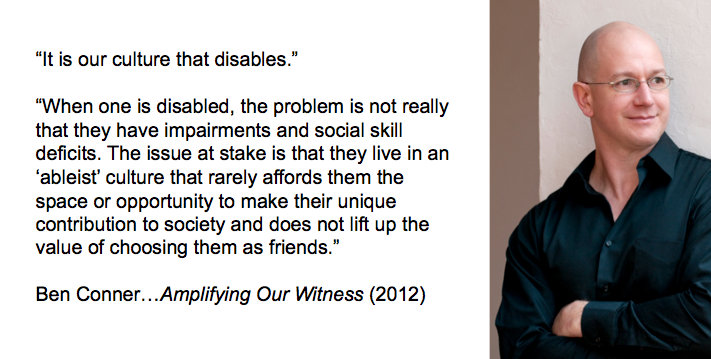
Ben Conner QuoteEven though I am free of the demands and expectations of everyone, I have voluntarily become a servant to any and all in order to reach a wide range of people: religious, nonreligious, meticulous moralists, loose-living immoralists, the defeated, the demoralized—whoever. I didn’t take on their way of life. I kept my bearings in Christ—but I entered their world and tried to experience things from their point of view. I’ve become just about every sort of servant there is in my attempts to lead those I meet into a God-saved life. I did all this because of the Message. I didn’t just want to talk about it; I wanted to be in on it!

1 Corinthians 9:19-23 (MSG)

The apostle Paul was incredibly passionate about wanting to share the Gospel with everyone he encountered. He was willing to do whatever it took to tell people about Jesus…including repeat visits to cities where the people attempted to kill him. We’ll come back to Paul’s example later…

I came across an interesting article on the Forbes Magazine website last week illustrating a shift in the way many in society are understanding the concept of disability. The article is largely taken from an interview with Dan O’Connor of the Berman Institute of Bioethics at Johns Hopkins University following a U.S. Department of Justice ruling that a Massachusetts university is required under the Americans With Disabilities Act to provide gluten-free meals to students with celiac disease who have no choice in purchasing the university’s meal plan. Here are two quotes from Dr. O’Connor that help illustrate the paradigm shift in how some are viewing disability…and the opportunities and challenges the new thinking presents to those serving in the disability ministry movement.

“One school of thought,” he says, “is that it’s your body that’s disabled you. If you can’t walk and use a wheelchair, it’s your legs that disable you, for example. But the newer thinking is that it’s not your body that disables you, it’s the environment around you.” For example, an environment full of stairs is actually what disables a person in a wheelchair. “That’s a much more interesting way to look at disability,” he adds. “So the onus isn’t on the ‘disabled’ person, it’s on the environment and on all of us.”

On behalf of our team at Key Ministry, I’ve made the argument on many occasions that the greatest barrier to inclusion of kids with emotional, behavioral and developmental disorders (what we’ve referred to as “hidden disabilities”) and their families at church involves the challenges presented by the environments in which we do ministry. Some common examples would include…

  • The child with sensory processing issues expected to participate in high-energy children’s ministry large group worship with bright lights and loud music.
  • The child with combined type ADHD expected to sit still and demonstrate self-control for an extended period of time in uncomfortable clothes and seating through worship services with content designed for adults.
  • The self-conscious teen who experiences difficulty picking up on nonverbal social cues who becomes resistant to attending small groups in the homes of unfamiliar peers and adults.
  • The middle schooler with separation anxiety who misses out on all the overnight retreats and mission trips.

As more and more people in society (and the church) recognize the contributions our environments make to conditions our society recognizes as disabilities, we have an opportunity to rethink our paradigm of how we minister to kids and families with disabilities. We can ponder how we can create ministry environments where kids with “neurodiversity“…differences in how they process sensory stimulation as well as verbal and non-verbal language, differences in ability to self-regulate emotion and behavior, differences in how they perceive threat or risk…and their families can thrive as they learn about Jesus, come to faith in Him and grow in faith in Him.

This doesn’t mean we turn our back on the proven methods and strategies for supporting families impacted by disabilities. Our movement is incomplete without both the traditional and evolving service paradigms for “doing” inclusive disability ministry. In this way, we can avoid one of the challenges Dr. O’Connor identified for the disability community…

“What you may find is an interesting division between people ‘traditionally disabled’ – who are blind, or in wheelchairs, for instance, who’ve fought long and hard for these rights, and whose disabilities interact with them every day – and those who are ‘disabled in other, ‘newer’ ways. They may become vexed with people trying to get particular part of their life made easier. Who’s really disabled? The traditionally disabled may worry that political gains they’ve made will be left behind.”

It’s not an either-or for the church…it’s both. Just as the church has many members with unique gifts and talents and abilities, individual churches will have programs and environments that will be more appealing to some families than others. Allow me to share two general principles that would help us collectively as a movement to become like Paul in “becoming a servant to any and all”…

No church will be able to develop a special needs/disability ministry or create ministry environments that will be ideal for every child and every family with every imaginable disability.

Every church can and should be intentional about doing something to become more welcoming and inclusive to families of kids with disabilities.

Accomplishing this is not without overwhelming challenges. Every church has a contingent of people who are adamant about doing church “the way we’ve always done it.” Any attempt to change ministry environments will be met with resistance (think about how worked up folks get about the music at church!) and has to be done in a way that those environments continue to appeal to kids and families who are “neurotypical” and most importantly, our ministry environments need to fulfill their primary purpose… helping kids and parents to come to know Christ and to grow in Christ.

I’m encouraged that God is at work here…because we clearly can’t do this in our limited wisdom and strength. But we can look forward to God working through the circumstances to hasten the day when there will truly be a church for every child.

***********************************************************************************************************

Accessibility Summit 2013Our Key Ministry team will be hitting the road to be part of the 2013 Accessibility Summit, hosted by McLean Bible Church in suburban Washington D.C. on April 19th-20th. This year’s Summit features Emily Colson (daughter of Chuck) As an artist, author, and speaker, Emily is passionate about inspiring others to persevere through their challenges and appreciate life’s gifts. In her book Dancing with Max, she and her late father share the struggle and beauty of life with Max, Emily’s son with autism.

For more on our Key Ministry presentations, click here. For more information on the Summit and registration, click on the Summit logo to the right.

Posted in Families, Hidden Disabilities, Inclusion, Key Ministry, Ministry Environments | Tagged , , , , , , , , | 1 Comment

Church…A Hostile Environment? Harmony Hensley

Our featured blogger today and Thursday is our Key Ministry teammate Harmony Hensley.

Harmony currently serves as Key Ministry’s  Director of Ministry Advancement. Previously, she served as Pastor of Outreach and Inclusion Ministries at Vineyard Cincinnati. The Vineyard has been ranked as one of the 50 most influential churches in America and is known for a strong outward focus and servant culture. Harmony has a Bachelor of Arts Degree from Cincinnati Christian University with a double major in Ministry Leadership and Biblical Studies. 

I imagine the title of this blog alone may ruffle some feathers.  How could someone say that church is a “hostile” environment?  The nerve!

Stay with me for a few paragraphs and I’ll explain what I mean.  The dictionary defines hostile as “not friendly, warm or generous; not hospitable.”

For families and children impacted by disability church is all too often viewed as a “hostile” environment in which they feel judged or unwelcome.  Sadly, I’ve met a number of families who would summarize their church experience this way.

Often this is a result of words unspoken, and the very environment we create to reach people for Christ.  The encouraging news is that many of the things that make the church experience difficult for these families are easily remedied.

Think of your ministry environment in terms of the sensory and social experience that visitors (both adults and children) will encounter.

Let’s take a “virtual” walk through your campus.  Close your eyes and imagine your campus (well, first read this blog and THEN close your eyes and do a virtual walk through- you get the idea).

When families pull into your parking lot what do they see?  Is there clear signage or staffing to direct them where to park?  Can they quickly identify your children’s ministry entrance?

When they enter into your children’s ministry entrance what does that experience look like?  Is the environment loud?  Over-stimulating?  How is the lighting?  Who is staffing the entrance?  What is their hospitality approach?  What signage is present in your facility?  What signage is missing?

These may seem like odd questions but I assure you these are the things that the families we serve are thinking about.  As my Key Ministry teammates can tell you many of the kids we serve have a number of questions that are scrolling through their mind as they think about the church experience –

  • Where are we going?
  • Who is going to be there?
  • What will it be like?
  • What if it’s cold?
  • What if they make me sit in an uncomfortable chair?
  • What if they make me sit?  (I don’t like to sit; I like to walk around)
  • Where will Mom and Dad be?
  • What if they make me read aloud?
  • What if they ask me a question and I don’t know the answer?
  • What if it smells funny?
  • What if it’s too dark?  What if it’s too bright?
  • What if it’s too loud?
  • How will I know what is coming next?
  • What if there are too many people?
  • What if…..(insert countless  anxieties here)?

There are a number of easy fixes we can look at to make sure that our ministry environment is inclusive.  In my posts from last year (which you can see here and here) I go over a number of tips that can dramatically impact the way in which children with ADHD will interact with your space.  On Friday, we’ll continue this discussion by taking a closer look at the human component of your ministry environments.

Updated January 30th, 2013.

***********************************************************************************************************

Accessibility Summit 2013Our Key Ministry team will be hitting the road to be part of the 2013 Accessibility Summit, hosted by McLean Bible Church in suburban Washington D.C. on April 19th-20th. This year’s Summit features Emily Colson (daughter of Chuck) As an artist, author, and speaker, Emily is passionate about inspiring others to persevere through their challenges and appreciate life’s gifts. In her book Dancing with Max, she and her late father share the struggle and beauty of life with Max, Emily’s son with autism.

For more on our Key Ministry presentations, click here. For more information on the Summit and registration, click on the Summit logo to the right.

Posted in Families, Inclusion, Ministry Environments, Strategies | Tagged , , , , , , | 1 Comment