Risky Rise of the Good Grade Pill…or New York Times Hatchet Job?

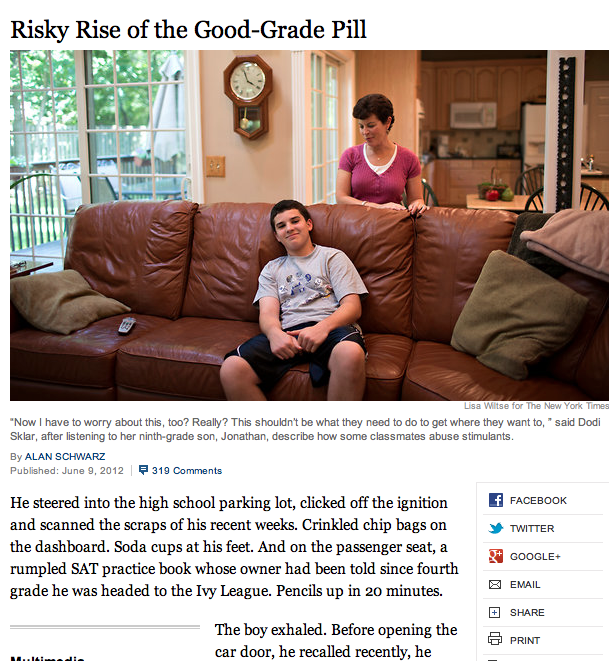
The New York Times has published a story making the sensational claim that 15-40% of students attending elite college preparatory schools in the Northeast corridor are abusing stimulant medication on a regular basis to improve their scores on college entrance exams and grade point average to gain admission to the most competitive colleges. The story begins with the story of a boy from a prestigious high school in suburban New York City and eight of his friends snorting Adderall in the parking lot on the morning of the SATs.

In addition to smearing the reputations of kids attending elite private high schools  and casting doubts upon the legitimacy of their academic accomplishments, the author of the story relies completely upon anecdote in using the platform offered by one of our “newspapers of record” in propagating misinformation that leads parents to unnecessarily fear seeking help for teens who are struggling academically…and often emotionally.

Some observations about the story from the perspective of a child and adolescent psychiatrist whose practice serves a significant population of kids and families from equally competitive schools in suburban Cleveland…accompanied by supporting data:

Kids are under extraordinary pressures to succeed in school and the college admissions process is intensely more competitive than in my generation. U.S. students are competing with kids throughout the world for limited positions in our elite universities. Given the state of the economy and uncertainty about the future, kids are under more pressure from parents to seek admission to prestigious universities. Once accepted, they’re competing against peers for limited scholarships to help pay the exorbitant tuition charged by those institutions. But I can’t say that I see many kids illegally obtaining stimulants to enhance academic performance. I would say I see at least five kids regularly using marijuana to self-medicate anxiety associated with the pressures from school for every kid illicitly using stimulants.

Here’s data from the 2011 National Survey on Drug Use and Health, conducted by the U.S. Substance Abuse and Mental Health Services Administration examining illicit drug use among youth ages 12-17:
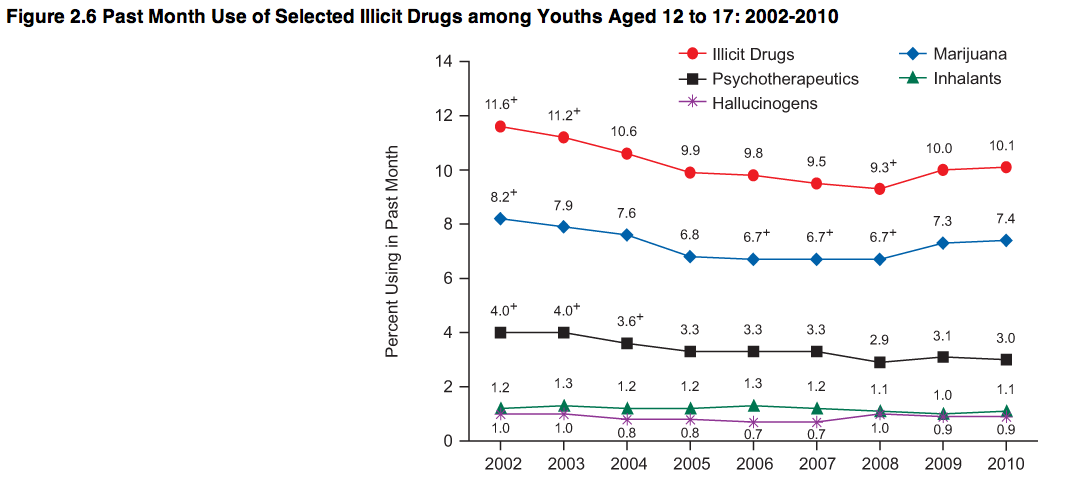
The rate of illicit use of psychotherapeutic medication (predominantly stimulants) has been decreasing over the past ten years. Narcotics obtained from drug cabinets at home and from the homes of friends are far more likely to be used illicitly than stimulants prescribed for ADHD.

A small percentage of kids at highly competitive schools will procure stimulants from peers who had been prescribed medication for ADHD. My teenage daughters have told me this happens.  Many kids who seek out medication for ADHD do turn out to meet criteria for the disorder following careful evaluations. There is evidence that students in fraternities and sororities with poor grades at highly competitive colleges in the Northeast are more likely than other college students to misuse stimulants.

If a child has ADHD and is treated with stimulant medication, they are no more (or less) likely to develop a substance use disorder than persons with ADHD who aren’t treated medically. Here’s a link to the highest quality study examining the relationship between ADHD treatment and future substance abuse.

A physician who takes the time to conduct a complete evaluation, involving input from teachers and parents (in addition to the student) and a thorough review of educational records is significantly less likely to be fooled by a kid coming in to get a prescription for medication that they don’t otherwise need. When I’m evaluating an older kid for ADHD, I ask parents to bring in their year end report cards from the time the child first entered school. There’s often a signature pattern for ADHD seen in the teacher comments year after year…problems with poor organization, less than optimal work habits, careless mistakes on papers and tests, excessive socialization, difficulty meeting deadlines, etc. A good clinician is going to look for corroboration from sources outside of the family (when available) prior to making a diagnosis. If anything, the child or family seeking medication for academic performance enhancement is going to seek out a busy primary care physician as opposed to a specialist with the time and inclination to do more thorough assessments.

To the extent that this type of illicit stimulant use occurs for cognitive enhancement, we as parents have to look carefully at what we communicate to our kids in terms of expectations for their academic success. Parents who send their kids to elite private schools have made a major investment in time and money in their education. My wife and I caught lots of flack from society folks she volunteered with when we decided to send our girls to public school. At the time, we calculated that we’d need to spend $500,000 after taxes to send them to one of the elite private girls’ schools in our area. In order to do private school, they would have lost their time with us. Kids pick up on the sacrifices their parents make to provide them with the opportunities to attend the best schools and don’t want to disappoint them…or fail to achieve their affirmation and blessing.

I’d like to think that we’ve tried to communicate what’s most important to our girls through our actions…they’ve seen my wife become very active in our local public school while serving as Board President at two major non-profits in our area and she’s almost always at home to greet them at the end of their day. They’ve seen me serve in leadership at church and through Key Ministry. And most nights, they’ve seen both of us at dinnertime.

Most parents I meet don’t seem to have a plan to guide their kids to the best possible future. To the extent that this type of medication misuse occurs, I wonder what we’re communicating to our kids about priorities and where to seek security?
Key Ministry’s mission is to help churches reach families affected by disability by providing FREE resources to pastors, volunteers, and individuals who wish to create an inclusive ministry environment.  We invite you to partner with us as we advance the Kingdom through our collaboration with the local and global church.  We have designed our Key Catalog to create fun opportunities for our ministry supporters to join in our mission.  The Key Catalog includes a variety of gift options for every budget.  A gift from the Key Catalog also makes for an amazing gift for a friend or loved one who is passionate about seeing the Body of Christ become more inclusive of people with disabilities.  Click here to check it out!

Posted in ADHD, Families, Mental Health | Tagged , , , , , , , , | Leave a comment

Is “Special Needs” Acceptable People First Language?

Our team at Key Ministry emphasizes the use of People First Language in our training events and throughout our ministry resources. People First Language represents an intentional effort to recognize that individuals are not defined by their disabilities. We want to communicate in a manner demonstrating respect for all people we serve and avoid language that perpetuates misconceptions that persons with disabilities are needy and dependent. Churches that participate in our Free Respite network sign an agreement in which they pledge to use People First Language at respite events.

People First Language appears to have originated from within the speech and language pathology community in an effort to develop a communication strategy to convey respect to the clients they serve. The American Speech-Language Hearing Association has developed an excellent resource on Person-First language that can easily be shared with church leaders and volunteers.

We’ve been considering the appropriateness of the term “special needs ministry” in this miniseries of posts. In our first post, we raised the concern that use of the term results in churches overlooking the needs of the largest group of families with children with conditions that present impediments to church participation and spiritual growth. Next, we discussed the challenges presented by the use of a term with no common agreed-upon definition. Today, we’ll consider whether use of the term “special needs ministry” is consistent with the principles of communication we want to model in our work.

Earlier this week, Christopher Phillips shared a very useful link with opinions from the disability community on the appropriateness of the word “special.” A handful of consistent themes run through criticisms of the use of “special.”

“Special” often carries with it the connotation of separate or segregated. Think in terms of the Special Olympics. While some kids may be most appropriately served at church in self-contained classrooms, the vast preponderance of kids with disabilities can be successfully integrated in most or all age-appropriate church activities. The vast majority of parents I meet in our practice desperately want their kids to be included in the activities and events in which their same-age peers participate. Does the church want to run the risk of parents developing a first impression that their child will be served differently than their peers? 

“Special” doesn’t communicate any specific information that helps church staff or volunteers to better understand how to meet the needs of an individual child or family. Consider “special education.” If someone didn’t have a background in education or the healthcare, would that term help them understand the nature of the services a child needs? One of the challenges churches face in launching ministry for families of kids with disabilities is fear of the unknown. Does use of vague and non-specific language help or hurt efforts to recruit volunteers and promote organizational buy-in for this type of ministry?

“Special” often means just the opposite when applied to persons with disabilities. Is it easier or more difficult to find families for children available through special needs adoption?

My takeaway on the subject…after considerable reading:

The majority of parents I work with in my practice (and an even higher percentage of kids) are desperate to not be seen as different. I have kids who would prefer to fail in school as opposed to be seen as different by their peers for walking into the special education department. I think there’s considerable risk that kids who become aware of being served through a “special needs ministry” would feel hurt and offended. I think there’s a minimal risk that parents who are currently outside the church might avoid involving kids in a “special needs ministry” because of assumptions their child would be treated differently. But why should the church run the risk of using language that might present an additional barrier to families of kids with disabilities connecting with their larger family in Christ through the local church?

Next in the series: If not “Special Needs Ministry,” what should we call the ministry we do?

Key Ministry’s mission is to help churches reach families affected by disability by providing FREE resources to pastors, volunteers, and individuals who wish to create an inclusive ministry environment.  We invite you to partner with us as we advance the Kingdom through our collaboration with the local and global church.  We have designed our Key Catalog to create fun opportunities for our ministry supporters to join in our mission.  The Key Catalog includes a variety of gift options for every budget.  A gift from the Key Catalog also makes for an amazing gift for a friend or loved one who is passionate about seeing the Body of Christ become more inclusive of people with disabilities.  Click here to check it out!
Posted in Controversies, Inclusion, Key Ministry, Strategies | Tagged , , , , , , , , , | 4 Comments

What’s the Definition of “Special Needs?”

This past Tuesday, we began to consider the question of whether we should abandon use of the term “Special Needs Ministry.” The principal argument put forth is that most kids with disabilities that produce impediments to church participation and spiritual growth would not view themselves (or be viewed by their parents) as having “special needs.” Today, we’ll raise another issue…When we use the term “special needs” to refer to a population of underserved children, who exactly are we referring to?

Thanks to the wonders of Google, one discovers quickly that there is no uniform definition of the term “special needs” under Federal law. In fact, the term special needs is used very differently in educational settings as opposed to the foster care, child welfare and adoption systems.

In the educational system, “special need” is often used synonymously with special educational needs. Children with emotional, behavioral, learning or psychiatric disorders generally qualify for special education services under the Individuals With Disabilities Education Act (IDEA) or accommodations under Section 504 of the Rehabilitation Act of 1973. Here’s a summary from the American Academy of Child and Adolescent Psychiatry describing how children qualify for additional services at school. Used within this context, the term “special needs” would be used to describe a very broad group of children and include kids with the full range of disabilities that often pose impediments to active involvement at church. Terri Mauro from About.com has a very nice summary article describing the scope of conditions falling under this broader rubric of “special needs.”

In the social welfare, adoption and foster care systems, the designation of “special needs” refers to qualifications under state law that qualify children and families for Federal financial assistance. Here’s an excellent summary from the U.S. Department of Health and Human Services of the differences in the use of the term “special needs” in the child welfare system. Kids who meet the legal definition of “special needs” for the purposes of the adoption and foster care systems will often not qualify for special education services. Likewise, kids with identified special needs at school may not qualify for additional funding or services when they’re adopted. To further confound the issue, the legal definition of “special needs” is different from state to state. Here’s a website listing the state-by-state definitions of “special needs.” A child can lose their designation of having “special needs” simply by their family relocating.

As more and more churches are led to serve and include kids with disabilities and their families, we need a common language if we’re going to work together effectively. In the absence of a common understanding of the definition of “special needs,” should we consider using different language to describe the nature of the ministry that we offer? And are there families impacted by disability for whom use of the term “special needs ministry” represents yet another barrier to church participation/attendance.

Updated August 2, 2014

***********************************************************************************************************

KM Logo UpdatedKey Ministry is pleased to make available our FREE consultation service to pastors, church leaders and ministry volunteers. Got questions about launching a ministry that you can’t answer…here we are! Have a kid you’re struggling to serve? Contact us! Want to kick around a problem with someone who’s “been there and done that?” Click here to submit a request!

Posted in Advocacy, Controversies, Inclusion, Key Ministry, Strategies | Tagged , , , , , , , , | 2 Comments

Should We Abandon Use of the Term “Special Needs Ministry?”

Today’s post on whether we should abandon the use of the term “special needs ministry” is the first in a series of Difficult Questions we’ll be addressing over the course of the summer.

What image comes to mind when a child is described as having “special needs?” Do you think of…

  • A child with Down’s Syndrome?
  • A child with autism?
  • A child with cerebral palsy?

More importantly, if you were a parent of a child or a teen with the following conditions would you think of your child as having a “special need” if they…

  • Maintain straight A’s in school with no special services but demonstrate extreme shyness in social situations and has great difficulty in unfamiliar environments?
  • Take medication to help with inattentiveness and disorganization associated with ADHD and work with a tutor for 45 minutes every school day in the resource room for assistance with reading comprehension?
  • Excel on their school’s Science Olympiad team and maintain excellent grades, but struggle with personal hygiene, talk about nothing but Dungeons and Dragons and are oblivious to social cues when around other kids?

My guess is that most parents would not consider the last three children described above as having “special needs.” And almost certainly, most of the kids described would not think of themselves as having “special needs.” I’d argue that our use of the term “special needs” narrows our focus in such a way as to exclude large numbers of kids and families who require some intentional effort and support to be successfully included at church, but fall somewhere outside our existing ministry paradigm.

In the not too distant past, I attended a conference with leaders of disability ministries where an argument was being made that churches needed to indicate their willingness to minister to our target population by placing the symbol on the right on their websites and in their yellow pages ads. In the same way that most parents of kids with emotional or behavioral disabilities (by far and away the most common disabilities in the pediatric population) wouldn’t think that a ministry identified by the symbol to the right would have anything to offer them, most families of kids with significant disabilities wouldn’t think of their child as having a “special need.” Worse yet, most churches don’t recognize the unmet needs of children falling outside their mental model of “special needs.” We radically limit the potential for God to work through our ministries by maintaining a narrow focus upon “special needs.”

Next: What’s the definition of a “special need?”

Updated March 14, 2014

***********************************************************************************************************

Emotional girlConfused about all the changes in diagnostic terminology for kids with mental heath disorders? Key Ministry has a resource page summarizing our recent blog series examining the impact of the DSM-5 on kidsClick this link for summary articles describing the changes in diagnostic criteria for conditions common among children and teens, along with links to other helpful resources!

Posted in Controversies, Inclusion, Key Ministry, Strategies | Tagged , , , , , | 15 Comments

The Next Chapter in a Remarkable Story

Annie Wetherbee is graduating from high school this afternoon.

Several months after launching this blog, I shared a little of Annie’s story, along with a link to an outstanding series of blog posts written by Annie’s mom, Katie Wetherbee, our Director of Training at Key Ministry.

Annie’s a very impressive kid. She’s been very active in serving through her local church and launched “Tiger Stripes,” a service group composed of students at Chagrin Falls High School who volunteer to help kids with special needs at the Intermediate School (grades 4-6) be included in community education activities.

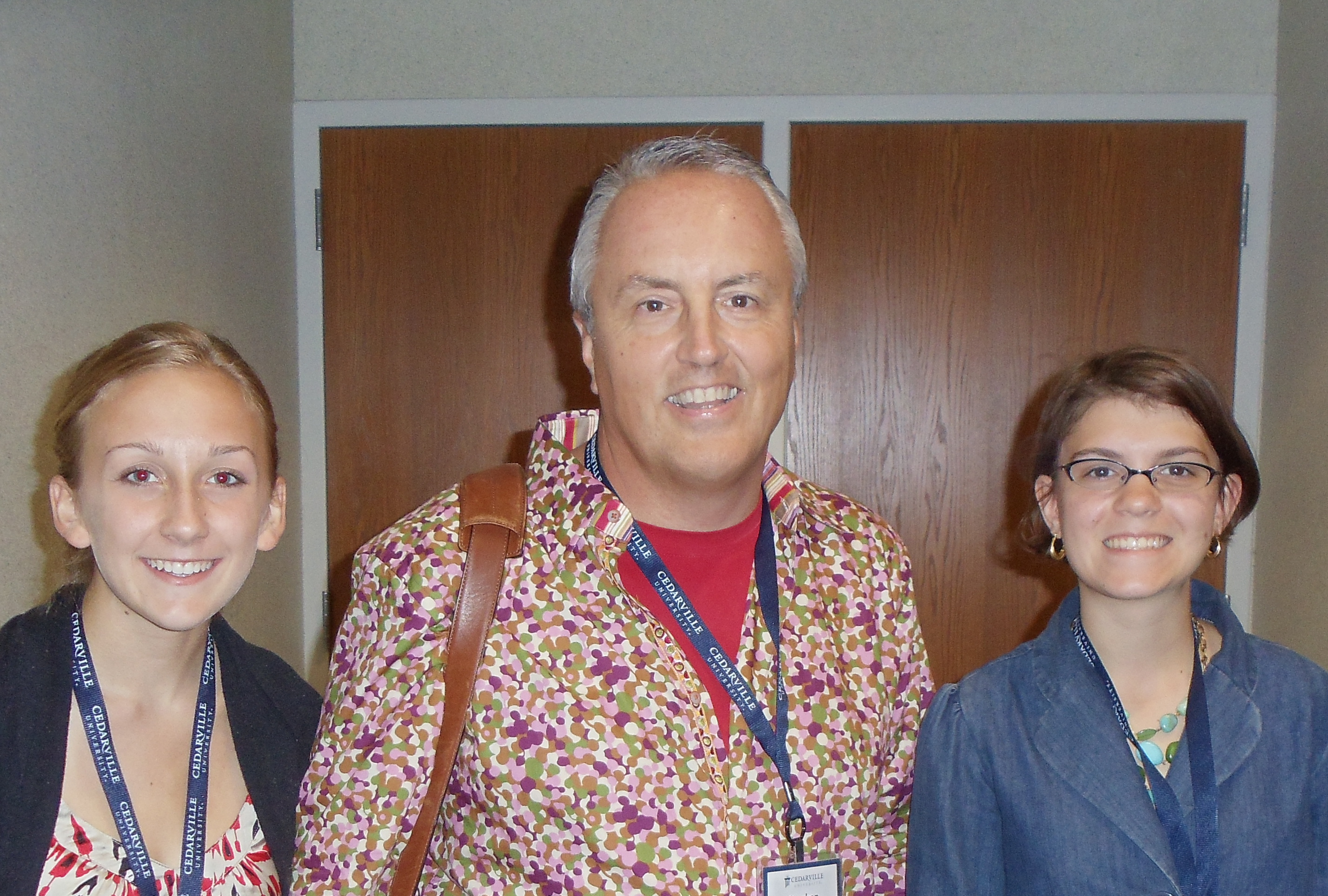
Annie has volunteered to speak on behalf of Key Ministry at the Joni and Friends Through The Roof Summit last fall at Cedarville University (Annie is on my right in the picture seen here, with Abby Hamilton on my left). She’s been accepted into Calvin College this fall with plans to pursue a career in Speech and Language Pathology.

Annie’s story is a great demonstration of God’s plans being fulfilled through the adversity of a disabling condition…

First, Annie is fortunate to have had parents well-grounded in their relationship with Jesus. Katie’s work with Key Ministry speaks for itself in expressing where she is in her faith. I served for two years with Annie’s father (Tom) on the elder board of their local church and can attest to his spiritual maturity, wisdom, patience, clear thinking and grace. There’s no doubt that Annie grew up in a home where the directives expressed in Deuteronomy 6 were implemented on a daily basis.

Next, Annie’s family found a church shortly after they moved to Cleveland where they could feel confident Annie would be well-cared for while they had the opportunity to worship together. Her parents already had a strong spiritual foundation at the time of Annie’s illness, but where can parents of kids with disabilities go to come to know Jesus and become strong enough in their faith to implement Deuteronomy 6 if they aren’t raised with that foundation? Where can they go if their assumptions about God are challenged as they experience the daily challenges that occur when a child has a disability? That’s why having churches in every city prepared to welcome families of kids with disabilities is so critically important.

Finally (the indispensable component of the strategy)…Through grace, the child with a disability comes to faith in Jesus and is filled with the Holy Spirit.

In Annie’s situation, the plan was executed perfectly. Congratulations are in order for Annie’s parents, her extended family, and the people of Fellowship Bible Church who supported and encouraged Annie and her family through the past thirteen years. Truly a job well done! But how many kids are there like Annie who won’t come to know Jesus because they don’t have churches prepared to welcome them and parents equipped to shepherd them in their faith?

Finally…Congratulations to you Annie! We’re honored to have you serve as a volunteer on our team and confident that you’ll fulfill God’s purpose in amazing ways in your generation.

Key Ministry’s mission is to help churches reach families affected by disability by providing FREE resources to pastors, volunteers, and individuals who wish to create an inclusive ministry environment.  We invite you to partner with us as we advance the Kingdom through our collaboration with the local and global church.  We have designed our Key Catalog to create fun opportunities for our ministry supporters to join in our mission.  The Key Catalog includes a variety of gift options for every budget.  A gift from the Key Catalog also makes for an amazing gift for a friend or loved one who is passionate about seeing the Body of Christ become more inclusive of people with disabilities.  Click here to check it out!

Posted in Families, Inclusion, Key Ministry, Stories | Tagged , , , , , , , | 2 Comments

Make ‘Em Smile 2012!

Our Key Ministry team extends our congratulations to Marie Kuck and her crew at Nathaniel’s Hope as they prepare for one of the most unique community outreaches anywhere to families of kids with disabilities. The Tenth Annual “Make ‘Em Smile” community festival in celebration of “VIP Kids” (kids with all types of special needs/ disabilities) will take place this Saturday, June 2, at Lake Eola, near Downtown Orlando.

Last year’s festival hosted over 10,000 people…including 1,500 VIP kids! Check out this video from last June:

In addition to Make ‘Em Smile, Nathaniel’s Hope has developed many programs to assist families, including a  growing respite program called Buddy Break. Buddy Break is a free kids/respite program done in partnership with local churches that provides a free “break” for caregivers of kids with special needs.  The Kucks hope is to build a national network of 1,000 churches to support VIP families with respite care.  Other programs offered by Nathaniel’s Hope include Caroling for Kids, a National VIP Birthday Club, Keep ‘m Smiling, Hall of Hope, and an Online Resource Center.

Interested in learning more? Here’s Marie’s video from last November’s Inclusion Fusion on the topic Launch Your Special Needs Ministry With a Respite Program! It Works!!!

Key Ministry’s mission is to help churches reach families affected by disability by providing FREE resources to pastors, volunteers, and individuals who wish to create an inclusive ministry environment.  We invite you to partner with us as we advance the Kingdom through our collaboration with the local and global church.  We have designed our Key Catalog to create fun opportunities for our ministry supporters to join in our mission.  The Key Catalog includes a variety of gift options for every budget.  A gift from the Key Catalog also makes for an amazing gift for a friend or loved one who is passionate about seeing the Body of Christ become more inclusive of people with disabilities.  Click here to check it out!
Posted in Families, Resources | Tagged , , , , , , , | 1 Comment

Summer Series: Difficult Questions

There’s a group of men that meets weekly on Tuesday mornings in the office building where we’re located to discuss matters of faith in the workplace. I try to attend when my schedule allows. I’ve been told by the leader of the group that I make a positive contribution by asking “difficult questions”…I took his words as a high compliment.

This summer, I’m going to ask…and offer my best answers for some difficult questions about disability ministry, and inviting some colleagues with differing opinions the opportunity to respond. We’re going to be talking about strategies as opposed to doctrine. It’s important that we maintain unity of spirit and purpose within the movement to make our churches more welcoming to families of kids with disabilities. But we also need to have collegial discussions that inform our understanding of how to help churches more effectively minister to the kids we serve. In my “day job,” we can have vigorous debates at medical meetings about the merits of one treatment or procedure versus another that don’t become personal. The thought process of the debate helps us to become better at what we do. I’d like to promote the same culture within disability ministry.

Here’s a sample of some “difficult questions” we’ll look at this summer:

  • Should we abandon use of the term “special needs ministry?” (this question will be a miniseries within the series)
  • Is it OK for churches to not have an identified disability ministry? 
  • Are there good reasons to not overtly present the Gospel at respite events?
  • Should “online church” be a key component of disability ministry in the future?
  • When is it OK for disability ministry leaders to discuss topics in the political arena?

Would you like to suggest a topic? Respond to a topic? Leave a comment below with contact information and I’ll be in touch.

There’s an interesting story behind the featured photo for this series…check it out.

We’ll also be introducing you to a variety of guest bloggers over the summer who are being used by God to do great things in ministry to families impacted by disabilities. There’s no reason for us to slow down when the needs of the churches and families we serve are so great.

Key Ministry’s mission is to help churches reach families affected by disability by providing FREE resources to pastors, volunteers, and individuals who wish to create an inclusive ministry environment.  We invite you to partner with us as we advance the Kingdom through our collaboration with the local and global church.  We have designed our Key Catalog to create fun opportunities for our ministry supporters to join in our mission.  The Key Catalog includes a variety of gift options for every budget.  A gift from the Key Catalog also makes for an amazing gift for a friend or loved one who is passionate about seeing the Body of Christ become more inclusive of people with disabilities.  Click here to check it out!

Posted in Controversies, Key Ministry, Strategies | Tagged , , , , , , | 2 Comments

The Ferrini’s Do Focus on the Family!

We’re pleased to share that our friends and colleagues Cindi and Joe Ferrini will be featured this coming Thursday (May 31) and Friday (June 1) as guests of Jim Daly and John Fuller on the Focus on the Family radio broadcast. Cindi and Joe will be speaking on the topic Unexpected Journey-When Special Needs Change Our Course.

Cindi and Joe did a wonderful job during last year’s Inclusion Fusion conference sharing from their experiences raising a son (Joey) with a developmental disability. Here’s a link to an earlier post on this blog with lots of great resources from Cindi and Joe, along with the video of their 2011 Inclusion Fusion presentation.

Here’s a link to the Focus on the Family website where you can find more information on the Ferrini’s, order a copy of Unexpected Journey, access an eight article module on Marriage and Special Needs, identify a radio station in your area carrying the broadcast and join a live forum with Cindi from 6:00 to 8:00 PM Eastern on Friday to answer your questions about raising children with special needs.

Our team at Key Ministry couldn’t possibly be more pleased for the platform Cindi and Joe have been given to help advance the cause of families of children with disabilities in the local church. Join us in checking out their two part interview with Jim Daly and John Fuller this week on Focus on the Family!

Key Ministry’s mission is to help churches reach families affected by disability by providing FREE resources to pastors, volunteers, and individuals who wish to create an inclusive ministry environment.  We invite you to partner with us as we advance the Kingdom through our collaboration with the local and global church.  We have designed our Key Catalog to create fun opportunities for our ministry supporters to join in our mission.  The Key Catalog includes a variety of gift options for every budget.  A gift from the Key Catalog also makes for an amazing gift for a friend or loved one who is passionate about seeing the Body of Christ become more inclusive of people with disabilities.  Click here to check it out!
Posted in Advocacy, Parents, Stories | Tagged , , , , , , , , | Leave a comment

The Luau 2012

Last year, I shared the story of Abby Hamilton, a current tenth grade classmate of our older daughter who initiated and led a outreach event, “FBC Luau 2011” to welcome and serve adults in our community with developmental disabilities. Abby’s effort drew lots of attention from local media. Check out this story from the local NBC station that aired following the Luau.

The Luau was a triple win. It was a win for the Kingdom because many adults who don’t otherwise experience much recognition had an opportunity to experience the love of Christ through a party thrown in their honor at a local church. It was a win because lots of kids and adults had the opportunity to use their gifts and talents in serving others. It was also a win because the Luau led at least one family to reconsider attending church because of the experience their son had at the Luau. Check out this blog post following the Luau from Rebecca Hamilton, Abby’s mother. Here’s a quote from her post that sums the event up nicely, and also sums up why we do what we do at Key Ministry:

“So, back to that Friday night party and the Sunday morning worship that followed it. It’s not about the party at all, is it? It’s about being the hands and feet  of Jesus Christ to families who are affected by disability. It’s about meeting them where they are, with lots of love and no judgment.  When we do this, we have a rare chance to serve up a little slice of Heaven right here on Earth. And that’s where the real party is!”

Last year’s Luau was such a success that the second annual Luau is scheduled for Friday, July 6. Abby was on the noon news today discussing the event…

Here’s a link to the Facebook page for the 2012 Luau to volunteer or learn more…

Key Ministry’s mission is to help churches reach families affected by disability by providing FREE resources to pastors, volunteers, and individuals who wish to create an inclusive ministry environment.  We invite you to partner with us as we advance the Kingdom through our collaboration with the local and global church.  We have designed our Key Catalog to create fun opportunities for our ministry supporters to join in our mission.  The Key Catalog includes a variety of gift options for every budget.  A gift from the Key Catalog also makes for an amazing gift for a friend or loved one who is passionate about seeing the Body of Christ become more inclusive of people with disabilities.  Click here to check it out!

Posted in Inclusion, Stories, Strategies | Tagged , , , , , | Leave a comment

The Burden…and the Paradox

large door final.inddPreachers talk about the sense of having a “burden.” In his book, Communicating for a Change, Andy Stanley, describes the “burden” in this way…

“As we continued our conversation, it became apparent that when he talked about a preacher’s burden, he was referring to the one thing. That one message, idea, principle or truth that had to be delivered at all cost. The one thing isn’t just information . It is not just a perfectly crafted phrase. It is literally a burden. It is a burden that weighs so heavily on the heart of the communicator that he or she must deliver it.”

While I’m not a preacher, I’ve been wrestling with a burden for a long time. That burden comes from the knowledge that there’s a population of millions of kids (and their families) impacted by emotional, behavioral and developmental disabilities who won’t come to faith in Jesus, grow in that faith with their brothers and sisters in Christ be used by God as a redemptive force in the world unless and until…

A. The church comes to a recognition that they exist

B. The church recognizes that their disabilities present invisible, but real obstacles to their inclusion in the life of local congregations

C. The church becomes intentional in reaching out to families impacted by these disabilities and seeks to remove or overcome the barriers they face to becoming followers of Jesus, living out their faith

My purpose in this month’s series (and ultimately, everything written on this blog) is to do what I can to help the Church “get it.” If I can help church leaders understand the kids and families I see on a daily basis, they’ll figure out how to share Jesus with them and how to help them grow in faith. The “burden” spurred the establishment of Key Ministry nearly ten years ago. Our original mission statement was:

To build the Body of Christ by empowering churches to minister to families with children of hidden disabilities

While the scope of our ministry has expanded in response to the need expressed by churches for assistance and support in all aspects of disability ministry and many other individuals and organizations have been called to help churches minister to those with special needs, no other organization can remotely approach our capacity to help churches serve families of kids with mental health and developmental disorders. Herein lies the paradox…

I found this devotional from Os Hillman of Marketplace Leaders in my mailbox this morning. Here’s the most relevant excerpt to our discussion:

Your greatest obstacle in fulfilling God’s purposes in your life is the skills you have acquired to perform well in your work life. One of the great paradoxes in Scripture relates to our need to depend on the Lord; yet at the same time, we’re instructed to use the talents and abilities God gives us to accomplish the work He gives us to do. It has been one of the most difficult principles to live out. How do we know that what we achieve is by the power of the Holy Spirit in our life versus our own abilities, and is there a difference? When we reach a level of excellence and performance in our fields, it actually becomes an obstacle to seeing God’s power manifest in our work. What we naturally do well becomes the object of our trust. When this happens, God retreats. You see, God allows us to develop skills, but these must be continually yielded to God’s Spirit. There will be times when God will use these skills to accomplish His purposes. There will be other times that God will not use any of our skills just to ensure that we know it is by His power that we can do anything.

That last sentence pretty much sums things up. I’ve spent a lifetime preparing for the work I’m currently doing,  and at one time I was recognized as one of the best teachers and communicators in my field. Yet I’m powerless to effectively communicate the burden I’ve been given because it’s absolutely essential for the world (and the Church) to know if this movement happens and the walls come crashing down that keep families who struggle with mental illness and developmental disabilities from connecting with the church that the work was unmistakably of God’s doing, and not that of a bunch of gifted people. At the same time, I can’t not try to get the word out, because the trying feels like an act of worship.

I’m going to take the weekend off, pray about this stuff and ask God to help me make sense of this paradox. I appreciate your prayer and encouragement in support of the work of our crew at Key Ministry.

Key Ministry’s mission is to help churches reach families affected by disability by providing FREE resources to pastors, volunteers, and individuals who wish to create an inclusive ministry environment.  We invite you to partner with us as we advance the Kingdom through our collaboration with the local and global church.  We have designed our Key Catalog to create fun opportunities for our ministry supporters to join in our mission.  The Key Catalog includes a variety of gift options for every budget.  A gift from the Key Catalog also makes for an amazing gift for a friend or loved one who is passionate about seeing the Body of Christ become more inclusive of people with disabilities.  Click here to check it out!

Posted in Inclusion, Key Ministry, Mental Health | Tagged , , , , , , , , , , , , | 3 Comments