Hot Topics: Should Christian Parents Seek Out Christian Mental Health Professionals?

Today’s post is the eighth in a series on Hot Topics in Children’s Mental Health offered in recognition of Mental Health Month, National Children’s Mental Health Awareness Week (May 6-12), and National Children’s Mental Health Awareness Day (May 9).

I think Christian families are inclined to first seek out help within our faith community because they’re seeking to make sense out of the problems experienced by their kids within the context of their worldview, beliefs and value system. I also suspect that many are seeking mental health services from fellow Christians because our professional clergy are all too often ill-prepared to be of help in their time of need. Parents who take seriously their roles as their child’s primary faith trainer would be expected to seek help from someone who might help them understand how to promote their child’s spiritual growth and maturity in the face of conditions that impede such growth and all too often pose barriers to participation in Christian community.

When I first tackled this issue last year, I failed to appreciate the need parents have for support and guidance when their kids have conditions that not infrequently result in behaviors that can be characterized as “sin.” The challenge lies in the effort to find one person who can address the child’s mental health needs while helping the kid and their parents grasp the meaning and significance of their disorder(s) within the context of their faith.

Earlier in my career, parents would often express surprise when I’d complete an initial psychiatric evaluation and recommend that their child see someone other than myself for ongoing counseling or therapy. When I get this reaction now, more often than not identified Christian parents are involved. I respond by sharing with them the reality that while I’m qualified to do the therapy, other people in my practice or in collaborating practices are better at offering the therapy than I am. To borrow from Andy Stanley, my focus is on doing the things that only I can do for the kids and families we serve and delegating everything else. In my work world, the two unique things I can offer families are the ability to explain why their child is experiencing difficulties from a biological, psychological, social/environmental and (when appropriate) spiritual perspective, along with the ability and experience to prescribe medication when such treatment is necessary and appropriate.

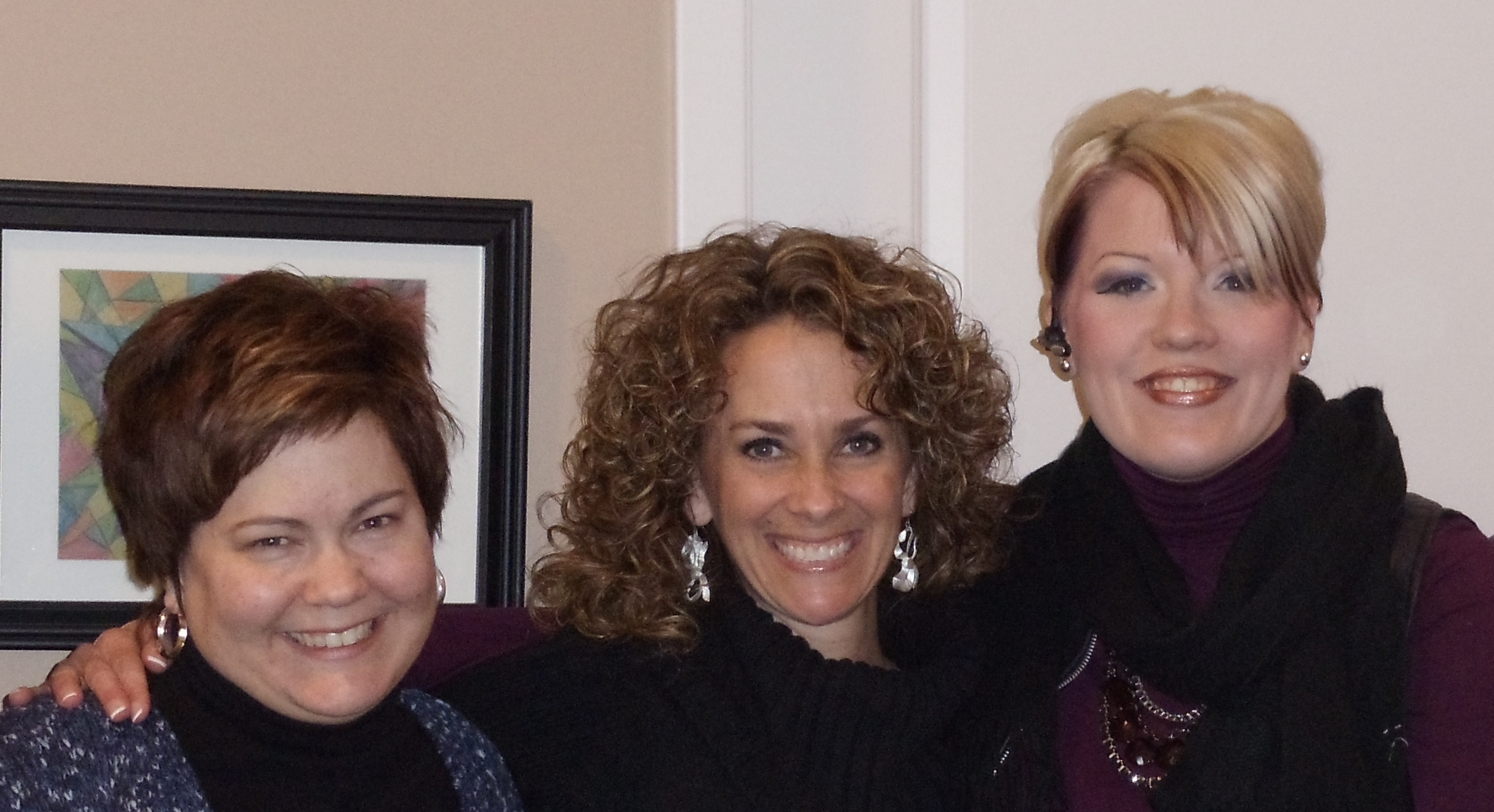
We’ve discussed in this series the obstacles families experience in finding good mental health care for their kids. Parents are probably fortunate if they can find a professional or group capable of providing excellent treatment for their child’s condition. Given the relative underrepresentation of Christian professionals at the elite levels in the field of children’s mental health, finding someone who can also address the spiritual component may be nearly as hard as finding a camel capable of passing through the eye of a needle. Keeping in mind that I practice near a large city with more mental health resources available than in most parts of the country, if someone close to me asked for a referral to someone who could simultaneously address their child’s mental health needs and spiritual development with excellence, I’d have a very short list of names to offer them. Two such people are on the Key Ministry Board…the third runs the group practice I work in.

Getting back to today’s question…If a parent has available to them a mental health professional capable of treating their child effectively while promoting their spiritual growth, they should leap at the opportunity. But perfect shouldn’t be the enemy of good. Effective treatment of your child’s mental health condition can often reduce or remove significant barriers to spiritual growth. Unfortunately, parents may find it far easier to find someone to fix their kid than finding someone to fix the attitudes demonstrated toward persons experiencing mental illness at their church.

Fortunately, more and more churches are developing the necessary understanding to effectively support Christian families with children experiencing significant emotional or behavioral disorders. NAMI FaithNet is an excellent resource for churches seeking to minister more effectively to families impacted by mental illness. So is Mental Health Grace Alliance.

As churches get better at helping families make sense of mental illness in the context of their Christian faith, parents will have one less need to consider in seeking treatment for their child.

Key Ministry’s mission is to help churches reach families affected by disability by providing FREE resources to pastors, volunteers, and individuals who wish to create an inclusive ministry environment.  We invite you to partner with us as we advance the Kingdom through our collaboration with the local and global church.  We have designed our Key Catalog to create fun opportunities for our ministry supporters to join in our mission.  The Key Catalog includes a variety of gift options for every budget.  A gift from the Key Catalog also makes for an amazing gift for a friend or loved one who is passionate about seeing the Body of Christ become more inclusive of people with disabilities.  Click here to check it out!


Posted in Controversies, Families, Inclusion, Mental Health, Resources | Tagged , , , , , , , | Leave a comment

Hot Topics: When Should You Fire Your Child’s Mental Health Professional?

shutterstock_69175456If you do what you’ve always done, you’ll get what you’ve always got.

The majority of families we serve through our practice have sought out and utilized the services of other physicians (psychiatrists, pediatricians, family practitioners) and mental health professionals (psychologists, counselors) before they come to see us. As a result, my practice probably represents a “skewed sample” in that we have an over-representation of families with unsatisfactory experiences in seeking help. I’m often wondering why parents continue as long as they do with costly and ineffective treatments with little apparent benefit for their kids.

Before we continue, I’ll remind our readers that treating kids with mental health disorders often remains more an art than a science and everyone who works with kids and families will be routinely humbled by their inability to effectively serve all of the folks who seek our help. No mortal human being has all the answers and each of us are guaranteed to disappoint some of the time. Nevertheless, from having served thousands of kids and families over the past 28 years, certain patterns become evident when families are actively involved in ineffective treatment interventions and the sooner parents can recognize that the professionals from whom they obtain assistance aren’t the right fit for their child or family, the more quickly they might move on to another professional or clinic who might help.

So…What are some of the signs parents should look for when they’re concerned that they’re not in the right place for their child with a mental health disorder?

When your professional is unable to give you a reasonably coherent explanation of why your child is experiencing the difficulties that led to the need for treatment.

When your professional is unwilling and unable to discuss the range of evidence-based treatments for your child’s condition, even if they themselves haven’t been trained or licensed to provide some of those treatments.

When your professional is unable to share with you the intended goals of their treatment intervention at any time during the course of treatment with your child.

When your professional is unable to offer you a reasonable estimate of the time required to see significant progress from treatment, as well as the alternatives when treatment doesn’t progress as planned.

When your professional is unwilling to meet with you to discuss your child’s overall progress in treatment (while respecting their right to confidentiality) and either help you to understand how you can best support your child’s treatment needs or refer you to a collaborating professional better equipped to address your questions and concerns.

When your professional is unwilling to invite the input of other appropriately trained professionals when your child’s behavior/condition is getting worse as opposed to better.

This list certainly isn’t meant to be inclusive. But I’ll share a few very specific situation that would give me cause for concern if I needed to take my kid somewhere for treatment…

For psychiatrists/physicians: When a child is taking prescribed medication (or a combination of medications) that appear to be ineffective or produce unacceptable complications and the physician is reluctant to try to simplify the child’s medication regimen-or wants to add on additional medications without a very good reason. Your child needs a prescribing physician capable of recognizing situations in which medication is making their situation worse.

For psychologists/counselors: I have two…When you get the sense that the therapist is having a difficult time defining an end point to treatment. Some clinicians (unconsciously) have a difficult time letting go of clients. If your child’s therapist repeatedly identifies new issues to treat after your child has met their initial treatment goals, there’s a risk of your child developing an unhealthy dependency upon the therapist.

The other situation occurs when a child or teen is failing to make progress in therapy and the therapist recommends a psychiatric referral, but lacks an established relationship with one. I’d expect the psychologist or counselor to have a system for coordinating care. We don’t typically accept referrals when the child has a therapist we don’t know. First, I don’t want to be held responsible for the outcome of a case when I don’t know whether the therapist knows what they’re doing. I also think that it’s important for all the professionals to be on the same page when serving the same child or family. An excellent therapist would see the value in developing and maintaining relationships with at least one competent psychiatrist.

One last observation…If you’re considering the possibility of firing your child’s psychiatrist or therapist, you owe it to your child to meet with the professional first in an effort to get your concerns addressed. It’s tough on kids to repeatedly tell their story to strangers. You want to give someone who knows your child and your family well the opportunity to “get it right.”

Updated May 17, 2014

***********************************************************************************************************

KM Logo UpdatedKey Ministry has assembled resources to help churches more effectively minister to children and adults with ADHD, anxiety disorders, Asperger’s Disorder, Bipolar Disorder, depression and trauma. Please share our resources with any pastors, church staff, volunteers or families looking to learn more about the influence these conditions can exert upon spiritual development in kids, and what churches can do to help!

Posted in Controversies, Families, Mental Health | Tagged , , , , , , | 4 Comments

Obstacles Families Face in Finding Mental Health Care For Kids

Parents of kids with significant mental health disorders frequently experience great frustration in negotiating the confusing maze that constitutes our system of mental health care in many communities across the U.S., along with the yet more confusing (intentionally?) system of paying for needed care. Quite frequently, pastors and ministry leaders are trusted resources to parents of children or teens in crisis, and my own professional society encourages parents who are looking for help for their kids to seek recommendations from their spiritual leaders. This post seeks to help ministry leaders better appreciate common challenges families face in finding the proper help for their kids, and offer some resources to share with parents looking for help.

Several major challenges families face include:

Access to appropriate professionals with the training and experience to effectively kids. I’m a child and adolescent psychiatrist by training…after medical school, I did a three year residency in general psychiatry at Cleveland Clinic prior to two additional years of training with kids at University Hospitals of Cleveland. According to a 2009 article, there are 7418 child psychiatrists actively practicing in a country with approximately 75 million children and teens. The vast preponderance of child psychiatrists are clustered in major cities, and docs who do what I do are especially rare in areas of the South or Midwest where the church tends to have more influence in the lives of families.

Finding professionals who will see kids and know what they’re doing can be a challenge. One difference between child psychiatrists and non-physician clinicians who see kids involves the variability of training experiences and supervision prior to entering practice among the non-physicians. Child psychiatrists have a minimum of five years of training and supervision following med school. In contrast, psychologists have the option of doing a one year internship in child psychology. Counselors in our state who identify children as an area of concentration would have a minimum of 1500 supervised contact hours of treatment with kids.

Here’s one example of the challenges families face…Cognitive-Behavioral therapy has been shown to be an effective alternative to medication in the treatment of kids with anxiety disorders or depression. In a city generally accepted to be in the top 5-10 in the U.S. for medical resources, there are less than ten therapists I feel confident referring kids to with the expectation that their treatment will mirror that offered the kids who participated in the research studies.

Getting an appointment in a timely manner. Because professionals with the training and experience to work with kids are in short supply, getting an appointment with the best people (assuming you have people in your area) can take a very long time. Even in large cities such as Boston and Washington D.C. with a relatively larger supply of professionals, appointment wait times have reached crisis proportions. In areas such as rural Wisconsin, waits for an appointment can reach two years!

Finding affordable care of high quality. In Northeast Ohio, we have a three-tiered healthcare system. Kids who qualify for Medicaid can access services through our teaching hospitals and community mental health centers. In some counties the available services for kids are outstanding and far exceed anything families with private insurance can access. In other counties, services are available, but child psychiatry access is limited to very brief appointments focused entirely upon prescribing of medication and counseling provided by inexperienced trainees.

The most highly regarded clinicians in private practice (child psychiatrists, psychologists, some counselors) are able to practice without having to accept insurance payments. Waiting lists are generally shorter, but such practices are becoming fewer and fewer in number as the hours spent in uncompensated tasks (phone calls, emails, paperwork, coordinating care with other professionals, working with schools, dealing with pharmacy benefit managers) become so great that many clinicians have had to close their practices and accept salaried positions. We can’t hire child psychiatrists for our practice because we can’t compete with the salaries offered by our publicly funded mental health centers.

Middle class families who depend upon their health insurance benefits may be in the most difficult situation of all. From a psychiatry perspective, the only way a physician can earn a salary comparable with those offered by public agencies while accepting insurance is to run an “assembly-line” practice composed of seeing high volumes of patients for very brief appointments. The large teaching hospitals in our area who contract with the big insurance companies won’t hire an adequate supply of clinicians to see kids with mental health issues because it’s impossible for those clinicians to see enough kids to generate the revenue necessary to cover the costs of their salaries, benefits and overhead on the reimbursement rates they get from insurance. Parents frequently get names of clinicians who are allegedly “in-network” from insurance company websites only to find that they’re not taking new patients, they don’t see kids, their offices are closed, they don’t accept the insurance in question, or that they’re scheduling six months in advance. Appointment times may not be available outside of work or school hours.

These are just a few of the struggles experienced by the parents of the kids who are acting out in Sunday School. What can the church do?

Pastors and ministry leaders can become familiar with the resources available in their immediate communities to help kids and families in crisis. Many churches will have members and attendees who are pediatricians, psychologists or counselors who might make recommendations as to local resources for families in need. The local chapter of NAMI may be an excellent resource for church leaders in search of resources for kids and families.

One way in which a church could provide a much-needed service to families in their immediate area would be to make available advocates or consultants who would help parents seeking mental health care for their kids to connect with resources offered through other churches, community agencies, schools, private clinics and their health insurer. The church can also provide a powerful demonstration of the love of Christ by creating ministry environments in which families of kids with mental health disorders are welcomed and valued.

Helpful Resources: Facts for Families…The AACAP developed Facts for Families to provide concise and up-to-date information on issues that affect children, teenagers, and their families. The AACAP provides this important information as a public service and the Facts for Families may be duplicated and distributed free of charge as long as the American Academy of Child and Adolescent Psychiatry is properly credited and no profit is gained from their use. Here are links to information on When to Seek Help for Your Child, Where to Find Help for Your Child and Understanding Your Mental Health Insurance.

Posted in Families, Hidden Disabilities, Key Ministry, Mental Health, Parents, Resources | Tagged , , , , , , , , | Leave a comment

Hot Topics: Is Antipsychotic Medication Safe for Kids?

Today’s post on the safety of antipsychotic medication in kids is the sixth in a series on Hot Topics in Children’s Mental Health offered in recognition of Mental Health Month, National Children’s Mental Health Awareness Week (May 6-12), and National Children’s Mental Health Awareness Day (May 9).

Back in the days when I was on the medical lecture circuit, I observed that physicians (and by extension, their patients) often worry about the wrong things.

Broadcast, traditional and online media have used a broad brush in painting a picture of indiscriminate use of dangerous medication in kids. In the case of kids being treated for ADHD with stimulants, a complete Medline search would identify somewhere in excess of 2,000 published studies over a 75 year period of time evaluating the safety and effectiveness of that class of medication. In our recent look at antidepressant medication, we saw more unanswered questions about the effectiveness of medicine used to treat depression in kids than exist around the safety of such medicine. Among the classes of medication commonly used for kids and teens with mental health disorders, I’m most concerned about the potential long-term safety risks associated with the use of antipsychotics.

Antipsychotics (the vast preponderance of which are second-generation antipsychotics…risperidone, quetiapine, aripiprazole, olanzapine) are clearly the most effective medications for kids with a valid diagnosis of bipolar disorder. Risperidone and aripiprazole have been shown to be effective in reducing the frequency and severity of aggressive behavior associated with autism spectrum disorders. The medications are also helpful for early-onset schizophrenia.

There’s a fundamental flaw in the way in which studies have been conducted for the FDA with antipsychotics in children and teens that has obscured the true impact of the side effects associated with the medications. Most kids who were in the FDA studies that led to pediatric approval of the second-generation antipsychotics had been treated with other antipsychotics in the past. It appears that prior exposure to antipsychotics significantly attenuates the side effects kids experience when treated with a new antipsychotic. But what happens when kids are started on antipsychotics for the first time?

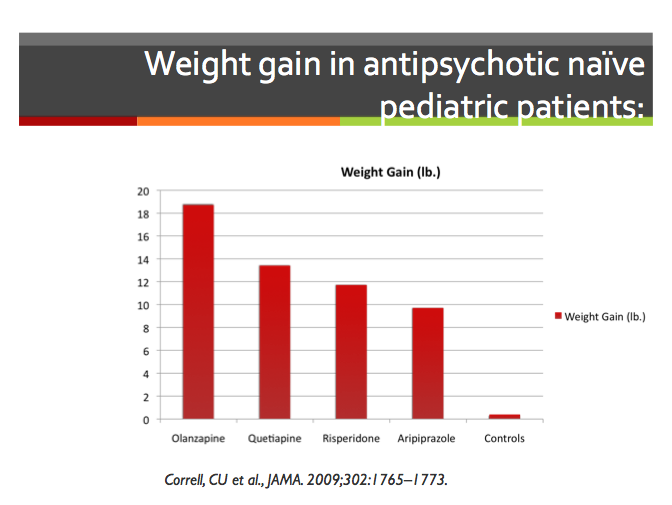
The best study (funded exclusively from non-commercial sources) examining the safety of antipsychotics among kids who hadn’t previously been treated was published by Dr. Christoph Correll in the Journal of the American Medical Association. This study examined metabolic issues in 338 kids treated for an average of 10.8 weeks with either olanzapine, quetiapine, risperidone or aripiprazole. Below is a graph looking at the mean weight gain per child over the course of an eleven week study. To put this data in perspective, the mean increase in waist circumference ranged from 2.0 inches on risperidone to 3.4 inches on olanzapine. Kids gained from 8-15% (on average) of their baseline body weight over the course of the study. Weight gain levels off in some patients over time, but in my experience, other patients continue to gain weight with long term use.

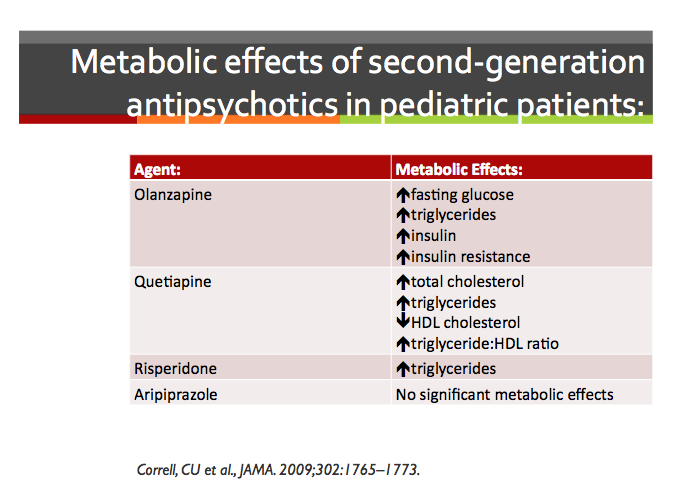
In addition to weight gain, other metabolic concerns emerged in the course of Dr. Correll’s study. Antipsychotics were also associated with increases in fasting glucose levels, insulin levels and insulin resistance (a pre-diabetic state) in the case of olanzapine, increased total cholesterol, decreased HDL cholesterol and an increased triglyceride to HDL cholesterol ratio with quetiapine and significantly increased triglycerides with olanzapine, quetiapine and risperidone.

It’s important to acknowledge that the data presented here is derived from a short-term  study, and it’s difficult to interpolate long-term risks from a short term study. But data from another short-term study, the Treatment of Early-Onset Schizophrenia (TEOSS) study produced similar results. The NIMH-funded controlled study compared tolerability and efficacy of olanzapine, risperidone and molindone in patients ages 8-19. The study monitors suspended the olanzapine portion of the study because of changes in liver function and the severity of cholesterol elevation noted in kids randomized to that medication.

Another known long-term risk associated with the use of antipsychotic medication is tardive dyskinesia, a chronic movement disorder associated with long-term use of medications that decease the activity of dopamine in the central nervous system.

Personally, if a kid clearly has bipolar disorder or a psychotic illness or an autism spectrum disorder with aggressive behavior of a severity that they may no longer be able to live at home or a severe tic disorder I have no problem prescribing these medications when the benefits outweigh the risks. But the majority of kids coming into my office after having been prescribed antipsychotics don’t fall under any of those categories.

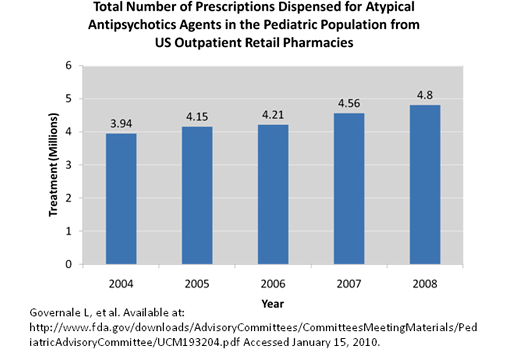
A 2006 study by Dr. Mark Olfson in the Archives of General Psychiatry reported that the most common indication for use of antipsychotics in kids was disruptive behavior, and that nearly 20% of psychiatric visits for patients age 20 and younger resulted in a prescription for an antipsychotic. Since Dr. Olfson’s study, the absolute number of prescriptions written for antipsychotics in kids has increased every year, to 4.8 million per year for children in the U.S.

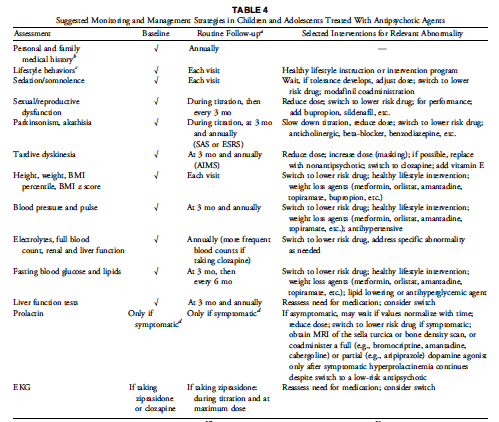
My frustration is that I see kids all the time who’ve been referred to our practice with a history of having been treated with antipsychotics coming in with parents who have little idea as to why their child is/was taking the medication prescribed, little understanding of the possible side effects associated with the medication and lacking the required monitoring for side effects while taking the medication. (from Correll, CU, J. Am. Acad. Child Adolesc. Psychiatry 2008; 47(1) 9-20.)

Here are some reasonable questions to ask your child’s health care professional prior to agreeing to treatment with an antipsychotic…

  • What condition are we hoping to treat effectively with this medication?
  • What evidence supports the use of this medication for the condition we’re attempting to treat?
  • What are the alternative treatments to antipsychotic medication for this condition?
  • What will be the plan to monitor for side effects my child might experience while taking this medication?
  • How long will my child likely need to continue this medication?
  • What will the alternative plan be if the weight gain or metabolic effects of the medication become problematic?
  • Here’s a question the parent(s) need to ask themselves…Has the treating physician taken the time to fully understand the nature of my child’s problems prior to prescribing an antipsychotic medication?
Next: When should a parent search for a new mental health professional for their child?
Posted in Controversies, Mental Health | Tagged , , , , , , , , , , , | 1 Comment

A Great Mother’s Day Gift

I’m a very proud parent today. Allow me to digress from our theme of hot topics in children’s mental health to share a story in honor of Mother’s Day.

This past Monday, our younger daughter (Mira) became a teenager. In lieu of a big party, she asked for money so that she could do something special for other people. Entirely on her own, she developed a plan to help some moms feel special who otherwise wouldn’t feel very special today.

Yesterday afternoon, Mira and my wife went to Costco, where she used a significant portion of her birthday money to buy roses and a large bag of candy. (For any of you last-minute shoppers, I’ve been told that our local Costco has very nice roses on sale for $16.99 per two dozen.) Mira and my wife came home and used the roses she purchased to put together lovely flower arrangements that the two of them delivered to our county’s shelter for battered women for each mom living there this weekend, along with the large bag of candy for their children to share.

Mira’s biggest concern about the day involved a request for a photo from the shelter’s director for the newsletter they distribute to donors. She’s not a person who feels comfortable as the center of attention. I told her that mindset is very consistent with what Jesus had to say about giving in the Bible.

The pressures that kids are under in our community are incredible and unlike anything that my wife and I ever encountered growing up. It seems as if every thought, behavior and idea they encounter in school, online and with friends is at work to undermine the values we’ve sought to impart to them. I showed up for our ministry team on Wednesday in a sleep-deprived state after contemplating for much of the night whether we’d done enough to prepare them to make the right choices in the months and years ahead. As our girls have gotten older and become more private about some of the issues they deal with on a daily basis, I worry that I don’t have the relationship with them necessary to be a positive influence when they need to make difficult decisions. I also worry I haven’t done enough to promote relationships between them and other like-minded adults who can provide wisdom and reinforce our values when stuff comes up that they’re not comfortable discussing with my wife or myself. I do know that being a part of a church has helped my wife and myself to be a far more positive influence to our kids than we could have been without that experience.

Later this morning, our 16 year old (Leah) will get up early, as she has on nearly every Sunday for the last couple of years to serve as a volunteer Sunday School teacher to a room filled with preschoolers. Beyond the lesson of the week, I think the time she spends with her class as a busy, popular kid who co-captains our high school dance team on Friday nights in the fall communicates something to the kids she serves about their importance in God’s family.

I’m sharing our girls’ story because I think my wife and I have received a better gift than the women in the shelter waking up to their flower arrangements this morning. Our hope for our girls has been that, similar to King David, they would “serve God’s purpose in their generation.” When I see them willingly looking for opportunities to serve, I know at some level that they “get it.” They’re not perfect… they have and will make mistakes and so will we. But I can’t imagine how a mom (or a dad) could ask for a better gift than to know that their kid is living out their faith.

This past Friday, an article ran in the USA Today based upon a survey of 1,000 Protestant pastors suggesting that what Mom may really want for Mother’s Day is for the entire family to go to church together. While not expressed in the article, I suspect that the hope among mothers to see their kids living out their faith drives their desire for their families to attend church together.

I’m proud that I have an opportunity to serve a team hard at work to make attending church a reality for thousands of families of kids with disabilities in hundreds of churches across the U.S. and beyond. Happy Mother’s Day to three of our moms (Rebecca, Katie and Harmony) who spent yesterday at Center Pointe Church in Cincinnati resourcing churches to welcome mothers and families to church who wouldn’t otherwise have the opportunity to be a part of a church. I’m sure your parents are as proud of you as Denise and I are of Mira and Leah.

Posted in Families, Spiritual Development, Stories | Tagged , , , , , , , , , , | 3 Comments

Hot Topics: What’s Causing the Epidemic of Mental Illness in Kids?

Today’s post is the fifth in a series on Hot Topics in Children’s Mental Health offered in recognition of National Children’s Mental Health Awareness Week (May 6-12), and National Children’s Mental Health Awareness Day (May 9).

As a child and adolescent psychiatrist, I frequently encounter parents and skeptics who freely share their opinions that much of the reported crisis in children’s mental health is fabricated…a marketing scheme of the pharmaceutical industry, a consequence of poor parenting or misplaced priorities on the part of families.

Opinions such as these endure because anecdotal data in support of  them can be relatively easy to find. There’s an argument to be made that drug company marketing in support of long-acting ADHD medications led to a spike in the number of kids being diagnosed in the early years of the last decade. I see parents who come looking for the “magic pill” to fix their child’s problems and recoil when family-based or behavioral interventions appear more appropriate. I spoke to a colleague who quit her job in a publicly-funded clinic because she was sick of parents who needed her to declare their kids sick so that they could obtain disability payments from the government. But these situations are by far the exceptions as opposed to the rule. I spend my days dealing with kids with real disabilities accompanied by well-meaning parents who more so than anything desire the best for their kids and are willing to try the strategies our practice team recommends.

In an earlier post, I shared data from a recent study examining the prevalence of mental health disorders among kids entering the first grade. Here are some of my hypotheses as to why over 20% of U.S. kids meet criteria for at least one mental disorder:

Rates of mental illness are a reflection of the struggle kids and families face in responding to the external demands placed upon them by our culture. I have a very hard time with the concept of first graders carrying planners. One of the biggest changes I’ve seen in my 26 years as a doc is the increase in the productivity expectations schools place upon kids. My youngest daughter had about the same volume of homework in the first grade that I had in the seventh grade in what was then an elite public school system in Ohio. Most kids that I see with ADHD come to my office because of problems with organizational skills and work completion. Kids getting diagnosed with the condition have genuine difficulty keeping up in school. The biggest change I’ve seen in the composition of my practice involves the number of kids struggling with anxiety. The pressures to succeed both academically and socially are unprecedented.

The general breakdown of the family…the maladaptive choices parents make in seeking to fill the emptiness in their lives have consequences for kids. This is the primary reason I quit doing community mental health eight years ago. My typical referral…Single mom comes in (five kids by four different guys, currently living with a boyfriend unrelated to any of the kids who beats her on a nightly basis in front of the children) with her seven year old who was suspended for fighting on the playground. I was far more overwhelmed by the level of spiritual poverty working in the city than the economic poverty that existed. I concluded that many of the families I was working with needed a pastor more than they needed a psychiatrist. That observation also holds true with lots of affluent families from the suburbs.

The consequences of a post-modern culture with an emphasis upon relative values and the lack of moral absolutes. I spend much of my talking to kids and teenagers who may be anxious, depressed or suicidal. Just to be clear, I’m absolutely convicted that God’s way works and the rules and standards for living in the Bible exist for our own protection. With that said, I’m probably not going to get very far making that argument with a teenager, even (in most instances) kids from Christian families. The lack of standards make things worse for kids with vulnerabilities to anxiety or impulsive behavior. I tell kids is that they fail to appreciate the intensity of emotions they’ll experience when sexual boundaries are crossed and they don’t yet have the necessary tools or experience to manage such intense emotions. Kids who tend to have a difficult time letting things go are often those who go on to become depressed or exhibit self-injurious behavior in response to the ups and downs of relationships. The breakdown of standards of absolute right and wrong has resulted in kids (and parents) exposed to problems and situations that they’re not equipped to deal with, not infrequently resulting in symptoms of mental illness. I never imagined being quoted in a major magazine for arguing the point that allowing one’s teenage son or daughter to sleep with their boyfriend/girlfriend in the family home is a really bad idea.

Better recognition of symptoms of mental illness among educators and professionals. Unquestionably, this is a big factor…except for autism, where studies have suggested that only a small percentage of the increased prevalence of the condition can be attributed to better diagnosis. Pediatricians in particular have become much more proficient at identifying kids at risk for conditions such as ADHD and depression.

The interplay of environment and genetics. We know that kids exposed to alcohol and tobacco in utero are likely to develop ADHD and experience learning disabilities. A landmark study demonstrated that exposure to tobacco smoke during the third trimester of pregnancy appears to be especially toxic for children with two identical copies of a specific gene associated with ADHD, resulting in an 8-fold greater risk of the condition. 

We’ll most likely discover the existence of multiple environmental toxins associated with the increased prevalence of autism spectrum disorders. This is pure speculation on my part, but I suspect that part of the reason why it’s so hard to demonstrate a link to any given toxin is that chemicals found in the environment may activate one of many genes contributing to a single trait found in kids with autism.

Here’s what I do know:

  • Every kid and every family needs to know Jesus
  • The church is called to make disciples
  • As the church, we’re called to share God’s love with kids with mental illnesses and their families, REGARDLESS OF THE CAUSE.

Originally published on May 1, 2011, Revised May 12, 2012


Posted in Controversies, Key Ministry, Mental Health | Tagged , , , , , , | Leave a comment

Hot Topics: Are Antidepressant Medications Safe For Kids?

Today’s post is the fourth in a series on Hot Topics in Children’s Mental Health offered in recognition of National Children’s Mental Health Awareness Week (May 6-12), and National Children’s Mental Health Awareness Day (May 9). We’ll look at a topic today that’s generated lots of controversy…the safety of antidepressant medication in children and teens.

Few topics in child and adolescent mental health have generated as much controversy over the last decade as the debate about the safety of antidepressant medication given to kids. In 2004, the FDA issued a “black box” warning claiming that antidepressant use in children and teenagers is associated with increases in suicidal thinking and behavior, which was expanded in 2007 to include adults between the ages of 18 and 24. In my opinion, the larger controversy about antidepressant use in children and teens is not “are they safe?” but “do they work?” and if they work, what do they work for? Some of those questions were addressed here.

In an effort to help parents make sense of what they read and hear, we’ll examine the findings of two large studies.

The first study (funded by the National Institute of Mental Health) was conducted by Dr. Jeff Bridge and his team at the University of Pittsburgh, analyzing results of 27 clinical trials of antidepressants…fifteen studies involved kids with depression, six with Obsessive-Compulsive Disorder (OCD) and six with non-OCD anxiety…encompassing 5,310 patients under the age of 19.

Important take-home points…

No child or adolescent patient to date in any trial of antidepressant medication submitted to the FDA or included in Dr. Bridge’s analysis actually committed suicide.

The number of patients who must receive a specific treatment for one to benefit (Number Needed to Treat-NNT) or for one patient to be harmed (Number Needed to Harm-NNH) varied for antidepressants depending upon the condition the child or teen was receiving treatment for in the study.

Major Depression: Number Needed to Treat=10     Number Needed to Harm=112

OCD: Number Needed to Treat=6     Number Needed to Harm=200

Non-OCD Anxiety: Number Needed to Treat=4     Number Needed to Harm=143

To clarify, patients with depression were eleven times more likely to experience significant benefit from antidepressant medication than to experience medication-related suicidal thinking or behavior, patients with OCD were thirty-four times more likely to experience benefit and patients with non-OCD anxiety were thirty-six times more likely to experience benefit.

The second study (also funded by the National Institute of Mental Health) was conducted by researchers at the University of Chicago examined suicidal thoughts and behaviors in 9,165 patients (including 708 youth) treated with fluoxetine or venlafaxine for depression (all of the youth were treated with fluoxetine). In the four studies of youth on fluoxetine, the medication was effective in treating symptoms of depression, and no evidence of increased suicide risk was seen. At the same time, there was no evidence that a reduction in depressive symptoms produced a decrease in suicide risk in youth, as is the case with adults. The author of the study has speculated that other factors beyond depressed mood likely contribute to suicidal thinking and behavior in kids.

So…what advice do I give to parents around use of antidepressant medication when they ask “What would you do if this was your kid?”

First, I’d point out that the potential benefits of medication appear to outweigh the potential risks, especially for kids with anxiety, but in my experience the risk of an increase in suicidal thoughts/behavior associated with antidepressant medication appears to be greater than zero. I would be most concerned about an increased risk in  kids with some other condition (in addition to depression or anxiety) that interferes with emotional self-regulation and/or impulse control (ADHD, trauma, kids with behaviors similar to those seen in Borderline Personality Disorder). One hypothesis put forth to explain a possible increase in risk involves the suggestion that antidepressants might cause disinhibition n a subset of patients…the pathways in the prefrontal cortex of the brain don’t fully mature for most people until their early to mid-20s, coinciding with the time after which antidepressants are no longer associated with increased suicidal risk.

Second, since cognitive-behavioral therapy (CBT) appears to be an effective alternative to medication for kids with anxiety and depression, kids with mild to moderate symptoms should probably receive a trial of CBT prior to a trial of medication.

Finally, I remind parents that antidepressants have been shown to be of significant benefit in kids with anxiety, moderately effective in kids with OCD and of modest benefit in kids with depression. It’s also important that parents understand the limitations of medication and the evidence suggesting medication use offers no guarantee that a child won’t make a serious suicide attempt.

Next: Is antipsychotic medication safe for kids?

Key Ministry will be offering another free, day-long JAM (Jumpstart All-Inclusive Ministry) Session at Center Pointe Christian Church in Cincinnati, OH on Saturday, May 12th. Click here to register!

Posted in Anxiety Disorders, Mental Health | Tagged , , , , , , , , | 2 Comments

Hot Topics: New Data on Foster Kids and Medication

shutterstock_161623058A detailed study looking at the use of psychotropic medication in 686,000 foster children in 48 states was published revealing some interesting findings and generating recommendations sure to receive attention from politicians, leaders in the social service system and child advocates across the U.S.

Investigators from the Policy Lab at Children’s Hospital of Philadelphia discovered the following:

All psychotropic use among children in foster care increased from 2002 to 2004, and then began to decline from 2005 to 2007, while antipsychotics experienced a consistent increase every year from 2002 to 2007.

At a state level, there was wide variation in the rates of both polypharmacy (children on three or more psychotropic medications for at least thirty days) and antipsychotic use among children in foster care (2007 polypharmacy range: 1% to 14%; antipsychotic range: 3% to 22%).

Trends over time within individual states were largely consistent for antipsychotic use, while trends for polypharmacy showed variability.  Antipsychotic prescribing increased in 45 states, while decreasing in only two and showing no change in one.  Conversely, for polypharmacy, 18 states showed increase, while 19 states showed decline and 11 no change.

Their conclusions were…

  • shutterstock_372797017Over the past decade, the proportion of children in foster care who were prescribed psychotropic drugs remained much higher than all Medicaid-­‐enrolled children.
  • The consistent increase in antipsychotic use among children in foster care across almost every state stands in contrast to trends in other psychotropic medications, both alone and in combination.
  • Wide state-­level variation in medication rates shows that where a child lives seems to influence their chance of being prescribed a psychotropic drug at least as much as the child’s medical needs.In addition to using this data to support oversight and monitoring efforts, states should consider strategies to implement evidence-­‐based practices, including counseling and behavioral interventions, as an alternate or complementary treatment strategy for the children with mental health needs.

So…why are we talking about this topic on a blog with a focus of helping churches do a better job of inclusion of kids with disabilities and their families?

We’re 100% behind any church seeking to demonstrate Christ’s love through initiatives to involve more families in serving kids placed in the foster care system. When Jesus made reference to serving “the least of these,” one would be hard-pressed to a segment of our society more vulnerable and in need of His love than kids in foster care. But we’re also instructed to consider the cost prior to taking on new commitments and initiating new plans. We want churches to be prepared to offer the necessary encouragement and support to families called into foster care ministry because those families will need their church to cope with the myriad of challenges involved with caring for kids in the system who often have severe emotional disturbances and challenging behaviors associated with past trauma, abuse and neglect. Any church planning a significant foster care ministry initiative needs to plan for including the kids being served and their families in the activities most essential for spiritual growth. Churches can also support families by helping them to identify resources for evidence-based counseling and behavioral intervention that are sorely lacking for many kids in the system and contribute to the use of medication to manage behavior with the potential to cause significant side effects.

Updated March 2, 2016

***********************************************************************************************************

© 2014 Rebecca Keller PhotographyCheck out Shannon Dingle’s blog series on adoption, disability and the church. In the series, Shannon looked at the four different kinds of special needs in adoptive and foster families and shared five ways churches can love their adoptive and foster families. Shannon’s series is a must-read for any church considering adoption or foster care initiatives. Shannon’s series is available here.

Posted in Adoption, Controversies, Families, Mental Health | Tagged , , , , , , , , , | Leave a comment

Hot Topics: Money and Children’s Mental Health: An Insurance Parable

Today’s post is the third in a series on Hot Topics in Children’s Mental Health originally offered in recognition of Mental Health Month, National Children’s Mental Health Awareness Week (May 6-12), and National Children’s Mental Health Awareness Day. We’ll kick off Children’s Mental Health Week by focusing on the challenges families face when seeking to access services for their kids through their health insurance benefits. Post updated January 19, 2013.

My guess is that most of our blog’s readers have purchased a local Entertainment book at least once. My wife and I are “foodies”…our weekly date night is spent going out to eat. Before we had kids we’d frequent a local Italian restaurant in the Entertainment book that allowed patrons unlimited use of the card for the “buy one, get one free” dinner special. We stopped buying the book when the restaurant discontinued this very generous policy because there weren’t any other restaurants in the book we wanted to check out. Our favorite  places aren’t in the Entertainment book. When the food is great, the tables are filled and restaurants don’t need to offer a big discount to entice people to come in.

Your health insurance card is designed to work like the card from the Entertainment book. This often results in big problems for families needing mental health care.

What we’ve experienced as “managed care” for the last two decades arose from the recognition of excess capacity in the healthcare system, especially hospital beds. When employers began to pressure insurance companies to control costs, insurers initiated utilization review (limiting bed days, sessions, prior authorization) to control costs. Aggressive utilization review produced more excess capacity in the system. The insurance companies then demanded deep discounts and all products, all-services contracts from hospitals in exchange for a steady flow of insured patients.

This system worked reasonably well for most services, but as time passed problems emerged. The rate structures in insurance contracts (largely based upon Medicare rates) result in some services generating enormous profits to the hospital. Heart surgery, orthopedic surgery, outpatient surgery and cancer care are big money makers. Mental health services for kids don’t make money. The insurance contracts virtually guarantee that children’s mental health will lose money (see previous post).

For a time, the highly profitable services at the hospital were able to subsidize the money losers. As belt-tightening continues, hospitals can’t continue to provide services that lose money. Will a hospital administrator charged with containing expenses hire a child and adolescent psychiatrist (or therapist) to see outpatients when the professional can’t possibly see enough patients during the day under the terms of the insurance contracts the hospital is saddled with to cover their salary, benefits and overhead costs? Note: I recently spoke with an administrator from a major teaching hospital in our area who told me that no one in their psychiatry/psychology departments was capable of covering their salary and overhead through direct patient care.

What alternatives can families pursue when the large healthcare systems promoted by both government and the insurance industry don’t make an important service available?

Families with private insurance face challenges using the community mental health system. Generally, non-profit mental health centers are required by their contracts to offer their most favorable rates to the government…Medicaid and Community Mental Health Boards. I’ve served as Board President and Medical Director respectively at two large community mental health organizations in our region. When I was involved with the public system, our Medicaid contracts were based upon an accounting formula that reimbursed the agencies for the actual cost of delivering services. We couldn’t contract with private insurers because those insurers typically paid less than half the cost of delivering the services provided. Accepting insurance contracts would have resulted in the use of public funds dedicated to indigent care to subsidize discounts for middle-class families with insurance who wouldn’t otherwise qualify for reduced fee care.

That brings us to the remaining independent practitioners. Finding good primary care physicians to participate in insurance networks isn’t usually a problem, because of supply and demand. We take our kids to an outstanding pediatric practice. But there are three or four other excellent pediatric practices within a short drive of our home. If our pediatricians quit accepting insurance, their patients would have several attractive options of practices in their insurance network. Specialties in short supply… like child psychiatrists and child therapists…constantly deal with overwhelming demand and have no incentive to contract with insurance plans.

Suppose someone approached you with this offer…

We want you to come to work for us. We’ll pay you a third to a half of your hourly rate while our executives make millions in bonuses.  Maybe you’ll get your paycheck in a month. Maybe you’ll get your paycheck in three months.  Actually, you’ll need to hire and train someone to collect your paycheck from us. We’ll only pay you for the time the child is sitting in your office…forget about the two hours you spent at school convincing them to do the testing for a learning disability that we refuse to pay for. Or the thirty minutes on the phone at 11:00 at night that averted the need for a trip to the emergency room. Would you sign up for that deal? Who would?

  • Someone who desperately needed the work.
  • Someone who recognizes their services aren’t worth the rates they charge.
  • Someone who is altruistic and doesn’t want the kid to be hurt by the policies of the parent’s insurance company? Unfortunately, most professionals with that mindset already work for the community mental agencies we discussed earlier or work for a large hospital system where (for the time being) their services are subsidized by charity or profits generated by other departments.

Back to our entertainment card/insurance card parable…

Large hospital systems are the restaurants in the Entertainment book that accept the card for lunch and dinner but choose not to open for breakfast when the family needs breakfast. Why open for breakfast when the breakfast business can’t sustain itself?

Community mental agencies operate in states where discount cards are prohibited by law. The family’s insurance card is of little or no value there.

Independent practices are like the small restaurants in the Entertainment book. In each city, there are a few exclusive restaurants everyone talks about that choose not to be in the book. Occasionally, a great restaurant appears in the book…after the restaurant attracts lots of people and reaches capacity they drop out of book. A few restaurants stay in the book because they want as many people as possible to try their food at a low price and don’t need the money to attract new chefs or to expand their restaurant. Other restaurants stay in the book year after because they have no other way to fill tables.

The end result: All too often, families can’t find what they need in the book…although they pay a great deal more money for the book that comes with their insurance card than they do for the Entertainment book.

***********************************************************************************************************

Key Ministry’s mission is to help churches reach families affected by disability by providing FREE resources to pastors, volunteers, and individuals who wish to create an inclusive ministry environment. We have designed our Key Catalog to create fun opportunities for our ministry supporters to join in our mission through supporting a variety of gift options. Click here to check it out! For a sixty second summary of what Key Ministry does, watch the video below…

Posted in Families, Mental Health | Tagged , , , , , , , , | Leave a comment

How Money Influences Children’s Mental Health Care…The 15 Minute Medication Visit

Today’s post looking at financial practices influencing children’s mental health care is the second in a series on Hot Topics in Children’s Mental Health we’re offering in recognition of Mental Health Month, National Children’s Mental Health Awareness Week (May 6-12), and National Children’s Mental Health Awareness Day. 

Parents and families are appropriately concerned when they have reason to believe that treatment recommendations they receive from mental health  professionals are influenced by anything other than the best interests of their child. An important component of the professionalism we’re expected to demonstrate as physicians is “a responsiveness to the needs of patients and society that supersedes self-interest.” Increasingly, professionals are being placed smack in the middle of a variety of competing interests in our role as advocates for kids and families…our personal economic interests, the interests of the practices, agencies or healthcare systems where the professional is employed, the insurance company providing benefits to the family, the pharmacy benefit manager contracted by the family’s insurance company, the government and the school the child attends.

Lots of attention has been paid to reports of drug companies lavishing gifts, trips, dinners and speaking engagements to physicians in attempts to influence prescribing habits. It’s absolutely true that abuses occurred, especially prior to 2008, but the combination of very costly legal settlements exacted from pharmaceutical companies for “off-label” promotion of medication prescribed for patients on Medicare and Medicaid, self-serving regulatory guidelines propagated by the large pharmaceutical companies, requirements for public disclosure of payments made to physicians by industry and a serious crackdown on ethics and conflict of interest policies by professional societies and medical schools, perceived or real conflicts of interest from payments or gifts provided clinicians by pharmaceutical companies are, in my opinion, of minimal impact on the care provided to kids today. I suspect that the extensive media coverage may be distracting attention from far more serious practices that greatly impact the quality of, and manner in which most U.S. families access mental health care. We’ll look at some of these practices in what is rapidly expanding into a multi-segment post, spotlighting their immediate impact on access to care and the quality of care received:

The design of fee schedules used by insurance companies to reimburse hospitals, clinics, physicians and other mental health professionals for care

The networks of hospitals, clinics, physicians and mental health services available to families seeking care and the timeliness with which care can be accessed.

The process through which families are able to access prescription medication

The impact of direct-to-consumer advertising of pharmaceuticals

We’ll start today by looking at the impact of insurance company fee schedules on the care kids receive and tackle the other topics in a future post(s).

Most physicians are paid on the basis of how many procedures they complete (surgeons, anesthesiologists, gastroenterologists, obstetricians) or on the basis of the clinical complexity of their office visits (primary care physicians…internists, pediatricians, family physicians). Unlike our other physician colleagues, psychiatrists are (with a notable exception) paid on the basis of how much time they spend with patients. They can’t make more money by working faster…as a surgeon or another physician can do who performs procedures.

A financial disincentive exists for the busy psychiatrist (or psychologist/counselor) able to fill all of their scheduled time. Any time you spend delivering a service that you’re not compensated for constitutes a loss in personal income. Remember…they can’t work faster to make up for the lost time. We’ll come back to this later.

Commercial insurance companies typically develop fee schedules based upon CPT (Current Procedure Terminology) codes, originally developed for the Medicare program.

The most commonly used billing codes reimbursed through private insurance are:

Psychiatric diagnostic interview/evaluation (generally assumed to be 60 minutes by most insurance companies). In our area, insurance would typically pay $140-$175 for this service, including the family’s co-payments.

45-50 minutes of psychotherapy by a physician with medication management (insurance plus copay $75-$100)

45-50 minutes of psychotherapy by a psychologist or independently licensed counselor, social worker, marriage and family therapist (insurance plus copay $50-$80)

20-30 minutes of psychotherapy by a physician for medication management (insurance plus copay $50-$75)

Pharmacologic management, including prescription, use and review of medication with no more than minimal medical psychotherapy (insurance plus copay $50-60)

The medication management code is an untimed code. The physician can generally bill as many of these as they want without triggering allegations of billing fraud. Four 10-15 minute medication visits can easily produce twice the income or more seen from longer appointments!
Talk doesn’t pay. Physicians, hospitals and clinics have a tremendous financial incentive to see lots of kids for relatively brief appointments. Here’s the problem…are the appointments sufficient for the physician to ascertain all of the information they need…interview the child, question the parent, inquire about the child’s functioning at school, with friends and in extracurricular activities, ask appropriate questions about medication side effects, discuss the course of treatment and available treatment options and answer questions from the parent and the child, and write/update any necessary prescriptions? Does the quality of care suffer when all of these tasks need to be accomplished in a 15 or 20 minute appointment? Does agreeing to practice this way with kids constitute a potential conflict of interest?

Let’s look at initial evaluations. Most general psychiatrists can do a pretty thorough assessment of an adult patient in 60 minutes. But what about a child or teen?

Here’s a link to the American Academy of Child and Adolescent Psychiatry’s practice parameters on the psychiatric evaluation of a child or teen. For me to interview a child at length without the parent(s) in the room, take a complete history from the parent(s) without the child in the room, review records from other treating professionals, review the child’s school records, obtain and review rating scales from the child’s parents and teachers (when applicable), discuss my clinical impressions and treatment options with the parents, review my recommendations in a developmentally-appropriate manner with the child/teen and answer questions, I usually spend a minimum of three hours, often broken up into two office visits, taking more time when I need to.

So…what happens when a clinician or a hospital agrees to a contract that pays them for evaluations under the assumption (as with adults) a complete evaluation can be conducted in an hour? Some insurance companies will pay for a second evaluation hour for a child or teen if the doctor or a staff member obtains a prior authorization…resulting in an expenditure of time. Does scheduling longer evaluations reduce the number of appointment slots available for more lucrative medication management visits and create a potential financial conflict? Does agreeing to complete evaluations within the time allocated by the insurance company increase the potential for an assessment less thorough than what the child or family really need?

Insurance companies typically don’t pay for time spent on tasks essential for clinical care that occur outside of office-based appointments…returning phone calls and e-mails, coordinating care with other clinicians, writing and phoning in prescriptions, attending team meetings at school, writing reports and letters, completing forms from schools, completing paperwork required by the insurance company. These tasks consume an increasing percentage of the clinician’s time. Huge financial disincentives exist for clinicians to do more than the minimum required from a medical-legal standpoint.

I’d like to make absolutely clear that by raising these issues, I don’t mean in any way to impugn the integrity or professionalism of the clinicians who participate in insurance networks (Our practice does not). In my experience, most of them either work for hospital systems or clinics that require them to see a specific number of patients per hour or day with administrators who determine the length of scheduled appointments, or feel they have no choice because the families they serve would have no other means to pay for services.

I do think that conflict of interest guidelines developed by professional societies need to consider all manner of clinician compensation with the potential to compromise care. Insurance contracts that provide huge financial incentives for very brief appointments and employment relationships that impact the autonomy of mental health professionals to spend the time they deem necessary with kids and families are at least as large a concern as relationships with drug companies.

Next: Money, Insurance Networks and Access to Care

FULL DISCLOSURE: 

I haven’t personally received any payment from a pharmaceutical company since 2007. I chose to stop doing promotional lectures for pharmaceutical companies in 2006. Our practice is part of a research network (CAPTN) originally funded by the National Institute of Mental Health (NIMH) and organized through the Duke University Research Institute. All of the research I’ve participated in over the past five years had funding originating from the NIMH…although we plan to participate in a long term medication safety study through the CAPTN network required by governmental authorities in Europe. Funding for that study will originate from Pfizer…We will begin recruiting in the next few months. Our practice will be paid through Duke University, but their funding will have originated from Pfizer.

Key Ministry received donations in 2008 and 2009 from Shire U.S. The ministry hasn’t received any corporate grants from a pharmaceutical company since 2009.

Our practice adheres to the guidelines on conflict of interest for child and adolescent psychiatrists of the American Academy of Child and Adolescent Psychiatry. I served as a member of AACAP’s Consensus Building Panel on Conflict of Interest that developed the guidelines in February, 2008.

Updated 5/3/12, 3:15 PM

Posted in Advocacy, Families, Mental Health | Tagged , , , , , , , | Leave a comment