How does the Gospel apply to self injury?

shutterstock_343217441A month ago, I wrote a post titled Four Reasons Teens Cut to COPE, sharing my own history of self-injury as well as the four most common reasons kids and adults hurt themselves. We do/did it for control, as an obsessive behavior, as punishment, or as an emotional release. For me, it was all four; for others, it might just be one or two. To read more about the why of self-injury, see that post here.

One comment jumped out at me and warranted a post of its own in response. Todd Benkert, a Southern Baptist pastor and adoptive dad who I respect a great deal, asked:

Shannon, given that self-harm is meant to help one COPE, how does the gospel apply to this need? How do you find that Christ would address each of these reasons?

As I answer, let me go ahead and define what I’m meaning in this post as the gospel: the good news that the God who created us in his image saw our helpless sinful state and sent his Son to live the perfect life we couldn’t, die as the ultimate sacrifice we could never offer, and defeat death once and for all by rising from the dead, offering an already but not yet promise: that those who believe may already have indwelling of the Spirit here on earth but that we persist in the reality that we’re not yet living in the perfection of heaven.

Phew. That’s some meaty theology in one sentence, huh?

Key Ministry exists because of that already but not yet friction. We already have the hope of Christ – hallelujah! – but our lives are marked with the not yet realities of life, including mental illness, disability, and childhood trauma. The church exists to be a community for those who know God and to shine the light of Christ into a dark world for all, including those who haven’t yet encountered our Jesus.

Cutting is a sign of already but not yet tensions. Some who injure themselves – be it by cutting or burning skin or punching surfaces or trying to break bones or some other means – don’t know Christ. Some, however, do. How do we respond in a gospel-driven way to both groups?

shutterstock_418511347

First, we must be humble. Just as we, in the church, wouldn’t try to treat asthma with repentance or set a broken bone with a Bible verse, we need to understand that professional help is almost always needed for those who persistently hurt themselves. For me, this includes both psychotherapy and psychiatric medications. When someone is engaging in self-harm, the behavior isn’t shameful or unspeakable. Self-injury occurs when the pain someone is feeling internally exceeds the resources available for healing. One such resource for healing is the professional help beyond what most churches are able to offer. This need for support outside of the church is one reason why those who attend worship services regularly may still go home and bring a blade across their skin.

Historically, the church has been slow to accept medical research about the physical and neurological foundations for mental illness, trying instead to treat challenges like these are purely spiritual. I’m seeing a change in this trend, thankfully. We still have work to do, though! We at Key Ministry are able to speak into that in a unique way, as Dr. Steve Grcevich – a clinical child psychiatrist – founded our organization and has served in a variety of roles ever since. In other words, as we train churches to respond to these needs, our approach will always involve a medical understanding of the problem.

But we’re Christians and ministry leaders too. So we also understand we aren’t just bodies with physical needs but souls with spiritual ones. One supernatural need we all possess is community. So, second, we must build relationships. Some refer to this as a ministry of presence or an incarnational ministry. After all, God didn’t just wave a magic wand or look down from the clouds to meet our needs; he came incarnate, wrapped in flesh, engaging our humanity from his own. Before the disciples in John 3 asked, “Who sinned that this man might be blind, him or his parents?” the first verse in that chapter tells us Christ saw the man. Before we jump to judging a person’s current state or trying to So how can we, in the name of Christ, come alongside those who hurt themselves? respond to them, we must first see the person. This response includes affirming each individual as a fellow image bearer of God, just like we are. Christ’s response – “neither this man nor his parents sinned, but this occurred that the works of God might be displayed in him” – does that. Each of us exists that the works and glory of God might be displayed and reflected in us. When it comes to self-injury, I’ve seen many well-intentioned adults respond out of their discomfort and try to fix the problem before loving the person. This will never work!

So how can we, in the name of Christ, come alongside those who hurt themselves? We can be with them, just as Christ brought healing as he walked side by side with the people he created. We can try to understand the reasons why. We can choose not to recoil from the behavior, even if it makes us uncomfortable, and instead dwell in discomfort with our hurting friend. We can help them access the resources needed – including professional support – to help them process pain in healthier ways.

Finally, we can share the already hope we have in Christ without denying the not yet struggles in the world. In other words, our gospel can’t just be one that stands before Daniel 3 furnaces and says, “God will save me and you from the fire.” No, it must also be able to say, “We believe in a God who can deliver us from the flames (and will certainly do so in heaven) but even if he does not on earth, we can still trust him.” We can’t proclaim a prosperity gospel (that is, a false gospel) which promises full healing and riches and comfort on this side of heaven. We shouldn’t offer Christ as the antidote to pain as if the Bible promises that becoming a Christian (or continuing in faith, for those who already know Christ) means we’ll never feel pain again. Our testimonies of how God has worked in our lives can and should not only include the highlights – how Jesus made and makes things new – but also the hard truths – how life still isn’t perfect in all the ways we might like it to be because we live in a fallen world. This isn’t denying the works of God in us but rather showing the hope of a heaven in which God, according to Revelation 21:4, will wipe every tear from our eyes as death and mourning and crying and pain are no more.

When those who are hurting cut into their skin or injure themselves in other ways, they’re saying that the world as we know it isn’t right or good or perfect. Our presentations of the gospel need to acknowledge that truth, or the hope we’re sharing will seem false. When Christ showed up to ultimately heal Lazarus, he didn’t start by calling him out of his grave. No, he met his sisters in their pain, he didn’t turn away from their agony, and he wept with them. We can do likewise. Then he raised Lazarus from the dead, but? Lazarus died again in due time. The miracle didn’t mean Jesus’s friend and Mary and Martha’s brother got to skip out on pain for the rest of his time on earth. And our salvation doesn’t mean that either.

Self-injury isn’t simple. The obsessive behavior component can make the habit into an addiction that is hard to break. If we act like we can simply solve the problem by walking someone through a salvation tract, then we’re treat the gospel like a magical incantation – hocus pocus or abracadabra – for self-harm. Not only does that dismiss the complexity of cutting, but it also presents a false prosperity gospel, promising a perfection on earth that the Bible never presents.

Let’s be humble. Let’s engage others in relationship. Let’s share the full gospel – both the already hope we can all have in Christ without sugarcoating the not yet tensions we experience in this world and the promise of an eternity without pain or tears or any reason to cut anymore. And let’s do it all for the good of our neighbors and the glory of God.

***********************************************************************************************************

shutterstock_291556127Key Ministry encourages our readers to check out the resources we’ve developed to help pastors, church leaders, volunteers and families on mental health-related topics, including series on the impact of ADHD, anxiety and Asperger’s Disorder on spiritual development in kids, depression in children and teens, pediatric bipolar disorder, and ten strategies for promoting mental health inclusion at church.

 

Posted in Hidden Disabilities, Key Ministry, Mental Health | Tagged , , , , , , , , | Leave a comment

Is the sexual revolution driving our kids to suicide?

shutterstock_298069748In the quarter century I’ve been practicing as a child and adolescent psychiatrist, I’ve come to appreciate the extent to which early involvement in sexual activity represents a risk factor for anxiety, depression, suicidal thoughts and suicidal acts among the kids served by our practice. From a developmental standpoint, there are lots of teenagers who aren’t remotely equipped to manage the intensity of emotions that accompany a sexual relationship. Buried beneath the headlines of a government-funded study released this past week, there’s lots of evidence that teens who voluntarily engage in sexual activity or are victims of sexual violence are far more likely to experience suicidal thinking or behavior than their peers.

The US Centers for Disease Control (CDC) released a new study this past Friday,  Sexual Identity, Sex of Sexual Contacts, and Health-Related Behaviors Among Students in Grades 9-12. The study is based on data from the 2015 National Youth Risk Behavior Survey (YRBS), an ongoing project to monitor six categories of priority health-related behaviors among youth and young adults: 1) behaviors that contribute to unintentional injuries and violence; 2) tobacco use; 3) alcohol and other drug use; 4) sexual behaviors related to unintended pregnancy and sexually transmitted infections, including human immunodeficiency virus infection; 5) unhealthy dietary behaviors; and 6) physical inactivity.

Students by Sexual IdentityFor the first time, the CDC investigators asked questions about sexual orientation, gender identity and the sex of sexual contacts of survey participants. The resulting survey is the first nationally representative study of U.S. lesbian, gay, and bisexual high school students. Not surprisingly, the media coverage thus far (see here and here) has focused upon the data from the LGBTQ participants, who represented 11.2% of a sample in excess of 15,000 teens (2.0% identified as gay or lesbian, 6.0% identified as bisexual, 3.2% identified as “unsure” and 88.8% identified as heterosexual).
What we’re going to look at in this data set is how sexual experiences impact suicide risk across the board for high schoolers of both majority and minority sexual orientations.

Let’s start by looking at the association between sexual orientation in this study of high school students and presence of self-reported “serious” suicidal ideation in the last twelve months.

Serious suicidal thoughts

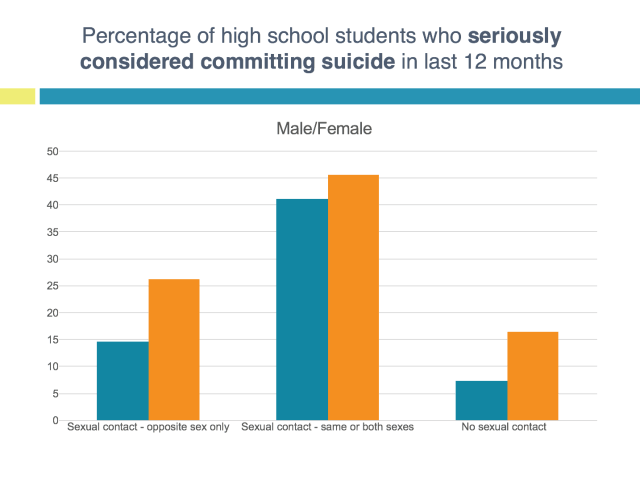
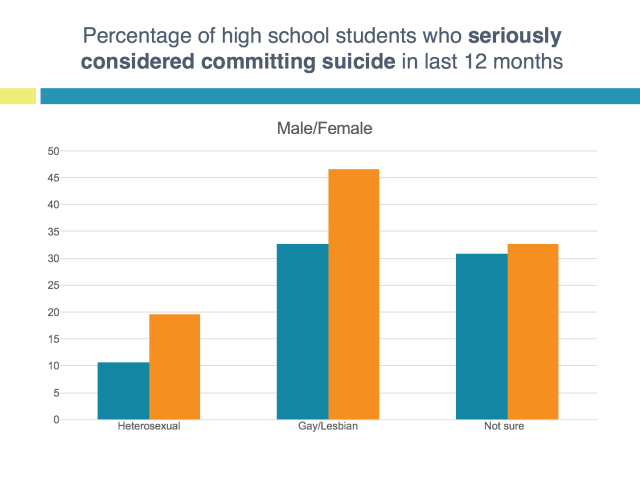
What we see here is that around 18% of U.S. high schoolers expressed “serious” suicidal thoughts in the past year – 15% among heterosexual students, 43% among LGB students, and 32% among youth identifying as “not sure” of their sexual orientation. Rates are clearly higher among females as opposed to males, in keeping with what we know about the sex rations of suicidal ideation in teens. Two observations…

  • The frequency with which high schoolers across the board endorse the presence of serious suicidal thoughts is unacceptably high for kids of all sexual orientations.
  • The statistics describing rates of suicidal ideation among LGBQ teens are especially  alarming and public health interventions targeted at reducing suicidal ideation and behavior among sexual minority youth are clearly indicated.

One of the responses we’ve seen to the very high rates of reported suicidal ideation among teens from sexual minorities is the implementation of anti-bullying strategies in schools across the country. The CDC made very specific support recommendations to schools for supporting youth from sexual minorities. The President made a video to express his support for anti-bullying initiatives. From the data below, we see that LGBQ kids report significantly more frequent victimization from bullying than heterosexual peers.

Bullying at school

In the sample, 20.2% of all students; 18.8% of heterosexual students; 34.2% of LGB students; and 24.9% of “not sure” students had been bullied at school during the twelve months prior to the survey. Put differently, LGB students are about 80% more likely and “Q” students are about 30% more likely to be bullied compared to “straight” peers.

In contrast, let’s go back to the slide on serious suicidal ideation and look at the impact of sexual contact on suicidal ideation in teens.

Suicidal ideation by sexual contact

  • Overall, students who experienced sexual contact with the same or both sexes were approximately 225% more likely to experience serious suicidal thoughts than students who had sexual contact with the opposite sex only and 370% more likely to experience serious suicidal thoughts than students with no sexual contact.
  • Boys who experienced sexual contact with the opposite sex only were twice as likely to report serious suicidal ideation than those with no sexual contact.
  • Girls who experienced sexual contact with the opposite sex only were nearly 60% more likely to report serious suicidal ideation than those with no sexual contact.

Let’s look at the statistics on high schoolers who developed a suicide plan

Suicide plan

  • Overall, students who experienced sexual contact with the same or both sexes are approximately 250% more likely to report having developed a suicide plan than students who had sexual contact with the opposite sex only and 390% more likely to report having developed a suicide plan than students with no sexual contact.
  • Boys who experienced sexual contact with the opposite sex only were 78% more likely to report having developed a suicide plan than those with no sexual contact.
  • Girls who experienced sexual contact with the opposite sex only were 55% more likely to report serious suicidal ideation than those with no sexual contact.

Here’s the data on suicide attempts and sexual contact

Suicide attempts

  • Overall, students who experienced sexual contact with the same or both sexes are approximately 285% more likely to report having attempted suicide compared to students who had sexual contact with the opposite sex only and 650% more likely to report having attempted suicide than students with no sexual contact.
  • Boys who experienced sexual contact with the opposite sex only were 215% more likely to report having attempted suicide compared to those with no sexual contact.
  • Girls who experienced sexual contact with the opposite sex only were 300% more likely to report having attempted suicide than those with no sexual contact.

Next, let’s look at kids who received medical intervention as a result of a suicide attempt

Suicide and medical intervention

  • Overall, students who experienced sexual contact with the same or both sexes are approximately over three times more likely to have been seen by a doctor or nurse following a suicide attempt compared to students who had sexual contact with the opposite sex only and over twelve times more likely to have been seen by a doctor or nurse following a suicide attempt than students with no sexual contact.
  • Boys who experienced sexual contact with the opposite sex only were seven times more likely to have been seen by a doctor or nurse following a suicide attempt compared to those with no sexual contact.
  • Girls who experienced sexual contact with the opposite sex only were more than three  more likely to have been seen by a doctor or nurse following a suicide attempt than those with no sexual contact.

Some thoughts that crossed my mind after reviewing this study…

To what extent is very early exposure to sexual intercourse a contributing factor to higher rates of suicidal thoughts and behavior in LGBTQ youth? Kids who experienced sexual intercourse prior to the age of 13 are more than twice as likely to identify as a member of a sexual minority. Girls with first intercourse prior to age 13 are four times more likely to identify as a member of a sexual minority.

Do all of our kids need “safe spaces” or do they need to learn resilience? When one in twelve high schoolers reports having attempted suicide at least once during the preceding twelve months, we have millions of kids who lack the ability to cope with the day to day challenges of adolescence?

What if sexual contact contributes significantly to the risk of suicide for youth from a subculture defined by sexual orientation and sexual expression? One issue begging to be explored in more depth is the extent to which suicide risk is reduced when kids from sexual minorities refrain from sexual contact.

shutterstock_98370545Finally, how is it still socially acceptable in this day and age for advertisers and social media platforms to promote sexual behavior in youth when a clear association exists between sexual behavior and suicide? Hats off to Abercrombie and Hollister for getting rid of their shirtless models. And how is it OK for parents to facilitate opportunities for their teens to engage in sexual contact with other teens? How are “coed sleepovers” any more acceptable than playing bartender to a basement full of teenagers just before handing them their car keys?

We live in a culture that puts great pressure on teens and adults to define themselves through their sexual behavior and sexual prowess. Many of our teens would be better served through discovering their identity elsewhere.

***********************************************************************************************************

shutterstock_138372947Know a family impacted by disability in need of help finding a local church? Encourage them to register for Key for Families. We can help connect families with local churches prepared to offer faith, friendship and support, while providing them with encouragement though our Facebook communities. Refer a friend today!

Posted in Controversies, Key Ministry, Mental Health | Tagged , , , , , , , , , , | 4 Comments

Living in a manner that honors Christ’s reputation

shutterstock_381988402Some of our readers may have noticed that I’ve been away for the last few weeks. I’d made plans to use most of the time working on our upcoming book on mental health inclusion in the church, but became “sidetracked” by a consulting project in which I was asked to make recommendations for redesigning the systems for providing psychiatric care to kids in a nearby city.

While reflecting upon the attributes of an excellent system of care for kids with psychiatric issues and their families in the future, I’ve been spending quite a bit of time thinking about  my future in medicine and the future of the practice group in which I serve.

Aside from this blog and Key Ministry’s social media platforms, in a typical week I come in contact with more people through my work than anywhere else. This post from iDisciple articulates  my thoughts about work and worship far more effectively than I ever could. If I claim to be a Christian, my work and the work of the other people in the practice for which I’m responsible should reflect the attributes of Christ.

I’ve wanted families coming to our office to experience care that’s unmistakably different from what they’ve encountered in the past. What that means in practice is that I’ve placed very high value on setting aside the time to be thorough and complete in my evaluations of kids and teens, taking the time to understand not just the “what” but the “why” behind the problems that brought them to us in a way that leads logically to an effective treatment plan. I’ve also looked for opportunities (when medically appropriate) to go the extra mile for some of our patients in an extravagant way that reflects the extravagant grace Jesus has extended to all of us. Showing up in person to advocate for kids at school meetings has been one way in which we’ve gone the extra mile. House calls are another.

Our ministry, and the churches and ministries we serve also seek to reflect the attributes of  Christ through the ways in which we reflect Christ’s love to families impacted by disability. One year ago this weekend, a highly valued and exceptionally competent professional colleague of mine (who also happened to be agnostic) died very suddenly and tragically. He had been so impressed by the willingness of hundreds of volunteers at churches across our region to provide free respite care for families of kids with emotional, behavioral, developmental and physical disabilities that he volunteered his services as a trainer for our ministry. He joined the Board of another like-minded ministry in our region serving kids with autism spectrum disorders. I don’t know whether Ethan ever “prayed the prayer” but he was clearly impacted by his experience of Jesus as reflected by his followers.

Our practice has found itself in an environment that with each passing year grows more hostile to our model of caring for kids and families. I won’t bore our readers with the details, but the combination of much more expensive health insurance for many of the families we serve accompanied by much higher deductibles, substantial restrictions in use of flexible spending accounts, decreases in productivity from cumbersome documentation requirements and abusive “prior authorization” demands from pharmacy benefit managers, demographic changes (fewer kids in our region) and a steep drop in demand for counseling/therapy services have left us with an unsustainable business model.

The parallels between the struggles of our practice and the struggles that many of our brothers and sisters in Christ are wrestling with as they seek to be witnesses in an increasingly hostile culture that continues to shift beneath their feet.

Twin Design / Shutterstock.com

Twin Design / Shutterstock.com

Many of us put our lives are on display through our social media presence. And much as our practice is becoming worn down by the challenges to provision of excellent care in a hostile environment, many of our fellow Christians are struggling to discern what to do say or do when faced with a selection of potential leaders with attitudes ranging from ambivalence to open hostility about values that many of us hold dear…the culture of life, religious liberty, the design and purposes of the family and freedom of conscience.

In much the same way that our practice’s challenges have forced me to re-examine what we do at work and why we do it, the shift in the culture is forcing many friends who publicly identify as Christian to reexamine their views about candidates for office…and their advocacy of causes and candidates. The common thread I’ve been wrestling with is this…

How shall I proceed in a way that honors Christ’s reputation?

So…if we’re wrestling with a business challenge or providing a service or advocating for a specific candidate or cause, the question on the table is this – will this action reflect well upon the reputation of the One I claim to serve in front of a hostile world?

***********************************************************************************************************

shutterstock_138372947Know a family impacted by disability in need of help finding a local church? Encourage them to register for Key for Families. We can help connect families with local churches prepared to offer faith, friendship and support, while providing them with encouragement though our Facebook communities. Refer a friend today!

Posted in Key Ministry, Uncategorized | Tagged , , , , | Leave a comment

One benefit of visiting a new church as a unique family

© 2014 Rebecca Keller Photography

© 2014 Rebecca Keller Photography

Our family stands out. We chose this life, as we adopted a child with visible disabilities and four children of different ethnicities than us in creating a family larger than most. I’m not complaining about our realities here. But I do miss the days when our family could slip in and out of any ordinary place without drawing stares.

When my husband and I realized God was leading us to change churches, we resisted. We were so known and accepted where we were. We didn’t feel like a spectacle. We started there as young newlyweds. As our family changed, our church was with us, one step at a time. They supported us when Zoe got her wheelchair. They asked the right questions to include her. They showed up when our son had his first seizure. They met dozens of practical needs for us while we adopted from Uganda and after we came home with six children under the age of seven.

The idea of visiting elsewhere terrified me. I knew we were well past the days of just showing up unannounced. When we found a place that felt right and my husband said it was time, I took a deep breath and wrote an email to their children’s coordinator. I included way more details than I probably should have. I hit send. I immediately regretted it, worried everything I said would scare her off. I got an undeliverable error message back. I was relieved.

I wrote a new, less specific email to the main church email address.

Then the reply came. It was to the first email, the one that was too long with too many of the hard realities of what it might look like to say yes to us.

She said yes anyway.

We talked on the phone. Every question she asked expressed a genuine desire to have us there. We showed up. Every interaction demonstrated that the teachers and some parents had heard a little about us, enough to not be surprised and welcome us well. We kept coming. They kept saying yes.

Between our first and second Sundays, they recruited two youth helpers to serve alongside Zoe. Then next week, the VBS director invited me to coffee to discuss how she could include our kids well. The following week, I sat down with the special needs ministry leader for all campuses of the church and the children’s coordinator for our campus.

As I left that meeting, it struck me: changing churches as a unique family is hard, but the same elements that make us stand out also make others notice us more easily. If it were just me and Lee and one or two typically developing kids, trying out a new church would have been easier. We would have required no email or phone conversation before showing up. I wouldn’t have gotten to know and be known so quickly by several leaders and volunteers who I now count as friends. We could have slipped in and slipped out for weeks before anyone remembered our faces and names.

We all want to be known. That’s not unique to our family. But because our family is unique, we were known more deeply at our new church early on. This has truly been a gift.

***********************************************************************************************************

Dingles SpringCheck out Shannon Dingle’s blog series on adoption, disability and the church. In the series, Shannon looked at the four different kinds of special needs in adoptive and foster families and shared five ways churches can love their adoptive and foster families. Shannon’s series is a must-read for any church considering adoption or foster care initiatives. Shannon’s series is available here.

Posted in Adoption, Families, Inclusion, Key Ministry, Special Needs Ministry | Tagged , , , , , , | 1 Comment

4 reasons why teens cut to COPE

shutterstock_209911381Let me start by saying this: I’m a bit of an expert on this topic but not in the way you think. My background and education is heavily in child development and education and communication, but I never studied self-harm in a classroom. I took a smorgasbord of psych classes, but those didn’t venture there.

No, I didn’t study self-injury in the tradition sense. I learned with a blade to my skin. My arms and thighs bear faint shiny lines, my skin’s memory of the deeper cuts.

I’m a natural researcher. I like to understand the why of complex issues, including my own. Even before I stopped my bloody habit, I read up on the primary reasons why kids hurt themselves.

(Note: throughout this piece and even in the title, I talk a lot about cutting. That’s because that was my particular self-injurious habit. But these reasons apply to other harmful behaviors, like burning yourself with matches, cigarettes, or friction, which is the more common method among adolescent males, while girls typically choose like I did. Also, this isn’t limited to teens. Adults and even younger children self-injure as well.)

Because acronyms help facts stick in our head, I’ve created one here: COPE. Teens – or kids or adults – cut for Control, as an Obsessive Behavior, as Punishment, or as an Emotional release. For me, it was all of the above. (Some kids start out of curiosity or after seeing others self-injure, but if it becomes habitual, one of these motivations has typically come into play.)

shutterstock_228348655Control: Um, have you been watching the news lately? This world feels out of control. Add to that the increasing demands on kids to perform, perform, perform in academics and athletics and church and everywhere else, and the pressure feels unsurmountable. Whenever everything seems out of control, many of us choose maladaptive behaviors to regain some semblance of control. For some, particularly when other hurts are out their hands, controlling one clear and easily understood kind of pain – like using a blade of some sort to make a red line on your skin – offers a sense of stability in an unstable world.

Obsessive behavior: Self-injury can be a compulsive behavior. Sometimes it starts that way; other times the compulsion develops over time. As the person links the emotional release (see E below) with the act of cutting, self-mutilation can shift from an act to a habit. The next time difficult feelings build, the craving to self-harm can too for those who cut. The behavior that may have been about control in the first place begins to take control. Something that was once a choice can become like an addiction.

Punishment: Sometimes kids – especially perfectionists – hurt themselves as a form of punishment. Not measuring up. Failing a test. Making a mistake. Disappointing a valued adult. Cut. Cut. Cut. Cut. As Demi Lovato put it in a 20/20 interview with Robin Roberts, “It was a way of expressing my own shame of myself on my own body. I was matching the inside to the outside. And there were sometimes where my emotions were just so built up, I didn’t know what to do, and the only way that I could get instant gratification was through an immediate release on myself.” (The video of that interview can be found here.)

Emotional release: We all get physical pain. If we stub a toe, for example, it hurts. Emotional pain is harder to understand. It’s intangible. Furthermore, the body’s neurochemical response to physical pain is to dispense endorphins, which improve a person’s mood. For me, cutting hurt physically – of course – but it felt good emotionally and made my brain clearer. The thin slices in my skin somehow – pun intended – cut through the pain and anxiety I felt. (This isn’t the answer for every self-injurious person, but now antidepressants have a similar and safer effect for me.)

As the acronym COPE suggests, this behavior is not typically related to suicidal desire. While some research indicates that those who self-injure are more likely to attempt suicide, the act of self-injury itself is not the same as a suicide attempt. Those unfamiliar with cutting often link it to the act of slitting ones wrist. I can understand that assumption, because the behaviors appear similar. In reality, though, people cut as a way to cope with intense emotional demands rather than as an attempt to fatally self-harm. Most people who habitually hurt themselves are not and will not be suicidal.

How would you know if someone is cutting? Some common signs of self-injury are wearing long sleeves in hot weather, having frequent yet similar unexplained injuries, or making excuses and unlikely stories about injuries. (If the injuries are bruises or something else that could be abusive in origin, reporting your concerns to authorities is a good first step to consider.) And of course, if someone tells you she is hurting herself, then that’s a clear indication.

How can you respond? First, don’t overreact. If someone who is engaging in self-harm trusts you with that information, you have entered a sacred space. Honor them. Listen. Ask how you can help him or her bear the pain. It’s okay (and wise) to ask if they have any cuts that require medical attention, either due to depth or infection, but show more concern for the person than the behavior.

Second, don’t underreact. Most pastors and ministry leaders aren’t trained to support kids with these sorts of struggles. You need to be somewhat knowledgeable, as you’ll likely be on the front lines for families as a sort of first responder before other helps are sought. But, please, don’t try to help where you’re not qualified. In the same way a primary care doctor isn’t expected to do complex surgery – and could do harm by attempting it – you can show great love to those you serve by identifying when someone better trained is needed.

Finally, be mindful that the cuts aren’t the primary problem. The core issue – the why – is what needs to be addressed. When adults treat cutting like the main dilemma instead of digging deeper, then kids learn to hide their behavior instead of changing it… and sometimes we’re comfortable with that because we didn’t really want to see the pain anyway. Let’s be willing to see the hurt and dwell in that discomfort with those who need support instead of merely trying to push pain further into darkness.

And what if this piece is describing you? If you’re reading this and recognize your own behaviors and reasons described here, please know you are not alone. (While I’m writing about teens, you’re not alone if you’re an adult engaging in these behaviors too. I started cutting when I was 11 – fitting the pattern shown in research that most self-injurers start between ages 11 and 15 – but all of my scars aren’t from adolescence.) Find someone to tell. Seek out professional help, not because you’re crazy but because this is an indicator you’re having great difficulty dealing with life’s demands. Needing help doesn’t mean you’re a failure; it means you’re human. All of us need support from time to time. If you’re hurting yourself to COPE, now’s your time to receive some extra measures of love.

Finally, trust me as I say something that might be hard to believe: you don’t deserve shame for what you have done or are doing to yourself. Self-harm is the tool you’ve found to deal with feeling overwhelmed. Just because you need to update your toolbox with a healthier strategy doesn’t mean you need to be ashamed of what you’ve done to get you to this day and place.

Self-injury might seem like a new phenomenon. It isn’t. Martin Luther beat himself for sinning, for example, but we all hurt ourselves in less extreme ways. Many of us – myself included – eat unhealthy foods as a way to deal with life. Others drink in excess or do drugs. Some smoke. All of these actions hurt our bodies. So instead of gasping at a way of hurting that seems foreign to us, let’s offer empathy and grace to one another and ourselves as we all learn to cope with better methods.

***********************************************************************************************************

shutterstock_291556127Key Ministry encourages our readers to check out the resources we’ve developed to help pastors, church leaders, volunteers and families on mental health-related topics, including series on the impact of ADHD, anxiety and Asperger’s Disorder on spiritual development in kids, depression in children and teens, pediatric bipolar disorder, and ten strategies for promoting mental health inclusion at church.


Posted in Controversies, Key Ministry, Mental Health, Resources | Tagged , , , , , , , , | 2 Comments

Catherine Boyle… Stepping Into Mental Health Ministry: Understand Who Your Church Is and Find the Champions

shutterstock_415618858Editor’s Note: Catherine Boyle presents her monthly update on her church’s progress in launching a mental health inclusion ministry. 

I listened to a podcast recently about the perhaps uniquely American desire to find a solution to every problem. Infomercials actively market products that were once only a vision – but also educate potential buyers about a need they may not know exists, that can only be solved by – you got it – buying the marketed product.

It’s tempting to step into mental health ministry with the same mindset. We just need to find the secret sauce, and churches everywhere will minister to the mentally ill.

However, ministry has never worked that way. Jesus was very deliberate and personal as He met needs. Paul the apostle admonished fellow Christ-followers to do the same, to learn what’s important to the group with whom he was working. Paul said, “To the weak I became weak, that I might win the weak; I have become all things to all men, so that I may by all means save some.” 1 Corinthians 9:22. What this means is that your mental health ministry will only – and should only – fit your church.

Understand who YOUR church is. If you’re launching a mental health ministry, it is critically important to understand who your church body is – and who it is NOT. Start with your demographics: A church made up of people in their 20’s and 30’s have grown up understanding that mental illness is real – but they may not be willing to talk about their own struggles or the struggles within their families. Brokenness and life experience take time. For that reason, a church of people in their 40’s, 50’s and 60’s – even though they did NOT grow up hearing about mental illness in positive terms – may be more willing to share their life experiences, because they’ve gone to the hard places themselves, or with family members. They’ve learned that no one is immune from such struggles, that mental illness is just another common aspect of being human.

shutterstock_429128548It’s also important to understand not just the spiritual but also the secular impacts and communities of your members. Denominational churches often have good data on the economic, educational and other factors comprising their church bodies. In most cities or metropolitan suburbs, there are data sources that can be accessed to understand economic and other factors that impact your faith community. I was fortunate to find a local foundation that surveys and monitors the health of communities in ten zip codes in which the majority of our members reside. From this foundation, robust data was readily available on specific mental health-related community needs. These already identified needs are helping Ironbridge Baptist Church begin to formulate a specific plan, for a specific set of needs of our faith community and our residential community.

Every cause needs champions. Ironbridge Baptist Church was already well on its way to becoming a ‘mental health friendly’ faith community before Outside In Ministries got involved: we already had a Depression and Bi-Polar Support Alliance (DBSA) group meeting bi-weekly in our church; we already had a DBSA Sunday morning small group. Our prayer team had for years fielded many prayer requests that were directly related to mental illness – meaning many individuals and families within our community were dealing with mental illness and its impacts. Ironbridge Baptist Church staff had already been thinking and praying about mental health ministry.

But just because the church staff wants to tackle a specific issue doesn’t mean the church members will be supportive. If you’ve held a job, you’ve likely seen the unintended consequences of management commanding a change. Employees will do what they are told, but often while grumbling and complaining. There’s no heart change.

One of the goals of Outside In Ministries is to end the stigma around mental illness. Ending stigma requires a heart change. To accomplish this within a faith community, other community members need to be on board, advocates for the cause.

Before launching the Ironbridge Baptist Church mental health pilot, I spent months talking and meeting with individuals of influence within the church community, many with ‘lived experience.’ The goal of such conversations was ultimately to generate support for the idea that we could – as a faith community – be much more upfront about the reality of mental illness, in all its various forms – and begin truly supporting one another.

The champions help change the conversation about mental illness within the faith community. As important as it is that your pastor not be afraid to mention mental illness in your communal worship experiences, it is also critically important that the other people in the room are free to talk about the lived experience of their own or their loved ones in an open and accepting way. Mental illness stigma in churches won’t end with an ‘either/or’ approach; stigma will only end with a ‘both/and’ approach – both pastors and community members involved.

Anecdotally, I am confident there are more conversations about loving and serving those with mental illness and their families within the Ironbridge faith community than ever before. I am a champion in my own faith family, but I can’t be the only one. By acknowledging that mental illness is a common human experience – even the scriptures do that! – and giving people space to talk about it, the shame goes away, the burden is shared. Spiritual healing comes faster when we’re open with people we trust about the things we find hardest to bear.

Once we start having these conversations, we can begin to see clearly the practical needs that churches are so very good at meeting.

Takeaways: Understand who your faith community is. Look at your own data, as well as data collected by government agencies or local foundations about the communities where your members live. Such data will reveal insights about factors impacting the mental health of your geographic area. If you are the pastor or ministry leader with a passion for the mentally ill, start conversations about the desire to better support individuals with mental health needs. Find the lay person or people who can be the mental health champions in your faith community. Be patient and encouraged in this process: you are laying the groundwork for the ministry to come.

Catherine Boyle has been impacted by mental health issues her entire life. In a quest to understand her own experience with anorexia, bulimia and associated anxiety and depression, Catherine wrote Hungry Souls: What the Bible Says About Eating Disorder, and helped launch a ministry home for women with eating disorders. She founded Outside In Ministries to help churches minister to individuals and families with mental illness.

***********************************************************************************************************

shutterstock_291556127Key Ministry encourages our readers to check out the resources we’ve developed to help pastors, church leaders, volunteers and families on mental health-related topics, including series on the impact of ADHD, anxiety and Asperger’s Disorder on spiritual development in kids, depression in children and teens, pediatric bipolar disorder, and ten strategies for promoting mental health inclusion at church.


Posted in Advocacy, Inclusion, Key Ministry, Mental Health, Strategies | Tagged , , , , , , , , , | Leave a comment

4 thoughts on being a church leader with alcoholism

newspring1This weekend, NewSpring Church in South Carolina announced in their services that Perry Noble has been removed from his position as pastor due to alcohol issues. More information, including full statements excerpted below, can be found at their website here. According to the church’s statement, Perry’s posture towards his marriage, increased reliable on alcohol and other behaviors, were of continual concern. Due to this, the Executive Pastors confronted Perry and went through the steps of dealing with sin in the church as outlined in Matthew 18.

The rest of the statement explains that, in accordance with their bylaws, their process ultimately ended in his removal from leadership. In Noble’s own statement, he expresses his love for the church, asks for forgiveness, and shares that he is under the care of an excellent psychiatrist as he works through his present issues. He writes,

In my opinion, the bible does not prohibit the use of alcohol, but it does prohibit drunkenness and intoxication. I never had a problem drinking alcohol socially, but in the past year or so I have allowed myself to slide into, in my opinion, the overuse of alcohol. This was a spiritual and moral mistake on my part as I began to depend on alcohol for my refuge instead of Jesus and others. I have no excuse – this was wrong, sinful and I am truly sorry.

PerryNobleI’ve read several pieces about this situation. Some had been charitable, and others haven’t. I can’t write about Noble and his situation because it’s not my story and I don’t care to speculate beyond the information the church has provided. I can, however, share what I know, as an alcoholic who has been sober for 12+ years.

  1. Alcohol abuse is a secondary issue. Alcohol is a depressant and a numbing agent. Those who abuse alcohol are using it to self-medicate. Simply put, for me, getting drunk was never about drinking. Staying sober isn’t about not drinking. Underlying issues were the root of the problem. Alcoholism was merely a symptom.
  2. Alcohol itself isn’t the enemy. I know some Christian leaders who don’t drink at all to be cautious. I know others who do drink in moderation. While drunkenness is addressed in scripture, I don’t believe alcohol is prohibited by God’s word. (That said, some churches and denominations do hold pastors and other leaders to an expectation of total abstinence from alcohol. If you minister in that context, you should abide by the rules you’ve accepted there or, if you disagree, engage in constructive dialogue about your differences.)
  3. Most churches aren’t comfortable with active addiction. Bring your stories of redemption, we say. Your testimonies of sobriety are welcome here. But if you’re in the muck right now, we’d really rather you clean yourself up because we don’t really want to get dirty.

We don’t actually say those words, but sometimes that’s what we communicate. We like Daniel 3 when Hananiah, Azariah, and Mishael come out of the fiery furnace without even the scent of smoke on them, but sometimes we have to meet people in the furnace. Sometimes loving others means not only we accept the smell of smoke – literally or figuratively – on their skin or clothes or lives, but also that we risk smelling like smoke too as we come alongside them.

  1. It is often good and right to remove a leader who is dealing with active addiction. The Bible is clear: leaders are held to a higher standard. In 1 Timothy 3, verse 3 specifically, not being addicted to alcohol is listed as a qualification for being an overseer in the church. As such, when a pastor – as in this example from the news – is struggling with alcohol issues, removal from ministry makes sense. Simply put, it’s a biblical response. Furthermore, it’s a compassionate response, prioritizing care for the person over the position. Treating not only the substance abuse as a symptom but also the underlying problems, whatever they may be, is necessary. (For me, I had to be sober first before other issues could be dealt with.) Furthermore, ministry work is demanding and stressful, so the work of sobriety can be more effective outside of that environment for many folks.

Why am I writing about this here? First, at Key Ministry, we advocate for the full inclusion of people affected by mental illness in churches. Addiction fits within that scope. Second, the specific church affected by this weekend’s announcement is one with a robust special needs ministry. I personally know some leaders there, as well as a few families served by that team. We join with others in praying for Noble and his family as well as the entire church. Finally, I am sure many voices will be speaking up about this in ways that fan the flames of scandal; I wanted to speak up as one who can offer words of reason and grace, both as a Christian leader myself and as a recovering alcoholic.

Substance abuse isn’t limited to other people. Christians struggle with it too. Let’s commit to smell like smoke as necessary for the good of others and the glory of God.

***********************************************************************************************************

Dingles SpringCheck out Shannon Dingle’s blog series on adoption, disability and the church. In the series, Shannon looked at the four different kinds of special needs in adoptive and foster families and shared five ways churches can love their adoptive and foster families. Shannon’s series is a must-read for any church considering adoption or foster care initiatives. Shannon’s series is available here.

Posted in Controversies, Hidden Disabilities, Key Ministry | Tagged , , , , , , , , | 2 Comments

Dr. Karen Crum…10 Ways to Make Bible Camp Successful for Children with Autism and Related Challenges

summer camp“GOOD–MORNING–CAMPERS–!!!.”  In iconic Robin Williams style, my husband bellows out this greeting each morning at the annual Bible camp sponsored by the church we attend. This has become a camp tradition and one of many reasons it is special to kids and staff. But if you ask me, one of best qualities of camp is that kids with special needs have been welcomed and loved here.  My daughter, Katie, and her autism were one of the reasons this welcoming path was paved several years ago, and the tradition to support atypical children continues.  What makes it work?  Here are ten ideas for staff wanting to help children with autism succeed at a camp for typical kids. (Note these suggestions most commonly apply to children with autism who have moderate to good verbal skills, but may apply to a wider range of skill levels and other disabilities, as well).

  1. Before camp, make sure key staff members talk to the child’s parents and can reach them for questions during the week. This gives a chance for parents to give information about specific sensitivities, calming techniques, potential rewards, and anything else that would help the child adjust.
  1. Provide clear structure (post a visual schedule) and put the child in a cabin where the leaders generally follow the schedule and adhere to the rules (but are flexible too).
  1. Pay attention to communication. Be straight forward but kind in your dealings with the child. Make it clear what is appropriate and what is not.  Find out if he understands jokes, sarcasm, etc. To be sure of understanding, ask her to repeat important communications back to you. Also be ready to “interpret” camp happenings, social interactions, inside jokes, etc.
  1. Avoid the child’s major stressors, if possible, and have a plan for calming if you can’t . Make sure the child and staff know when, how, and where it is appropriate to take a break or to modify a task to increase chances of success. Identify ahead of time and provide a safe place and person (whom the child likes) where he/she can retreat to when overwhelmed.
  1. Assign staff to look out for and stand up for the child, especially during unstructured time. The child with autism may not know what to do or how to act during these times and this is when other kids tend to tease, mock, or goad the child into poor behavior. This is a sad reality that needs to be kept under control as much as possible. Provide staff to supervise unstructured time!
  1. 0511_camp_regStrongly encourage the other kids, especially those in his/her cabin or age-group, to be helpful and kind. With permission from the child and his/her parents, this might mean disclosing some information about the disability.  One year I went to every girl’s cabin to explain autism so the girls would know how to understand and support Katie.


  1. Allow for normally “unsanctioned” sensory breaks or calming activities if they help. Katie was allowed to bring her bicycle to ride around at camp during free time.  This was an exception to the rule but kept her occupied and gave sensory support during unstructured and unsupervised social time.  This prevented many misunderstandings, altercations and meltdowns.
  1. Remember he or she is a child first and treat them as such. What does he like/dislike?  What is motivating?  What makes her feel successful?  What are talents and skills?   Give the child a chance to succeed during what is likely a challenging week. For example, at Sierra Bible Camp, we’ve seen some kids with autism blossom during their performances at evenings set aside for skits and songs.

Also consider what hurts his feelings or makes her sad? Sometimes what upsets a child with autism is not related to the disability, per se, but the fact that preferences are not met, he/she feels left out, lonely or home-sick– just like other kids.

  1. Be creative and flexible, considering what the long-term goals are for the child. Do you want the child to return next year—and the year after?  Then make it a positive experience the first year even if you have to break a tradition.  At the very least, each child needs adequate sleep, acceptance, sensory breaks, and a friend or two. Sometimes activities with older or younger kids work well socially so she can either feel supported and nutured by more mature kids, or like a leader and teacher to little ones.  Don’t be afraid to step out of  “camp as usual” in order to meet the needs of a child.
  1. Most importantly—care about the child. Pray for patience, kindness and divine calm during unexpected outbursts or meltdowns. Leave your ego at home and remember you are at camp to prioritize what is best for the kids, not to do what is most convenient for staff.

I’m so thankful for the people who helped my daughter be successful at our camp from the time she was 5 until age 18. They were not autism experts—they just did their best to love and accept her.  Sierra Bible Camp also gave out an “Overcomers Award” each year—awarded to  the child who overcame significant obstacles to consistently attend camp and to maintain a positive attitude, even if their background or biology made “Christian behavior” foreign or difficult.  This was not the award for most popular camper, best behaved camper, or for the child with the most Bible knowledge.  It was for an underdog who never give up. I think Jesus must love it.  My daughter received this award her last year as a camper—it was a dream fulfilled. I recall her walking forward to accept the trophy. As she reached the front of the mess hall, I stole a quick glance at our longtime friend and camp director who was to hand her the award. What I saw were tears of joy and pride welling up in his eyes.  It’s that sort of love and commitment from God’s church that breeds success in our disabled or at-risk kids

***********************************************************************************************************

Karen CrumDr. Karen Crum is the author of Persevering Parent: Finding Strength to Raise Your Child with Social, Emotional or Behavior Challenges. This book points to God’s truths and to practical and spiritual principles that enhance hope, joy and effective special-needs parenting. Persevering Parent can be purchased online by following this link.

Persevering Parent Ministries is a non-profit organization and a portion of proceeds from direct website orders are donated to provide respite care for struggling families. The book is also available from Amazon and other online distributors.

Posted in Autism, Hidden Disabilities, Inclusion, Key Ministry, Resources, Strategies | Tagged , , , , , , , , , | Leave a comment

Review: Black and White Bible, Black and Blue Wife by Ruth A. Tucker

shutterstock_319249094Here at Key Ministry, we write about childhood trauma from time to time. The impact can be seen in behaviors and struggles in Sunday school and other children’s ministry settings. I’ve noticed many readers assume we’re focused on adoption and foster care whenever I address the topic – perhaps because I’m an adoptive mom – but research indicates that kids in all sorts of families experience trauma. Sadly, living in a fallen world sometimes means a traumatic world.

Churches need to be aware and awake to this prior to and outside of adoption and foster care. Sometimes abuse occurs at home. Sometimes the abuser is a parent. Sometimes the child is spared physical abuse, but the trauma of witnessing an abused parent is traumatic as well. Sometimes removal from the household – to a kinship placement or foster care or adoption – occurs, but not always.

And sometimes those families are sitting in your church every Sunday, with bruises you don’t see or perhaps ones you notice but overlook. It’s easy to tell ourselves it doesn’t happen in our families. But it does.

That’s why I was intrigued upon seeing Black and White Bible, Black and Blue Wife by Ruth A. Tucker. Tucker is both a survivor and a scholar, making for a unique story. The book mixes the personal and the theological, serving as both a wife’s narrative of enduring domestic abuse by a pastor husband and a theology professor’s analysis of the biblical, theological, historical, and contemporary issues surrounding abuse in the church.

Be prepared: Black and White Bible, Black and Blue Wife will make any reader uncomfortable at times. For starters, she provides details of horrific encounters before eventually leaving her husband. Her descriptions aren’t graphic but they are (rightfully) unsettling. Second, her commitment to tell the full story leads her to include troubling details. A foster child in their home was assaulted by her husband, for example, and rather than reporting the crime to the proper authorities or seeking out therapeutic supports for the girl’s recovery, she simply had the child moved out of their home. I’m still struggling with that part of the story, to be honest. Finally, for those holding a complementarian view of marriage, she weaves together both experience and theology to lay out both her practical and biblical concerns with that perspective. The book has value for both complementarian and egalitarian readers, though, suggesting caution for the former in making sure extremes are avoided so abuse can be prevented and offering solid biblical arguments in support of the views of the latter. (In other words, I think you’ll find benefit here regardless of your theological perspective on gender roles in marriage.)

She challenges respected Christian leaders – including John Piper, Russell Moore, Bruce Ware, and Matt Chandler – in their theological stances on women in the church, but she does so with grace. Often personal anecdotes – like times spent in conversation with the Pipers – humanize the views of even though with whom she disagrees. I found her style both challenging and conversational. More than telling the reader what to believe, she raises questions for us to come to our own conclusions.

Overall, I found her story to be powerful. One paragraph was particularly haunting for me, and I think it serves as a stark lesson for church leaders. Years after her divorce, she crossed paths once again with Mr. Miles, the founder and president of the Christian school where she and her ex-husband had taught when their son was only four. Once Mr. Miles had come upon her walking home late one night and scolded her for violating the rule for both students and faculty: no walking alone after dark. He made sure she got home safety and, by this reunion, didn’t remember the incident anymore. She writes,

“I tried to jog his memory of that night, but he had forgotten. But I didn’t let the matter go. I chided him for assuming I would be safe behind locked doors. I told him I had walked that long block hundreds of times and that I had never even once been attacked in the neighborhood. It was inside that house, not outside, where I was assaulted.” (emphasis hers)

shutterstock_151887428Tucker isn’t alone in her experience, sadly. According to the American Psychological Association, more than one in three women and more than one in four men in the United States have experienced rape, physical violence and/or stalking by an intimate partner in their lifetime. It’s not just adults, either; one in five female high school students reports being physically and/or sexually abused by a dating partner. Furthermore, women with disabilities have a 40 percent greater risk of intimate partner violence, especially severe violence, than women without disabilities.

And how aware are we in the church? According to a Lifeway study from 2014, pastors grossly underestimate the prevalence of domestic violence in their congregations. When asked, “17% estimate 11%-20% of their congregations have been victims of sexual or domestic violence, 21% estimate the number at 6%-10%, and fully 37% of pastors estimate less than 5% of their congregation have been victims of sexual or domestic violence.” As a likely result of their lack of certainty about the magnitude of this problem, two out of three (65%) pastors talk about domestic violence one time a year or less. Twenty-two percent say the topic comes up once a year. Thirty-three percent of pastors say they speak about it “rarely.” And one in 10 are silent, never speaking to their congregations about this topic.

Let us not be so concerned about abuse outside of our churches that we fail to see it within. The problem is real. Stories like Tucker’s aren’t anomalies. Lord, open our eyes that we may see and care for those in great need amongst us.

***********************************************************************************************************

shutterstock_291556127Key Ministry encourages our readers to check out the resources we’ve developed to help pastors, church leaders, volunteers and families to better understand the nature of trauma in children and teens, Jolene Philo’s series on PTSD in children, and series on other mental health-related topics, including series on the impact of ADHD, anxiety and Asperger’s Disorder on spiritual development in kids, depression in children and teens, pediatric bipolar disorder, and ten strategies for promoting mental health inclusion at church.


Posted in Controversies, Key Ministry, PTSD | Tagged , , , , , , , , | Leave a comment

Subversive for the Kingdom in post-Christian America

shutterstock_258951413We celebrate today the birth of a country founded 240 years ago by men willing to subvert the “old order” of doing things. America evolved into a republic in which individual rights…in particular, freedom of speech, freedom of association and freedom of religion.

Within what seems to be a blink of an eye we find ourselves subjected to a new tyranny as our culture has placed higher value upon the right to self-determination and sexual liberty. Anyone who refuses to affirm the revolution is likely to face increasingly serious consequences. Those who place their trust in politicians or government to protect them will be sorely disappointed.

What are we we do?

Jesus reminds us that his kingdom is not of this world, and our primary allegiance needs to be to Him and Him alone. Our job is to reflect the love of Christ as he seeks to re-establish his kingdom here on Earth. For the time being, the outposts of the kingdom that he’s established in our corner of the world are under siege. Our calling is to wrestle against the powers that oppose the King and the Kingdom.

For we do not wrestle against flesh and blood, but against the rulers, against the authorities, against the cosmic powers over this present darkness, against the spiritual forces of evil in the heavenly places.

Ephesians 6:12 (ESV)

Here are five ideas for Christians as individuals and churches collectively for advancing the  Kingdom in a post-Christian America…

We can go the extra mile for kids and families in need who cross our paths. As I enter the twilight of my career in my line of work, I find myself (when appropriate) looking for ways to go above and beyond the care and support families have come to expect. One way I do this is by showing up in person for a family’s IEP meeting. I want parents and families and school officials to remember how things once were.

shutterstock_419042602What might that look like for a church? Maybe it’s footing the bill for a consultation with a specialist that a family desperately needs but isn’t able to afford? Maybe it involves the special needs ministry director going with a family in need of services from their local school, mental health center or developmental disabilities board when the family feels like they’re hitting their head against the wall? Maybe it involves recruiting volunteers from your church’s respite or disability ministries to watch over a child with suicidal thoughts or plans when no hospital beds are available?

We can become far more intentional in educating our youth. We need to be at least as intentional about promoting the moral and spiritual development of our kids as we are in building their academic and athletic skills. Anyone who seeks to exercise control over society will desire to shape the thinking and culture of generations to come.

We need to provide the same (or better) quality of educational support services for kids in Christian schools that families are able to access through public schools when children have learning disorders or other conditions that interfere with their ability to reach their academic potential. The folks at CLC Network can help. We need to be prepared to come alongside parents looking for the right things to say when their kids encounter ideas in school, from friends and while surfing the web that run counter to the teachings of our faith.

shutterstock_137790215We can mirror the value God places upon human life. We’re fighting a multi-front war with proponents of radical self-determination. We need to start preparing now for how we might support families pressured to abort their children prior to or following birth. In the same way that the church supports crisis pregnancy centers, we need to be prepared to establish support centers for persons with chronic medical conditions living in places where “right to die” laws facilitating physician-assisted suicide will inevitably lead to a “duty to die” when the caregiver burden or cost to society for ongoing medical care becomes overwhelming.

We can be deliberate in seeking ways to serve the vulnerable in society that lead us into relationship with those outside the church. It’s a real eye-opener to my non-believing friends in the mental health field to see the church meeting practical needs of kids and families impacted by mental illness. It’s cool when the church decides to do this. Or this.

shutterstock_287259992We can prepare to support one another when there’s a price to be paid for living out one’s faith. There will be teachers and principals who will lose their jobs for standing up for traumatized kids forced to share locker rooms with members of the opposite sex. There are pharmacists losing their jobs for refusing to dispense the “morning after pill.” There will be physicians and nurses who will lose their livelihoods by refusing to facilitate requests for assistance from patients desiring to commit suicide. It will be easier for our brothers and sisters to live out their faith if the decision to do so doesn’t render their families destitute. I suspect that many of our future church leaders will come from among those required to sacrifice their careers in order to avoid compromising their witness.

I’ve had a hard time coming to grips with the reality that earthly life may become far more difficult for those who publicly identify as Christian and seek to live out the Gospel outside the walls of the church. At the same time, Christianity hasn’t exactly been proliferating in an environment of religious freedom and is demonstrably more vital in countries where believers face persecution. God can still love me while prioritizing his Kingdom and his glory over my comfort.

Do we cower in fear as the country around us changes, or do we fight back with the weapons we’ve been given?

***********************************************************************************************************

KM_ForFamilies_OrangeBackKnow a family impacted by disability in need of help finding a local church? Encourage them to register for Key for Families. We can help connect families with local churches prepared to offer faith, friendship and support, while providing them with encouragement though our Facebook communities. Refer a friend today!


Posted in Advocacy, Key Ministry, Strategies | Tagged , , , , , , , | Leave a comment