
Church transitions and kids with disabilities

DSC_0657With the beginning of a new school year in Northeast Ohio, we can look forward soon to the beginning of a new year to for kids and families in our church programming, even if we can’t look forward to four months of winning football.

Transitions are highly anticipated by most kids and families. At the church we attend, preschoolers entering kindergarten start to attend elementary school large group worship next Sunday. Kids entering sixth grade begin middle school programming and small groups. Ninth graders have their own Sunday evening worship and start “house groups” the following week.

Kids with “hidden disabilities” and their families may not look forward to these transitions with the same anticipation as their peers at church. Transition times all too often result in kids and families falling away from church programming. With a little understanding of how transitions may impact kids with specific disabilities and some advance planning, church staff, volunteers and parents can help most have positive experiences as they progress into their age-appropriate ministry environments at the start of the new program year.

shutterstock_173700593Some kids may have more difficulty transitioning into environments with more sensory stimulation than they’ve been accustomed to. Kids with sensory processing difficulties (common in kids with autism and ADHD) may experience distress when exposed to very bright lights, loud music and more noise than they’re accustomed to. Ministry leaders aware of kids with sensory issues may consider adjusting lighting and sound amplification in advance of the child’s transition to a new ministry environment. If such adjustments aren’t practical, alternative arrangements can be made for kids during times of excessive sensory stimulation…offering opportunities to serve elsewhere in the church, use of videos or prerecorded worship music or other alternative worship activities.

Kids with anxiety may have more difficulty transitioning into large groups with many older kids with established peer groups and friendships. Imagine being a shy, reserved sixth grader walking into a room with lots of older (and more physically mature) kids hanging out with friends in pre-existing groups, or a high school freshman walking in on a group of 16 and 17 year-olds who drove to church. Designating leaders to personally welcome kids who appear to be alone can be helpful. Planning in advance for friends or acquaintances to join kids who are more shy or withdrawn until they’ve made solid connections with peers and group leaders is another useful strategy. Another approach involves having trusted group leaders “loop” for two year commitments…following kids through the transition from elementary to middle school or middle school to high school ministry.

shutterstock_47556007Kids of middle and high school age with less well developed social skills may have difficulty transitioning into small group environments with more sophisticated peers. Transitions become easier when ministry leaders and parents can create a peer culture accepting of kids with differences.

Be on the lookout during the transitions at the beginning of the program year for kids who have regularly participated in your church’s programming for children and youth but are suddenly missing from their age-appropriate activities. They may be kids with “hidden disabilities” struggling as a result of change from familiar (and comfortable) ministry environments.

Updated August 16, 2014

***********************************************************************************************************

shutterstock_118324816Key Ministry has put together a resource page for pastors, church staff, volunteers and parents with interest in the subject of depression and teens. Available on the resource page are…

  • Links to all the posts from our recent blog series on depression
  • Links to other outstanding blog posts on the topic from leaders in the disability ministry community
  • Links to educational resources on the web, including excellent resources from the American Academy of Child and Adolescent Psychiatry (AACAP), a parent medication guide, and excellent information from Mental Health Grace Alliance.

Posted in Hidden Disabilities, Inclusion, Strategies | Tagged , , , , , , , , | 3 Comments

If this were your kid…

IMG00019-20090407-1928Welcome to the tenth and final installment of our Summer 2013 blog series…Ten Questions Parents and Caregivers Ask About Kids and MedicationToday, we’ll explore the most frequently asked question I receive from parents contemplating a recommendation for medication: If this were your kid, what would you do?

“If this were your kid, what would you do?”

This is the one question I’m asked most frequently from parents of the kids I treat, especially in situations where the complexity of the child’s problems is great and there’s no clearcut answer regarding the best treatment plan.

My guess is that a surprising number of my colleagues in child and adolescent psychiatry would want their kids treated much more aggressively or much less aggressively than they typically treat their patients. I try to treat my patients the way I’d want my own kids treated, keeping in mind the differences in my risk tolerance compared to the family sitting in my office at any given time and the differences in my family’s ability (because of personal connections and financial resources) to access a range of alternative mental health and/or educational services. With that said, I’ll try to share some general answers to the “If this were your kid” question pertaining to medication on the basis of diagnosis and clinical presentation.

FaraoneIf my kid had significant difficulty academically resulting from straightforward ADHD, I would have no reservation about starting them on medication. I would probably want to see them started on a long-acting amphetamine-based stimulant (either Adderall XR or Vyvanse), depending upon the length of time medication coverage was needed, because I would argue the presence of a small efficacy advantage of the amphetamine-based stimulants compared to the methylphenidate-based stimulants (see figure above).  If they had some comorbid problem (anxiety, tics) along with ADHD, I’d want to make sure they were getting every appropriate educational accommodation prior to a conservative trial of stimulant medication, starting with a methylphenidate-based product if they had an issue with tics.

If they were struggling with symptoms of an anxiety disorder, I’d want them to have a trial of cognitive-behavioral therapy from a highly skilled clinician before considering medication. Kids can pick and choose when they use the skills learned from CBT…they can’t turn off the side effects associated with a serotonin reuptake inhibitor. I’d do the medication along with CBT if their functional impairment was severe…if they were unable to attend school, or experienced significant difficulties with sleeping, eating, memory or  concentration as a result of anxiety. I’d take the exact same approach if they had depression, especially if they experienced persistent suicidal thoughts or suicidal thoughts with an actionable plan to harm themselves.

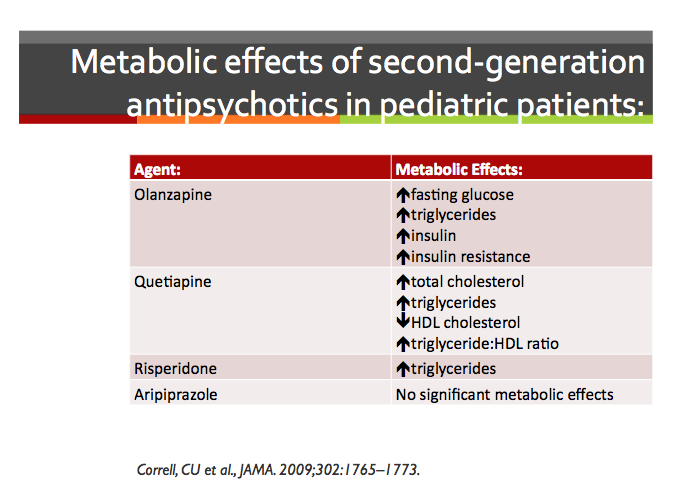
Metabolic Effects CorrellIf they were in the midst of an unequivocal manic episode qualifying for a diagnosis of bipolar disorder, I’d want them to be started on aripiprazole…while hardly weight-neutral, it appears to be the most benign medication approved for treatment of pediatric bipolar disorder from a metabolic perspective with demonstrable efficacy.

If they had a tic disorder, I’d likely do nothing, or consider a central-acting alpha adrenergic agent (guanfacine). The problems caused by many of the medications used to treat tic disorders are worse than the tics themselves.

If my kid had a problem with aggressive behavior, I’d want them to have the best possible assessment prior to initiating treatment. If they were found to have a specific condition that contributed to their aggression, I’d treat that condition. I’d look at available resources for behavioral therapy or cognitive-behavioral therapy. I would only consider an antipsychotic if my child’s aggression placed them at serious risk of harming other people or if being on an antipsychotic enabled them to continue to live with our family.

There’s something else I’d want for them as well…I’d want them to have the opportunity to experience Christian community in a local church where they felt welcomed and accepted regardless of their emotions or capacity for self-control on any given day. I’d want them to have the opportunity to develop their gifts and talents through meaningful opportunities to serve other people and to serve the church. I’d want them to have relationships with spiritually mature adults outside of our family who would help reinforce the values my wife and I hope to instill in them and be available to them when situations arise when they need advice from someone other than their parents. I’d also want to be in a place where my wife and I could experience a sense of community and find support on the days when our child’s problems became overwhelming.

Key Ministry seeks to develop resources including this blog series, resources available through our website, live training, and our Inclusion Fusion Web Summit because we believe the church can be a great blessing and support to families of kids impacted by mental illness once the leaders of the church and the people who make up the church better understand the need. I’d ask any of you who found this series, or any other Key Ministry resource helpful to help us by sharing our resources with anyone in the church with a heart for sharing the love of Christ with kids or families impacted by mental illness who very much need to experience Christ’s love.

Those are my kids in the picture above, taken by my wife during Spring Break 2009 in Boca Raton, Florida. They’ve grown up a little in the last four years.

***********************************************************************************************************

Question MarkEnjoying the content in this series…Ten Questions Parents and Caregivers Ask About Kids and Medication? Miss any of the posts earlier in the series? Here are links to the other nine questions we addressed…

  1. Why does it seem so many kids are on medication?
  2. How would I know if my child would benefit from medication?
  3. What type of evaluation should a child receive before starting medication?
  4. Who’s qualified to prescribe medication for my child?
  5. When should parents consider non-medical treatment first?
  6. How well should medication work for my child’s condition?
  7. Are the medications prescribed to kids and teens with mental illness safe?
  8. How long will my child need medication?
  9. When should we question if our child is getting the right treatment?
Posted in ADHD, Anxiety Disorders, Bipolar Disorder, Controversies, Depression, Families, Hidden Disabilities, Key Ministry, Mental Health | Tagged , , , , , , , , , , , , | Leave a comment

When should we question if our child is getting the right treatment?

ContemplatingWelcome to Part Nine of our Summer 2013 blog series…Ten Questions Parents and Caregivers Ask About Kids and MedicationToday, we’ll explore the topic: When should we question if our child is getting the right treatment?

Today’s question applies to any mental health treatment provided to kids and teens- not simply pharmacologic treatment.

I’m astounded by how many kids come into our practice with a history of  being on a specific medication regimen for an extended period of time, or extended involvement with a psychologist or counselor with little or no benefit. It’s not at all unusual for me to see kids who have been taking medication for months or years and neither the parent or the child can tell me why the medication was originally prescribed, or how they would be able to know if the medication is working.

Here are six “red flags” that should signal to a parent, either at the onset of treatment, or at any point during a course of treatment, that they may want to question the treatment prescribed for their child…

  • Your professional can’t explain WHY your child is experiencing the difficulties that led you to treatment. “Why” needs to come before “what”. If they can’t give you a reasonably coherent explanation of why your child is experiencing the difficulties that led you to seek help, there’s a good possibility they won’t be able to identify the appropriate remedies.
  • Your professional is unwilling or unable to discuss the range of evidence-based treatments for your child’s condition. While there are many conditions for which medication may be considered a “first-line” treatment, for most mental health conditions seen in children and teens, alternative evidence-based treatments exist. If they’re not familiar with the alternatives, or not comfortable in recommending alternatives that they themselves don’t offer, parents need to question whether they’re pursuing the right course.
  • Your professional is unable to share the intended goals of their treatment. I see this frequently in kids receiving longer term therapy that appears ineffective. If your doctor/therapist can’t specifically describe to you how their ongoing treatment will address your child’s presenting problems, you may be in the wrong place.
  • Your professional can’t offer a reasonable estimate of the time required to see significant progress from treatment, and next steps if your child doesn’t respond. The conditions we treat with medication or psychotherapy significantly impact multiple areas of child development. There’s an opportunity cost to ineffective treatment. If treatment is not helping, it’s probably hurting…if it’s preventing your child from having access to a more effective treatment.
  • Your professional is unwilling to meet with you to discuss your child’s progress. In fairness to your child’s physician, you may need to schedule a formal appointment for such a discussion and pay them for their time, since recent mandated changes in insurance billing make it difficult or impossible for prescribers to get insurance reimbursement for services when your child is not present. In counseling or therapy, confidentiality doesn’t keep a clinician from meeting with parents or sharing their overall impressions of your child’s response to treatment.
  • Your professional is reluctant to seek another opinion when your child’s condition is getting worse. Nobody (but Jesus) has all the answers and not every physician or clinician is a good fit with every child/family. At times, I’ll recommend a second opinion to families when what I’m recommending doesn’t seem to be working or I’m out of ideas. The right professional will check their ego at the door when your child is struggling.

As a parent of a child with an emotional, behavioral or developmental disorder, you don’t have to settle. When your child isn’t getting better within the anticipated time frame, ask questions. When you don’t get reasonable answers, you owe it to your child to seek out more effective help.

Photos courtesy of http://www.freedigitalphotos.net

***********************************************************************************************************

Question MarkEnjoying the content in this series…Ten Questions Parents and Caregivers Ask About Kids and Medication? Miss any of the posts earlier in the series? Here are links to the first eight questions we addressed…

  1. Why does it seem so many kids are on medication?
  2. How would I know if my child would benefit from medication?
  3. What type of evaluation should a child receive before starting medication?
  4. Who’s qualified to prescribe medication for my child?
  5. When should parents consider non-medical treatment first?
  6. How well should medication work for my child’s condition?
  7. Are the medications prescribed to kids and teens with mental illness safe?
  8. How long will my child need medication?
Posted in Advocacy, Families, Key Ministry, Mental Health | Tagged , , , , , , | Leave a comment

How long will my child need medication?

More pillsWelcome to Part Eight of our Summer 2013 blog series…Ten Questions Parents and Caregivers Ask About Kids and MedicationToday, we’ll explore the topic: How long will my child need to take medication?

One of the first questions parents typically ask when I suggest medication is to inquire how long their child will need to be on it. While many of the conditions we treat in child and adolescent psychiatry are very chronic, most parents intuitively sense that “less is more” when it comes to medication. We’d like to think that medication can be a temporary tool to help kids through a rough patch of development. Sometimes that’s true. Sometimes it’s not. Some key determinants of how long we use medication include…

  • The chronicity of the condition
  • The extent to which the child’s environment affects the expression of the condition
  • The availability of effective, non-medical treatments for the condition
  • The ability of the child/teen to develop compensatory strategies to manage the condition
  • Potential or actual side effects from medication

Let’s look at how the question may be answered differently, depending upon the condition we’re treating.

Kids in schoolI would tend to view ADHD as a condition in which the need for treatment is highly dependent upon the demands of the child’s educational and home environments.  The need for medication is typically greatest during middle school and high school when the demands for academic productivity overwhelm the organizational skills of kids with the condition. Motivation is a big factor. When kids are interested in the subject being taught-because of an especially engaging teacher or because the material is engaging-they typically do well. For this reason, many of my kids with ADHD generally need less medication after they settle in at college. Unlike high school, kids get to pick a “major” at college…presumably, a majority of their classes are in a subject area in which they profess to have interest and have some relevancy to future career plans.

About half of the kids who are diagnosed with ADHD continue to meet the diagnostic criteria for the condition as adults. In general, difficulties with impulse control and hyperactivity tend to resolve over time as the brain’s prefrontal cortex fully develops, resulting in less need for medication for those particular target symptoms. Adults are also at an advantage compared to kids because they’re free to choose work environments that suit the way their brains process information. In our practice, we have lots of kids with ADHD who have parents with ADHD-most are untreated, and many are very successful. Three observations about our untreated parents who are functioning well…

  • A disproportionate number of them are entrepreneurs or senior leaders at their companies…they’re good at big picture stuff and don’t like detail work or others telling them what to do.
  • A much higher proportion of them find jobs where they travel a lot. They get bored sitting in an office, seeing the same people every day.
  • Many are very successful in sales jobs where financial incentives and competition help them to maintain their motivation.

I tell parents of kids I treat for ADHD that it’s highly unlikely I’d ever hire their children to do my taxes. Persons with ADHD are more likely to need medication if they’re in jobs that require a high degree of organizational skills, demand lots of paperwork and impose lots of deadlines.

Depression is one of the least chronic conditions we treat in kids. While there aren’t specific guidelines describing an ideal duration of treatment for kids and teens with depression, assuming kids we’re treating for depression don’t have another chronic  condition (OCD), most clinicians will typically treat with medication for a year and then offer the child/family an opportunity for a trial off medication. In the FDA trials of kids who responded positively for depression, approximately 70% were able to remain medication-free for one year after they were weaned off medication. On the other hand, depression tends to recur, and an examination of the data on the frequency with which antidepressants are prescribed to adults in the U.S. suggests that kids treated for depression will very likely require medication for the condition at frequent intervals during adulthood.

Anxiety tends to be a more chronic condition as opposed to depression, and tends to manifest in different ways at different times during development…i.e., the six year old with separation anxiety is often the the 11 year-old with panic attacks and the teenager with social anxiety. We typically treat with the same medications we use in depression-SSRIs. The greater the severity of anxiety symptoms and the more chronic the condition, the greater the likelihood the child/teen will need medication long-term, although we don’t have good data on the impact that good cognitive-behavioral therapy may have on the long-term need for medication. OCD is one condition that tends to be especially chronic. In the discontinuation studies performed for the FDA, relapse rates for kids who responded positively to medication for OCD were in the range of 90%.

Bipolar disorder is generally considered to be a condition requiring lifelong treatment with medication, assuming the child/teen has been accurately diagnosed. The presence of cyclical mood symptoms may predispose patients to more frequent and more severe mood cycles as they grow older. The biggest question with long-term medication use has more to do with whether we can encourage the child and their parents to continue to take effective medication. A one-year follow up study of kids and teens in short-term FDA studies of medication for bipolar disorder completed at the University of Cincinnati reported that only 35% of patients were considered to be “adherent” to medication-defined by taking 75% or more of prescribed medication for their condition. 42% were “partially adherent”, taking 25-75% of their medication, while 23% stopped medication completely…and we’re talking about families who, for the most part,  had sufficient capacity for follow-through to enroll in and complete a FDA-sanctioned clinical trial!

Treatment for any given child or family is highly individualized, and as a clinician, I would much rather have a child on less or no medication as opposed to more. Unfortunately, many of the conditions we treat in child and adolescent psychiatry are quite chronic in nature, and as a general rule, the more chronic the condition and the less available good non-medical treatments are for the condition, the greater the likelihood is that kids may require medication long-term.

Next: When should we question if our child is getting the right treatment?

Photos courtesy of http://www.freedigitalphotos.net

***********************************************************************************************************

Question MarkEnjoying the content in this series…Ten Questions Parents and Caregivers Ask About Kids and Medication? Miss any of the posts earlier in the series? Here are links to the first seven questions we addressed…

  1. Why does it seem so many kids are on medication?
  2. How would I know if my child would benefit from medication?
  3. What type of evaluation should a child receive before starting medication?
  4. Who’s qualified to prescribe medication for my child?
  5. When should parents consider non-medical treatment first?
  6. How well should medication work for my child’s condition?
  7. Are the medications prescribed to kids and teens with mental illness safe?
Posted in ADHD, Anxiety Disorders, Bipolar Disorder, Depression, Families, Mental Health | Tagged , , , , , , , , , | 1 Comment

Rick and Kay Warren on Mental Illness

Rick Warren returned to the pulpit at Saddleback Church on July 27th-28th for the first time since the tragic suicide of his son, Matthew, accompanied by his wife, Kay.

This is some of the best teaching I’ve ever heard explaining mental illness from a Christian perspective. The video is definitely worth a look…when you click on the picture below, you’ll be taken to the Saddleback Church website. If you don’t have time to watch the entire video, start at around the 73 minute mark.

Rick Warren Sermon

Thanks to Amy Kendall, who serves as Disabilities Ministry coordinator at Saddleback, I was able to get a copy of the text of Rick and Kay’s message. Here’s my favorite excerpt-one in which Rick speaks about mental illness…

Many of you, and I mean many of you, are struggling with your thoughts. And actually your thoughts torture you. You don’t tell anybody about it but it bothers you. Your thoughts torture you with depression or your thoughts torture you with anxiety. Or your thoughts torture you with self loathing. Or shame.

Some of you are tortured with blame and resentment. And some of you are tortured with fear and worry. And some of you are tortured with compulsions and attractions and addictions. And some of you are tortured with anger and some of you just feel out of place. I’m the odd person out. I don’t fit. I’m not in the in crowd. I’m on the edge. I just feel like the square in a round world.

You have these thoughts and you can’t get them out of your mind. You can’t make your mind mind.

Let me just say this to you as somebody who loves you. You’re not going crazy. If you’re afraid that you’re going crazy – I’m afraid that I’m losing my mind. Let me tell you this: People who are insane aren’t afraid of losing their mind. The fact that you’re afraid means you’re not losing your mind. So take a deep breath and let that one out. People who are insane don’t worry about it. The fact that you’re worried means you’re rational.

So you’re not going crazy but you do need help with your thought life.

The second thing I want to say to you is this: you’re not alone. There are three thousand people in this room here tonight. If this is an average like it is here in America, six hundred of you are struggling with some kind of mental illness. Six hundred.

Sixty million Americans struggle with some kind of mental illness. Four hundred million worldwide. That would be larger than the United States if it were a nation.

And I want to just say this: you may have a chemical imbalance in your body that messes with your mind. But your chemistry is not your character. And your illness is not your identity. And God’s grace doesn’t just cover our genetics, our genes and genetics. It covers our guilt and everything else.

And God’s mercy doesn’t just cover the things we do wrong. It covers our DNA. And we want you here at Saddleback Church. It is not a sin to be sick. And there’s no shame in taking meds. There’s no shame in seeing a psychiatrist. If my back is broken I go to a back doctor. If my heart doesn’t work right I go to a heart doctor. If my kidney stops working I go to a kidney doctor. If my brain isn’t functioning right I go to a brain doctor. There’s no shame in that.

Why is it that any other organ in your body cannot work and there’s no stigma attached to it? If my spleen stops working there’s no shame… if my pancreas stops working… if I have diabetes there’s no shame, there’s no stigma on that. But if my brain stops working why am I supposed to keep quiet and not talk about it and be ashamed of it? That’s just wrong.

Ten years ago God called Kay and then called me and then called many of you at Saddleback to remove the stigma of HIV and AIDS. It’s not a sin to be sick. And now ten years later God is calling us as a church to remove the stigma of mental illness. And we’re going to do that. If you’re struggling with any kind of mental torture we want you here. Cause we’re all a little crazy here.

If you’re perfect we don’t want you in this church. Go somewhere else. And by the way if you ever find a perfect church, please don’t join it because then it won’t be perfect any more. Once you join.

At Saddleback Church we take this so seriously we have literally hundreds and hundreds of support groups and thousands and thousands of people in those support groups. In fact in all of our small groups we have over 32,000 people in seven thousand small groups from Santa Monica to Carlsbad.

In front of you is a card. I want you to pull this out. It says “Saddleback Cares.” If you’re on the second row hand one to the person in front of you. I want you to take two of these with you as you go. Two of these with you – one for you and one for you to give away to somebody else who you know in pain.

Here’s just a list of some of the support groups that we have. Support groups for ADD; for Alzheimer’s; for Asperger’s; for bipolar; for breast cancer; cancer; chronic pain; depression; divorce care; eating disorders; empty arms – that’s people who have miscarried; people who have family, loved ones, in prison; grief support; hepatitis; infertility; kidney disease; living with AIDS; Parkinson’s; on and on and on. There’s almost no problem you could name we don’t have a small group for. You can go out on the patio and get information after the service.

Take this with you. Take one and give one to a friend.

The third group I want to talk to; those of you who are in families and you have a family member like the Warren family did who is seriously mentally ill. Maybe it’s your dad. Maybe it’s your mom, your husband, your wife, your brother, your sister, a child. We want you in Saddleback Church. This is your church. And we will support you and we will help you and we will work on the pain you’re going through together. You should not suffer in silence. We are here to help your family but you’ve got to speak up. And you’ve got to let us know about the pain. As I said we want to remove that stigma together.

God never wastes a hurt. I have no doubt that God is going to use the hurt that Rick and Kay Warren experienced to help countless families impacted by mental illness to experience the love of Christ.

Updated August 10, 2013

***********************************************************************************************************

600817_10200479396001791_905419060_nConfused about all the changes in diagnostic terminology for kids with mental heath disorders? Key Ministry has a resource page summarizing our recent blog series examining the impact of the DSM-5 on kids. Click this link for summary articles describing the changes in diagnostic criteria for conditions common among children and teens, along with links to other helpful resources!

Posted in Key Ministry, Mental Health | Tagged , , , , , | 1 Comment

Adults with disabilities and church attendance…What does the data say?

110711105909_abbyhamiltonOne of the challenges faced by the disability ministry movement is the absence of good data examining the impact of specific conditions on church attendance and spiritual growth. Speakers all too often quote a statistic during talks without a specific reference.

This past Friday, our good friend and colleague Laura Lee Wright of Bethesda Lutheran Homes posted a request in the Special Needs and Disabilities Ministry Facebook group for a statistic on how many people with disabilities are unchurched. The one piece of data I’ve traditionally shared was a 1994 Harris survey reporting that 49% of adults with disabilities attended religious services at least once a month, compared to 59% in a control group of persons without disabilities. Statistics on the impact of disability in children on church attendance are practically nonexistent. Thanks to the wonders of Google, I was able to find more recent statistics in adults.

The Kessler Foundation and the National Organization on Disability commissioned Harris Interactive to conduct the 2010 Survey of Americans with Disabilities. This has been an ongoing research project for 20+ years tracking a number of quality of life indicators and employment data for adults with disabilities, comparing those indicators to adults in the general population without disabilities. One of the quality of life indicators used in the study is frequency of attendance at religious services…the source of the statistic I mentioned above.

Here’s a description of the survey methodology:

A national cross-section of 1,001 adults with disabilities and (2) a national cross-section of 788 adults without disabilities. These interviews took place between May 5 and June 3, 2010. When a person with a disability was unavailable for an interview or unable to be interviewed, a proxy from the same household who was best qualified to answer questions about that person was chosen to complete the interview. Overall, 10% of the interviews were conducted with proxies. In the case of findings on employment among people with disabilities, the data is based off of employed people ages 18 to 64 from the national cross-section, as well as an oversample of 315 people with disabilities in the labor force which was conducted online using sample from the Harris Poll Online panel. All of the results were weighted to be representative of the general population ages 18 and over with and without disabilities.

The sample of people with disabilities was limited to non-institutionalized individuals with disabilities, with a person qualifying for this portion of sample if he or she currently: Has a health problem or disability that prevents him or her from participating fully in work, school, housework, or other activities; or reports having a physical disability of any kind; a seeing, hearing, or speech impairment; an emotional or mental disability; or a learning disability; or considers himself or herself a person with a disability or says that other people would consider him or her to be a person with a disability.

Church AttendanceHere’s the data examining the relationship between the presence of a disability and attendance  at religious services. Adults with disabilities are significantly less likely than their peers without disabilities to attend religious services (50% vs. 57%, respectively). They are also significantly more likely to have NEVER attended a religious service compared to non-religious controls. In the 24 years of the survey, the gap in attendance at religious services has fluctuated over time…the biggest gap was 18% in 2000. The current gap has narrowed only by 2% (within the 3-5% margin of error in the survey) since 1994.

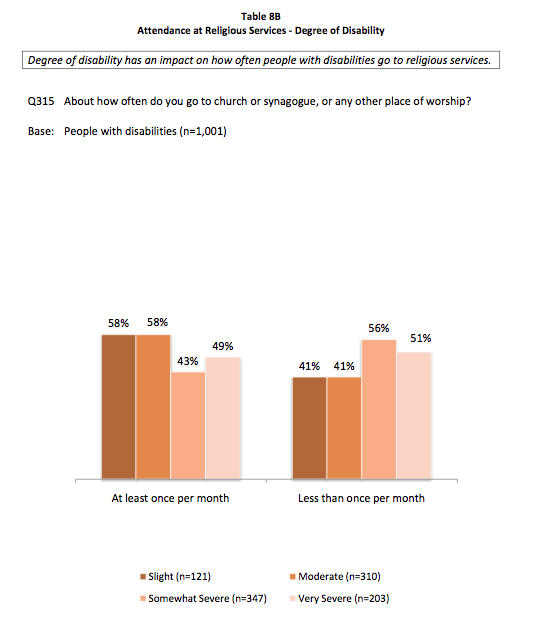
Severity of Disability and Church AttendanceThe survey also examined the relationship between the severity of disability and frequency of attendance at religious services. Participants self-identified their disability as “slight”, “moderate”, “somewhat severe” or “very severe”. Those with self-described “slight” and “moderate” disabilities were significantly more likely to attend church compared to participants with more severe disabilities. Quoting from the study authors…

“This difference is the same as it was in 2004, suggesting that not much has changed in the way of removing architectural, communications, and attitudinal barriers that prevent people with disabilities—especially people with severe disabilities—from regular attendance”. (Table 8B)

There are major limitations to this study. This survey excludes persons with disabilities who are not able to live at home. We don’t know the nature of the disabilities impacting survey participants. We don’t know whether there are others in the home with disabilities. We don’t know from the statistics on religious service attendance whether persons with disabilities aren’t attending churches, synagogues or mosques, or whether the denomination of the church makes a difference. We do know that a sizable percentage of participants in this survey became disabled later in life. Does the age of onset of disability affect attendance at religious services. We don’t know.

We do know that the Body of Christ is incomplete without the gifts, talents and presence of everyone. We also know that God’s at work through a multitude of churches and ministries sharing His love with adults with disabilities. We also know that as recently as 2010, an extremely limited data set suggests the burgeoning disability ministry movement hasn’t yet made a statistically significant impact upon church attendance among adults with disabilities.

Here’s a link to the full survey, including methodology.

***********************************************************************************************************

600817_10200479396001791_905419060_nConfused about all the changes in diagnostic terminology for kids with mental heath disorders? Key Ministry has a resource page summarizing our recent blog series examining the impact of the DSM-5 on kids with mental health disorders. Click this link for summary articles describing the changes in diagnostic criteria for conditions common among children and teens, along with links to other helpful resources!

Posted in Controversies, Inclusion | Tagged , , , , , , | 5 Comments

Are the medications prescribed to kids and teens with mental illness safe?

PillsWelcome to Part Seven of our Summer 2013 blog series…Ten Questions Parents and Caregivers Ask About Kids and MedicationToday, we’ll explore the topic: Are the medications prescribed to kids and teens with mental illness safe?

Much of the controversy around the use of psychiatric medication in children and teens centers around concerns that serious long-term health risks of these medications may be overlooked. Critics have raised the prospect that at some point in the distant future we’re likely to see an epidemic of long-term effects resulting from the widespread use of medication for kids during the first two decades of the 21st Century.

The challenge we face in child psychiatry is balancing risks about which relatively too little is known. There’s a risk of treating…but there’s also a risk of not treating…and we’re often in the position of having to make recommendations to families in the face of insufficient data.

For the purpose of this discussion, we’ll limit our focus to classes of widely used medications that are FDA-approved for use in children and teens…stimulants and non-stimulants for ADHD, serotonin reuptake inhibitors for anxiety disorders, OCD and depression and antipsychotics approved to treat schizophrenia, bipolar disorder and aggressive behavior in kids with autism spectrum disorders. Technically, all of these products have been determined to be “safe and effective” as a result of having progressed through the FDA’s review process, but there are major limitations in the mandated review process (for good reason) that result in significant knowledge gaps around commonly used medications.

The most obvious limitation is the lack of long-term studies evaluating the safety and effectiveness of psychiatric medication in kids. The “pivotal” Phase 3 trials that determine FDA-approval are typically 4-12 weeks in length. Occasionally, we’ll see dose optimization/continuation studies that continue for a year. Beyond that, there’s little data from controlled studies…we tend to rely more upon case reports and clinical observation. One reality-It’s very difficult to do long-term studies with kids…Full disclosure: our practice is currently involved in a three year study evaluating safety and tolerability of sertraline in children and teens mandated by European regulators. Families move or lose contact with investigators, kids spontaneously discontinue medication, etc.

Here’s what we know from the research literature about long-term effects of medication in kids…

  • In kids with ADHD treated with stimulants or atomoxetine, there appears to be a statistically, but not clinically significant effect on growth (1-2 cm reduction in child’s ultimate height compared to what would have been expected without medication).
  • The risk of tardive dyskinesia in kids treated with the antipsychotic risperidone has been reported to be 0.4%/year of exposure to the drug.

That’s pretty much it. Some authors have attempted to draw conclusions from follow-up data with kids who were enrolled in the MTA study of ADHD treatment conducted in the mid 1990’s that can’t be drawn because the study wasn’t designed to evaluate the long-term safety and effectiveness of ADHD treatments.

So…what safety concerns associated with medications approved by the FDA for use in kids should be of greatest importance to parents? I’d suggest there are two big ones…along with considerations associated with specific drugs (risk of lethal overdose, thyroid and renal toxicity with lithium in kids with bipolar disorder, metabolic syndrome in kids treated with olanzapine for bipolar disorder or schizophrenia, prolactin elevation with several second generation antipsychotics)…

TADS#2. Increased risk of suicidal thinking or behavior on serotonin reuptake inhibitors. I addressed this concern in some detail in this post from our winter blog series on depression. To summarize, it’s my opinion that parents need to be most concerned about an increased suicide risk in kids with some other condition (in addition to depression or anxiety) that interferes with emotional self-regulation and/or impulse control (ADHD, trauma, kids with behaviors similar to those seen in Borderline Personality Disorder). One hypothesis put forth to explain why an increased risk is present involves the suggestion that antidepressants might cause disinhibition in a subset of patients…evidence supporting this hypothesis includes the observation that pathways in the prefrontal cortex of the brain modulating impulse control don’t fully mature for most people until their early to mid-20s, coinciding with the time after which antidepressants are no longer associated with increased suicidal risk. Let’s keep in mind…patients with depression were eleven times more likely to experience significant benefit from antidepressant medication than to experience medication-related suicidal thinking or behavior, while kids with anxiety were thirty-five times more likely to experience significant benefit vs. increases in suicidal thinking/behavior. The graphic (above) from the TADS study demonstrates this reality…for the vast majority of kids in the study, including kids treated with medication alone or medication with cognitive-behavioral therapy, suicidal thinking decreased.

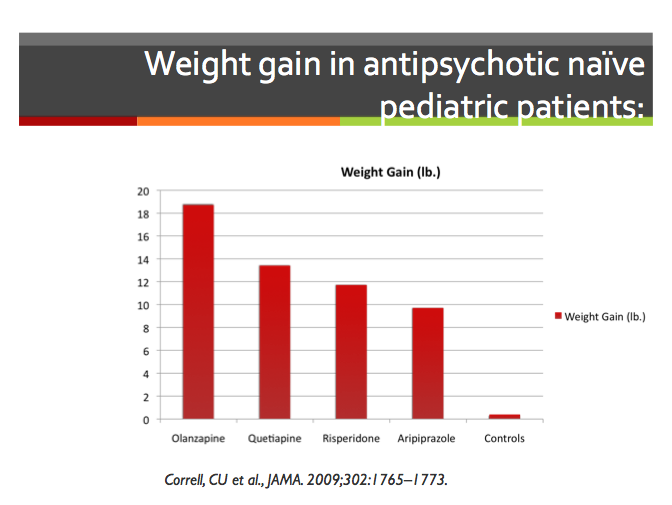
Correll Weight Gain#1. Weight gain, lipid and cholesterol elevation, and potential for diabetes/pre-diabetic conditions in kids treated with second-generation antipsychotics. If we have a long-term “ticking time bomb” from medications widely used in children and teens, this will be it. Here’s a detailed post on the question Is Antipsychotic Medication Safe for Kids from our 2012 Hot Topics series.  This is a situation in which the physicians had been unintentionally misled by the way in which kids were recruited for FDA studies…kids are much more prone to major problems with weight gain when they’ve never before been exposed to antipsychotics, as evidenced by the study above.  This NIMH-sponsored study examined weight gain in kids newly started on antipsychotics (average duration of treatment 10.8 weeks). Most kids in the FDA studies were recruited from academic medical centers where they typically had several previous trials with antipsychotics…as a result, new weight gain was underestimated in those studies.

Metabolic Effects CorrellHere’s a summary slide describing known metabolic side effects associated with antipsychotics…20% of all psychiatry visits for patients age 20 and under result in a prescription for antipsychotic medication…typically to treat aggressive behavior independent of any specific psychiatric diagnosis! In some states, as many as 22% of kids in the foster care system are on antipsychotics. What are the long term medical complications of elevated lipids and cholesterol in kids who may be on prescribed medication for thirty, forty or fifty years? We don’t know.

So…what’s a parent to do? You have to be able to place significant trust and confidence in the judgments of your child’s treating professionals because we don’t yet have the quality of data to look at long term risks and benefits of treatment vs. non-treatment. Ask questions. Go to reliable websites online to research proposed treatments…I recommend the American Academy of Child and Adolescent Psychiatry’s website, along with the National Institute of Mental Health’s website. And don’t forget to pray for wisdom and guidance! After all, God knows our children’s past, present and future and loves each of them more than any of us will ever be able to appreciate.

Photo courtesy of http://www.freedigitalphotos.net

***********************************************************************************************************

220px-The_ScreamKey Ministry offers a resource center on Anxiety and Spiritual Development, including helpful links, video and a blog series on the impact of ADHD upon spiritual development in kids and teens. Check it out today and share the link with others caring for children and youth with anxiety disorders.

Posted in ADHD, Advocacy, Bipolar Disorder, Controversies, Families, Key Ministry, Mental Health | Tagged , , , , , , , , , , , , | 1 Comment

How well should medication work for my child’s condition?

PillsWelcome to Part Six of our Summer 2013 blog series…Ten Questions Parents and Caregivers Ask About Kids and Medication.In this segment, we’ll review the question: How well should medication work for my child’s condition?

Once parents have expressed an openness to a trial of medication for their child, I try to give them as well as their child/teen (when appropriate) a realistic expectation for the change they might expect see, and the time frame in which they can expect results. From time to time, I have parents call me in search of a second opinion when their child has had a positive response to medications because of unmet expectations. One important reason why I don’t see kids engaged with psychologists or counselors with whom I don’t have a working relationship stems from experiences early in my career when therapists sent kids my way with expectations that a “magic pill” would resolve a crisis or prevent a child from engaging in self-harm.

It’s important to families to understand that some disorders are far more responsive to medication than others, and within a given category of medications, some may produce a greater effect than others

We’ve discussed effect size in earlier posts. When a pharmaceutical company submits a drug to the FDA for marketing approval, two unique clinical trials are required demonstrating that the drug works better than nothing (placebo). As a clinician, I want to know how much better than nothing the drug is for the problem I’m attempting to treat. Effect size is a measure of how big a difference we see with an active treatment compared to a placebo. Effect size is usually indicated by a ratio ranging from zero to 1.0, with the number on occasion exceeding 1.0. When an effect size is below 0.20, the benefit of the treatment to an external observer would be difficult to detect. An effect size of 0.50 suggests a moderate effect. Effect sizes of 0.80 and above suggest a robust effect.

FaraoneEffect sizes for ADHD medications are among the largest that child psychiatrists encounter in clinical practice. Here’s data from an analysis of 29 controlled studies of  ADHD medications involving over 4,400 kids, the effect size of amphetamine-based stimulants (Adderall, Adderall XR, Vyvanse) was 0.92, the effect size of methylphenidate-based stimulants (Ritalin, Concerta, Focalin, Daytrana) was 0.80, and the effect size of atomoxetine (Strattera) was 0.73. ADHD medications, when well-tolerated, are very effective. Typically, 75-80% of kids with ADHD will improve following an initial trial with an adequate dose of stimulant medication, while 92% will respond to at least one drug when given trials of both an amphetamine-based and a methylphenidate-based stimulant. FYI…the effect size of Omega-3s for ADHD is 0.36, and the effect size for restricted diets in ADHD is 0.19.

SSRIsIn contrast, the effect sizes for serotonin reuptake inhibitors (SSRIs)-medications commonly used for depression, anxiety and OCD-are considerably more modest, and vary greatly depending upon the condition we’re treating. This data comes from a review of 27 controlled studies of SSRIs registered with the FDA involving 5,310 children and teens who were being treated for either depression, Obsessive-Compulsive Disorder (OCD), or non-OCD anxiety. SSRIs are effective anti-anxiety medications. They’re moderately effective in the treatment of OCD. The smallest effect size noted is for depression…in fact, the majority of controlled studies of SSRIs in children and teens with depression failed to demonstrate a benefit of the active drug compared to placebo.

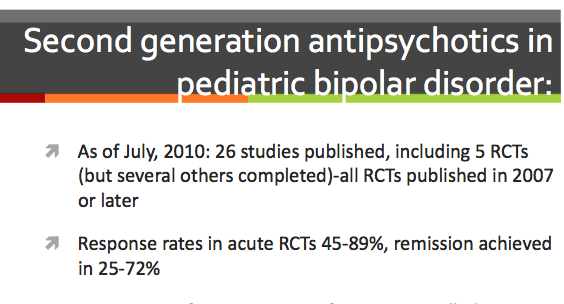
SGAs BipolarSome of our most aggressive treatment is reserved for kids and teens diagnosed with bipolar disorder. At this point in time, the approved treatments for bipolar disorder include several second-generation antipsychotics (SGAs)…risperidone (Risperdal), aripiprazole (Abilify), quetiapine (Seroquel) and olanzapine (Zyprexa), along with lithium  carbonate. Short-term treatment studies of antipsychotics suggest a wide range of response rates. One study suggests that as many as half the kids who responded positively to SGAs in short-term studies for bipolar disorder relapsed within one year of beginning treatment.

Anticonvulsants in PBDAnticonvulsant medications have been widely used in the treatment of pediatric bipolar disorder, with significant effects reported in short-term studies without control groups. These findings weren’t replicated in studies using placebo controls. Two controlled studies have failed to demonstrate efficacy of valproic acid (Depakote) in pediatric bipolar disorder. We have one small controlled study (25 patients total, ranging in age from 12-18) reporting a response rate of 46% to lithium among a sample of youth diagnosed with bipolar I, bipolar II, mania or major depressive disorder with risk of future bipolar disorder.

TEOSSOur best comparison study for the effectiveness of medication in teens with early-onset schizophrenia is the TEOSS study, comparing effectiveness of risperidone, olanzapine and molindone. In the TEOSS study, positive response rates to medication were 50% with molindone, 46% with risperidone and 34% to olanzapine.  In a short-term treatment study of early-onset schizophrenia, the majority of teens treated with commonly used antipsychotics failed to respond to treatment.

The take-home point from our discussion is that medication typically isn’t a panacea for kids and teens experiencing mental illness, and in general, the more serious the symptoms of mental illness experienced by children and teens, the lower the likelihood is that medication will lead to an ongoing remission of the child’s symptoms.

***********************************************************************************************************

600817_10200479396001791_905419060_nConfused about all the changes in diagnostic terminology for kids with mental heath disorders? Key Ministry has a resource page summarizing our recent blog series examining the impact of the DSM-5 on kids with mental health disorders. Click this link for summary articles describing the changes in diagnostic criteria for conditions common among children and teens, along with links to other helpful resources!


Posted in ADHD, Anxiety Disorders, Bipolar Disorder, Depression, Key Ministry, Mental Health | Tagged , , , , , , , , , , | Leave a comment

When should parents consider non-medical treatment first?

ID-10053853Welcome to Part Five of our Summer 2013 blog series…Ten Questions Parents and Caregivers Ask About Kids and Medication. In this segment, we’ll review the question: When should parents consider non-medical treatment first?

Lost in the controversy swirling around the numbers of kids in the U.S. receiving prescription medication for ADHD, anxiety, depression, mood disorders and aggressive behavior is the reality that non-medical treatment is often the most appropriate first step for the majority of children and teens entering the mental health delivery system. Many mental health conditions are commonly seen in kids for which medication generally isn’t the first step in a well-developed treatment plan. Today, we’ll look at some situations when parents and clinicians might consider non-medical treatment alternatives first.

Kids and teens with depression of mild to moderate severity, without suicidal thinking. Education, case management and brief, supportive treatment has been shown to be as effective as cognitive-behavioral therapy (CPT) or interpersonal therapy for kids with mind depression. Quoting from the American Academy of Child and Adolescent Psychiatry’s (AACAP) practice parameter for the treatment of depression…

“Thus, it is reasonable, in a patient with a mild or brief depression, mild psychosocial impairment and the lack of any clinically significant suicidality or psychosis, to begin treatment with education, support and case management related to environmental stressors in the family and school. It is expected to observe response after 4 to 6 weeks of supportive therapy.”

Kids with Obsessive-Compulsive Disorder (OCD) without first degree relatives  with OCD  (although concomitant medication may be necessary in severe cases). In the POTS (Pediatric OCD Treatment) study, CBT was superior to placebo, while sertraline was not. The rate of clinical remission for combined treatment (CBT plus sertraline) was 53.6%; for CBT alone, 39.3%; for sertraline alone, 21.4%; and for placebo, 3.6%. A secondary analysis of the study data demonstrated that kids with a family history of OCD had more than a sixfold decrease in the effect size of CBT monotherapy relative to their counterparts in CBT without a family history of OCD.

Because of the findings of the POTS study, AACAP recommended the following…When possible, CBT is the first line treatment for mild to moderate cases of OCD in children. 

Anxiety Disorders (especially phobias)…Since the publication of the most recent AACAP Practice Parameters in 2007, results from the CAMS (Child and Adolescent Anxiety Multimodal Study) have demonstrated that combination therapy (CBT plus medication) is the most effective treatment approach to kids and teens with anxiety. Nevertheless, 60% of kids in the study assigned to the CBT-only treatment group responded positively to treatment within twelve weeks, compared to 23% of kids receiving placebo, 55% receiving sertraline alone, and 81% receiving combination treatment. Per the current practice parameters…

Until evidence from comparative studies inform clinical practice, treatment of childhood anxiety disorders of mild severity should begin with psychotherapy. Valid reasons for combining medication and treatment with psychotherapy include the following: need for acute symptom reduction in a moderately to severely anxious child, a comorbid disorder that requires concurrent treatment, and partial response to psychotherapy and potential for improved outcome with combined treatment

Post-Traumatic Stress Disorder (PTSD). Again, per the AACAP Practice Parameter for the Assessment and Treatment of Children and Adolescents With Posttraumatic Stress Disorder…

“Trauma-Focused Psychotherapies Should Be Considered First-Line Treatments for Children and Adolescents With PTSD.”

Preschoolers with ADHD. The US Agency for Healthcare Research and Quality recently sponsored a comparative effectiveness review of interventions for preschoolers at risk for attention-deficit/hyperactivity disorder (ADHD) that was published this past April in Pediatrics.

RESULTS: Fifty-five studies were examined. Only studies examining Parent Behavior Training (PBT) interventions could be pooled statistically using meta-analysis. Eight “good” studies examined PBT, total n = 424; Stength of evidence (SOE) was high for improved child behavior, standardized mean difference = –0.68 (95% confidence interval: –0.88 to –0.47), with minimal heterogeneity among studies. Only 1 good study evaluated methylphenidate, total n = 114; therefore, SOE for methylphenidate was low. Combined home and school/day care interventions showed inconsistent results. The literature reported adverse effects for methylphenidate but not for PBT.

CONCLUSIONS: With more studies consistently documenting effectiveness, PBT interventions have greater evidence of effectiveness than methylphenidate for treatment of preschoolers at risk for ADHD.

We have some truly fabulous tools to assist parents of kids with mental illness in doing their “due diligence” in evaluating treatment recommendations professionals suggest for their children. One of my favorites is the website for the National Library of Medicine. One last tip for parents…really good clinicians enjoy fielding questions from educated parents and don’t feel threatened when parents are well-read. Don’t be afraid to ask about non-medical treatment approaches!

Photo courtesy of http://www.freedigitalphotos.net

***********************************************************************************************************

cropped-key-ministry-door.pngOur Key Ministry website is a resource through which church staff, volunteers, family members and caregivers can register for upcoming training events, request access to our library of downloadable ministry resources, contact our staff with training or consultation requests, access the content of any or all of our three official ministry blogs, or contribute their time, talent and treasure to the expansion of God’s Kingdom through the work of Key Ministry.

Posted in ADHD, Anxiety Disorders, Controversies, Depression, Families, Hidden Disabilities, Key Ministry, Mental Health | Tagged , , , , , , , , , , | Leave a comment

Who’s qualified to prescribe medication for my child?

ID-10033447Here’s the fourth installment in our Summer 2013 blog series…Ten Questions Parents and Caregivers Ask About Kids and Medication. Today, we’ll examine the question Who’s qualified to prescribe medication for my child?

Parents of kids with mental health concerns are confronted with the need to navigate a maze of specialists and service delivery systems with roles that frequently overlap. When the need to consider medication as part of a comprehensive treatment plan arises, parents are often confused when they discover that physicians from a number of different specialties may be involved in prescribing psychotropics to kids. Today, in an effort to relieve some of the confusion, we’ll take a brief look at the specialists who prescribe medication for kids and the differences between them in training and expertise.

Child and Adolescent Psychiatrists: I’ll admit my bias as a past-President of our child psychiatry society in Northeast Ohio…in my opinion, child and adolescent psychiatrists, on the basis of our training, are best equipped to do the detailed evaluation integrating biological, psychological, environmental, genetic and family systems influences that contribute to mental illness in kids, and receive the most extensive training and experience in understanding the medications prescribed to kids with these conditions. Here’s a page from the American Academy of Child and Adolescent Psychiatry briefly describing the nature of the training and supervision we receive during residency and fellowship.

Pediatric Neurologists: Specialists in pediatric neurology may actually be in shorter supply than child and adolescent psychiatrists. There’s also a little bit of overlap in the training pediatric neurologists and child psychiatrists receive, because the content of their exams for board certification overlaps. In our area, it’s not unusual for neurology practices to be composed of kids with ADHD and/or developmental disorders. Kids on the autism spectrum are frequently referred to neurologists because of stereotypic movements, difficulty/delays in development of motor skills or aggressive behavior. Kids with moderate to severe tic disorders as comorbid conditions are frequently seen first by neurologists. Most neurologists in our area are employed by large hospital systems that accept most insurance plans, while most child psychiatrists work for publicly funded mental health agencies primarily serving kids on Medicaid, with the remainder in private practices where contracting with insurance companies is unfeasible. As a result, we may have a higher percentage of kids with parents who rely upon private insurance to pay for treatment being seen by pediatric neurologists.

Developmental Pediatricians: Developmental pediatricians are typically found in academic medical centers and large pediatric hospitals. Locally, they are frequently involved in evaluating very young children with developmental delays well before the age when mental health concerns are frequently addressed with medication. Here’s a definition of the role of the developmental pediatrician from the American Academy of Pediatrics.

Pediatricians: Pediatricians write more prescriptions for psychotropic medication for kids than physicians of any other specialty. Compared to the subspecialty physicians listed above, pediatricians are frequently at an advantage because they may know a child for many years and have some understanding of the child’s developmental trajectory as well as the dynamics of the child’s family before the need to consider medication arises.

In my experience, the knowledge base and comfort level of pediatricians in prescribing psychotropics varies widely. In our area, most pediatricians are very comfortable making a diagnosis of ADHD and getting kids through one or two trials of stimulant medication for the condition. They are often less comfortable in treating conditions such as anxiety or depression because of safety concerns associated with serotonin reuptake inhibitors, and most uncomfortable with the use of antipsychotics. Some larger pediatric groups will have a physician within the practice take a special interest in kids with mental health concerns.

For many families, the local pediatrician may be the only option when a child needs medication because of difficulty accessing child psychiatry services (lack of availability outside large cities, cost barriers, gatekeepers in publicly-funded agencies).

Family Physicians: The typical family physician likely has more training and exposure in caring for persons with mental illness because of the number of adults they care for who require medication. Unfortunately, kids are not “little adults” and frequently react very differently to medication than do adults.

Primary care physicians (pediatricians, family physicians) face an additional challenge when caring for kids with mental health needs. The business model under which their practices operate isn’t conducive to lengthy appointments in which the physicians have the luxury of time to discuss a variety of treatment options or answer lots of in-depth questions from parents. A number of primary care physicians I know who do a good job of caring for kids do so through providing uncompensated time and challenging  administrators responsible for maintaining the practice’s bottom line.

Nurse practitioners, physician assistants: As time goes on, more and more kids in need of medication are likely to be seen by “physician extenders.” Two of the major teaching hospitals in our area are using nurse practitioners as substitutes for child psychiatrists because wait lists are so long. One downside to physician extenders is their inability to prescribe stimulant medication in many states (including Ohio). We’re starting to see private practices employ physician extenders as well. The effectiveness of their services is likely to be highly dependent upon the specifics of their training and experience, along with the quality of input and level of involvement of their supervising physician.

Bottom line…If you’re open to considering psychotropic medication for your child or teen, you want an experienced clinician who will take the time to fully understand the nature of your child’s difficulties prior to whipping out the prescription pad. You want a clinician who appreciates the benefits and limitations of medication and is capable of recognizing situations when medication makes problems worse. You want a clinician with the time and availability to answer difficult questions when they arise.

Photo courtesy of http://www.freedigitalphotos.net

***********************************************************************************************************

600817_10200479396001791_905419060_nConfused about all the changes in diagnostic terminology for kids with mental heath disorders? Key Ministry has a resource page summarizing our recent blog series examining the impact of the DSM-5 on kids with mental health disorders. Click this link for summary articles describing the changes in diagnostic criteria for conditions common among children and teens, along with links to other helpful resources!

Posted in Advocacy, Families, Key Ministry, Mental Health | Tagged , , , , , , , , , , , | Leave a comment