Thinking Orange: Supporting the family’s role in spiritual development when kids have disabilities…

In this post from our blog series: Applying “Orange” Principles in Ministry to Families of Kids With  Disabilities we’ll to explore the role of the family in the spiritual development of  kids with disabilities…and how churches can be most helpful in supporting families in helping their kids to grow in faith…

This discussion covers pages 42-77 in Think Orange.

If I could take what I’ve learned from my day job and share it with leaders in the church, the most important insights would echo the content Reggie included in this chapter. If there were one “takeaway” for leaders in children’s or family ministry serving the folks we see in our practice, it would be this:

“You can choose to believe that most parents, regardless of their baggage, have the desire and capacity to improve…Your perception of parents’ potential to change can drive how you respond to them.” (Think Orange, Page 47)

Parents of kids with disabilities are often dragging along quite a bit of baggage. Many of them have their own struggles and limitations that undermine the best of intentions when it comes to their personal spiritual development and the spiritual development of their kids. Follow-through may be difficult for many parents, but that doesn’t mean that they don’t want to. The church plays an invaluable role by walking with them, encouraging them and helping them to take the next step.

Reggie outlined five “family values” that form the foundation of the role of the home in the “Orange” philosophy. Each provides unique challenges to families of kids with disabilities.

SuperheroValue#1: Imagine the end: Reggie challenges parents to contemplate the question: Who do I really want them (my children) to become?

Having served in the leadership of two churches in addition to my role with Key Ministry, I’m surprised at how many highly committed Christian parents have never asked themselves that question or contemplated how the choices we make for our kids on a daily basis help support our desires for their spiritual development. That issue aside, one of the challenges the parent of a child with a disability faces is the inability to foresee their child’s future in the same way as other parents.

When I’m meeting with parents to share the results of a psychiatric assessment, the most common questions (aside from questions about the advantages and disadvantages of specific treatments) usually relate to what they can expect for their child’s future. How long will they need treatment? How will this condition affect their education? Will they be successful? Will they be popular? Will they develop a substance use problem or land in jail? Will they be able to support themselves? Will they be happy?

The church can help by providing kids with and without disabilities opportunities for meaningful service that takes advantage of their unique gifts and talents…according to Paul, we all have gifts to contribute to the church. I’m aware of a number of kids with disabilities in churches we’ve served who have developed ministries serving younger children with similar conditions. The church is a perfect place for kids of all abilities to discover opportunities for important service in God’s Kingdom.

Parent Child PrayingValue#2: Fight for the heart: Reggie accurately described a majority of kids in my community when he described them as “experience-rich and relationship-poor.” The nature of the disabilities we see in the kids passing through our office is such that parents often take a more active role in monitoring academic progress and encouraging social activity, resulting in ample opportunity for conflict. Just today, I had a parent making reference to the “homework wars” with her high-school age son. I see situations on a weekly basis in which the parent has torched their relationship with their child in order to get them through the seventh grade or engaged in physical confrontations over the use of a computer or game system. It’s hard for parents to reflect the value they place on the relationship with their child in the midst of the daily struggles.

The church can help by providing the parents with opportunities for a little rest and respite to allow them to regain perspective on how they can best build relationships with their kids based upon trust. The church can also be a place where parents can build relationships with leaders and other parents who can help provide wise counsel in the midst of chaos.
Church pewsValue #3: Make it personal. Parents can’t pass on to their kids faith that they themselves don’t possess. Kids need to see their parents living out their faith on a daily basis, in both words and actions.

I’ve found many church leaders to be very short-sighted in their conceptualization of disability ministry, resulting in the need for more family-centered approaches. How are the kids in the family supposed to come to know and love Jesus if we’re not prepared to welcome the parents to church…and all the other activities at church we’ve found to be helpful in facilitating spiritual growth?

I had a conversation in my office last week with a parent who started a small group in their home for couples with kids with autism spectrum disorders. The group members pay for specialized child care so they can enjoy their fellowship and study time with minimal interruption. This person wanted to offer the small group to other families attending their church (where small groups are integral to the church’s strategy), but was refused because their group didn’t meet frequently enough (because of the need for child care). The bottom line…If you’re a church leader, we’re happy to help you do what you need to do to get the parents into whatever environment you think helps them to grow spiritually. If they grow in small groups, make sure someone can care for their child while they’re in small group. If parents grow in your worship services, let’s figure out something for the kids while the parents are in worship. The win occurs every time a child with a disability or their family has a meaningful contact with a local church.

Coffee CupValue #4: Create a Rhythm. Families of kids with disabilities are more likely to experience disruptions in the normal rhythms of life. Here’s an example…Mornings are often the time greatest stress in families of kids with ADHD. Kids with ADHD often need constant redirection while getting ready for school and much time and frustration is spent organizing what’s needed for the day before prescription medication has fully kicked in. Dinner is often brief…Ever seen a kid with ADHD try to sit at the table for conversation after they’re done eating? Bedtime often involves considerable yelling and duress because kids aren’t sleepy, haven’t finished homework or are enthralled with their game system of choice.

Churches can help by providing parents of kids with disabilities with the resources to initiate spiritual discussions and support the practice of spiritual disciplines within the rhythms that work best for the family. The folks we see in our office spend a fair amount of time driving to therapy appointments, social skills groups and tutors. Many kids with hidden disabilities will process discussions more effectively one on one in a car with their parent than they will across the dinner table or at bedtime. While many of our leaders in children’s ministry are gifted communicators, most of the time, parents of kids with a disability will often be more effective at communicating important truths with their child affected by a disability than the most talented children’s pastor.

Social mediaTechnology may become a valuable resource to churches seeking to resource parents. What if parents got a reminder pushed to them through their i-Phones while sitting at a traffic light after school of the main theme discussed at children’s worship two days before? Or questions suitable for either 1:1 or family discussions? Matt McKee is a children’s pastor connected with Think Orange who leads a company (R04R) that helps churches develop apps that can be easily adapted to help serve families of kids with disabilities.

Value #5: Widen the Circle. The families we serve in our practice frequently experience great social isolation. The parents don’t regularly get out with other couples. Kids with disabilities (and their siblings) are less likely to be involved in the extracurricular activities that lead to social networks among families. Kids with disabilities are less likely to have friends who invite them to church activities. These families are often most in need of what the church is uniquely positioned to provide…an extended network of adult role models who can demonstrate what it means to be a follower of Christ and reinforce the lessons parents model at home as to who God is and why He can be trusted.

Churches simply need to be intentional in their implementation of strategies that encourage the development of relationships between kids with and without disabilities with adults who model what it means to be a follower of Christ. One strategy involves providing opportunities for kids and youth to serve in meaningful ways with adults from the church, which also gives parents the opportunity to identify and cultivate their children’s spiritual gifts. Another strategy involves “relational respite”…churches are intentional about connecting families making use of respite events with small groups within the church who then provide ongoing respite care along with opportunities for relationships with families in the church who may or may not have children with disabilities.

Photo courtesy of http://www.freedigitalphotos.net.

***********************************************************************************************************

Key Ministry-NewEver wonder if the often-quoted statistics about divorce rates in families impacted by disability are true? Check out Key Ministry’s resource: Special Needs and Divorce…What Does the Data Say? In this article, Dr. Steve Grcevich reviews the available research literature on the topic of disability and divorce…and draws some surprising conclusions! Check it out…and share with your friends!

Posted in Families, Hidden Disabilities, Inclusion, Key Ministry, Strategies | Tagged , , , , , , , | Leave a comment

Who knew? Guest blogger Denise Schamens

Schamens FamilyI met Denise Schamens for the first time at the McLean Accessibility Summit several weeks ago. She shared with me a remarkable story demonstrating the impact her local church had upon her family…especially the impact of church upon her son (Sam). Sam is diagnosed with autism and receives therapy to help him improve his communication skills. Denise graciously agreed to share her family’s story with our readers as we wind down our celebration of Autism Awareness Month. Here’s Denise…  

Who knew Monday, August 5th, 2013 would be a pivotal turning point in my children’s spiritual journey… and a turning point for me as a parent to look at them with fresh eyes! Renewed eyes of love that my children have chosen a path I have prayed for long and hard!

To understand this path, we need to go back…

“Living by example” has always been the line that plays in my head. Placed there by a very loving, wise, older woman in my first women’s bible study over 10 years ago. At that time, I was just beginning to attend our church and my husband was not yet walking the same path as I.

I felt alone, but somewhat at peace that this is where God wanted me. I had just had my daughter and checked her in the daycare to be able to be fed Spiritually by these powerful women. God was working in me and I knew I had to be obedient. Both my boys were in school full time. My oldest son, Jacob was just diagnosed with ADHD, and my son, Sam was diagnosed with PDD-NOS. Autism had invaded our world. We were deep into therapy with up to 5 people at any given time coming into my home to work with Sam. I dove into the autism world to find out what I could do for my son.

The ADHD world was mysterious and elusive to me. I didn’t know how to make right the feelings of “is it behavioral or is his neurology different?” Not finding much support in this area, we tried so many options and kept failing.

My husband, Mike found his place in our church, coaching Upward Basketball with our son Jacob. My prayers for him to walk the same road with me were fulfilled! The next year he gave his life to Jesus to my amazement and thrill!

Schamens 2Each year we dove more and more into our church, volunteering and serving in areas that fed us spiritually and brought us together as a family. We started paying one of Sam’s therapists to attend service with him, so he was able to participate in the classrooms and my husband and I could sit together during service. Some days it was a struggle to get everyone there, and to have Sam in a “good” place, in an environment that didn’t really have any training to support him. But they loved on him in a way that a church should and welcomed him and his therapist each week.

Some days were really hard, when Sam would get away from one of us and we would lose him for a short time in the building. Minutes that seem like an eternity for a mother of a child on the spectrum! There would be the looks and questions about his behavior or noise level. All part of the territory. God was working in me again…obedience!

Somedays, it felt like my other two kiddos were just along for the ride. Were they being fed spiritually? Was God working in their lives? I had met many women there that were dealing with some pretty heavy stuff with their children. Drugs, alcohol, running away, fighting, getting in trouble with the law.

I had always been a good listener, and listening to their own journeys had stirred some pretty scary feelings in me as a mother. I saw that they just kept coming to church and trying to get their kids involved in some way in that community. The women who didn’t keep bringing them and left them at home or didn’t find ways to have them serve, struggled day after day. I watched.

We kept coming, each one of us weaving our own journeys separately. As Jacob reached middle school age and found a love for technology, he started serving in our children’s ministry as a cameraman. He started working closely with the Tech team leader. The Tech team leader started working with me and my new non-profit to produce a movie, in which Jacob had a major part. Our whole family was part of this production and it brought us together again. God sure places people in your life for a purpose. He opens doors that we need to see and walk through!

My daughter, who is a product of constant social therapy, from Sam’s walk with autism, is an amazing young lady. She communicates and makes friends easily! God gave her many gifts, drama (the good kind) empathy, sensitivity, and a huge heart! She thrived in church and loved getting involved in the children’s ministry Christmas productions.   Again, we all got involved, which brought us together again. God’s always working! I see that in every part of our journey!

Sam speech therapySam was now in middle school and finding more ways to live with his autism. We had stumbled upon a technique for communicating that Sam used only in school to test his reading comprehension. He was making huge strides academically and learning to express himself with his Speech Therapist. She was his speech therapist way back when he was in preschool. She re-entered his world as a RPM therapist who now had a new way for him to communicate…another person placed perfectly in our world by God!

We continued this way year after year. I continued to pray for each of my children, trusting that God had his hand in everything.

Which brings us to that God ordained, Monday in August! All three of my children and I had just finished wrapping our auditions for my non-profit’s new film. We went out for pizza with a family friend.   The conversation somehow went to Baptism. Jacob said very matter-of-factly…I want to be baptized. My Mommy heart burst with amazement! I kept my cool and calmly talked about when that could happen. My daughter Anna chimed in with her desire to be baptized as well! Gushing! As I sat there stunned and trying to soak up every glorious minute of this event, I thought out loud….wouldn’t it be amazing if we found out where Sam is in his spirituality? If we could find out what he believes, and if it was what we had hoped, all three could share their amazing stories together! Talk about impact! That night, as I shared the whole evening with my husband, I was moved to tears and thankfulness! What a blessing this could be, not just for our family, but to all the families that I know! Those that struggle with bringing their children with special needs to church with them, for fear of all the judgment, uneasiness, and embarrassment that it might bring. For all the families that have lost children, not able to convince them that hearing a God filled message can help them find their way!

Joshua 1:9 kept me focused on what would lie ahead!

Be strong and courageous, do not be afraid, God will be with you and will never forsake you!

The next week, I brought Sam to see his RPM therapist in her home for his weekly session. Luckily, I record each session, because what was to unfold was all God’s doing and plan! I asked him if he wanted to talk about God. He spelled out “yes.” I asked if he understood what it means to be baptized? He spelled out “it means to accept Jesus into your heart.”

He asked if we could all do it together, we discussed that his father and I had been baptized years before, but his brother and sister would do it with him.   I realized that after all of our discussion on baptism he had much more to discuss. He spelled out that he needed to know about God’s forgiveness. He asked because he had been really mad at God for giving him autism.

This is where the Holy Spirit took over and gave me the ability to answer his questions. It’s one of those times in your life as a parent you hope you can guide your child with scripture and share the Gospel with them.

To summarize, we all have struggles, it’s an opportunity for us to direct the attention to God and we can look at it as a gift, to make a difference in the world.

What’s next in this journey? I think the video can sum it all up! I am truly blessed by what God has done in all of our lives and continues to do each day! My message to you? Bring your children to church! Create systems if they do not exist! Invest in their spiritual future! It will pay off! All will be blessed!

gfLogoDenise Schamens serves as Vice President and Treasurer of Good Friend, a 501(c)(3) nonprofit organization dedicated to Autism Awareness, Acceptance, & Empathy ®. The mission of Good Friend is to create autism awareness, teach acceptance of differences, and foster empathy for students with ASD among their typically-developing peers.


Posted in Autism, Families, Inclusion, Key Ministry, Stories | Tagged , , , , , , , , | 1 Comment

Today’s worship schedule at The Front Door…

Front Door CrossWelcome to the Front Door… Online Church from Key Ministry for families impacted by disabilities, presented with the support of Community Bible Church in San Antonio, Texas.  Here’s what we have in store for Sunday, April 27th

Hosted worship services will be available from 8:00-9:30 AM Eastern, 10:00 AM-1:00 PM Eastern and from 4:00 PM to 11:30 PM Eastern. Today’s highlights include…

Robert Emmitt teaches from John 12 on the topic of “Walking into Fear“…examining how we might conduct ourselves when life is going well, but we find ourselves approaching a time of fear and discomfort. Service times…

8:00 AM, 10:00 AM,, 11:30 AM, 4:00 PM, 5:30 PM, 7:00 PM, 8:30 PM, 10:00 PM

Chris Emmitt talks about a life-changing conversation…the Conversation Before the Cross detailed in John 18 between Jesus and Pontius Pilate. Chris teaches at…

8:55 AM, 10:55 AM, 12:25 PM, 4:45 PM, 6:15 PM, 7:45 PM, 9:15 PM, 10:45 PM

We have a special feature for attendees today. Denise Schamens shares a remarkable story of the impact her local church had upon her family…especially the impact upon her son (Sam) this morning at Church4EveryChild. Sam is diagnosed with autism and receives therapy to help him improve his communication skills. Her older son (Jacob) is diagnosed with ADHD…Watch the compelling video illustrating how God was at work through the disabilities impacting her family today at 8:45 AM, 10:45 AM, 12:15 PM 3:50 PM, 5:20 PM, 6:50 PM, 8:20 PM, 9:50 PM and 11:20 PM.

Front Door LogoRemember…we depend upon YOU to get the word out about Front Door! Please share this schedule or a link to the Front Door site with any person of family you know who is unable to attend church because they themselves or another family member experiences a disability that makes attending church difficult to impossible.

Posted in Key Ministry | Tagged , , , , , | Leave a comment

The experiment…

Social mediaThis past winter, we shared with our readers a blog series…Including Kids and Teens With Mental Illness at Church examining components of an effective ministry strategy for outreach and inclusion of families of kids with mental health concerns. Astute observers of this blog may have noticed that we never really concluded the series. The most recent post in the series listed the components we hypothesized would be essential to an effective outreach and inclusion strategy and promised “A bold experiment…

Making church available to families online through The Front Door is the experiment.

Those who joined us this past weekend for Easter worship experienced a brief glimpse of what we have planned for our online platforms. Let’s take a look back at the components of a ministry strategy we discussed last month and examine how the strategy could be implemented through an online church model…

Online Church 2The strategy would be outwardly focused. We need to take “church” to families who don’t currently belong to a Christian community. There’s a mounting body of evidence that they won’t spontaneously come to us. Making worship services, small groups and Christian education available online affords church members and attendees the ability through social media to invite their friends and neighbors to church in a socially acceptable and non-threatening way.

The strategy would promote integration of families into the relational fabric of the local church. An essential component of our online strategy is the use of technology in cultivating relationships between families impacted by the full range of disabilities and people who have been strategically positioned to assimilate families into their “bricks and mortar” church. Online church isn’t an end in and of itself, but a tool we seek to use to promote the opportunity for kids with disabilities to worship, grow and serve in the physical presence of other Christ-followers. What will that eventually look like?

Hangouts 1Families who struggle to find child care or respite care will be able to join small groups online with other families with/without disabilities. We’re working with a couple in a church our ministry serves who are starting a small group through Google Hangouts for other couples in their church with kids with severe disabilities. One of the reasons we sought out Nils Smith as a ministry consultant was the extent to which Community Bible Church was connecting their online congregation through small groups.

Without getting into lots of technical detail, the software we’re using to produce our online worship services affords our worship hosts (who will be strategically-placed leaders or volunteers in local churches as our initiative grows) the opportunity to follow-up with people in need of prayer and the ability to cultivate relationships with online worshipers outside scheduled church activities.

shutterstock_12834553The strategy would afford families the opportunity for an initial experience of “church” in the environments best suited for them. Earlier in this series, we looked at seven barriers that families of kids with mental illness are likely to encounter in our ministry environments that hinder active participation in a local church. The seven barriers are…

  • Social isolation
  • Social communication
  • Executive functioning
  • Sensory processing
  • Recognizing the child/teen’s need for support
  • The desire of kids and teens to not be seen as “different”
  • Parents with mental illness

In helping local churches to make their worship services, Christian education, small groups and service activities available online, we’re providing them the opportunity to introduce the church to families in an environment that works best for that family. Parents are more able to focus on the content of a worship service very early in the morning or late at night after their kids are in bed? They can do that! A child has a sensory processing disorder? A parent can adjust the volume of the worship music on their big screen TV! A socially awkward teen struggles with the pragmatic language skills necessary for a great experience in large group worship? They can chat online during youth worship with other teens from their community in a discussion moderated by an experienced youth pastor or carefully screened small group leader!

Front Door Screen ShotThe strategy would promote inclusion at weekend worship services and other church activities without the need for kids or families to self-identifyEarlier in this series, we discussed the propensity of many kids, teens and parents with more subtle disabilities to FLEE identified “special needs ministries” and avoid inclusion strategies that present the appearance of serving individual kids differently than their same-age peers. The beauty of an online strategy is that churches can target families impacted by mental illness or other disabilities in their local communities without anyone having to know they’re being targeted and without anyone requiring accommodations. Once you’re on the website, the teen with a disability or family impacted by disability is served just like anyone else. The “accommodation” is whatever works best for the viewer of the service.

The strategy would be simple for churches to implement at a modest cost in money and volunteers. Online ministry doesn’t cost a lot of money. We’re planning as a missional initiative for later this year to help a church with fewer than 100 weekly attendees to launch an online church campus to serve families impacted by disabilities in the city they serve. Technology is becoming inexpensive and ubiquitous. I’m familiar with a church that was serving 100,000 online worshipers per week with a paid staff of six people. We could help any church that’s currently video recording worship services to launch an online initiative to families with disabilities in their local communities for less than $10,000, using their existing content and volunteers and including a reasonable budget for local advertising.

Online church for families impacted by disabilities is an experiment. I’m not in any way suggesting that we at Key Ministry have all the answers for churches seeking to serve families impacted by mental illness. Online church certainly won’t be the only answer for inclusion of kids and adults with mental illness, trauma or developmental disabilities. We’ll learn along the way that some things we try will work and some things we try won’t work. We’re testing a hypothesis based upon twelve years of organizational experience in helping churches minister to families impacted by disabilities, and lots of observations of the struggles individual families have experienced in trying to “do church.” We very much appreciate your willingness to come alongside us as we launch our “experiment.”

Posted in Families, Hidden Disabilities, Inclusion, Key Ministry, Mental Health, Ministry Environments, Strategies | Tagged , , , , , , , , , | 1 Comment

Reflections on our first weekend of online church….

Front Door CrossThe path upon which our Key Ministry team embarked this past weekend in launching the Front Door is one I now realize is likely to be one characterized by all manner of unexpected twists, turns and surprises. It wasn’t what I expected…but it was better than what I’d expected in a number of ways.

The blog post announcing the worship schedule for Front Door was the second-most frequently shared post on Facebook that we’ve ever had…well over 400 people took the time to post the schedule to their Facebook walls and share with friends. We’ve clearly identified a need.

Our greatest limitation in launching new worship services online is the availability of worship hosts. Worship hosts make themselves available on the chat wall that appears on the screen below the area where the worship video is presented. We typically won’t make online worship available without hosts available to engage visitors, pray with anyone who requests prayer and to invite families to join worship through our social media tools. As of the middle of last week, we had one trained worship host. Four of our Facebook followers were led to volunteer their services as hosts late last week and did a fabulous job! Two of the four I’d NEVER before met or interacted with online. All were superbly qualified to host. A huge THANK YOU to Allyssa Green from the Interdenominational Theological Center in Atlanta, Barb Dittrich from Snappin’ Ministries in Wisconsin, Julie Brooks from Grapevine, TX and Nora Barringer from the Shawnee Mission schools in Kansas for serving with excellence this past weekend.

Two other encounters from the weekend stand out in my mind…

Front Door Logo

  • During one of our Saturday night services, we were joined by a mother from a large midwestern city unable to attend church because of the challenges her son experiences on the high end of the autism spectrum compounded by sensory processing issues associated with cochlear implants. Within an hour, thanks to the help of the Special Needs and Disability Ministry Leaders group on Facebook, she had two possible connections for her family with churches in her general area.
  • Halfway through our last service on Sunday night, I glanced at the chat wall before heading off to bed and saw that our worship host was engaged in prayer with one of our guests…here’s a message I received from the worship host following the encounter (with edits to protect the privacy of the family involved)…

Oh, my gosh! XXXX is amazing. She is an ordained pastor and an RN. She does foster/adoption of extremely medically fragile children. XXXX, her son, was having a rough week with brain stem seizures. She was so grateful to attend that Easter service online! At the end of the service, she told me XXXX’s seizures had stopped and he had fallen peacefully asleep. Glory to God! FYI… XXXX is part of that FB group. Ironic how I didn’t want to host a 10 PM service. But I figured, if she could be suffering through XXXXXX’s seizures with him, I could suffer through another hour by attending church with her.

Thanks to our partners at Community Bible Church in San Antonio for making this possible. Worship is available 24-7 at their site, www.onlinechurch.com.

***********************************************************************************************************

Key Ministry-NewCan you help us to help churches seeking to pursue kids with disabilities and their families? Help us get the word out regarding the free services we make available to churches and families? Help us invite more families to join us for online church? We need you to share our Facebook page with others who can help connect families of kids with disabilities to churches equipped to welcome them. Here’s more on how you can help.


Posted in Families, Key Ministry | Tagged , , , , , , , | 3 Comments

Experiencing the God of hope in the prison of spiritual autism…Dave Lynden

Dave LyndenIn today’s seventh and final installment of David Lynden’s blog series on Spiritual Autism he examines how God reaches out to us and breaks through our static routines to reveal Himself to us.

Being the parent of a special needs child is often a journey of constant despair. You ache for the many things your child will probably never enjoy or experience. With autism, you pine for some kind of deeper connection that you know will always be impaired. Sometimes, it can feel like a kind of prison. But, in this small moment, I suddenly realized that God was taking my routines and trying to break through to connect with me. With this little crack in the wall, I could feel God burrowing through the walls of hopelessness with a small glimmer of a promised world renewed; of a deep blue Pacific Ocean, of a place where the bars and cement block walls that kept me away from my son and kept me away from my God would one day crumble to dust.

Some more puzzle pieces were snapped into place. Yes- I had simply watched a movie. But, what I had really watched was the story of the Bible, particularly the Book of Exodus. I don’t know how I had missed it all those other times, but when Andy had escapes and Warden Norton goes to the wall safe to make sure the financial books Andy kept were still there, he found that Andy had replaced the books with his prison-issued Bible. Norton opened the cover where Andy left him a little note- “You were right, Warden. Salvation lies within.” And then, Warden Norton flipped open the Bible to where Andy had been hiding his rock hammer. It was in The Book of Exodus!

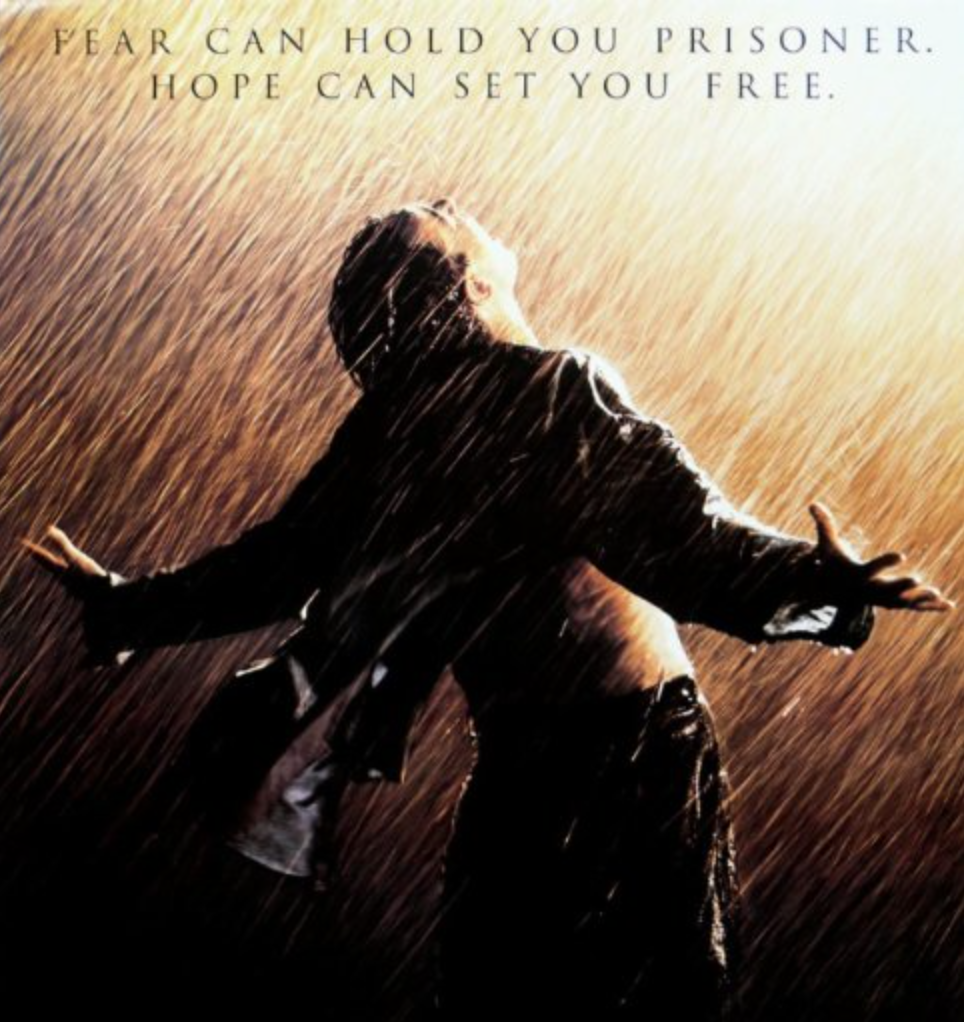
Tim Robbins Shawshank RedemptionBut unlike the Book of Exodus, there is more completeness to this story. Our hero stories all stir a desire for hope, for redemption, but they leave us looking for the bigger story. This movie, however, took this desire a step further. It was the story of the Exodus- a people under bondage and a heroic figure who leads others to freedom and an encounter with the presence of God. But, Andy was not a Moses-figure in the story. He was a Christ-figure in the story. He was an innocent man thrust into a horrible world filled with guilty men; men who could not even admit their guilt- that is, all but Red who jokingly called himself, “the only guilty man in Shawshank.” And wherever Andy- this one truly innocent man- went, he brought renewal and restoration and hope. His escape from Shawshank Prison was a virtual death and resurrection as he crawled through the sewer pipes under the earth for 500 yards before emerging alive, reaching towards the heavens after shedding his prison uniform and feeling the rain on his face. And then he drew his friend Red out of despair and into a new land; a friend who was imprisoned not just by iron bars and cement block walls, but also by fear and guilt and hopelessness. He instilled the promise of hope in Red and then gave him the means to leave this hellish world behind and join him in a completely new and beautiful place that had been all but forgotten. And there, on a heaven-like seashore, Andy embraced his redeemed friend.

When these puzzle pieces fall into place, I sometimes “feel” God with something other than a sense of vision or hearing or smell or touch. I feel God as I see myself as part of a larger story with little moments of hope.

  • A moment of hope with my little boy, who broke from his routine to whisper to me that he loved me.
  • A movie I have watched so routinely that I had missed how it suddenly became part of a bigger story of redemption crying out about the power of hope.
  • Another reading of The Book of Exodus where God redeems His enslaved people, brings them out of oppression and establishes a reunion where His presence would reside in the midst of them. God brings His people not simply out from slavery, but into this elusive “relationship” with Him; into a new land, a new world.

Routines that had lulled me to sleep had suddenly begun to burst with a sense of hope. And this prompts a question in my mind. From where does hope come? False hope certainly could come from our own attempts to make an unlivable situation livable. Perhaps some people can conjure up this false hope better than others. Or maybe the people who refuse to hold onto something false and live in despair are the only ones living in truth. But, I have a hard time believing that. There is something to these stories that reflect something from this bigger story that just does not seem like a coincidence to me. Why do they keep telling the same story over and over again? And why do these stories finally point us to hope? Why do stories of hope live on in our memories, while stories of despair tend to die? Is it simply because we prefer being sedated by an unrealistic hope or because we instinctively know these stories are true in some sense?

Micah in tree 1The story of redemption had suddenly bounded over this barrier in my head that said, “A relationship with God must be attained through the same sensory system that interprets the rest of this world I live in.” This was a difficult barrier to get past. Since I could not see, smell, taste, touch or hear God, I guessed that I could not actually have a relationship with Him. And yet, maybe He meets us in our world of sensory input and basic needs and familiar routines to awaken the mind. We see little moments of redemption- the beauty of music or the truth in a piece of art or a small display of kindness in a world that sometimes scoffs at such sentimentality…or a rare moment when a little boy whose mind seems imprisoned in routines and repetitions breaks free and whispers a sincere, “I love you” to a father who wonders if he truly understands how much he means to the father. And in these small hours, these little wonder, we see hope within reach. Maybe God is whispering to us through the little moments of hope amidst the routines of life. Maybe God is breaking through our static system with a narrative that woos us to a more fluid place of hope, whispering to us, “I love you.” Maybe those flickers of hope are actually little signals to us. Maybe those glimpses of our deepest heart’s desire resonate in our stories that are burned onto the hard drive of our minds. Maybe God is helping us out of our spiritual autism with something right before our eyes. These are among my hopes and I do not believe that they are hopes that are merely sentimental, but rooted in something real and rich. And so I hope.

    • I hope that my connection with Micah continues to be less and less impeded.
    • I hope that my connection with God continues to be less and less impeded.
    • I hope that this world to come is as green and lush as it is in my dreams.
    • I hope.

***********************************************************************************************************

Square Peg Round HoleKey Ministry has assembled a helpful resource on the topic of Asperger’s Disorder and Spiritual Development. This page includes the blog series Dr. Grcevich and Mike Woods developed for Key Ministry, links to lots of helpful resources from other like-minded organizations, and Dr. Grcevich’s presentation on the topic from the 2012 Children’s Ministry Web Summit. Click here to access the page!


Posted in Autism, Key Ministry, Spiritual Development | Tagged , , , , , , | 2 Comments

The Front Door…Online Church For Families Impacted By Disabilities

Front Door Logo

And I tell you, ask, and it will be given to you; seek, and you will find; knock, and it will be opened to you. For everyone who asks receives, and the one who seeks finds, and to the one who knocks it will be opened.

Luke 11:9-10 (ESV)

Our team at Key Ministry is honored to welcome you at The Front Door.

The Front Door is an exploration of the use of technology to share the Gospel of Jesus Christ with families impacted by disability.

We believe The Front Door represents a new expression of Christian community…an online extension of the local church through which children and families may be introduced to Jesus Christ via technology in environments chosen by their parents and caregivers at times of the day when families impacted by disability may be more receptive to teaching and discipleship.

We know that very real barriers to church attendance exist for families impacted by all disabilities. While we at Key Ministry are uniquely focused on helping kids, teens and families impacted by mental illness, trauma and developmental disabilities to overcome the obstacles that exist to full participation in the life of the church, The Front Door is intended to be a resource for local churches to reach out to families impacted by the full range of disabilities and bridge the barriers that prevent families impacted by disability from being full participants in the life of the local church.

The Front Door is not designed as a substitute for “bricks and mortar” church…it represents a strategy to connect families impacted by disability with churches in their region prepared to welcome and include them. The Front Door is intended to serve as a catalyst to families worshiping in the physical presence of other Christ-followers and experiencing the ministry of a local church.

We intend for the Front Door to be a reflection of the DNA of Key Ministry as well as the DNA of our partner churches. We seek to provide the families joining us and our partner churches at The Front Door an experience that is…

  • Highly relational
  • Grounded in ministry to families
  • Innovative, collaborative and generous
  • Supportive of churches called to connect with families impacted by disability in their home regions

We intend (through our partner churches) to offer more than simply the ability to attend worship services online. We seek to help families…

  • Connect online to churches with a physical presence in their home regions.
  • Provide online worship and online community to teens, facilitated by carefully screened pastors and experienced church volunteers.
  • Offer many opportunities for participation in highly interactive online groups.
  • Identify service opportunities for kids and parents to use their gifts and talents in the service of Jesus’ Kingdom.
  • Share resources with parents to support them as they seek to raise their children in the faith.
  • Create opportunities for adult education, book studies and topical Bible studies of areas of special interest to families impacted by disability.
  • Initiate individual and group opportunities for prayer.
  • Make personal connections with individuals and families who can help facilitate their inclusion in the life of the local church.

578524_10151266419728410_502320352_nWe’re honored on this Easter Weekend to collaborate with Community Bible Church in San Antonio, Texas in launching our first Front Door “campus.” We’re grateful to the staff at CBC for their willingness to work together with us on this project. We’re especially grateful to Nils Smith, the visionary online pastor of CBC for helping to make The Front Door a reality. The content of the Easter worship services presented this weekend will originate from CBC.

You or your friends may worship with us at scheduled times over Easter weekend by visiting the CBC Front Door campus at http://go.mediasocial.tv/cbcfrontdoor. Log in through Facebook or Twitter to chat with our worship hosts or post prayer requests. You’ll also have opportunities to explore current small group opportunities available through CBC.

We’ll be updating our worship schedule and adding services as the weekend progresses. Here’s the current schedule (all times Eastern)…

Thursday, April 17th: 10:00 PM, 11:00 PM (9:00PM and 10:00PM Central)

Friday, April 18th: 4:00 PM, 5:00 PM Eastern

Saturday, April 19th: 5:00 PM, 6:00 PM Eastern

Sunday, April 20th: 7:00 AM, 8:00 AM, 9:00 AM, 10:00 AM, 11:00 AM, 12:00 PM, 1:00 PM, 2:00 PM, 9:00 PM, 10:00 PM, 11 PM

We at Key Ministry very much appreciate your prayers and encouragement as we embark upon this new adventure. We know that in order to reach people no one else is reaching, we’ll have to try stuff no one else is trying. If you’re praying for us or have a word of encouragement to share, can you leave us a message below or on our Facebook Page? Most of all, can you help us by sharing the links we’ll be posting to our worship services and group activities with families who need to experience the love of Jesus Christ?

In His Service,

The Key Ministry team

I am the door. If anyone enters by me, he will be saved and will go in and out and find pasture. The thief comes only to steal and kill and destroy. I came that they may have life and have it abundantly. I am the good shepherd. The good shepherd lays down his life for the sheep.

John 10:9-11 (ESV)

Worship schedule most recently updated Friday, April 18th, 5:25 PM Eastern Time.

Posted in Families, Inclusion, Key Ministry | Tagged , , , , , , , , , , , , , , , | 2 Comments

The Whispers of Hope…Dave Lynden

Micah TickleIn the sixth installment in David Lynden’s blog series on Spiritual Autism he examines how God offers us “little rays of hope” in the busyness of life…and the importance of holding onto that hope.

Hope is what we are really striving for in this world of static systems. We can sometimes get glimpses of a world that once was, a world long forgotten, a world where we knew God and did not need clichés that, quite frankly, no one really believed when it came to this “relationship with God”. But, these glimpses fade away so quickly, it is like grasping at smoke. And it so easy to get lulled to sleep by the routines of life that we miss both the small moments, these little wonders of everyday life as well as the startling jolts out of the routine that shout out unexpectedly that there is a God who wants to know us and a world to come that will restore all that was lost. I have had many of these moments in the midst of Micah’s routines. It seems as though God uses my own routines to insert little opportunities for me to break free from my spiritual autism and see true hope. I caught one of these moments while putting Micah to bed one evening. I caught another moment sitting in the living room just after tucking him and his siblings in for the night and watching one of my favorite movies…for the twelfth time.

School BusNow Micah has a set routine for just about everything. When he heads outside to get on the bus for school, he steps just outside the garage and finds the same spot and hops back and forth five times. And when he gets off the bus, he checks the mailbox and then hops five times up the driveway before settling into a skip/walk the rest of the way to the house. And when it is time for bed, he turns on the fan (for the white noise, I assume, since it is not pointing towards him), sits on his knees at the side of the bed and then picks up some imaginary something-or-other from the carpeted floor and pretends to toss it into his bed…five times. Then, I lie next to him in bed and read a story to him while he gets situated. His favorite is a children’s Bible with lots of pictures, though he also loves the book, Man Gave Names to All the Animals by Bob Dylan (I read it in my Bob Dylan voice for both of our entertainment). Then, we turn out the light, I sing him a Jewish prayer called the “Shema” followed by my own prayer for him at the end…and then comes another routine. He calls out for a “zerbertz” (blowing farty noises on his belly) and then a “Mike Tyson” (an ear nibbling), another zerbertz, another Mike Tyson and three “tickles”, a spasmodic all-out tickle attack targeting the belly, knees, feet, neck and -as he calls them- “underarm pitties”. Finally, I tell Micah, “I love you, Micah” and he responds by saying, “I love you, Micah”. I then correct him by saying “no” and then point at myself, to which he then makes the adjustment and says, “I love you…daddy”. Then, and only then, is Micah ready to settle in for the night.

So, one night we read our book and did the zerbertz, Tyson, tickle routine. I finished with, “I love you, Micah” and he whispered, “I love you, daddy”. I kissed him goodnight and trudged downstairs to watch one of my top ten favorite movies, The Shawshank Redemption…for the twelfth time (yes, I have my own routines). The movie had just begun when I suddenly realized that Micah had said, “I love you, daddy” without the correction. I pondered that little ray of hope before settling into my own routine of watching the story of Andy Dufresne (played by Tim Robbins) and his friendship with Ellis “Red” Redding (played by Morgan Freeman) and a story all about hope.

Shawshank RedemptionIn a nutshell, The Shawshank Redemption is a story about a banker who is suddenly dragged out of his normal world when he is found guilty of murdering his wife and her lover and transported to Shawshank Prison. Andy has a very rough beginning to prison life. His education (he was a banker) makes him something of an outsider and he is targeted by a savage group of inmates who call themselves “The Sisters”. But, eventually he begins to not just move along with the routines of prison life. He begins to find redemptive things to do. He begins a friendship with Red and starts introducing the inmates to the concept of hope. He finds hope everywhere- in the music of a Soprano duet, in helping inmates attain their GED, in shaping his own chess pieces with his miniature rock hammer in order to engage Red in chess matches for a time to simply play. He is able to take the library with a few Reader’s Digest books and some magazines and turn it into a first-rate prison library equipped to give the inmates an education and the hope to make it on the outside.

Andy gets used to the idea of confining his own hope within the prison walls until a new inmate, Tommy, puts some past experiences together and Andy’s innocence is able to be established. That hope is dashed by Warden Norton (the tyrannical slave master in this hero story) who is using Andy’s financial skills to cover up all of the money trails he is making through scandalous dealings outside the prison gates. Norton has Tommy shot and makes it look like an attempted prison break. But, these years in prison have also given Andy the chance to burrow a hole from his wall to the sewer pipes with his rock hammer. He escapes Shawshank and flees to Mexico to a place on the Pacific where all of the horrors he has lived through can be forgotten. But, before he goes, he pushes Red to make a promise to him. If Red ever gets out, he must look for a particular field in the town of Buxton, and for a particular oak tree in that field where Andy had proposed to his wife…and for a peculiarly placed, black volcanic rock at the base of that tree where Andy has left something for Red. The tree is a symbol for Andy- it is the place that pictures a world almost forgotten, a place where tragedy and horror had not yet invaded into Andy’s life. Red, who has all but lost hope of living in a world beyond his prison routine and settled into the static systems of life behind bars, promises Andy that he will. Soon afterwards, Red is released and finds the rock. There under the rock, just as Andy had promised, is an old tin box. And in that old tin box is a large sum of money and a note from Andy encouraging Red to meet him in Mexico. “I will keep an eye out for you and the chess board ready”, Andy writes, “…Remember Red, hope is a good thing, maybe the best of things.   And no good thing ever dies.”

Red sees hope within reach and grabs it. He boards a bus, breaking parole and heads off to reunite with his friend. And as the film draws to an end, we see Red taking the bus to Fort Hancock, Texas and we hear his voice gently narrating this little moment of wonder-

“I hope I can make it across the border. I hope to see my friend and shake his hand. I hope the Pacific is as blue as it has been in my dreams. I hope.”

The film ends with Red and Andy reuniting on the beach in an embrace of friendship and peace for which they could only have dreamed. There I sat, some two plus hours after having tucked in Micah, having heard him break the routine to whisper, “I love you, daddy”. I could see his face in my mind, looking right into my eyes and beaming from ear-to-ear with a smile as beautiful and brilliant as a field of wildflowers in full bloom. “I love you, daddy.” I had done this bed time routine so often, this moment of hope had almost slipped right past me. It fled so quickly, it was like grasping at smoke, except I had stored it in my mind. And then, I watched The Shawshank Redemption. In fact, what I had watched was yet another movie that told the story that was burned onto my hard drive- a story of a hero and a force of evil attempting to enslave; a story of redemption and restoration and the whispers of hope.

***********************************************************************************************************

Key Ministry-NewEver wonder if the often-quoted statistics about divorce rates in families impacted by disability are true? Check out Key Ministry’s resource: Special Needs and Divorce…What Does the Data Say? In this article, Dr. Steve Grcevich reviews the available research literature on the topic of disability and divorce…and draws some surprising conclusions! Check it out…and share with your friends!

Posted in Autism, Spiritual Development | Tagged , , , , , , | Leave a comment

Ten truths for parents of kids with autism…Colleen Swindoll-Thompson

slide-jonathan-colleen3Colleen Swindoll-Thompson’s new book When Life Isn’t Fair: What They Didn’t Teach Us in Sunday School will be available as a premium to those who donate to Insight For Living during the month of March. Here’s a post she shared with our readers several years ago…

Shock. Disbelief. Anger. Hopeful. Bewildered. Relieved.  Words that represented my feelings leaving the doctor’s office that day; and feelings that wave through my soul like the sea swells through the oceans.  My son was diagnosed with Autism 16 years ago; 1 in 10,000 children were diagnosed with the same lifelong, no cure disability.  The icy, windy winter afternoon, it was clear that Jon’s life, my life,  and all of life would not fit the picture I had painted.

In it all, I want you to know, you are not alone. Finding a “new normal” is not easy.  Life is challenging. But you are never alone.  There is much loneliness, but you are not alone. Jesus Christ experienced everything you endure; He walked through the anguish and walks with you today. He encountered social battering,  religious rejection, and was betrayed by His closest friends.  Christ had siblings who didn’t understand their brother. He wept, He begged God to find another way, and eventually, He was killed.  But, that was NOT the end of his life; this was the beginning of life eternal.

Colleen's bookToday, 17 years into Jon’s life, his complicated disabilities have not been reduced, they have grown.  His diagnosis includes: severe Tourette ’s syndrome, autism, intellectual and global developmental disabilities, ADHD, OCD, ODD, and complicated trauma syndrome. He has endured bullying and profound mistreatment. Yet, in it all, I have more freedom, more joy, more hope because it is birthed and grown by the grace of my sovereign, faithful, good, unlimited God and Heavenly Father.  Dear friend or parent, if I may offer you some rays of hope in the dark tunnel of autism, may our Lord be honored and your soul be filled with hope.

Limited to 10 truths, I pass along the following lessons I’ve learned:

1)      I have learned: You cannot handle the burdens of life. If you could, would you need a Savior. Strength to carry on is given by God alone so depend on Him.

2)     I have learned:  There is a profound purpose in loneliness and isolation.  Darkness reveals the true condition of your soul which is being refined through fire.

3)     I have learned:  Rejecting the help of others reveals pride, not strength.  Part of soul care means humbling oneself under God and accepting His grace.

4)     I have learned:  Misplaced hope is not true hope.  Therapies, studies, doctors, specialists, examinations, report cards, school advocacy, diets, answers will never provide you with a final answer and renewed hope.  Hope comes only from the Lord.

5)     I have learned:  True forgiveness is tough when judgment, rejection, and betrayal come our way.  Forgiving or resenting is a choice; forgiving is a command. Asking God for help to forgive opens our soul.

6)      I have learned:  There is a vast difference between ‘the God of my Bible stories” and “the God of the Bible”.  Abiding faith does not come from false beliefs but from the truths of God; immerse your mind on what is true.

7)     I have learned:  God is NOT required to answer our questions.  Entitlement demands answers; God is never required to give an explanation.

8)      I have learned:  Resentment reflects my selfishness. Finding relief is not what God promises; becoming self-less brings relief.

9)     I have learned:  God’s love is unconditional.  Authentic faith is cultivated when we believe God embraces us with His love.

10)    I have learned:  accepting Christ as my eternal Savior is the only way on the journey of life with autism. In Christ, there is eternal hope and joy.  Life is tough, but God is always good and faithful.

Updated March 5, 2015

***********************************************************************************************************

Square Peg Round HoleKey Ministry has assembled a helpful resource on the topic of Asperger’s Disorder and Spiritual Development. This page includes the blog series Dr. Grcevich and Mike Woods developed for Key Ministry, links to lots of helpful resources from other like-minded organizations, and Dr. Grcevich’s presentation on the topic from the 2012 Children’s Ministry Web Summit. Click here to access the page!

Posted in Autism, Families, Key Ministry, Spiritual Development, Stories | Tagged , , , , , , | Leave a comment

Mike Woods: So I Send You…Missional Special Needs Ministry

So I Send You Key MinistryMike Woods is serving as a resource to churches requesting assistance from Key Ministry. Mike is sharing a monthly blog post on “missional” approaches to special needs ministry and sharing strategies for how churches may become more effective at serving persons with disabilities and their families beyond their walls. Here’s the second installment in Mike’s series…

The church that Jesus designed is made for impact—highly transformative impact at that. And if we take Jesus at his word when he says, “As the Father has sent me, so I send you” (John 20:21) then we must realize that our being “sent” must be part of the basis for how we do ministry…to include special needs ministry.

“As the Father has sent me…”

Jesus talked a lot about being sent by his Father. Over and over again, he talked about the reason for his existence, and the reason for what he was doing.

“As the Father has sent me…”

Jesus accomplished His mission by going to those who were out of relationship with Him. His ministry was grounded in the nature of God, who is a sending God.

The whole Bible is about the mission of God. God chose a people to carry out His mission to bless the world. God sent his Son to carry out His mission. Now, Jesus gives the mission to those who call themselves “Christ followers.”

“…so I send you.”  

Jesus said, “As the Father has sent me, so I send you” (John 20:21).

Jesus gives us His mission. This is why church as a gathering place is not enough. Church is a gathering of people who have a relationship with Jesus. It is also a group of people who are being sent by Jesus into the world, to live as He lived, to serve as He served.

We’ve been called to enter into the lives of people in our communities. We have been sent to leave our place of security, to risk ourselves, to travel to the places where people are, to go onto their turf rather than to expect them to come onto our turf.

We’ve been called to become missionaries in our own communities, to understand our culture, to creatively engage the issues of the day. We’ve been sent into the world by our Lord just as He was sent.

The Four Phases Of A Missional Special Needs Ministry

I’d like to suggest that there are 4 phases of being “sent” that Jesus modeled. These phases can serve as a way for thinking about how to “do” missional special needs ministry:

Move Out

The first phase of a missional special needs ministry must be a willingness for us to move out—to simply make a decision to go to the people that we want to serve, wherever that might be. For most of us, what is required to engage in missional special needs ministry is to rely on the Holy Spirit to give us the desire to reach out to others, to take a risk and get involved in what God is already doing in our disability communities.

In my previous post, Special Needs Ministry: Salt Block or Salt Shaker? I talked about the Joy Prom that we hosted at our church. I was surprised that only a relatively small percent of Joy Prom guests returned as guests to our church. Why didn’t they? The more I dug into the question the more I realized that our special needs ministry needed an outreach component.

I recognized that we needed to be out in the Orlando disability community ministering to those who don’t see church as welcoming. Or worse yet, those who’ve been told, “We don’t have anything for you here.”

I recognized that our ministry needed to Move Out. If I was going to lead the way for others in our Special Friends ministry and in our church, I needed to be the first to move out. You cannot lead others to places where you yourself haven’t been.

Move In

The second phase of a missional special needs ministry is to determine what group of people you want to impact. The intent of this phase is to identify the people group you want to serve in order to start making meaningful connections. Move In means you have to be purposeful in going where they go, hanging out where they hang out, and doing what they do. Move In is the component that involves:

  • Proximity: God’s way of reaching the world was to incarnate Himself in Jesus. God moved into the “neighborhood.” Therefore, our way of reaching the disability community should likewise be incarnational and have a Move In component. Proximity means that you need to take the initiative to be physically near those you want to serve.
  • Frequency: proximity locates Christian’s among the disability community, but frequency increases the opportunities and familiarity needed to develop credibility in the disability community. Frequency is the key that moves from you identifying with the locals to actually becoming one. This is exactly what Jesus did through the incarnation.

We had eight special needs group homes attend our Joy Prom. In the Orlando community, this is the disability group that has the greatest difficulty getting to church. Transportation issues, group home policies, staffing, and medication requirements are a few of the obstacles to attending church on Sundays.

This group is the group of people that I decided to “Move In” with. The way that I accomplished this was to contact two of the group home agencies that participated in Joy Prom. I contacted the Russell Home and the Primrose Center. I started volunteering at both agencies in their group homes each week.

Move Alongside

The third phase of a missional special needs ministry is building deeper connections and creating genuine and authentic friendships. This is the phase where you get to know the people you serve, the ones you serve with, and they get to know you. It’s all about relationships.

This is especially needed in the disability community because of the level of relational poverty that exists. Poverty is the state of being extremely poor. Relational poverty is the state of being extremely relationally poor…having very few, if any, friends.

We are a relational people because we have been created in the image of a relational God. And one of the most painful things that a person can experience is loneliness and relational isolation. Negative reactions, assumptions, and stereotypes make it extremely difficult for people with disabilities to find and maintain positive interpersonal relationships with others who are not family or paid providers.

Friendship is a gift that the body of Christ must offer because we image the One who sat on the margins of society with those whom the world considered unlovable. The truth of the Gospel can only be understood when it is manifested in the lives of people who have experienced and been transformed by the love of Christ…and it is shared with others through genuine friendships.

I’ve been volunteering now each week for six months. As a result of the relationships with staff and administrators that have been developed, I’ve been given the green light for our church to start providing weekly activities for residents of both agencies! Bingo, House Party, and Chillin’ & Grillin’ are the initial activities that will serve as the bridge for members of First Baptist Orlando to offer the gift of friendship.

Move Toward

The final phase of a missional special needs ministry is to move our new friends toward Christ. Look in the mirror. The person you see is exactly the kind of person God wants to use to bring His love and grace and the message of his Son to the disability community.

Move Toward is more than just proclamation of biblical truth, though this is an important part of this final component. It is also about loving people, serving them, being models of Christ’s grace, and telling them your story of God’s presence and love from within the relationship you’ve developed with them.

Spiritual conversations don’t have to be forced and uncomfortable. They should be a natural part of our lives and overflow into our newfound friendships in simple organic ways.

I look forward to sharing some of what God’s doing thru our ministry as we continue to try and live “sent.”

What are some of the successes and challenges you’re facing as you strive to make a difference in your local disability community?

Mike WoodsIn addition to his consulting work for Key Ministry, Mike Woods currently works as the Director for the Special Friends Ministry at First Baptist Orlando.

Prior to joining First Baptist Orlando, Mike worked for nine years as the Autism and Inclusion Specialist for a large St. Louis school district. Mike has also worked as a Parent Training Specialist for the nationally known Easter Seals agency: LifeSkills. He’s a Board Certified Associate Behavior Analyst (BCABA) and senior-level certified Crisis Prevention Instructor. Mike has conducted workshops for a variety of churches, several national level autism conferences, and various annual state conferences on topics pertaining to autism.

Christ-follower, husband, dad, choco-holic, and peanut-butter lover! Mike is passionate about faith and special needs. Mike is happily married to his lovely wife Linda and is the father of three wonderful boys, all three of whom are on the autism spectrum (yes, all three!).

***********************************************************************************************************

Key Ministry-NewEver wonder if the often-quoted statistics about divorce rates in families impacted by disability are true? Check out Key Ministry’s resource: Special Needs and Divorce…What Does the Data Say? In this article, Dr. Steve Grcevich reviews the available research literature on the topic of disability and divorce…and draws some surprising conclusions! Check it out…and share with your friends!

 

Posted in Key Ministry, Ministry Environments, Strategies | Tagged , , , , , , , , , | Leave a comment