
Can disabilities be disabling in some places, but not others?

A recent article in the New York Times critical of the trend of more children and teenagers receiving medication for ADHD spurred my thinking about our conceptualization of disability, the interface between disabilities and environment, and my frustration at the lack of progress we’ve made in helping churches welcome and include kids with mental illness, experiences of trauma and developmental disabilities.

One reason that we’re seeing so many more kids diagnosed with ADHD now compared to 20 years ago is that the external demands imposed within school and work environments upon kids and adults with ADHD have radically changed. The light bulb went on for me a few years ago when our youngest daughter (then in the first grade) was bringing home about the same volume of work I had when I was in middle school in what was at the time one of the top school districts in our state. I’ve had first graders in my office who are required to carry planners. I don’t think our kids are necessarily different than we were. I do think that the demands for work product placed upon them in school and the number of activities and commitments they have to juggle are radically different than what my generation faced. Kids with genetic traits resulting in more inattentiveness and disorganization than peers and more difficulty delaying gratification (shutting off the X-Box to do homework) struggle more as the demands of the environment shift.

Another phenomena I see among kids with ADHD are grades that are highly dependent upon their level of interest in a subject or the entertainment value of their teacher. In middle school and high school, they struggle mightily in required classes they perceive to have little to no relevance for their future, but thrive in classes when they find a subject interesting. For many of these kids, I can tell their parents with some confidence that once they identify an engaging major in college or a career with demands that fit the way their child processes information, there’s a good possibility they may no longer need accommodations or medication on a regular basis. They have traits that are lumped together and characterized as disabilities that are no longer disabling when in a more friendly environment.

Many of the conditions I treat on a daily basis fall into this same category…they represent clusters of traits that may be adaptive in some environments but very maladaptive in others.

Kids with social anxiety are often respectful of their parents and very conscientious students, but struggle mightily if they’re dropped off for the first time at a church youth group, or need to approach a teacher with a question. Adults with Asperger’s Disorder may be highly proficient in certain technical capacities, but avoid like the plague signing up for a small group Bible Study. Their problems are different than those of children and adults who fit into the traditional mental model of disability ministry or special needs ministry, but face obstacles not unlike those faced by persons with physical or intellectual disabilities when mismatched with the demands they face in church environments.

Many of our non-medical interventions for kids with ADHD involve environmental accommodations…a seating location in the room with the fewest possible distractions, allowing them to take tests in a quiet, distraction-free room, helping them to organize their bookbag and homework at their locker five minutes before their peers pour out into the hallways, rushing to their school bus.

What do we do when folks need accommodations in order to consistently attend church and participate in activities that facilitate spiritual growth but function relatively well at home, at work or in school?

Updated December 22, 2013

***********************************************************************************************************

IMG_0209-2Can you help us to help churches pursue kids with disabilities and their families? For this year’s Key Ministry Online Campaign, we’re asking our friends not for money, but to share our ministry’s Facebook page with others who share interest in our mission. We’re over halfway to our goal of 5,000 “likes”! Forward this post to your friends, ask them to “like” our Facebook page, and share it with others who wish to see more families of kids with mental illness, trauma or developmental disabilities welcomed and included at church.


Posted in ADHD, Hidden Disabilities, Inclusion, Key Ministry | Tagged , , , , , , , | 2 Comments

I’m taking my talents to Houston…for the Faith and Disability Symposium

I’m looking forward to seeing some old friends…and meeting new ones at the Faith and Disability Symposium, scheduled for Saturday, October 13th at St. Peter’s United Methodist Church in Katy, TX.

The conference keynote speaker will be Arland Nichols, National Director of Human Life International America. Denise Briley, well-known author, speaker and Director of Special Needs Ministry at First Baptist Church in Houston will also be speaking, along with a number of highly regarded speakers from across Texas.

I’ll be doing two different presentations at the conference…Barriers to Spiritual Growth in Kids and Teens With Mental Disorders and Including Kids at Church Who Behave Aggressively. In the first presentation, I’ll discuss obstacles to spiritual maturity resulting from the functional impairment associated with common mental health disorders seen during childhood and adolescence and outline strategies for promoting inclusion at church and spiritual growth at home. In the second presentation, I’ll seek to help churches include as many families as possible by establishing ministry environments that minimize risk factors contributing to aggressive behavior, offering strategies for church staff and volunteers who interact with kids at risk of behaving aggressively and identifying strategies for ministering to families when a child presents too great a risk of aggressive behavior to be safely included in church programming.

Here’s a link to the complete program for the conference, and here’s a link to register.

Hope to see you in Katy, TX for the Faith and Disability Symposium on Saturday, October 13th!

Key Ministry is coming up on our tenth anniversary, but churches and families everywhere will be getting the presents. Stay tuned for a big announcement on Tuesday, September 4th.

Posted in Key Ministry, Mental Health, Training Events | Tagged , , , , , , , , , | Leave a comment

To My Child’s Teacher…Guest Blog from Brenda and Dan Maas

More years ago than I’d care to admit, I met Dan Maas when a trip on the lecture circuit took me through Western Michigan. Dan had been a pastor who accepted a job in the pharmaceutical industry because they were struggling to support six children (five adopted) on a pastor’s salary. For a time, I circulated a series of devotionals Dan wrote for people in pharmaceuticals, challenging them to live out their faith at work.

We’ve stayed in touch over the years, and recently, Dan shared with me the letter that he and his wife Brenda wrote that serves as the today’s subject…we thought it would be of interest to the church leaders and parents who follow this blog. In Dan’s words…

Brenda and I were talking about how difficult it is for a teacher to stretch beyond their “success” style and the challenge that the special needs student offers. She asked me to help her with encouraging her teachers on why its important to keep the big picture in mind when working with special needs students. The ideas turned into a letter from a parent to his child’s teachers.

I suggested she give a “50,000 foot view” of the situation and ask the teachers to do the same. The ideas from that conversation morphed into “What I wish teachers would think about MY child” and how they could really help.

To My Child’s Teacher…Brenda and Dan Maas

An open letter to my child’s teacher;

I am so proud that you have been chosen by God to guide my child through this next year of school. I’m trusting that you will have the chance to fulfill many valuable goals this year with my son or daughter.

I was thinking this summer about why someone enters the profession of teaching. Were you gifted in a subject and decided to share that giftedness with others? Were you a teacher first, with a love for the children in your care? Did you find a wonderful fulfillment in watching a child grow in understanding and maturity as you gently urged them to mastery of your subject? Your head and your heart were into teaching, and now you find yourself with a new year with new challenges.

You see, my child has a special need.  I’m not really sure what that means or how it will effect his performance this year. I don’t know if we have the right “label”, who we should be partnering with professionally, what medications might help, or what the future will hold for this little one. But I can tell you this…I did not expect this road when our family was blessed with this child.

Our child does not fit the “norm”, has had different troubles with peers and teachers in the past, and even now is quite a handful at home. I need help because every child has a place and a purpose in the world. The Bible tells me so, and in my heart I trust that nothing in Creation is wasted. The problem is this: I don’t know the future for my child and neither does he/she. God does, so we will trust in Him.

We have enrolled our child at NorthPointe for a reason: its a Christian school with a godly reputation. You are a part of that reputation, so I have chosen to trust you for just a few things.

1. My child does not know your subject, how to learn your subject, what to like about your subject, or how your subject fits with his future. It may take everything you know, and then some to guide my child into the joy of your subject. Will you try hard to come alongside this child and build courage in him/her? Help them to learn the next step in the subject, and even if times are repetitious or the “light bulb” doesn’t seem to come on?

2. My child is a little bit angry (ok, maybe a lot angry) at the world, us as parents, at teachers, other professionals, and at God. This anger gets in the way of the will to try new things, conquer a new thought, make a friend, or trust our gracious Savior. Will you introduce the idea of hope, love and perseverance into my child? It will help to slow down the emotion and replace it with something much more positive!

3.  My child is following a different path from the rest of his peers. It will take a different view of him/her, more help from others more skilled in his/her personal learning style, and much more communication to keep up with the many challenges to be faced this year. Will you reach out to professionals who want to come alongside you so you are better equipped to guide my child into the joys of your subject? Will you call me when you have questions, see changes in behavior or attitude, or just to touch base and encourage me? Will you help my child see that all paths to fulfilling God’s will are individual, and he/she joins in the grand tradition of believers with their unique path? Will you help my child take the next step in his Path?

4. Finally, my child may take you to the very end of your ability. You may find yourself at the point of giving up because it seems like a hopeless cause, you have hit the end of your ability, and my child is resisting any and all attempts to move forward with your subject. Will you pray? Only our Lord may reach my child at that moment, over that wall that seems to exist between you both. Will you talk to the God who created both you and my child about your concerns and needs? Will you ask for the wisdom and knowledge to truly lead my child into the joys of your subject? Will you ask for God’s intervention in my child’s life, and all that could bring?

This is a tall order, I understand. I’ve been trying to learn these same lessons through the years. But I truly believe that our gracious God has put you, your passions, skills and gifts, into my child’s life for a reason. Teaching is leading. You know where you are going with the material and the class. You know the important next steps that need to be learned in your subject. You know why the subject is important. And you know that God has a future for my child. Will you lead my child, even though it is difficult, to the next step in his/her journey of becoming a part of God’s Kingdom on earth?

Thank you for your service to our King! Please call or write me often so we can work through, pray through and learn through the challenges this year. And finally, may God richly bless you as you lead my child on this year’s learning journey! I will be praying for you.

Sincerely,

A Parent

Brenda Maas serves as Director of the Student Union (the special needs ministry) of the Northpointe Christian Schools in Grand Rapids, Michigan. She oversees four fulltime staff along with several part-time tutors. Her greatest thrill is to see a student find and flourish in a God-honoring life that fits their gifts, skills and blessing. She has been teaching for thirty years…seventeen as a home school Mom-the rest in public and private schools.

Dan is a supportive husband of 31 years and works as a sales representative/ trainer for Jazz Pharmaceuticals.

Dan and Brenda have six children, four grandchildren and one more on the way! They adopted five children along the way. Three kids are launched into careers and marriage, the rest are in 10th, 9th and 7th grades.

Key Ministry is coming up on our tenth anniversary, but churches and families everywhere will be getting the presents. Stay tuned for a big announcement on Tuesday, September 4th.

Posted in Advocacy, Families, Spiritual Development | Tagged , , , , , , , | 2 Comments

“Why?”…Our Conference Theme for Inclusion Fusion 2012

Why? Why is it so important that churches become more intentional about welcoming and serving children and adults with disabilities? That’s our theme for Inclusion Fusion 2012…Key Ministry’s Second Annual Disability Ministry Web Summit. This year’s Web Summit is scheduled from November 12th-November 16th, 2012.

Our Program Committee felt strongly that “Why?” has to come before “How?” We’ll still have a number of speakers to address the specifics of how churches can more effectively  meet the needs of kids and adults with disabilities, but all of the resources we provide will be of little use unless there’s first buy-in as to why this ministry is so necessary and so important.

We’ll be inviting some of our speakers to post videos on You Tube in which they answer the question “Why”…While I’m not currently scheduled to speak, here’s my video as Chairman of this year’s Inclusion Fusion Program Committee:

Help us get the word out about “Why” it’s so important that churches join us for Inclusion Fusion 2012 and become more intentional about inclusion of kids and adults with disabilities. Make your own video in which you answer the question “Why” and post a link below in the comments section. We may use your video to help promote this year’s Web Summit!

Key Ministry is coming up on our tenth anniversary, but churches and families everywhere will be getting the presents. Stay tuned for a big announcement on Tuesday, September 4th.

Posted in Inclusion Fusion, Key Ministry, Training Events | Tagged , , , , , | Leave a comment

Parenting with Purpose?

This coming Friday, Harmony and Skyler Hensley will be celebrating the first birthday of their son, Ransom. Note to Mom…Ransom’s one year self-evaluation of performance and ministry goals for the coming year are due by September 15th…kidding.

I’m surprised by how few Christian parents are intentional about parenting their kids with a plan for the challenges they’re going to face in the future. On the occasion of Ransom’s first birthday, and our two other paid staff (Rebecca Hamilton and Katie Wetherbee) taking their oldest kids to college for the first time this week, I thought it appropriate to repeat this post from last year…

Many friends and supporters of Key Ministry are already aware of the new addition to our team last week. Harmony and Skyler Hensley welcomed Ransom Levi Hensley into their family early last Friday morning. Harmony very eloquently described the way in which Ransom’s arrival represents God’s response to years of prayer from the Hensley’s, their family and friends. Check out her post-it’s a must-read.

From a spiritual development standpoint, I can’t imagine how Ransom could have been given a better family. He has two parents who don’t just talk the talk but walk the walk. He’ll be exposed to all of the great stories of the Bible. He’ll be surrounded by people who will model an active and meaningful prayer life. Had he come along a day or two earlier, he might have found himself serving at his first respite outreach. He’ll always be surrounded by a supportive church family while growing up. But imagine the task confronting the Hensley’s over the next 18+ years!

A few weeks ago, I went back and visited my old church and saw Bill Burr. If they had a picture of an elder in the Bible, it would probably be Bill. I spotted Bill, shook his hand and told him he was looking good. He smiled, and responded, “Not too bad for 90, huh?”

Given the advances likely to occur in modern medicine, there’s an extremely good possibility that Ransom will still be serving God here on Earth (like Bill) in some capacity in the 22nd century. Consider how the world has changed in our lifetimes. What kind of world do we need to prepare him to face?

I’ve spent a lot of time this past year in the Old Testament. I’m amazed at the recurrent ineptitude of the spiritual leaders in Israel to pass along their faith to the next generation. Whenever Israel had a godly king, his heir generally demonstrated a tolerance for immorality and pagan worship exceeding that of preceding generations. I’d think that the kings would have prioritized their relationships with their children, if for no other reason than the reality that the preservation and expansion of the king’s legacy fell to his their children. I wonder if their stories were preserved as a reminder to us to depend upon God and to share the knowledge of Him with our children continually.

It’s hard for me to imagine any service we can provide more important or more impactful to the Kingdom than addressing the spiritual development of our kids. And not just our biological or adopted children…all of the children in our sphere of influence.

Here’s my hope for Ransom and all of our kids…

I hope Ransom has the opportunity to be a part of a church that will support him in fully using his gifts, talents and abilities to serve God’s purpose in his generation.

I hope Ransom will have the opportunity for relationships with adults who will reinforce and model for him the principles he’s taught by his parents.

I hope Ransom will be well-prepared for the spiritual battles he’ll have to confront in the world in which he’ll serve.

I hope Ransom’s children will know and love God and grow the spiritual legacy established by their grandparents.

Know therefore that the LORD your God is God; he is the faithful God, keeping his covenant of love to a thousand generations of those who love him and keep his commandments. 

Deut. 7:9 (NIV)

Welcome to the team, Ransom!

Key Ministry is coming up on our tenth anniversary, but churches and families everywhere will be getting the presents. Stay tuned for a big announcement on Tuesday, September 4th.

Posted in Parents | Tagged , , , , , | 1 Comment

Family ministry makes sense for families of kids with disabilities

FamilyIn my day job, I work with kids and families with a very complex array of emotional, behavioral, developmental, neurologic and medical conditions. I spent a long time training to do my job. I was accepted into an accelerated medical school program five days before turning eighteen, followed by a three year residency at Cleveland Clinic and a two year fellowship in child and adolescent psychiatry at Case Western Reserve University. I’m in my 30th year of doing my job. Yet, I don’t pretend to parents that I’m the expert in dealing with their child. They are. I’m their consultant. I come alongside them to help them understand the problem that led them to our practice, along with a range of safe and appropriate options for addressing the problem(s).

So…how does this relate to the church and the children’s/family ministry leader?

The church is also called to serve and to make disciples of families with the full range of disabilities – visible and invisible…without the benefit of the training I went through. Our team at Key Ministry is more than happy to help you develop an identified ministry to serve kids with disabilities in your community, but no church is ever going to be able to design a ministry program tailored to meet the needs of all kids and families with disabilities in your community. As is the case in our practice, when serving kids with disabilities, the church needs to rely on experts with the most understanding and experience of a child’s learning, communication styles and relationships…their parents!

Here are four advantages to a family ministry approach when families have kids with disabilities…

  • Most of the time, parents of kids with a disability will be more effective at sharing important truths with their child affected by a disability than the most talented children’s pastor. A children’s pastor, volunteer or small group leader probably doesn’t have the training to communicate important faith concepts most effectively with every child, especially kids with very unique styles of processing information.
  • Parents of kids with disabilities may have more 1:1 time with their children than parents of kids without disabilities. A key argument made by supporters of family ministry models is that kids spend far more time with their families than they do at church. When kids have disabilities, they’re often spending lots of time in the car or in waiting rooms for professional appointments and they’re less likely to be on travel teams and committed to as many activities as kids without disabilities. Parents have more opportunities for conversations related to important principles related to faith and character.
  • In many cases, parents of kids with disabilities may not have the same depth of understanding of important faith concepts as other parents if their child’s disability has been an impediment to church attendance and engagement. An approach to ministry offering resources for parents to use in guiding faith development at home is most helpful when parents struggle to identify resources on their own. We also need to keep in mind that “the apple doesn’t fall far from the tree” and kids with disabilities (especially mental illness) often have parents with the same disabilities. The parents may have had conditions while growing up that interfered with church involvement and spiritual growth. You’re discipling the parents so they can disciple their kids.
  • A family ministry approach allows you to “redefine your win” in serving families of kids with disabilities and offers your ministry volunteers a greater appreciation of the impact they make through serving. The “win” for the church in disability ministry occurs every time any family member of a child with a disability connects meaningfully with their larger family in Christ through the ministry of a local church.

A couple of years ago, I was with our team when they were doing an out of town training event. A volunteer expressed great frustration at her inability to get through the day’s lesson with a child who has a severe developmental disability. Our team reminded her that even if the child she served learned nothing during the time they were at church, her parents had the opportunity to hear their senior pastor teach on an important topic knowing that their child was well-cared for, her parents were able to share what they learned with her two brothers who never got to attend church when younger because of their sister’s disability, and the church’s middle and high school ministries now had the privilege of serving the brothers because the family had a church home and her parents were growing spiritually. Lots of wins there!

A family ministry approach recognizes the centrality of parents God has uniquely positioned and qualified in His plan to share His love with kids who experience differences in emotions, behavior, learning style and communication.

For additional resources on family ministry strategies when families have kids with disabilities, here are links to a blog series featured here last year, Thinking Orange: Family Ministry Strategies When Families Have Special Needs, including outstanding guest posts from Libby Peterson and Mike Woods

***********************************************************************************************************

shutterstock_24510829Key Ministry is pleased to make available our FREE consultation service to pastors, church leaders and ministry volunteers. Got questions about launching a ministry that you can’t answer…here we are! Have a kid you’re struggling to serve? Contact us! Want to kick around a problem with someone who’s “been there and done that?” Click here to submit a request!

Posted in Families, Key Ministry, Strategies | Tagged , , , , , , , | 2 Comments

Heart transplants and autism…should we fear the slippery slope?

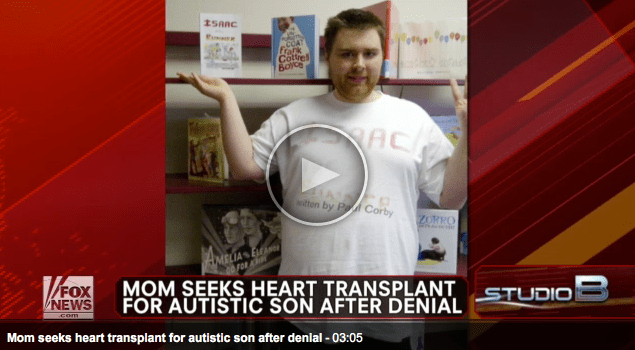
Many who know me are aware that I’m very troubled by trends I’ve observed in medical ethics as applied to persons with disabilities. This past week, we learned of Paul Corby, a 23 year old man with autism who was denied access to the heart transplant list at the University of Pennsylvania primarily because of his autism. If you click on the picture below (sorry, couldn’t embed the video), you can see a news report on Paul’s situation. Paul’s family has launched an online petition with over 240,000 signatures to the U.S. Senate in an effort to get him a transplant, and plans to seek second opinions at the Mayo Clinic and the University of Pittsburgh.

On another note, a paper published in the Journal of Medical Ethics with the title Should religious beliefs be allowed to stonewall a secular approach to withdrawing and withholding treatment in children? recommended “rapid access to legal remedies for end-of-life disputes involving children whose parents resist withdrawal of aggressive therapy on the basis of religious beliefs.” The Journal did publish several commentaries on the paper (summarized here), most notably this response from Julian Savulescu, Oxford University professor and Journal editor:

I argue that Brierley et al are wrong to claim that parents who request futile treatment are acting against the interests of their child. A better ethical ground for withholding or withdrawing life-prolonging treatment is not that it is in the interests of the patient to die, but rather on grounds of the limitation of resources and the requirements of distributive justice. Put simply, not all treatment that might be in a person’s interests must ethically be provided.

The meaning of “distributive justice” will be critical to the fate of children and adults with disabilities in the not too distant future. Is it possible that medical ethicists will find ways to manipulate the meaning of this principle in the event that exploding financial pressures in the healthcare system necessitate rationing of care? We discussed Dr. Savulescu and  the Journal of Medical Ethics back in March in a different context. Is it too much of a stretch to imagine a scenario at some future date in which pregnant women are required to undergo amniocentesis and health care is denied for children born with foreseeable disabilities on the grounds that the money could more “justly” (according to  medical ethicists) be spent on others?

From my read of the Bible, the same patterns continue to recur throughout human history. It won’t be a surprise if, as in the first and second centuries, Christians are again in the position of caring for the sick and the disabled and advocating for the powerless.

Should we fear the “slippery slope?” When the ethicists responsible for laying down the principles for determining who will and won’t get access to medical treatment operate from a position of contempt for Christians (and other people of faith), we’ve already started careening down the hill.

Key Ministry’s mission is to help churches reach families affected by disability by providing FREE resources to pastors, volunteers, and individuals who wish to create an inclusive ministry environment. We have designed our Key Catalog to create fun opportunities for our ministry supporters to join in our mission through supporting a variety of gift options. Click here to check it out! For a sixty second summary of what Key Ministry does, watch the video below…


Posted in Advocacy, Autism, Controversies | Tagged , , , , , , , , , , | 2 Comments

What Pat Robertson should have said…

Well-known Christian broadcaster Pat Robertson made some widely publicized comments on the 700 Club earlier this week that have received much attention in the adoption ministry and disability ministry communities. His remarks were in response to a question from a single mother with three children, each adopted from a different country…

Our friend and colleague Shannon Dingle wrote a marvelous response to Mr. Robertson’s remarks on her personal blog last week that I strongly encourage you to check out and share with other adoptive families. I hope Shannon’s blog post circulates to everyone who needs to hear her message. I wonder how many adoptive parents have experienced statements similar to Mr. Robertson’s from people in positions of leadership or influence within their churches.  As a physician with a fair amount of experience in treating adopted children with emotional, behavioral and developmental disorders and a working knowledge of the Bible, allow me to suggest an alternate response to Mr. Robertson or any other Christ follower if a similar question comes up again.

Susan…you don’t just talk the talk, you walk the walk. I’m sure Jesus is pleased with your worship as expressed through the love and care you give to your children.  After all, the Bible says caring for orphans is a reflection of true religion.

Your children are your ministry…and your ministry has the potential to be very demanding. Children available for adoption are more likely to have been exposed to significant trauma, neglect or abuse, the effects of which may not become fully evident for many years. They may require medical treatments that are either unavailable or prohibitively expensive in their countries of origin. They are more likely than biological children to require treatment for mental health disorders.

Consider this…How many men would be interested in committing to a relationship with you if your ministry were overseas mission work? Life could be pretty good if you’re called to a place that’s temperate and peaceful with lots of modern conveniences. But what if the future were unclear? What if you were called to a place of isolation or hardship where the threat of poverty, danger and persecution is ever present? Would that limit your potential dating pool?

In some ways, your ministry could be viewed by others as more challenging than the overseas missionary. If their assignment becomes too demanding or unpleasant or destructive to family life, missionaries generally have the option to go home or request a reassignment from their sponsoring organization. But you’ve made a lifetime commitment to your ministry with your children…a commitment you can’t walk away from in the event life becomes too hard.

You have an extraordinary faith. While my wife and I haven’t felt called to pursue adoption as you have, I’m not sure I’d have sufficient faith to follow such a call if we received one. I don’t know that I have the spiritual maturity to commit to the sacrifices that might be involved. I suspect that the men who lose interest after they learn of your children are doing you a service in considering the possible cost before making a commitment. You and your children deserve someone who would consider serving as your husband and their father as an honor as opposed to a burden. You also deserve a church family who would consider it an honor to come beside you as you raise your children with the knowledge of Jesus and His love for them.

Mr. Robertson was clearly unprepared for the question he was asked earlier this week. We can learn from his experience and be better prepared to respond as Jesus would have us respond to the adoptive families who cross our paths.

Note…Shannon Dingle’s personal blog richly chronicles her family’s experience during their recent adoption of Zoe Amanda. It’s a pretty impressive living testimony of God at work through the lives of Shannon, her husband Lee and their three children and an inspiring read.

Posted in Adoption, Controversies, Key Ministry | Tagged , , , , | 7 Comments

Disability and the Sovereign Goodness of God…from John Piper

John Piper and his team from Desiring God have released a free book addressing the question…Does God have a good purpose in my disability?

In Disability and the Sovereign Goodness of God, John Piper explores what the Bible has to say on the topic of disability. The book is intended to be a resource to assist church leaders everywhere confronted with difficult questions pertaining to disability, and to challenge the church to consider how we’re called to respond to persons with disabilities and their families.

The book consists of four sermons offering an in-depth examination of John 5:1-18 and John 9:1-38, along with an interview John conducted with John Knight, a blogger who writes of his firsthand experiences as the parent of a son with blindness, autism and cognitive impairments.

The book is a great free resource and I’d very much encourage our readers to share the link with pastors and church leaders everywhere. The folks from Desiring God are also putting on a one-day conference, The Works of God: God’s Good Design in Disability on Thursday, November 8 in Minneapolis, featuring Nancy Guthrie, Greg Lucas, Mark Talbot and Reverend Piper that’s definitely worth checking out.

Key Ministry’s mission is to help churches reach families affected by disability by providing FREE resources to pastors, volunteers, and individuals who wish to create an inclusive ministry environment. We have designed our Key Catalog to create fun opportunities for our ministry supporters to join in our mission through supporting a variety of gift options. Click here to check it out! For a sixty second summary of what Key Ministry does, watch the video below…

Posted in Inclusion, Resources | Tagged , , , , , , , , | Leave a comment

Appreciate your prayers today…

I’d very much appreciate your prayers today, especially around the noon hour when our Key Ministry Board will be meeting.

We’re blessed to have an extremely passionate and gifted staff and Board. Today, our Board is going to be tackling several important issues…a job description for the Board President, processes for communication between our Board and staff and processes for resolving disagreements…which will occur when you have as many bright, passionate, strong-willed and successful people in your organization as we have.

I’d ask you pray for God to give our Board wisdom and discernment in determining the best stewardship of the time and talents of our people, and for God to be at work in strengthening and protecting our relationships with one another and our relationships with like-minded leaders outside of our team…because the enemies of our mission would like to see those relationships be broken.

UPDATE: Your prayers were very much appreciated. We had an excellent Board meeting and made progress on a number of challenging organizational issues.

Posted in Key Ministry | Tagged , , , | 8 Comments