Jeff Davidson…No More Peanut Butter Sandwiches

IMG_8478During the weeks leading up to Inclusion Fusion, we’re introducing our readers to disability ministry leaders doing great work who will be participating in this year’s Web Summit. Jeff Davidson was part of our last Web Summit, and will be joining us again this year. 

You can chat live with Jeff this coming Thursday at 8:30-10:00 PM Eastern time at our Front Door Online Church site while viewing Jeff as he speaks about the differences in men and women as it relates to being parents of a child with special needs. Here’s Jeff…

I get asked all the times by parents of children with special needs how to get dads more involved and engaged. Here’s an easy way, dads.

Dads, your words contain the power of life and death.

Parents, you have got to be speaking words of life over your kids every day. Your kids will believe whatever you say about them. Your child will become whatever he or she believes. And what they believe about themselves will be determined by what you speak over them. They will become whatever the voices they hear say about them. So make a point, every day, to speak positively and affirm your child.

At sixteen my son is nonverbal. Barring a miracle, he won’t be able to stand up at my funeral and tell the world how proud I was of him. But rest assured, he knows it. And that’s all that matters. We can talk about it in heaven someday.

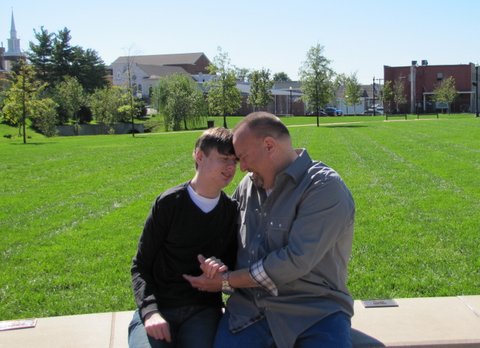
jeff-and-ja-300x225I love my son just the way he is because my dad loves me just the way I am. Not because of anything I have done, or am doing, or will ever do. I learned unconditional love for my son because my dad loves me unconditionally.

My friends, this is the essence of how God loves us. We don’t earn it, we don’t do anything to deserve it—he just lavishes it on us simply because we are his children.

There is nothing we can do that will earn us more love from him or make him love us more. He loves us simply because we are his children.

I am still amazed and astonished to realize that as much as I love Jon Alex, God loves him even more than I do. I cannot imagine it possible to love my son more than I do, but God does.

At first, it was difficult coming to terms with laying down my dreams. Like any special needs dad, it’s hard emotionally to reach the point where you realize the dreams, goals, and plans you had for your child aren’t going to happen the way you hoped. But whose dream was it anyway? It wasn’t God’s dream.

This is where the choice happens for dads. You can choose to spend the rest of your life wallowing in the “Why” and grieving the dead dreams. Most men choose this route. At the end of their journey, they find they have been following a dead-end street that goes nowhere.

Or you can go down the road marked “How.” How are we going to rise above this situation and still find the glory and purpose that God has in this? How can we use this different dream to still find fulfillment and joy?

My son will never do anything that makes me love him anymore than I already do. I love him because he is my son.

Period.

I made him. I created him. He was formed in my image. And for that, I love him unconditionally. Nothing he can ever do will make me love him any more than I already love him. If all he ever does in life is just be my son, that is enough. My love for him is unconditional.

I got that from my dad. Not just the one here on earth, but the One who made all of us as well.”

–Excerpted from No More Peanut Butter Sandwiches: a father, a son with special needs, and their journey with God

Davidson Book CoverI wrote this book because I too am a special-needs parent. There was a pivotal time in my life that I felt God had wrecked my life by choosing me to be the father of a child with special-needs. I struggled, like so many other parents, with denial, blame and anger. At the time, I did not realize that I had been given a gift. God had chosen me to receive a masterpiece.

God sent a broken child into a broken world to a broken father so that together they would find God in their brokenness. This book is not about our story. This book is about the story of God and I hope it helps other special-needs families realize their part in the telling of God’s story.

***********************************************************************************************************

DavidsonJeff Davidson is an author and pastor who enjoys speaking at churches, conferences, events and to groups, ministering to special needs families and individuals. Jeff and his wife Becky started Rising Above Ministries when they realized the incredible gift and blessing their own son with special needs (Jon Alex) was to them. Jeff’s book, No More Peanut Butter Sandwiches, is available through Crosslink Publishing, Barnes and Noble and Amazon.

Posted in Families, Inclusion Fusion, Intellectual Disabilities, Stories, Training Events | Tagged , , , , , , , , , , | 2 Comments

Are parents of kids with ADHD stigmatized at church?

shutterstock_90358606_2Shannon Dingle had a wonderful post on perceptions of folks in the church about ADHD. I’d encourage you to read her post, because I’m challenged to express my opinions as eloquently as she did on her blog. I appreciate the comments left on her blog from a pastor (Carey) who gave voice to the thoughts and feelings Shannon was seeking to describe in her post.

Here are three specific quotes from Carey’s comments I’d like to respond to:

“However, as a Pastor, and one who is continually involved in family and marriage counseling, my concern is that some/many/alot (not sure the figure) of the ADHD diagnosis are not hitting the true need the child has – better parenting.”

“My concern is that kids who are mis-diagnosed with ADHD, when they really need better parenting at home are being “drugged” rather than what they really need… and nobody really benefits from that.”

“My comments are not aimed at those parents, so please understand that. I’m concerned about those who are quick to label their child with special needs as a way to side-step their Biblical responsibility as parents. Parenting is not easy, and many shirk it like they do other difficult things in life (conflict, work, etc.). Those children get drugs instead of loving discipline, and they are not served well by it. From my seat it seems all too common.”

Micah TickleThe reality is that within the church community, there are some diagnoses that are considered “legitimate” disabilities, autism being the condition getting the most attention at the moment. When we started Key Ministry, our primary reason for being was the firsthand experience of the founding members of our team with families of kids with “hidden disabilities” who stopped attending church because of the responses they experienced from people within the church. It didn’t seem to us that the established disability ministry organizations were attuned to the needs of families with children experiencing primary mental health conditions, presumably because they didn’t fit into the existing construct of “disability” or “special needs.”

Our “marching orders” are to make disciples of all nations…let’s say for the sake of discussion that all of Carey’s assumptions are correct. Given that 11% of all school-age kids in the U.S. have been “drugged” for their ADHD, representing more than 11% of families (because more than 11% of families have at least one child who has been prescribed medication for ADHD), how effective are we likely to be as church in reaching out to and connecting with those parents and building relationships with them that lead to meaningful life change?

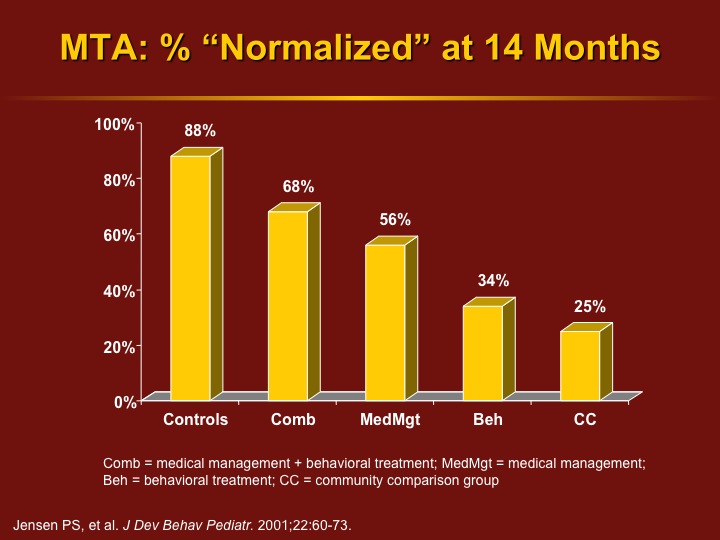
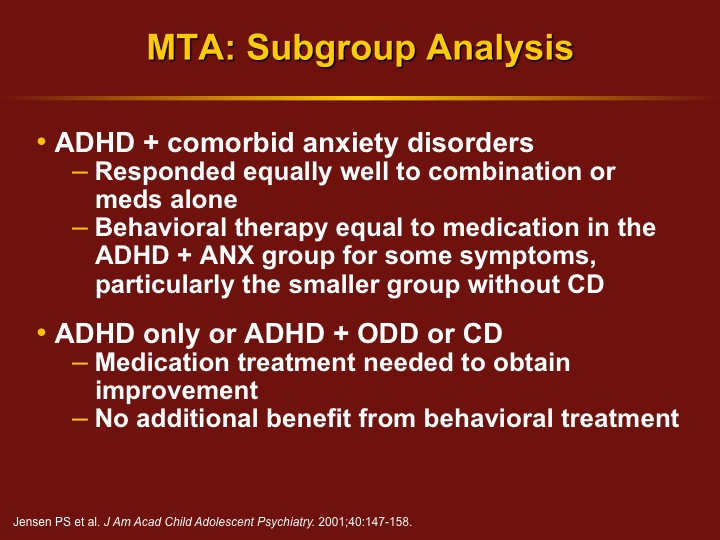
Behavioral therapy is not a particularly effective treatment for kids with uncomplicated ADHD. The landmark study that folks in the field point to in examining this topic is the MTA study (Multimodal Treatment of ADHD), funded by the Federal Government and conducted in the mid 1990s. The premise of the study was to compare the effects of medication alone, an intensive course of behavioral and psychosocial treatment alone, the combination of the two treatment approaches and treatment readily available in the community in kids with uncomplicated ADHD, kids with ADHD and other disruptive behavior disorders (Oppositional Defiant Disorder, Conduct Disorder), kids with ADHD and internalizing disorders (primarily, anxiety) and kids with ADHD plus two or more comorbid conditions.

An overview of the study results is presented below.

Behavioral/psychosocial therapy was most helpful in situations in which kids had multiple comorbid conditions, along with kids with concomitant anxiety disorder. For kids with uncomplicated ADHD, medicine alone was clearly more effective than the behavioral therapy alone, and the benefits of behavioral/psychosocial treatment were seen only after the kids were also treated with medication. For what it’s worth, if there was a bias in how this study was designed, the bias was in favor of demonstrating the benefits of behavioral interventions. The cost to a parent looking to replicate the counseling, case management and classroom interventions used in the MTA would be well in excess of $30,000/year.

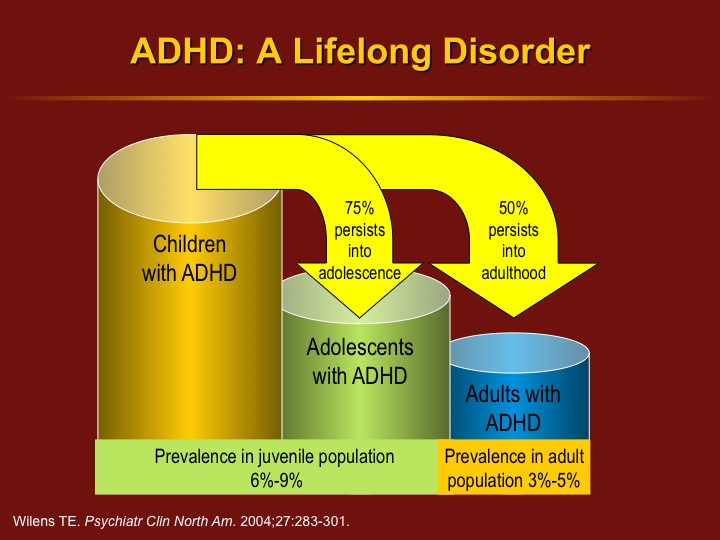
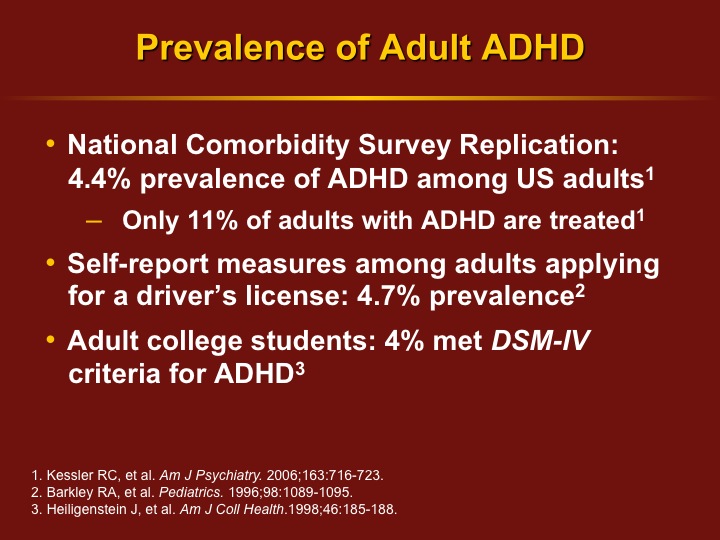
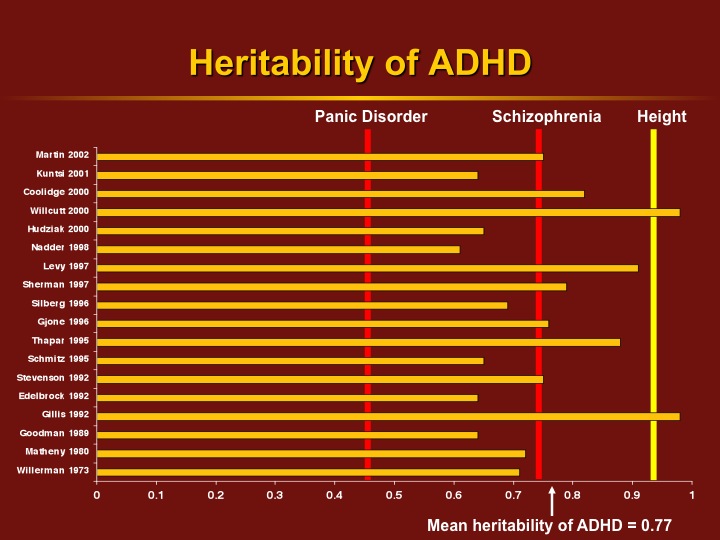
Is it possible that the parents themselves might have a disability that would negatively impact their ability to consistently implement more effective parenting strategies? Literally, the apple doesn’t fall far from the tree. Looking at the data below, can we safely assume that all parents of kids with ADHD are capable of implementing strategies that require great consistency in order to be effective?

A better question to ponder may be how we as the church can we help such parents more readily bear the burdens associated with their child’s condition? Would it make more sense to err on the side of grace in how we view families of kids with ADHD, at least until we know them well enough to feel we could walk in their shoes?

Where exactly is the evidence that large numbers of kids are inappropriately being treated with medication? The folks at the National Institute of Mental Health did a study looking at this very issue during the time when use of medication for ADHD was rapidly escalating. Here’s what they found. The situation may be different in Perry’s community.

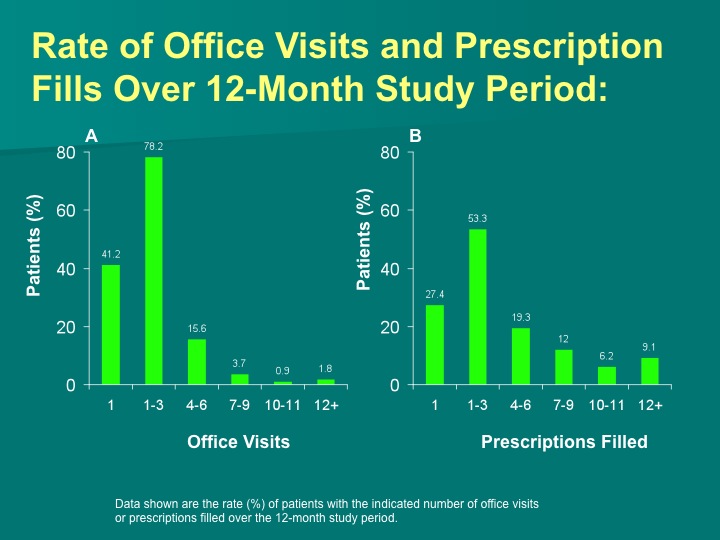
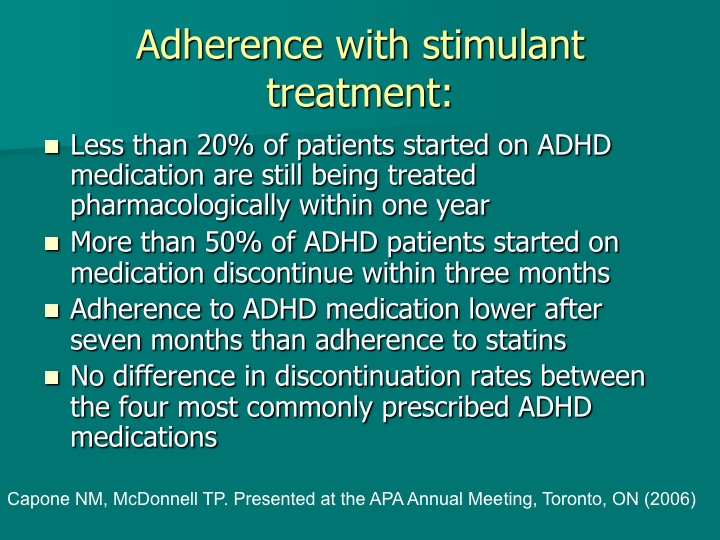
Finally, much to the chagrin of the pharmaceutical industry, there aren’t large numbers of parents beating down the doors to get medication for their kids. Check out the slides below-one is from a study I presented around five years ago looking at information from a large pharmacy database. The average parent of a child with ADHD fills around 4 ½,  30-day prescriptions per year for medication. The average adult with ADHD fills around three prescriptions per year.

For the majority of patients I see with ADHD, especially those with comorbid conditions, the side effects of medication are often a problem. Parents don’t typically want to give medication to their kids unless they absolutely have to. I see more situations in which parents are ruining their relationships with their kids (and as a result, losing their ability to exercise meaningful influence during their child’s teen years) with all the nagging, badgering and consequencing many have to do in an effort to get them through school.

I’ve seen parents with messed up priorities, looking for quick fixes for problems they may have created for their kids by poor choices they’ve made stemming from spiritual poverty. In my experience, they’re clearly the exception as opposed to the norm when it comes to my families impacted by ADHD. But they too were created in the image of God, and they too (like us) are desperately in need of grace, forgiveness and a relationship with our Savior, Jesus Christ. If our goal is Kingdom-building, I think it’s far better to start with the attitude that we all far short. We should seek to let go of attitudes that present a potential obstacle to families connecting with their larger family in Christ.

***********************************************************************************************************

shutterstock_68372575Key Ministry is pleased to offer resources for church leaders and parents seeking to better understand how they might help kids and families impacted by ADHD. Included is a blog series by Key Ministry’s President (and ADHD researcher) Dr. Steve Grcevich, links to a lecture from Dr. Russell Barkley explaining key brain processes in ADHD, and an ADHD Resource Center developed by the American Academy of Child and Adolescent Psychiatry. Check it out today!

Posted in ADHD, Controversies, Families, Inclusion, Key Ministry | Tagged , , , , , , , , , , , , | 3 Comments

Inclusion Fusion 2014 Video #KMIF14

Thanks to Key Ministry Board member Stephen Burks and his crew at Good City Productions for their work on the video for this year’s Inclusion Fusion Disability Ministry Web Summit!

[vimeo 109004005 w=640&h=360]

Help us get the word out about Inclusion Fusion through sharing with pastors, church staff, parachurch ministry leaders, volunteers and families impacted by disability who would want to be part of this FREE event!

***********************************************************************************************************

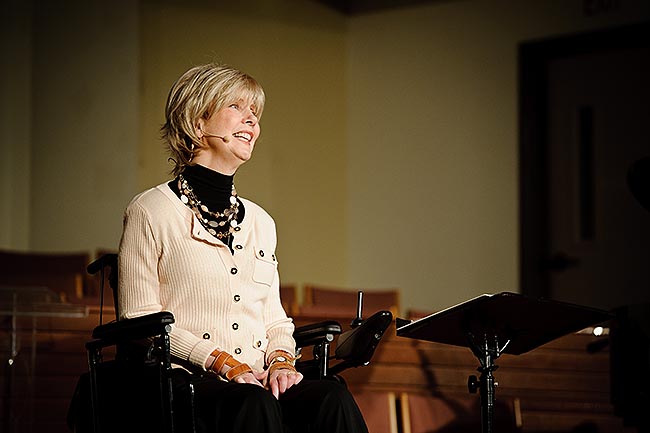
13_JONI_KKLAWOMENSNIGHT_0005Join keynote speaker Joni Earackson Tada and 20+ leaders representing the scope of the disability ministry movement this coming November 12-13 for Inclusion Fusion 2014, Key Ministry’s FREE, worldwide disability ministry web summit. Engage in interactive chat with many of our speakers and watch each presentation at the time of day that works best for you in the environment in which you’re most comfortable. Click here for FREE registration.

Posted in Inclusion Fusion, Key Ministry | Tagged , , , , , , , , | Leave a comment

The four kinds of special needs found in children in adoptive and foster families

© 2014 Rebecca Keller PhotographyThis is the second post in a series by Shannon Dingle examining adoption and the church. In addition to Shannon’s role as a Key Ministry Church Consultant, she is a co-founder of the Access Ministry at Providence Baptist Church in Raleigh, NC. 

In adoption language, “special needs” usually means anything that makes a child less likely to be adopted, including disability, ethnicity, age, and being part of a sibling group. For the purposes of churches including adoptive and foster families in their body and serving them well, I’m definitely special needs in the same way I do for any inclusive ministry purpose:

  • Special needs in church are anything that can hinder a child or family from full inclusion in YOUR church.

In other words, special needs are equal parts what’s unique about the family you’re serving and what’s happening in your church structures, environment, and programming that might create obstacles for that family.

Let’s pause for one crucially important note, though: To be able to welcome the child or family well, we don’t need to change them. We need to be willing to change OURSELVES.

I know that’s hard. Historically, change has been hard for churches. Even when you consider disability, churches were excluded from the Americans with Disabilities Act because they fought against it, arguing that changes to their buildings would be too costly to consider, even though refusing those changes literally meant that many people with physical disabilities would be unable to enter those churches.

Let’s not do that again, church. Let’s say no to any action or lack of action that tells any person, “You’re not welcome here” or “Our church is only for those who look, act, behave, feel, or act like I do.”

So what are the four kinds of special needs found among children in adoptive and foster families?

  1. The usual ones: These are the special needs we commonly see among any other group of kids: Down syndrome, autism, cerebral palsy, and so on. Also, as churches aren’t limited to a finite list of qualifying criteria a family must meet before a child can be served, these usual special needs can include some extra outreach and support for a child who is new to the church and doesn’t know her way around yet.
  2. Short-term needs related to adoption or foster care: One example here is initial attachment needs. For a child born into a family, research shows that attachment begins in the womb as the baby gets used to his or her mother’s voice and soon after birth as the newborn responds differently to the scent of the parent than to that of other adults. For children who enter a family by adoption or foster care, that doesn’t happen. The parent-child relationship begins with a baby, child, or teenager meeting a complete stranger who they’ll be living with for a foster period or for the rest of their lives. That’s a major transition, and I’ll write in one of my next posts about how church leaders can be attachment informed to support these children and families well. For one of our four children who were adopted, attachment needs faded over time and aren’t much of a consideration anymore, though that’s not the case for many children in adoptive and foster families. A better example of a short-term special need is English language learning for children adopted internationally from cultures with different languages, as those needs dissipate over time as the child’s English proficiency improves.
  3. Long-term needs related to adoption or foster care: Especially for children with multiple placements, past trauma, or adoption after the preschool years, attachment isn’t a short-term need. For our three children who joined our family a year ago at ages 2, 4, and 6, attachment is definitely still a work in progress, and I expect it to be a lifelong consideration in our parenting for at least one, if not all three, of those dear ones. In addition to attachment and trauma-related needs, these long-term ones more common for children in adoptive or foster placements include fetal alcohol syndrome disorders (FASD), reactive attachment disorders (RAD), and mental illness.
  4. Sibling needs: For our family and many other Christian families who chose to adopt or provide foster care, we have children already in the home. I’ve seen great benefits of adoption for Jocelyn and Robbie, our biological children, and for Zoe, who was adopted but then had to adjust after we adopted a second time, but the challenges are real too. These siblings need love and TLC as their family realities might mean that Mom and Dad are spending a lot more time focusing on the new addition(s) and less time spent with them. If you’re tempted to dismiss this as being no different from the birth of a new child into the family, please re-read the previous three items in this list. It’s not the same. And these siblings sometimes feel displaced, uncertain, and confused, and they tend to externalize those emotions by acting out or internalize them by not admitting how they feel because they don’t think they’re allowed to do so.

In the coming posts, I’ll unpack five concrete things churches can do to say yes to families like mine. For now, though, consider these areas of special needs for adoptive and foster families. Knowing what we may be going through is a huge step in being able to love us well.

Finally, I know this was a long post, so I want to end with my sincere thanks: If you’ve read this far, you care enough to learn more. Even if you’re still feeling uncertain about what your church’s next steps should be, please know that you are on the right track by caring and educating yourself for our sake and for the sake of the children entrusted to us, whether it be for a season in a foster placement or for the rest of their lives in adoption.

Thank you for that.

***********************************************************************************************************

12_JONI_SPEAKING_0001Join keynote speaker Joni Earackson Tada and 20+ leaders representing the scope of the disability ministry movement this coming November 12-13 for Inclusion Fusion 2014, Key Ministry’s FREE, worldwide disability ministry web summit. Engage in interactive chat with many of our speakers and watch each presentation at the time of day that works best for you in the environment in which you’re most comfortable. Click here for FREE registration.

Posted in Adoption, Advocacy, Families, Inclusion, Key Ministry | Tagged , , , , , , , , | 1 Comment

Finding Friendship…Christen Morrow-Ara

Christen MorrowDuring the month leading up to Inclusion Fusion, we’ll be introducing you to a number of disability ministry leaders doing great work who will be featured during this year’s Web Summit. Today, it’s our pleasure to introduce Christen Morrow-Ara. Christen was interviewed together with Pam Harmon from Young Life Capernaum for this year’s conference.

Christen has served with Young Life’s Capernaum ministry since her college years as a volunteer and on full time staff for 12 years, developing Capernaum ministry in Fresno, California, throughout Latin America and most recently serving as the Transition Specialist with the mission wide Capernaum team. Christen is an leader, speaker, and an advocate, butmostly she would say she has been privileged to be shaped by her friends with disabilities since childhood and she’s passionate about sharing those friends with the world and with the Church! Christian and her Peruvian husband live in Clovis, California and are excited to be welcoming their first child into he world this October. Christen can be reached at chosencrm@gmail.com. Here’s Christen…

Thank you, Dr. Steve and Inclusion Fusion for what you’re doing to move disability ministry forward in churches and communities around the country. We’re grateful for the opportunity to share here on your blog! We are with you in vision and passion, especially when we speak of churches!

CapernaumYoung Life’s Capernaum’s outreach ministry to teenagers with disabilities addresses the incredible need for friendship among our teenagers with disabilities. It’s the hallmark of what we do (along with laughter, controlled chaos, games and lots of joy) and the platform from which we present the gospel. Many of our Capernaum friends come from unchurched homes and have never heard the good news about a God who loves them, has created them as they are for a purpose, and wants them to know Him personally.

Because of the unique emphasis on relationship and the friendships built, our friends struggle to find a similar place for spiritual community or belonging outside of Capernaum. However, our older friends who met Jesus in high school and have been coming for many years need more. They need age appropriate community, friendships, dignity and need to be challenged to the next step in their walk with Christ as a part of the body of Christ. The challenge is finding churches that are prepared to welcome our friends and offer more than a simple program to them-relationships and a place in the life of the church.

YL LogoWe’ve begun to identify and collaborate with ministries and models of ministry around the country being done with adults so that we can learn and prepare our friends, prepare churches and help smooth the process of transition in an already challenging time when many of our friends’ services have dropped off and they experience isolation. This is precisely the time when the body of Christ can welcome our friends and experience the truth of I Corinthians 12:18-21; “But our bodies have many parts, and God has put each part just where he wants it.How strange a body would be if it had only one part! Yes, there are many parts, but only one body.The eye can never say to the hand, “I don’t need you.” The head can’t say to the feet, “I don’t need you.”

Not only do we believe that our friends will find a place to belong at a time in life when they may be losing parents, moving into group homes and losing contact with teachers, peers, and those who have been constant on their lives, but we know that the body of Christ will become more complete, more whole, and more alive when they experience the uniqueness and joy of our friends in their midst.

Join us for Inclusion Fusion and learn with us the heart behind these transitions, how we are approaching it, where it is working well, and how you can perhaps be a part of creating a place in your church to welcome our friends and make them a part of the life of your church.

Click here to check out Young Life’s Capernaum ministry.

***********************************************************************************************************

12_JONI_SPEAKING_0001Join keynote speaker Joni Earackson Tada and 20+ leaders representing the scope of the disability ministry movement this coming November 12-13 for Inclusion Fusion 2014, Key Ministry’s FREE, worldwide disability ministry web summit. Engage in interactive chat with many of our speakers and watch each presentation at the time of day that works best for you in the environment in which you’re most comfortable. Click here for FREE registration.

Posted in Inclusion, Inclusion Fusion, Intellectual Disabilities, Key Ministry, Strategies | Tagged , , , , , , , , , | Leave a comment

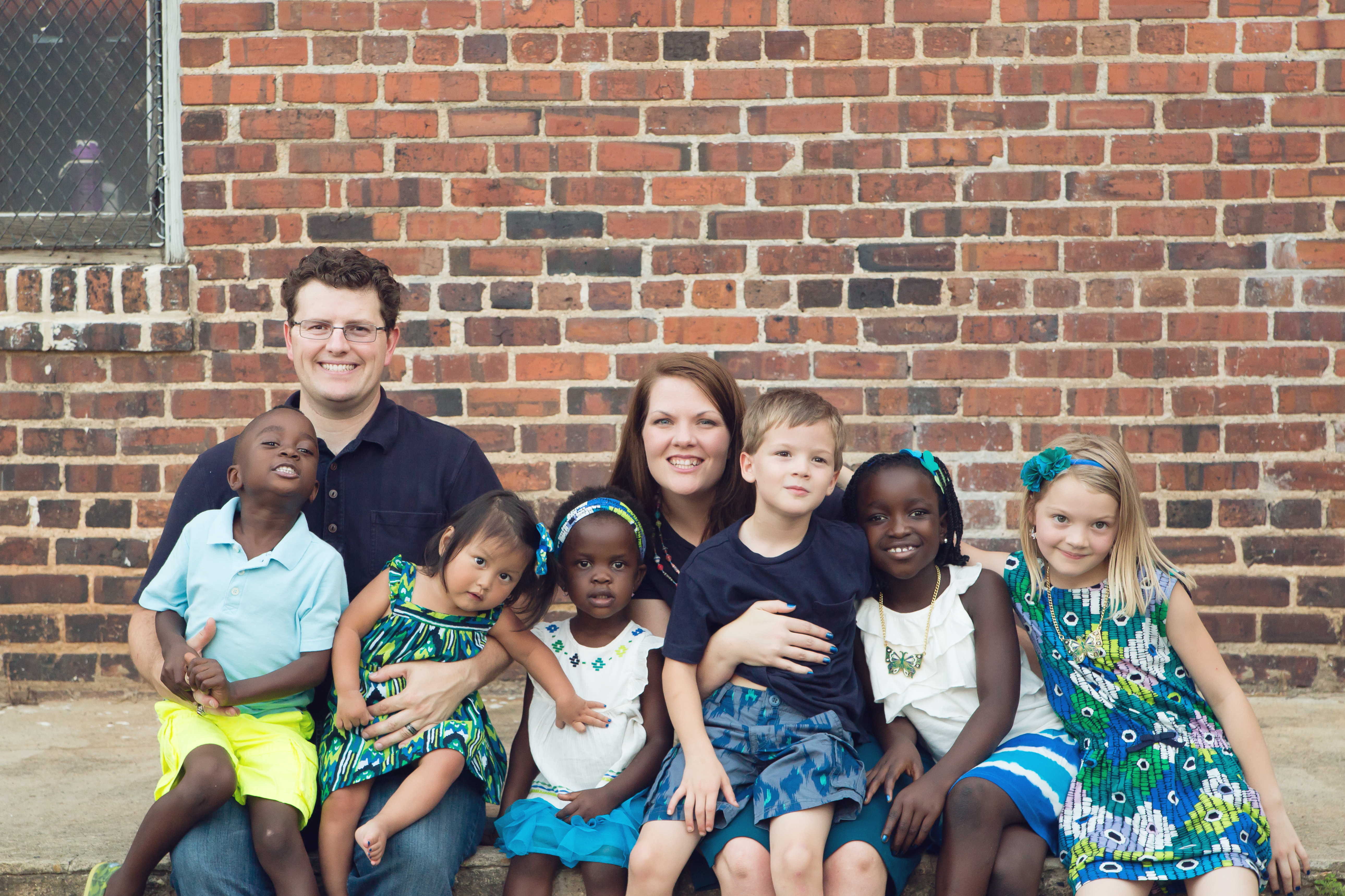
Hi, I’m Shannon, and this is my family

Dingle Higher Resolution

I never planned to have a large family. I never expected to have six children from three continents. I would have laughed in your face had you told me we would adopt four children from two countries in less than 18 months.

But that was our reality, adding Zoe to our family from Taiwan in 2012 and Patience, Philip, and Patricia in 2013.

When my husband and I launched Access Ministry, our church’s inclusive ministry for children and youth, we had no idea that our family would be served by it. We didn’t know then that special needs adoption would be part of our lives or that one of our biological children would be diagnosed with a couple of special needs.

Now, seven years later, our lives are drastically different. Our children’s pastor once said, “You didn’t realize you were creating the ministry that your family would one day need.” He’s right. I didn’t.

But as more and more Christians adopt children in need and more and more adoption programs are designed to find families for children with special learning, medical, or behavioral needs, I get a little worried. I see us, as a church, cheering at announcements about pending adoptions and then not knowing what to do when the child arrives and eventually joins in children’s ministry programming. I listen to friends who have had to change churches after the welcome mat was pulled away when it became too hard to include them. And I also hear church leaders saying that they want to help but they just don’t know how.

I’m convinced the first step is being willing to say yes – both to God and to these families – before having a perfect plan in place. I know that’s hard for those of us who are planners. Trust me, I know. God called our family to a reality that shattered all my plans, and I don’t have words to quantify how unbearably hard that felt at times.

But? I wouldn’t change it for anything in the world. I’ll be sharing a few more posts here leading up to the Together For Adoption conference October 17-18 in Greenville, South Carolina, but the gist is this: Our kids are worth it, so please partner with us in a way that shows that you’re in it with us for the long haul.

Just as I never expected that our family would be what it is now, our church didn’t know what the future held either back when two newlyweds entered Providence Baptist Church for the first time in the summer of 2005. Yet they’ve shown great love for us by being willing to serve, adapt, and learn so that all of our kids can be involved in the body of Christ.

What love! What sacrifice! What radical commitment to living, breathing people rather than static, dead plans on paper!

So now I ask you: what would it look like for your church to do the same?

IMG_0361Editor’s note: This is the first post in a series by Shannon Dingle examining adoption and the church. In addition to Shannon’s role as co-founder of the Access Ministry at Providence Baptist Church in Raleigh, NC, she serves as a Key Ministry consultant. Shannon will be speaking this weekend at the Together for Adoption Conference in Greenville, SC.

***********************************************************************************************************

12_JONI_SPEAKING_0001Join keynote speaker Joni Earackson Tada and 20+ leaders representing the scope of the disability ministry movement this coming November 12-13 for Inclusion Fusion 2014, Key Ministry’s FREE, worldwide disability ministry web summit. Engage in interactive chat with many of our speakers and watch each presentation at the time of day that works best for you in the environment in which you’re most comfortable. Click here for FREE registration.

Posted in Adoption, Key Ministry | Tagged , , , , , , , , | 2 Comments

HERE’S JONI! Registration opens for Inclusion Fusion 2014

12_JONI_SPEAKING_0001

Our team at Key Ministry is honored and delighted to announce Joni Eareckson Tada as our Keynote Speaker for this year’s Inclusion Fusion Disability Ministry Web Summit, to be available everywhere on November 12th-13th, 2014.

Joni serves as the Founder and CEO of Joni and Friends International Disability Center, and is an international advocate for people with disabilities. A diving accident in 1967 left her, then 17, a quad­riplegic in a wheelchair, without the use of her hands. After two years of rehabilitation, she emerged with new skills and a fresh determination to help others in similar situations.

During her rehabilitation, Joni spent long months learning how to paint with a brush between her teeth. Her high-detail fine art paintings and prints are sought-after and collected.

Her best-selling autobiography Joni and the feature film of the same name have been translated into many languages, introducing her to people around the world. Mrs. Tada has also has visited more than 47 countries.

Abby, Annie, JoniMrs. Tada has served on the National Council on Disability and the Disability Advisory Committee to the U.S. State Department. She has helped guide evangelism strategies among people with disabilities worldwide as Senior Associate for Disability Concerns for the Lausanne Committee for World Evangelization.

She has received numerous awards and honors, including the Victory Award from the National Rehabilitation Hospital and the Golden Word Award from the International Bible Society. Joni has been awarded several honorary degrees, including: Doctor of Divinity from Westminster Theological Seminary; a Doctor of Humanitarian Services from California Baptist University; and a Doctor of Humane Letters by Indiana Wesleyan University where she was inducted into IWU’s Society of World Changers

Joni has written over 50 books. She has received the Gold Medallion Lifetime Achievement Award from the Evangelical Christian Publishers Association. Joni’s latest book is Joni & Ken: An Untold Love Story published by Zondervan.

Since 1982, Joni has been hosting the short-feature radio program “Joni and Friends” which is aired on more than 1,000 outlets. In 2012, the National Religious Broadcasters inducted Joni into its Hall of Fame.

In 2012 The Colson Center on Christian Worldview awarded Joni its prestigious “William Wilberforce Award.” She has been interviewed on “Larry King Live,” “ABC World News Tonight,” and in magazines such as Christianity Today and World Magazine.

Joni and her husband, Ken Tada, have been married since 1982.

Inclusion Fusion for Key TVInclusion Fusion is a Disability Ministry Web Summit made available free of charge by Key Ministry.  The conference is an opportunity for Christ followers everywhere to share ideas and resources to advance the movement to fully welcome and include children and adults with disabilities and their families in the life of the local church. The theme of Inclusion Fusion 2014 is INNOVATION.

Inclusion Fusion offers prerecorded videos made available “on-demand” to conference registrants, supplemented by interactive online chats and experiences. We encourage discussion of diverse ideas and views and promote the development of new relationships between pastors, church leaders, and families. We seek to promote a dialogue around how to most effectively share God’s love with families who historically have confronted substantial barriers to church participation and form relationships that advance the building of God’s Kingdom.

Our two previous Web Summits involved 46 speakers representing a broad range of ministry interests and passions. Videos from Inclusion Fusion have been viewed well in excess of 20,000 times. Check out all of our past Inclusion Fusion presentations at Key Ministry’s NEW You Tube channel!

Inclusion Fusion 2014 registrationWe encourage you to register for this year’s Web Summit. Advance registrants will receive invitations to exclusive, pre-summit events and activities. You can click this link to access our registration form, or scan the QR code pictured at right. Later this week, we’ll be releasing the full speaker lineup for Inclusion Fusion 2014. Help us get the word out by using the hashtag #KMIF14 (short for Key Ministry Inclusion Fusion 2014).

Posted in Inclusion Fusion, Key Ministry | Tagged , , , , , , , | 1 Comment

Surrendering to help…Barb Dittrich

Barb D.In addition to her role as Executive Director and “Foundress” on SNAPPIN Ministries, Barb Dittrich is serving as our Social Community Director at Key Ministry. Barb wrote this post yesterday on her SNAPPIN’ blog. She gave us permission to share as today is National Depression Screening Day. Here’s Barb…

Whoever exalts himself will be humbled, and whoever humbles himself will be exalted.

Matthew 23:12 (ESV)

In a “pick yourself up by your boot straps”, “God helps those who help themselves” culture, it’s hard to accept that you need help. When the expectations of everyone around you scream that you should be able to handle life, you begin to self-impose that same pressure. Some may extend a hand again and again, yet you smile, downplaying your difficulties, assuring, “I’ve got this.”

For too many decades of my life, I suffered needlessly because of this faulty thinking. Unfortunately, that meant everyone around me suffered as well.

I probably lived with chronic depression since my youth without it ever being diagnosed. I was raised by a mother who had untreated mental illness and an addiction to prescription pain relievers. My father held the pervasive attitude of that generation when it came to these issues, uttering, “Get ahold of yourself,” if we were ever less than cheerful.

It wasn’t until I was a young adult and had made several bad decisions that I softened to the idea of seeing a psychologist. I was willing to get some input when I had a boyfriend abuse me in my college years, or when I miscarried my first child, or when my first marriage was falling apart. At least at that point I discovered how helpful Cognitive Behavior Therapy could be to a person like me. Rather than blaming everything on my past, I learned that I could discuss challenges and put new tools in my tool chest to deal with them. I learned the skill of doubting my doubts and challenging my despair.

Zoloft_bottlesEven so, I recoiled at the notion of medication. Perhaps it was my own mother’s addiction coupled with the attitude that my father had engrained in me, but the thought of psychotropic drugs was something I felt compelled to avoid at all costs.

It wasn’t until I got to the point of nearly suicidal depression early in my second marriage that I finally acquiesced. At my psychologist’s referral, I saw a psychiatrist for medication, and my life has never been the same since. As my therapist put it, the prescription literally puts a floor under my depressive free-fall.

Don’t get me wrong. It doesn’t do the emotional work for me. A person can take all the drugs they want, and that won’t magically make their problems disappear. But the medication has been like a ladder to help me climb out of a deep, dark, impossible hole.

I had to humble myself before I could be lifted up. I had to admit my inability to solve this problem on my own.

Contrary to the popular nonsense so pervasive in the world of prosperity gospel, I could not just think my way out of this illness with a good attitude. That is one of the most difficult parts of chronic depression. A person can logically look at themselves wishing to get better, sensing their emotions are larger than anything that is happening in their lives, yet they can’t shake the mood. It is miserably heavy, uncomfortable, and exhausting. There are things that can be done to improve it. Exercise, sunlight, proper diet, adequate sleep, and filling the mind with our Eternal Hope are extremely important. Even so, for so many people just like me, God still allows us to walk with this stubborn “thorn in the flesh”.

Yet, in my weakness, He is strong. My depression keeps me ever-humble, realizing that it’s all God plus none of me that accomplishes His will in my little world. In my place of brokenness, I have the privilege of learning that God’s faithfulness and trustworthiness far exceeds any emotion I may have. I may feel that I will be crushed by my circumstances to the point of utter hopelessness, but my cognitive mind can always ride out the darkest episode assured that I know better than that. God’s goodness transcends my feelings. This Eternal Hope helps me to ride out any depressive episode I may have to endure like a pesky head cold. I know that it is miserably uncomfortable, but I also know that it will eventually pass. The Holy Spirit holds me close and ushers me through it.

When I first had to face this monster of depression, I felt great shame, and kept to myself about it. Yet, as God equipped me to live with this chronic diagnosis, He also compelled me to be more transparent with others. He showed me that in admitting my brokenness, I made the world safer for others like me. As I opened up about my battle, I helped remove the stigma for others. I could reassure people that, just because I struggle with depression does not mean that I am a bad Christian, or that I am faithless, or that I am a worse sinner than anyone else. No, instead, I could demonstrate that living with this diagnosis means that I have a faith that is continually tested, yet comes out solid as a rock. And on the days when my depression is winning the fight, telling me that God has abandoned me, He still remains ever loving, ever devoted to me. When I can’t feel Him by my side, He is still there.

In God’s great grace, He also enabled my depression to blazon a trail for one of my children who struggles with a mental health issue. While my child’s diagnosis differs from mine, I am still able to be of comfort in between episodes of that child’s anxiety, “God is real, no matter how you feel.” I am able to equip my child to do the hard work of dealing with ugly mental health issues, because I have been there myself. It is a blessing to bring a calming effect to a situation because I speak from hard-fought experience, and this child of mine knows it.

This world has been broken since the day that man invited sin into it by disobeying God. Mental illness is just part of that brokenness. It is no different from my osteoarthritis being part of that brokenness, or my daughter’s severe allergies being part of that brokenness, or my son’s hemophilia being part of that brokenness. It may be a serious challenge, but it doesn’t solely define who we are. In this world, we may be undergoers, but in Christ, we are overcomers as we surrender to His help.

PRAY: Thank You, Lord, that when we are weak, Your true strength shines through. Help us to talk back to the devil, pushing back the stigma and false accusations of mental illness. Heal that wounds that exist between Your Church and those dealing with mental health issues. Nothing is too big or too small for Your deliverance!

~ Barb Dittrich

***********************************************************************************************************

KM Logo UpdatedKey Ministry has assembled resources to help churches more effectively minister to children and adults with ADHD, anxiety disorders, Asperger’s Disorder, Bipolar Disorder, depression and trauma. Please share our resources with any pastors, church staff, volunteers or families looking to learn more about the influence these conditions can exert upon spiritual development in kids, and what churches can do to help!

Posted in Depression, Key Ministry, Spiritual Development, Stories | Tagged , , , , , , , , , | 1 Comment

What keeps kids with ADHD out of church?

shutterstock_148715915_2Since we’re filming a training this weekend on the impact of ADHD on spiritual development, I thought today might be a good time to review some of the impediments to kids and adults with ADHD becoming involved and staying involved at church.

Let’s start by looking at this issue from the perspective of the parent. In all probability, the kids aren’t coming to church if the parent doesn’t bring them to church.

By the weekend, many parents of kids with ADHD are very tired. Kids with ADHD often have a very difficult time getting through their morning routine. They need constant reminders to get out of bed, get dressed, eat breakfast and are easily distracted by the TV, the dog, just about anything. If kids are taking medication, the stuff does take a little while to kick in, so that mornings often become a great source of frustration to parents.

shutterstock_155968427_2If the parent(s) can get their child up and ready in a reasonable time, the next challenge is the car ride to church. Compared to kids without ADHD, the child with ADHD is more likely to be angry about going to church, more likely to be screaming, yelling or crying because of some perceived grievance about their sibling’s behavior, and the family as a whole is less likely to arrive in a worshipful mood.

A major obstacle is the perception of many parents that they’ll be placed in a situation where they’ll be expected to explain their child’s behavior to others, or where they’ll be judged by others. Like it or not, there’s a stigma associated with many of the hidden disabilities (while this study from the American Journal of Psychiatry doesn’t address ADHD, it does reinforce the point). I was at a worship service in our church a number of years ago for Disability Sunday at which a couple got up to share their story of what it was like looking for a church with two young boys with ADHD. The mother’s words illustrated the expectations parents of kids with ADHD and other hidden disabilities bring to church:

“People in the church believe they can tell when a disability ends and bad parenting begins.”

shutterstock_55828720_2Another common complaint I hear from parents whose experience of church has been in denominations or traditions in which children and parents are expected to attend worship services together is that they can’t get anything out of the experience if their primary focus is monitoring their child’s behavior during the service. We’re seeing a growing trend among Catholic churches we serve to offer (at least periodically) separate worship experiences for kids and adults as a strategy for addressing this problem. I’m admittedly apprehensive about the well-intentioned efforts of some in the family ministry movement to discontinue separate worship experiences for kids because I suspect we’d lose many of the families of kids with ADHD who have difficulty with self-control.

Finally, we have the issue of parents who themselves have ADHD. They’re more likely to have difficulty following through on good intentions. They may want to come to church, they may know it’s important for their kids to be involved at church, but they have a hard time pulling things together to make it to church. They’re more likely to suffer from insomnia, or be “night owls” themselves, and struggle to get themselves up in the morning, much less their kids. They have more difficulty with establishing priorities and managing time. I can spot the families affected by ADHD in our church parking lot ten minutes after the start of the last service with Mom hopping across the parking lot putting her shoes on with three kids in tow.

For parents who themselves may have ADHD, the ease and clarity with which a church communicates where to go and what to do when you arrive is especially important. They tend to be easily frustrated looking for parking. They have a very difficult time remembering directions, resulting in the need for signage that is highly visible and processes for checking in and checking out kids that are as simple as possible.

Here’s one more issue to consider: Unlike families in which a child has an autism spectrum disorder, in which divorce rates are no higher than in the general population, the divorce rate nearly doubles in marriages where there’s a child under the age of eight with ADHD. Kids with ADHD are more likely to be alternating from household to household on the weekend, making establishment of a consistent routine of church attendance more difficult.

What about the experience of church from the perspective of the child or teen with ADHD?

shutterstock_46864729_2Kids with ADHD are often capable of intense focus when they’re engaged in activities they find interesting. In fact, the vast preponderance of the time kids come into my office with a history of wetting themselves during the daytime, their “accidents” occurred while playing a video game or outside in the middle of play with their friends. In many ways, ADHD should be thought of as an attention dysregulation as opposed to an attention deficit…kids with ADHD pay attention to too much stuff, much of which is unimportant, at the expense of what they need to pay attention to.

Kids with ADHD don’t do well in situations when they perceive the activity or the topic as boring or irrelevant, and unfortunately that’s the case in too many churches. I’ve said on many occasions that I believe it’s a sin to bore kids with the Gospel. And that’s exactly what happens when kids are required to sit through worship services designed for adults, especially kids with ADHD.

For many kids with ADHD, especially those with the “H” component, the mental energy required to maintain self-control for an extended period of time takes away from their ability to get the desired “take away” from their church experience. They don’t like sitting for extended periods of time. Many educators are starting to catch on to the importance of movement and exercise on learning.

As kids with ADHD get older, rates of insomnia increase. Many of these kids are “night owls”…they stay up very late because they have a hard time slowing down their brains to settle enough to fall asleep. The problem is compounded when they have to get up very early (6:00 AM in the case of our tenth grader) on school days. By the weekend, getting up and out of bed may be more of a challenge for the teen with ADHD than their friends. One of the wiser moves the leadership made at the church our daughter attends was moving high school worship service from 9:00 AM to 6:06 PM on Sundays. Let’s just say there weren’t a whole lot of kids with ADHD responding to invites from their friends to check out 9:00 AM church!

shutterstock_68372575_2Here’s another consideration… there are a lot of kids with ADHD who need to take medication to have a successful school experience during the week who don’t have that option available to them on the weekend because of concerns their treating physician or parents have about the effects of medication on appetite and growth. Think about this: If many kids with ADHD require medication for school during the week despite accommodation plans and assistance from teachers with special training, how do you think they’re going to do at church on the weekend without medication and a volunteer leader who lacks a teaching degree?

One of the main points my former ministry colleague Katie Wetherbee makes when training church staff and volunteers is that kids want to be successful. My kids with ADHD often get very frustrated and discouraged and start to see themselves as a disappointment to parents and teachers. Put that kid in an environment in which the behaviors resulting from their inability to maintain self-control may be labeled as sin and see how excited they’ll be about coming back next week!

shutterstock_173700593One final word on the issue of environments…there is such a thing as too much stimulation for kids with ADHD. When kids are struggling with sensory overload…too noisy, too many kids talking, lighting is too bright-they don’t learn and may experience the environment as unpleasant or aversive. Let me share an example…

We’ll call my friend Jake. Jake has ADHD along with auditory processing difficulties. When several people are talking at once, Jake’s experience is like listening to a radio with lots of static. Because of his ADHD, he notices all the different sounds in his environment. One day, I was hanging around in the lobby of the church about five minutes after the start of our second service and Jake comes up to say hello:

Jake: Hi, Dr. Steve

SG: Hi Jake. How you doing?

Jake: Just great

SG: How’s school?

Jake: Really good this year. (Hesitation) Dr. Steve, Can I ask you a question?

SG: Of course

Jake: When I go into my church service, there are too many kids yelling and screaming and talking and pushing…I can’t concentrate on what’s going on. Do you have any suggestions for what I can do?

Jake just had too much trouble tolerating the level of stimulation in the large group worship area that was present at the time. He liked the discussions when he broke out into his small group, so his parents and leaders came up with a great solution. Jake was given an orange vest and made a part of the parking team between services. We had people who drove around the lot looking for Jake on Sunday morning because of his friendly demeanor. He’d finish directing traffic about the time his large group worship was winding down and the kids were getting ready for their breakout groups.

***********************************************************************************************************

KM Logo UpdatedKey Ministry has assembled resources to help churches more effectively minister to children and adults with ADHD, anxiety disorders, Asperger’s Disorder, Bipolar Disorder, depression and trauma. Please share our resources with any pastors, church staff, volunteers or families looking to learn more about the influence these conditions can exert upon spiritual development in kids, and what churches can do to help!

Posted in ADHD, Families, Hidden Disabilities, Inclusion, Key Ministry | Tagged , , , , , , , , , , | 1 Comment

Doing Ministry Like a Missionary…Mike Woods

Heidi_Baker_BabyhouseI think that we’re going to have to think differently about special-needs ministry in order to reach the special needs population with the Gospel. Statistics may vary, but many report that approximately 80% of the disability community are unchurched. And though there are several factors that may account for this, I would like to focus on one important factor called “cultural distance.”

The concept of “cultural distance” is one paradigm that will help us to understand the reason why special-needs ministry outreach is an essential activity in bringing the gospel to the disability community.

Cultural distance is a simple concept that was initially developed by Alan Hirsch. Alan is a South African-born missiologist, author, and an acknowledged leader in the missional church movement.

What is cultural distance? According to Hirsch:

Cultural distance is…“a conceptual tool that we can use to discern just how far a person or a people group is from meaningful engagement with the gospel.”

Let’s say that you take a continuum that is a line. And on that line you indicate cultural barriers from left to right, evenly spaced. Each cultural barrier needs to represent a real significant barrier to meaningful communication of the Gospel.

What are some significant cultural barriers to the Gospel? Try thinking of cultural barriers in terms of missionaries who go to foreign countries to plant a church. What are some of the significant cultural barriers that missionaries have to cross in order to effectively share the Gospel with people of other cultures? Here’s a few of the primary ones:

  • Language
  • Values and beliefs.
  • Current cultural practices.
  • Past history.
  • Stereotypes
  • ________ ?

Here’s what it would look like visually depicted:

Missionaries and Cultural Barriers

Make no mistake about this: missionaries go through a course of training to overcome the obstacles to reach a people group. To be a successful missionary you must be willing to learn the language, the cultural practices, the history, and the values & beliefs of the people you are going to in order to reach them with the Gospel.

The problem that I see happening now in many churches and church-based special-needs ministries is that we’re not the ones crossing the cultural barriers anymore.

Many church-based special needs ministries (and churches) have sunk a lot of time and energy and effort into developing a great special-needs ministry located within the walls of the church building. And there is nothing wrong with that…in fact, it is a good thing. I spent my first two years working hard to create a welcoming special needs ministry at First Baptist Orlando.

But realistically, this type of “come and see” special needs ministry only shares meaningful communication of the Gospel with people who are within the walls of your church building.

In other words, the Gospel is only shared with those differently-abled individuals who attend your church and participate in your special needs ministry. The problem with that, as I have mentioned earlier, is that the larger percentage of the disability community is nowhere to be found within the church building.

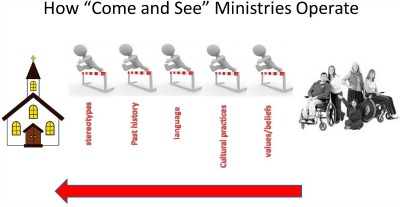
In essence, by operating only in the “come and see” mode we place the burden of crossing cultural barriers on the disability community. In other words, they now have to become the missionaries and take the initiative to cross significant barriers to get to the church. The more barriers that someone has to overcome the less likely they will be to cross them.

Here’s what it would look like visually depicted:

Come and See Ministries

That’s crazy! Each barrier presents a potential reason for someone to say, “Forget it.” That would be like a missionary going to Botswana, building a church building, and waiting for the Gciriku people to come to church after having made no effort to engage and relate to them. The “If you build it, they will come” philosophy isn’t a sure bet.

Whether you want to call it “outeach,” “missional,” or “go and tell,” I think it’s important for church-based special needs ministries (and churches without special needs ministries) to start operating again like missionaries.

We need to be the ones to shoulder the responsibility of being missionaries and take the initiative to cross cultural barriers in order to reach the people that we’re passionate about to meaningfully communicate the Gospel.

What’s one thing you could do this week to begin to do ministry like a missionary?

***********************************************************************************************************
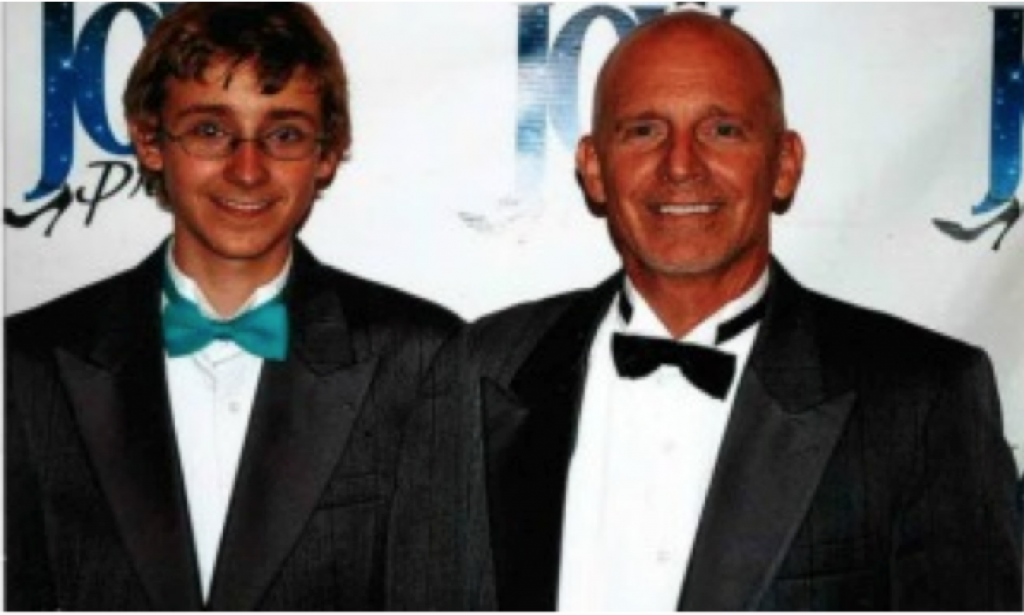
Mike-Woods-Joy-Prom-@-1024x615In addition to serving as a Church Consultant with Key Ministry, Mike Woods currently works as the Director for the Special Friends Ministry at First Baptist Orlando. Prior to joining First Baptist Orlando, Mike worked for nine years as the autism and inclusion specialist for a large school district in metropolitan St. Louis. Mike regularly blogs for Key Ministry on topics related to “missional” Special Needs Ministry…how churches can “leave the building” to share the love of Christ with families impacted by disabilities in their local communities.

Posted in Key Ministry, Strategies | Tagged , , , , , , , , | 3 Comments