
 This past January, we received a very intriguing request in the message box through which we usually receive requests for assistance from churches.
iDisciple is the world’s leading provider of Christian content, focused on “connecting you with the life-changing Word of God.” iDisciple has more than 500,000 users and features more than 240 authors offering articles, video, and audio to nurture their users’ walk with God.
Since iDisciple launched in the fall of 2013, their founders have been committed to giving all of their profits to help fight social injustice on a global scale for the cause of Christ. Among the causes they’re most passionate about are adoption and foster care, and supporting Christian families who become involved with adoption and foster care ministry.
Our team at Key Ministry is very honored, along with five outstanding ministries…Back2Back Ministries, Bethany Christian Services, Christian Alliance for Orphans, Focus on the Family and Tapestry…to have been invited to contribute to a comprehensive array of online resources available through iDisciple – a “life theme” for adoptive and foster families. These resources are available through iDisciple’s free service, available online and in apps for smartphones and tablets.
There’s an unbelievable amount of content available on the website and through the app. Over 18,000 audio messages, over 6,000 video messages and over 32,000 articles from authors including Francis Chan, Rick Warren, Joyce Meyer, Charles Stanley and Andy Stanley, 12 music and nine talk radio stations, and dedicated ministry channels, including channels from Third Day and Focus on the Family.
By answering a few questions about your interests and lifestyle, iDisciple creates and delivers a menu of personalized content to you each day. You’ll have access to your favorite Christian authors, pastors, and ministries wherever you go. And there’s now a dedicated life theme for adoptive and foster families with lots of useful resources for families of kids with every imaginable challenge or disability.
How can families access iDisciple and find the resources developed by our ministry and the other like-minded ministries involved with the development of the adoptive and foster care life theme?
Go to iDisciple.org (or download the app from your favorite online source) and click here to open your free account. Once you register for the first time, you may be asked a series of questions that allows the site/app to personalize the content you’ll receive on a daily basis. When you sign back in for the first time, you’ll see your daily feed…the personalized content based upon your preferences. If you click on “life themes” on the left hand toolbar, you’ll then be directed to this page.
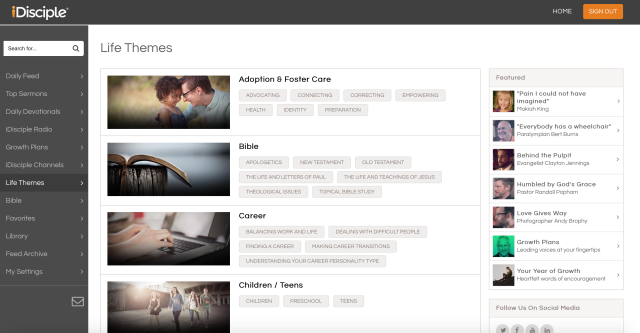
Within adoption and foster care, you may then click on any of the topics of interest… advocating, connecting, correcting, empowering, health, identity and preparation. Our followers will also find lots of great resources in the Children and Teens, Life Challenges and Parenting life themes. Any resource you find may be easily shared via social media
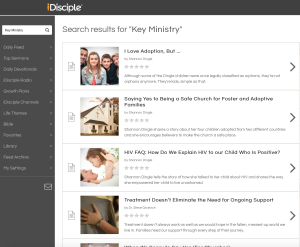 You can search our content specifically, any Key Ministry contributor individually, or any other topic or author through the search box on the upper left hand side of the screen.
Our friends at iDisciple have additional blessings they’re preparing to share with adoptive and foster families. We’ll keep our readers in the loop as new resources become available.
Please check out this fabulous FREE resource that our friends at iDisciple have assembled and share freely with pastors, friends and family who might benefit.
***********************************************************************************************************
 Check out Shannon Dingle’s blog series on adoption, disability and the church. In the series, Shannon looked at the four different kinds of special needs in adoptive and foster families and shared five ways churches can love their adoptive and foster families. Shannon’s series is a must-read for any church considering adoption or foster care initiatives. Shannon’s series is available here.
 Depression is what I call “an active illness.’ When a person with mental illness is able, she has to participate in her recovery – kind of like alcoholics need to go through the program so as not to fall off the wagon again. I’ve been on the path to healing for a few years with the help of a therapist, medication, community, attempts at healthy choices habits, and relying on the strength and closeness of Jesus.
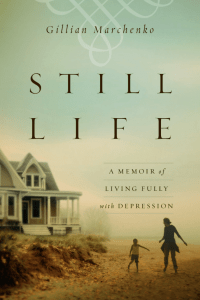 But if I can be honest, re-engaging into my life after a particularly difficult episode proves more difficult then the actual depression. In my newly released book Still Life; A Memoir of Living Fully with Depression with InterVarsity Press, I call re-engagement ‘Freddy Krueger frightening.” In my times of non-functioning I become a shell of a woman. I don’t feel. Sometimes I don’t remember whole days. But when the darkness ceases, and I climb out of the pit of an episode and back onto solid ground beneath my feet, the grueling labor of the effort of acclimation to return to life deep depression is actually easier. I know these thoughts are untrue. I know my family needs me. I know it is far better to live than to fantasize about death. But there it is. Re-engaging into life requires so much exhausting work that it is easy to decide that my mental illness episodes are easier than life. I’m confused and tired in re-entry. I don’t know how to participate in my family, friendships, and in basic human interaction. Once again… re-engaging into life after a depressive episode is ‘Freddy Krueger frightening.”
 For Gillian Marchenko, “dealing with depression” means learning to accept and treat it as a physical illness. In
  Do you want to partner more effectively with the parents in your ministry?
 Yes, Christ did display the work of God in healing the blind man later in that same chapter, but evidence from the rest of the Bible and from experience shows us that God doesn’t always choose to display His deeds by miraculously healing every ailment here on earth. A great example is that of Paul, whose weakness was a conduit for showing God’s perfect power.
 Editor’s Note: Today’s post is from Beth Golik, Special Needs Ministry Director at Bay Presbyterian Church. It was inspired by a story Beth shared three weeks ago in our church’s bulletin. Here’s Beth…
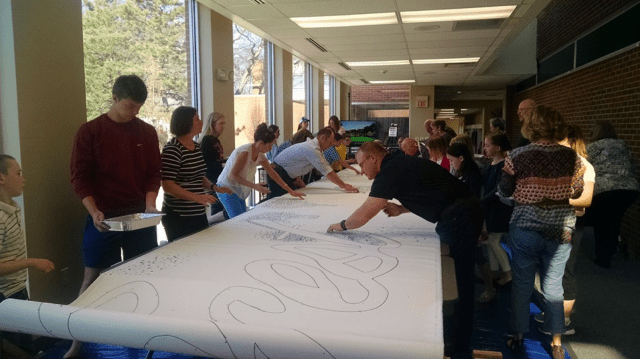
  Recently, our church was the first host site for a Guinness World Record attempt for creating the world’s largest fingerprint painting aimed at raising awareness for playgrounds that are accessible for everyone, including those with disabilities.
 Twice a year, our ministry takes part at public events designed for families with children with special needs (and children who struggle but have not been formally diagnosed) to learn about local resources, therapies and after-school programs. At a recent event, we were the only church represented out of 60 public and private organizations. Being there allowed us to reach another layer of the community: parents who had given up on the opportunity to attend worship together and grow in their faith.
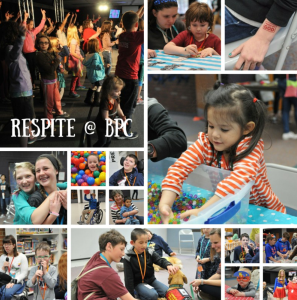 Inviting the public in is another way to connect with families and show them the love of Christ. At Bay Pres, we hold Respite Events, which offer a night of fun for children with special needs and their siblings while their parents enjoy a much-needed break for the evening. We average 60 guests and 150 volunteers during the two and a half hour event. While we are blessed to have a large facility and large volunteer base, smaller scale events are just as meaningful for participants. Our Respite Events allow us to minister to families beyond those we serve on Sunday mornings. However, through these events we often gain at least one new student and/or volunteer for our Sunday morning programs.
 It doesn’t matter what size your church is; there are ways for you to connect with the community and to make families feel welcomed. If you’re just starting out, get to know people by taking a team of church volunteers to a community event. If your church already has a special needs ministry, offer your building as a venue for an event that supports the community. Keep a presence in the community and talk with your pastors about ways that a special needs ministry enhances the church and acts to connect people into the family of faith.
 What would you do if a family came to your church with a child identified by their parents as “transgender?” What would the response be to parents who want their child to use the restroom corresponding to their’s child’s perceived gender identity or to participate in ministry activities based upon gender identity as opposed to the child’s anatomical sex? How would your student ministry respond to a gender-discordant teen undergoing hormonal therapy to prevent the onset of puberty or seeking to change their appearance to reflect their gender identity?
 I bet it’s safe to say these are issues few leaders or volunteers serving in children’s ministry or student ministry ever contemplated prior to assuming their current roles. But in the aftermath of the discussion surrounding the media coverage of the physical transformation of the 1976 Olympic Decathlon champion into Caitlyn Jenner, and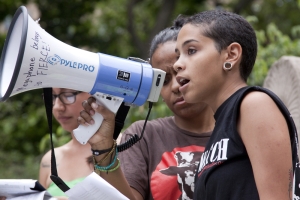
 The limited data available suggests markedly elevated rates of suicide among transgender youth. In this sample, 47% of transgender adults attempted suicide prior to the age of 25. In a
  Key Ministry has a critical role to play in educating pastors and church staff members about the possible causes and treatments for mental health disorders common among children and youth.
 I came across an
  Key Ministry encourages our readers to check out the resources we’ve developed to help pastors, church leaders, volunteers and families to better understand the nature of
 Depression is a lonely, isolating illness. I don’t have the mental, emotional, and physical capacity to spend time with people in and just after a depressive episode. If you have a friend who rejects your invitations to meet in person, there are other creative ways to show you care. Mail a card. Drop off a meal. Take the kids for an afternoon. Reach out via text, simply letting them know you are thinking about them and that there is no need to respond. Here’s a warning: don’t reach out too often because that may add more stress and get in a person’s life..
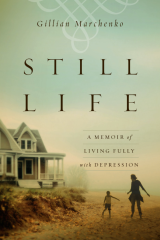 For Gillian Marchenko, “dealing with depression” means learning to accept and treat it as a physical illness. In


 Kara Dedert and her husband Darryl have been blessed with four kids — Sophie, Noah, Evelyn, and Calvin. Kara and Darryl had anticipated a life overseas but after five years as missionaries in Cambodia they had a son, Calvin, born with a neuronal migration disorder and severe brain malformations. Their lives have changed drastically but God continues to display His faithfulness and grace. Kara blogs at
 “Okay.” Zoya’s voice is small, distant. I see fear in her eyes, and work to remember whether I’ve taken a shower today, or yesterday, or whether I will perhaps take one tomorrow. “Um, Papa says it’s time for dinner. Can you come down and eat with us?” My daughter’s face is creamy, smooth white velvet. (I catch her once in a while, when I’m better, in her bed. “Whatcha doin’?” “Nothing, just resting,” she says. “Okay,” I reply, and walk down our light yellow hallway. I wonder if she’s sad. Would she tell me? In a lot of ways Zoya is the kid most similar to me out of the four: natural athletic ability but not a lot of follow-through, a somewhat round shape, prone to watching long television programs and spending time alone. I worry she’ll have whatever wacked gene I seemed to have inherited that makes life bad and hard sometimes for no reason. I hope to God it isn’t so.)
 What will my children remember about me when they are grown? I lie in bed at night and wonder. My bones chill, and I find myself rubbing my feet together, attempting to breathe a little warmth into my sobering thoughts. Will they remember their mother swinging them at the park? Will they remember their mother praying with them before bed, or setting the table while Papa puts the finishing touches on dinner, or cheering for them at a school assembly? Or will they remember a closed door? Don’t bother Mom, she’s not well. Keep it down now, girls, Mom is having a hard day. Will they remember phone calls unanswered, unkempt playdates, Mom’s inability to get it together enough to sign them up for gymnastics and swimming? What will they remember? The thought is a plague. Moments make up our lives, right? If that’s true, then I’d best remember that good moments exist, too. But there are lessons in remembering the bad. Because good moments aren’t as good if their worth isn’t realized. Because a good life could go unnoticed if nothing opposed it. Good moments wouldn’t mean as much without the bad. Remember that, Gillian. Name the good and bad moments, and thank God for them.
 Mental illness is real. Brain scans show differences neurologically between those with and without diagnoses like ADHD, childhood trauma, anxiety, and bipolar disorder, to name a few. Research backs therapeutic and pharmaceutical supports as effective treatment options. This isn’t about emotions. This is about a physical injury or difference, except the brain is affected instead of the lungs or kidneys. How would you reply if I shared a diagnosis of diabetes or cancer? Push through your discomfort with mental illness, and respond to us in that spirit.
 Most of the world sees our kids at their best. Usually, we help with that image. Rather than dishonoring our kids by sharing stories of them at their worst, we offer filtered stories and edited pictures. We might use #keepingitreal but few of us post our realest real, for good reason.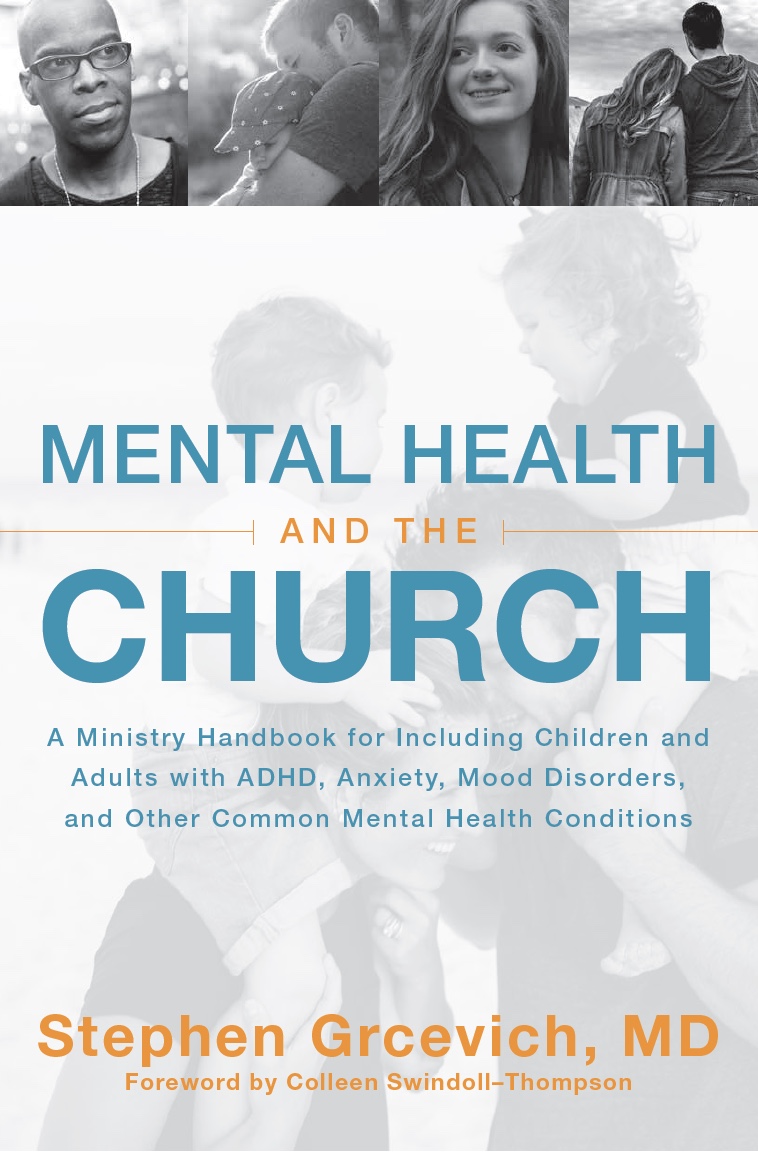


 Church4EveryChild