Spiritual growth in kids…what does the research say?

shutterstock_2191510What do we know about the determinants of why kids grow and mature spiritually? Let’s take a look at the available research on the topic.

We’ll examine data from three different sources:

Search Institute Study of Impact of Christian Education…a 3 ½ year long study examining indicators of faith maturity in 2,365 youth, primarily from mainline denominations (PC-USA, UMC, UCC, ELCA, Disciples of Christ, with Southern Baptists as used as a comparison group. Here’s a link to their report:

Lifeway research project by Clay Reed and Ed Stetzer…interviews of parents of 1,005 young adults between the ages of 20-35 examining parenting practices that contributed to positive spiritual outcomes in young adults. The research is to be published in an upcoming book. Here’s a video of Ed Stetzer presenting the data:

Barna Group: Research summarized in the book Revolutionary Parenting (Tyndale Press, 2007). The Barna Group condensed information from in excess of 1,000 interviews with parents of young adults, comparing parenting and religious practices of parents with grown children characterized as “spiritual champions” to practices in Christian homes in which young adults failed to meet such criteria. Here’s a link to the Barna website describing the book.

In the Search Institute study, the key predictors of “integrated faith” were the frequency of discussions with parents about matters of faith, the frequency of family prayer, devotions and Bible Study exclusive of meal times, the frequency with which parents and children were actively involved in serving others as a family and finally, lifetime involvement in Christian education. Less important factors included lifetime church involvement, religiousness of best friends, experience of a “caring” church, lifetime involvement in serving others and non-church religious activities.

In the Lifeway data, the most important predictor of positive adult spiritual outcome was the time kids spent in prayer. Other significant predictors (in order) included grades in school…better grades were associated with better spiritual outcomes, the child not being “rebellious”, the child having connected with a senior pastor or youth pastor, parents not using time out to discipline child…49% used time out in the group with the most positive spiritual outcomes,  regular service at church while growing up and participation in ministry or service projects as a family.

In the Barna data, (I’d strongly encourage anyone with an interest in this topic to purchase or download the book if you haven’t already) a number of interesting observations were made. The parents of young adults characterized as spiritual champions saw themselves (not the church) as having primary responsibility for faith training of kids. They saw the church’s role as one of reinforcing lessons taught at home. Parents of spiritual champions wanted to be more aware of their child’s church experience, were more likely than typical parents to withdraw their children from church activities if the experience doesn’t meet the parent’s expectations and their satisfaction with children’s/youth ministry was inversely proportional to their expectations of such ministry. Their faith practices were consistent with those described in the Search data and the Lifeway data. The parents of spiritual champions in the Barna data were more likely to come from single-income households in which parents spent significantly more time in conversation with their kids than the norm in U.S. culture and were intentional about helping their kids develop a mature Christian faith. They were also more likely to prioritize their child’s character development as opposed to their achievement.

What steps would I take as a parent if I want to increase the likelihood that my kids are going to grow up to be mature Christians, actively engaged in a local church and using their gifts and talents in serving others?

  • I’d want to pray regularly with my kids, and have them see my wife and I praying regularly.
  • I’d want my kids to see my wife and I studying the Bible regularly, and initiate spiritual conversations with them on a regular basis about applying Biblical teachings in day to day life.
  • I’d want to pursue opportunities to serve other people as a family through my church.
  • I’d want to make sure my kids saw my wife and I going to church every week, and encourage them to participate in the ministry offered at church for kids in their age group. I’d also encourage them in forming relationships with pastors or youth leaders outside of our home who will support and reinforce the values we’re trying to foster in our kids.

Updated March 11, 2018

***********************************************************************************************************

shutterstock_24510829Key Ministry is pleased to make available our FREE consultation service to pastors, church leaders and ministry volunteers. Got questions about launching a ministry that you can’t answer…here we are! Have a kid you’re struggling to serve? Contact us! Want to kick around a problem with someone who’s “been there and done that?” Click here to submit a request!

Posted in Families, Spiritual Development, Strategies | Tagged , , , , , , , , , , | 4 Comments

What do we know about gender non-conforming kids?

shutterstock_383471308What would you do if a family came to your church with a child identified by their parents as “transgender?”  What would the response be to parents who want their child to use the restroom corresponding to their’s child’s perceived gender identity or to participate in ministry activities based upon gender identity as opposed to the child’s anatomical sex? How would your student ministry respond to a gender-discordant teen undergoing hormonal therapy to prevent the onset of puberty or seeking to change their appearance to reflect their gender identity?

Leelah AlcornI bet it’s safe to say these are issues few leaders or volunteers serving in children’s ministry or student ministry ever contemplated prior to assuming their current roles. But in the aftermath of the discussion surrounding the media coverage of the physical transformation of the 1976 Olympic Decathlon champion into Caitlyn Jenner, and today’s announcement by the Departments of Justice and Education that schools that refuse to allow students to use the restroom or locker room consistent with their gender as opposed to biological sex, the topic is now squarely front and center. In December of 2014, the highly-publicized suicide of Leelah Alcorn, a Cincinnati-area teen (pictured right) from a church-involved family has led to a national debate about treatment offered to teens with gender dysphoria.

Perhaps the most contentious topic of debate within both the medical community and the broader culture involves the trend on the part of some parents with the support of professionals to recognize younger and younger children as transgendered. Here’s a report from Kate Snow of NBC News telling the story of a family that made a decision to identify their preschool-age biological daughter (Mia) as a transgender boy (Jacob).

How do we make sense of the topics of gender non-conforminty and gender discordance in kids and what do we say to parents coming to us seeking advice?

Gender nonconformity (defined as variations in norms in gender role behavior such as toy preferences, rough and tumble play, aggression and playmate gender) is quite common among young children. The majority of children at some point in time exhibit some interest in toy, play and peer preferences more typical of the opposite gender. Gender discordance refers to discrepancy between an individual’s biological sex and their gender identity…their personal sense of self as male or female.

For the vast majority of kids who exhibit gender non-conformity (88%-98%), discomfort with the biological sex resolves during childhood as they develop the capacity for more flexible thinking and recognize that one can still be a boy or a girl despite some gender-nonconforming interests. A much smaller percentage of kids reach adolescence with persistent discomfort with their biological sex. They might follow several distinct developmental trajectories.

Editorial Credit: Glynnis Jones / Shutterstock.com

Editorial Credit: Glynnis Jones / Shutterstock.com

Among boys who reach adolescence with gender discordance, research suggests the majority (75-80%) demonstrate a homosexual/bisexual orientation by age 19. A second path is characterized by heterosexual orientation and a third, smaller group (2-12%) will continue to experience gender dysphoria into adolescence, and ultimately, adulthood. In one small follow-up study (N=25) of school age girls diagnosed with gender identity disorder, 24% were classified as lesbian/bisexual in behavior and 32% in fantasy as adults, with the remainder classified as heterosexual or asexual. 12% continued to experience gender dysphoria as adults. In another sample, gender dysphoria resolved by late adolescence or early adulthood for the majority of boys and girls referred for gender dysphoria during childhood. Of the subjects for whom gender dysphoria resolved, all of the girls and half of the boys reported a heterosexual orientation, while nearly all subjects of both sexes for whom gender dysphoria persisted developed a homosexual or bisexual orientation.

Last month, we looked at data describing mental and physical health concerns among adults with gender dysphoria prior to and following medical and/or surgical treatment. Despite data suggesting the majority of persons with gender dysphoria treated medically and/or surgically are satisfied with the results, an extraordinarily large percentage continue to struggle with mental illness. Rates of suicide attempts following treatment ranged between 43-45% in one long-term follow-up study from Sweden, and persons who underwent surgery were four times more likely than the general population to be admitted to a psychiatric hospital and nineteen times more likely to attempt suicide than their same-age peers without gender dysphoria. I can’t imagine any parent who would want their child to experience persistent gender dysphoria in light of what we know about the long-term mental health outcomes.

What do we know about teens with persistent gender dysphoria?

  • They are more likely to experience depression. One study reported that 23.5% of a large sample of transgender women experienced depression during adolescence. Bullying and trauma may contribute to roughly 50% of the increased risk, according to this study.
  • A sample of 180 patients (ages 12-29) from a community health center reported that transgender youth had a twofold to threefold increased risk of depression, anxiety disorder, suicidal ideation, suicide attempt, self-harm without lethal intent, and both inpatient and outpatient mental health treatment compared with cisgender-matched controls. No statistically significant differences in mental health outcomes were observed comparing FTM and MTF patients, adjusting for age, race/ethnicity, and hormone use
  • They are more likely to have been victims of physical, psychological or sexual abuse, and more likely to have PTSD.
  • shutterstock_380461300The limited data available suggests markedly elevated rates of suicide among transgender youth. In this sample, 47% of transgender adults attempted suicide prior to the age of 25. In a smaller sample of transgender youth (ages 15-21, N=66), 45% seriously considered suicide and 26% had engaged in life-threatening behavior.
  • Higher than expected rates of autism spectrum disorders have been reported among children and teens with gender dysphoria. In this clinical sample, nearly 8% of kids with gender dysphoria met diagnostic criteria for autism. In addition to autism, higher rates of schizophrenia have been observed in clinically-referred samples of patients with gender dysphoria, and increased obsessional interests are seen among clinically-referred boys.

The question of what to do with children and teens with gender dysphoria in the face of insufficient data is the hot-button topic that their parents and the professionals who treat them are wrestling with. Here’s a study published in the last few weeks describing some of the ethical issues the professional community is wrestling with…

(1) The absence of an explanatory model for gender dysphoria

(2) The nature of gender dysphoria… is it a normal variation in development, a social construct or mental illness?

(3) What role does physiological change during puberty play in the development of gender identity?

(4) The role of comorbid medical and mental health conditions

(5) What are the range of possible physical or psychological effects associated with pursuing (or choosing not to pursue) early medical interventions?

(6) At what age is a child/teen competent to consent to hormonal/surgical treatments and what rights should parents have to consent to treatment before kids are capable of making such decisions?

(7) The role of social context in how gender dysphoria is perceived.

To summarize, we know that most kids with gender non-conformity become comfortable with their biological sex as they progress through childhood. For those who continue to experience significant gender discordance as adolescents, far too many will have experienced trauma, mental illness, social isolation, self-injury and suicidal thoughts.

Updated May 13, 2016

***********************************************************************************************************

shutterstock_24510829Key Ministry is pleased to make available our FREE disability ministry consultation service to pastors, church leaders and ministry volunteers. Got questions about launching a ministry that you can’t answer…here we are! Have a kid you’re struggling to serve? Contact us! Want to kick around a problem with someone who’s “been there and done that?” Click here to submit a request!

Posted in Advocacy, Controversies, Key Ministry, Mental Health, PTSD | Tagged , , , , , , , , , , , | 3 Comments

Lessons learned from five years in the blogosphere…

CNsDJ97dKcQKYc7YrjCFzk09vnQlo8BzBDSXxIe7dpw-2Five years ago today, our crew at Key Ministry launched this blog in an effort to build bridges between churches and families of kids with “hidden disabilities.” You can check out our very first post here, but this passage captures our purpose…

I hope and pray that God will use this blog and the efforts of our team at Key Ministry to help people involved in the church world to get to know and understand the families I see in my work world. Families of kids with “hidden disabilities”…significant emotional, behavioral, developmental or neurologic conditions without outwardly apparent physical symptoms. Once my church friends get a handle on the families in their communities who come to practices like mine, we can problem-solve together just how to welcome them into our environments, include them in the stuff we do so they can come to know Jesus, accept him as Lord, and grow to be more like him. Just like we do.

When we launched this blog, Katie Wetherbee’s blog, our Facebook page and Twitter feed as outgrowths of our first social media plan in the Spring of 2010, I’ll confess to thinking that our online presence was a tool for making our team more visible so we’d have more opportunity to do “real ministry”…getting invited to conferences and individual churches in-person to train church staff and volunteers to minister to kids and their families. I had no idea to the extent that our online presence would become our ministry.

inclusionfusionfinalNot too long after we got started, I made a couple of mistakes that I still regret to this day. The end result was a few broken relationships, a ministry colleague who was needlessly hurt and doors closing as opposed to opening for our team to do the type of ministry work we sought to do. In searching for a survival strategy, we became very intentional about developing collaborations with like-minded people and organizations and working together with them to help get the word out about the resources everyone had to offer. Inclusion Fusion came about after one of our team members was “disinvited” from a children’s ministry conference where they had been promoted as a featured presenter. Through the process of reaching out to others and looking for ways to promote their ministries, we discovered the secret to whatever “success” our ministry has experienced since that time.

What makes a blog or a social media strategy successful is lots of people who take the time and effort to share content they find valuable with friends and colleagues. More so than anything else, the content we’ve shared through this blog and and our social media platforms that has been created by wonderful, like-minded ministry colleagues we’ve had the pleasure of meeting over the past five years has helped us to disseminate the content we’ve created around ministry with families of kids with mental illness, trauma and developmental disabilities to far more churches, ministry leaders and volunteers than we would have ever imagined five years ago.

Ministry to Children honorWe’ve averaged around 1,370 visitors per day to the blog this year (that works out to around 41,000 unique visits per month). To put that statistic in perspective, it takes us less than two days get as many visitors as we had in all of 2010! The blog has been accessed from 203 countries. We’ve been able to make our resources available to far more people in far more places than I ever imagined. And we recently received some very neat recognition from the folks at Ministry to Children as the fourth most popular children’s ministry blog, based upon link popularity of the home page, global link popularity of the whole site, and social media popularity in the last 6 months.

So…what’s in store for the next five years?

Plans remain in some degree of flux as our Board continues to search for the future leader of our organization, but here are some preliminary ideas we’re exploring…

  • You’ll be introduced to more voices from throughout the disability ministry movement. Using the blog and our other platforms to introduce our friends and followers to new faces, new organizations and new ideas is very gratifying and in keeping with the overall spirit of the movement. In addition to myself and Shannon, we’ll likely add more ongoing contributors to the blog.
  • Either on this platform or another platform, we’ll likely begin to make ministry resources and supports directly available to families. If we’re going to build bridges between churches and families impacted by disability, a one-way bridge won’t give us the desired results. We’re wrestling with the idea of what a “family portal” might look like.
  • We’ll be exploring strategies for getting out on the road more and providing more and better live training together with our ministry partners.

We have one project that we’ll commence work on almost immediately. I’m of the opinion that we should offer as many resources as we can free of charge so that to as great a degree as possible, money wouldn’t be an additional obstacle preventing churches from getting help in reaching out to and welcoming families impacted by disability. As a result, I’ve always thought of this blog as our “book”…a living, breathing, searchable journal of ideas churches can use in ministry with families.

In “church world,” a big determinant of who gets quoted in the magazines and journals thousands of church leaders read and speaking invitations to the conferences that thousands of church leaders attend is the credibility that results from having written a book. So…at the urging of several of our Board members and at least one of our ministry consultants, I’ll be taking 2 ½ weeks off from my ministry responsibilities and my day job to finish a book that’s currently in rough draft form that will put forth a model for churches seeking to minister with kids and teens with mental health concerns and their families. The goal is to have a manuscript ready to send off for editing by the end of July.

Thanks to all of you who share our resources with others through e-mailing links, posting to Facebook and sharing through social media! You make it possible to get the word out to churches and families everywhere.

We appreciate your prayers for the next five years to be more impactful than our first five!

blog-grcevich-logo.jpg

Posted in Key Ministry, Strategies | Tagged , , , , , , , | 1 Comment

Suicide by doctor?

shutterstock_234464116

Editor’s note: On October 5, 2015, California Governor Jerry Brown signed a physician-assisted suicide law covering nearly ⅛ of the U.S. population. Ironically, the law goes into effect upon completion of a special legislative session on healthcare. Physician-assisted suicide is now legal in California, Oregon, Washington, Montana and Vermont.

Should mentally ill patients have “the right to die?”

I came across an extraordinarily troubling post by Wesley Smith over at First Things describing the increased availability and acceptance of physician-assisted suicide in Europe for persons with mental illness. From Smith’s post…

A few years ago, I spoke about end-of-life care at a town-hall event; it quickly devolved into an intense debate on assisted suicide. When the time came for audience questions, a self-described “mentally ill” woman took the microphone and declared that she had a right to doctor-prescribed death. More than half the audience burst into applause.

Helping the mentally ill commit suicide was unthinkable not long ago. Today, it is a growing practice.

In 1994, the Dutch Supreme Court ruled that physician-assisted suicide was justifiable in patients with “unbearable mental suffering” A study published in the New England Journal of Medicine in 1997 surveyed half the licensed psychiatrists at the time in the Netherlands and of the 83% of the sample responding to the survey…

64% (N=345) thought physician-assisted suicide for psychiatric patients “could be acceptable.” Of that group, 70% (N=241) reported they could conceive of a situation in which they would be willing to assist in suicide.

A study of general practitioners, elderly care physicians ad clinical specialists from the Netherlands published earlier this year in the Journal of Medical Ethics reported the following…

The response rate was 64% (n=1456). Most physicians found it conceivable that they would grant a request for EAS in a patient with cancer or another physical disease (85% and 82%). Less than half of the physicians found this conceivable in patients with psychiatric disease (34%), early-stage dementia (40%), advanced dementia (29–33%) or tired of living (27%). General practitioners were most likely to find it conceivable that they would perform EAS.

This past February the Canadian Supreme Court unanimously ruled that persons with “a grievous and irremediable medical condition” have a right to physician-assisted suicide. Ashton Ellis provided analysis of the decision in this post at The Public Discourse…

In Carter, however, eligibility for assisted suicide is not tied to a severely curtailed life expectancy. Rather, it is triggered whenever an illness, disease, or disability is present that can’t be fully cured.

It gets worse. The Carter Court explicitly states that either “physical or psychological suffering” merits access to assisted suicide. If such suffering becomes “intolerable” to a person, she can get help killing herself merely because she can’t bear the thought of a diminished life, however she defines it.

shutterstock_158472119The ability of patients with treatment-resistant depression to request assistance in committing suicide appears to be permissible under the ruling in Canada and has been a hot topic of discussion. This past May, a professor from Queens University in Ontario argued in the Journal of Medical Ethics that persons with treatment-resistant depression should be entitled to assistance in committing suicide…

Competent patients suffering from treatment-resistant depressive disorder should be treated no different in the context of assisted dying to other patients suffering from chronic conditions that render their lives permanently not worth living to them. Jurisdictions that are considering, or that have, decriminalised assisted dying are discriminating unfairly against patients suffering from treatment-resistant depression if they exclude such patients from the class of citizens entitled to receive assistance in dying.

A “mental health advocate” blogging in the Huffington Post in the aftermath of the decision in Canada appears to champion this new rationale for “parity” in how mental illness is viewed relative to other medical conditions, and sees trauma victims as potential “beneficiaries” of this new right…

I have advocated extensively for mental illness to be treated and looked at the same as physical illnesses. That’s why if we’re going to accept physician assisted-suicide as an appropriate remedy for people suffering from an irremediable physical illness then we must accept this to be an appropriate remedy for people living with mental illness.

When I think of when physician assisted-suicide may be appropriate for somebody living with mental illness, I think of the people who appreciate the consequences of their choices both good and bad, people who have extensively received treatment for mental illness which is reported to be ineffective by the patient, and I think of people who have suffered from psychological trauma that has destroyed their lives that don’t see envision a future for themselves.

shutterstock_65290903For readers who conclude this is an abstract discussion, here’s a link to data on physician-assisted suicide in Belgium. In 2013, 1.7% of all reported deaths in the country were attributed to physician-assisted suicide. The number of assisted suicides for patients with “neuropsychiatric disorders” has increased every single year since 2007, from 25 in 2010 to 33 in 2011, 53 in 2012 and 67 in 2013. This paper describing the process of organ harvesting from persons who underwent physician-assisted suicide included a 62 year old man experiencing self-mutilation. This news report from last week describes a 24 year-old who was approved for lethal injection as a result of chronic suicidal thoughts. Last year, age limits were removed on the “right to die” in Belgium, extending the right to die to children, or parents acting on behalf of their children.

Here in the U.S., 26 states have enacted, or are actively considering legislation to permit physician-assisted suicide as of this past February.

A personal concern of mine involves the ability of physicians to invoke the right to “conscientiously object” to demands they respond to requests for assistance from patients who desire help in committing suicide. Recent events in the U.S. suggest strong public support for the policy that religious freedom is relinquished by those who provide services to the general public, as all physicians are licensed to do by their respective states. The language of the decision in Canada leaves to legislatures the responsibility to reconcile the rights of patients with the rights of physicians. From another post by Wesley Smith

Doctors who morally object to killing patients might be forced to participate. The court gave Parliament 12 months to pass legislation consistent with its sweeping opinion, stating that “the rights of patients and physicians will need to be reconciled” by such legislation or left “in the hands of physicians’ colleges.”

That may leave doctors who embrace Hippocratic values twisting in the wind. Quebec, which legalized euthanasia last year, requires all doctors asked for death by a legally qualified patient to give the lethal jab or refer to a doctor who will. Professional medical societies in Canada also appear ready to quash physician conscience. The College of Physicians and Surgeons of Saskatchewan, for example, recently published a draft ethics policy that would force doctors with a moral objection to providing “legally permissible and publicly-funded health services”—which now include euthanasia—to “make a timely referral to another health provider who is willing and able to .  .  . provide the service.” If no other doctor can be found to do the deed, the original physician will be required to comply, “even in circumstances where the provision of health services conflicts with physicians’ deeply held and considered moral or religious beliefs.” In other words, a willingness to kill patients who want to die may soon become necessary to practice medicine in Canada.

At what point does the “right to die” become a “duty to die” for those with severe mental illness? Might persons with chronic mental illness be more susceptible to manipulation by spouses, children and extended family members? What happens when health care cost-containment efforts by the government or private insurance companies limit access to more costly treatments? What will extending the “right to die” to mental health patients with “intolerable” suffering do to increase the vulnerability of persons with other chronic disabilities?

What shall the church do to uphold human dignity and the sanctity of life, especially for persons with chronic mental illness and those with physical or psychological suffering associated with severe or chronic disability?

Joni Eareckson Tada spoke of her own experience of hopelessness and depression following the diving accident that resulted in her quadriplegia in this blog post

But the truth is pain is not among the top reasons for why people choose assisted suicide. Instead, they are psychological issues which can be effectively treated. When I broke my neck and doctors told me I would never again have use of my hands or legs, I sank into suicidal despair. But looking back, my problem was never my spinal cord injury: my problem was clinical depression that later lifted through the support of family and Christian friends. Besides, who is to say when quadriplegia, multiple sclerosis, muscular dystrophy or ALS is classified as “terminal”? There are tremendous risks to this new law, including suicide contagion, elder and disability abuse, and the inevitable expanse to broader groups of people to reduce their choice. So rather than making it the state’s responsibility to help despairing people kill themselves, let’s pour more effort into improving pain management therapies and strengthening the hospice movement. Let’s lift people out of depression through compassionate care. Because after all, we must do all we can to protect, defend, and preserve every life — especially those with disabilities

Updated October 5, 2015

***********************************************************************************************************

KM Logo UpdatedKey Ministry has assembled resources to help churches more effectively minister to children and adults with ADHD, anxiety disorders, Asperger’s Disorder, Bipolar Disorder, depression and trauma. Please share our resources with any pastors, church staff, volunteers or families looking to learn more about the influence these conditions can exert upon spiritual development in kids, and what churches can do to help!


Posted in Advocacy, Controversies | Tagged , , , , , , , , , | 1 Comment

Receiving the refugees of the sexual revolution…

shutterstock_182299751Our churches need to be the places who can receive the refugees from the sexual revolution – those who have been hurt and harmed by it. We can’t do that if we give up the Gospel… And we can’t do that if we’re angry at our neighbors and screaming at them rather than loving them…” – Russell Moore, President, Ethics and Religious Liberty Commission, Southern Baptist Convention

Russell Moore’s article (highly recommended) from the Washington Post addressed an issues I’ve been struggling with…

Some Christians will be tempted to anger, lashing out at the world around us with a narrative of decline. That temptation is wrong. God decided when we would be born, and when we would be born again. We have the Spirit and the gospel. To think that we deserve to live in different times is to tell God that we deserve a better mission field than the one he has given us. Let’s joyfully march to Zion.

I recognize I need to do some spiritual work on the anger and selfishness that comes from fear of the the extraordinary transformation of our culture. But some of our anger as Christians is godly anger. I’m angry at the injustice of kids having to grow up in a postmodern culture increasingly hostile to those who reject the civil religion of moral relativism and seek both publicly and privately to live in accordance with the teachings of Scripture. From my front row seat to the culture as a child and adolescent psychiatrist I can attest that God’s way works. Dr. Moore is spot-on in his call to the church to prepare to receive the next wave of young casualties of the sexual revolution.

How shall we prepare? Here are six ideas from someone who has treated far too many of the wounded…

When compared with children who grew up in biologically (still) intact, mother– father families, the children of women who reported a same-sex relationship look markedly different on numerous outcomes, including many that are obviously suboptimal (such as education, depression, employment status, or marijuana use). On 25 of 40 outcomes (or 63%) evaluated here, there are bivariate statistically-significant (p < 0.05) differences between children from still-intact, mother/father families and those whose mother reported a lesbian relationship. On 11 of 40 outcomes (or 28%) evaluated here, there are bivariate statistically-significant (p < 0.05) differences between children from still-intact, mother/father families and those whose father reported a gay relationship. Hence, there are differences in both comparisons, but there are many more differences by any method of analysis in comparisons between young-adult children of IBFs and LMs than between IBFs and GFs.

While the NFSS may best capture what might be called an ‘‘earlier generation’’ of children of same-sex parents, and includes among them many who witnessed a failed heterosexual union, the basic statistical comparisons between this group and those of others, especially biologically-intact, mother/father families, suggests that notable differences on many outcomes do in fact exist. This is inconsistent with claims of ‘‘no differences’’ generated by studies that have commonly employed far more narrow samples than this one.

We have reason to suspect from this study in England as well as this study from Scandinavia that same-sex marriages may turn out to be less stable than traditional marriages. The bottom line is that it is not unreasonable to hypothesize that kids raised in homes in which parents of the same sex are married to one another are more likely to present with more challenges. Editor’s note: Divorce Care for Kids is an excellent resource for churches seeking to minister with kids from non-traditional families.

  • We need to get much more serious about coming alongside families seeking to raise their children with a Biblical perspective of sexuality, right, wrong and “self-determination.” Where else will families be able to turn?
  • We in the church need to get our own house in order in addressing our ongoing struggles with sexual brokenness and challenging more couples to live out the picture of marriage portrayed in the Bible.
  • As faith-based organizations are facing increasing pressure to compromise their values or abandoning their roles in the social services, we will need leaders of faith to infiltrate the adoption and foster care systems and individual families to step up to care for the youngest victims of the sexual revolution both here in the U.S. and abroad.
  • While it troubles me greatly to suggest this, youth who struggle with gender identity or with to resist the urge to act upon same-sex attraction may need very well-trained Christian counselors exempt from licensure by the state. We’ll talk more about this topic in a future post, but vaguely worded laws prohibiting “conversion therapy” have been enacted in California and New Jersey and a nationwide movement seeks to pass preventing…

“any practices by mental health providers that seek to change an individual’s sexual orientation. This includes efforts to change behaviors or gender expressions, or to eliminate or reduce sexual or romantic attractions or feelings toward individuals of the same sex. “

“Any sexual orientation change efforts attempted on a patient under 18 years of age by a mental health provider shall be considered unprofessional conduct and shall subject a mental health provider to discipline by the licensing entity for that mental health provider.”

shutterstock_150116513Where will parents be able to take their kids for help when their attractions or behaviors are “ego-dystonic?” Surely, any Christian licensed as a mental health professional who seeks to adhere to traditional Biblical teaching on sexuality and chooses to treat kids with same-sex attraction will become a potential target for censure (or worse) in our current environment.

  • We have to represent a radical alternative to the culture the victims of the sexual revolution are leaving behind. From Dr. Moore…

There are two sorts of churches that will not be able to reach the sexual revolution’s refugees. A church that has given up on the truth of the Scriptures, including on marriage and sexuality, and has nothing to say to a fallen world. And a church that screams with outrage at those who disagree will have nothing to say to those who are looking for a new birth.

We must stand with conviction and with kindness, with truth and with grace. We must hold to our views and love those who hate us for them. We must not only speak Christian truths; we must speak with a Christian accent. We must say what Jesus has revealed, and we must say those things the way Jesus does — with mercy and with an invitation to new life.

 We know how this battle is going to turn out. Let’s get ready to care for the victims.

This is no time for fear or outrage or politicizing. We see that we are strangers and exiles in American culture. We are on the wrong side of history, just like we started. We should have been all along.

Let’s seek the kingdom. Let’s stand with the gospel. Let’s fear our God. But let’s not fear our mission field.

Updated March 1, 2016

***********************************************************************************************************

shutterstock_24510829Key Ministry is pleased to make available our FREE consultation service to pastors, church leaders and ministry volunteers. Got questions about launching a ministry that you can’t answer…here we are! Have a kid you’re struggling to serve? Contact us! Want to kick around a problem with someone who’s “been there and done that?” Click here to submit a request!

Posted in Advocacy, Controversies, Key Ministry | Tagged , , , , , , , , , | 1 Comment

The apple doesn’t fall far from the tree…ADHD in families

shutterstock_149729270In an earlier post, we discussed spiritual challenges that kids with ADHD encounter related to core deficits in executive functioning. Today, we’re going to take another angle on the topic of spiritual challenges to look at the obstacles to growth that result in some cases in ADHD families.

The first issue we need to consider is that kids with ADHD often have parents with ADHD. If a parent has ADHD, the odds that any one of their children will have ADHD is around 50%. Around 75% of cases of ADHD in kids can be attributed to genetic influences, but that doesn’t necessarily mean that environmental influences aren’t important, because some of that 75% includes the interaction of environment and genetics. Other cases are caused by developmental or environmental insults…premature birth, exposure in-utero to alcohol or tobacco, lead exposure, early physical or sexual abuse, and possibly, excessive exposure to video games or media.

Dr. Steve Faraone is one of the top researchers and statisticians in the child mental health field. He co-authored a editorial in JAACAP reviewing studies on the genetics of ADHD. I included this excerpt because the understandings we’re reaching about ADHD are likely to be what we’ll find with autism and other “hidden disabilities”…

“While twin studies report that ADHD is influenced 60% to 90% by genes, at best, only 5% of that influence can be traced to specific candidate genes. In some ways, this discovery was also an important one because it motivates us to think of genes in a different light. Rather than think of genes as disease genes, which they almost certainly are not, it is perhaps better to embrace the concept of susceptibility genes, i.e., that some DNA variants increase the risk for the brain variations underlying a disorder but are not necessary and specific causes of the disorder. In this way, each DNA risk variant can be seen as being responsible for influencing a trait, expressed as a variation in brain functioning, and the combination of these traits may be what puts one child at risk for a disorder, and yet a different combination may be protective.”

Sorry about digressing, but here’s the bottom line: When kids have ADHD, we’re often relying upon parents who themselves have difficulty setting priorities, following through on tasks and maintaining focus to be their primary faith trainers. 

Many of these parents were the kids who were turned off by church trying to sit still as a 12 year old in a straight-backed pew through a boring sermon while wearing uncomfortable clothes. One can make an argument that our “seeker-sensitive” churches represent an attempt to create an environment welcoming to adults with ADHD through offering relevant messages with one main point, services incorporating rich media, contemporary music, stadium seating and holders for coffee cups or other caffeinated beverages. (I told my last pastor that the least I could do after he spent 20 hours on the sermon was to show up with my Diet Mountain Dew Code Red prepared to listen.)

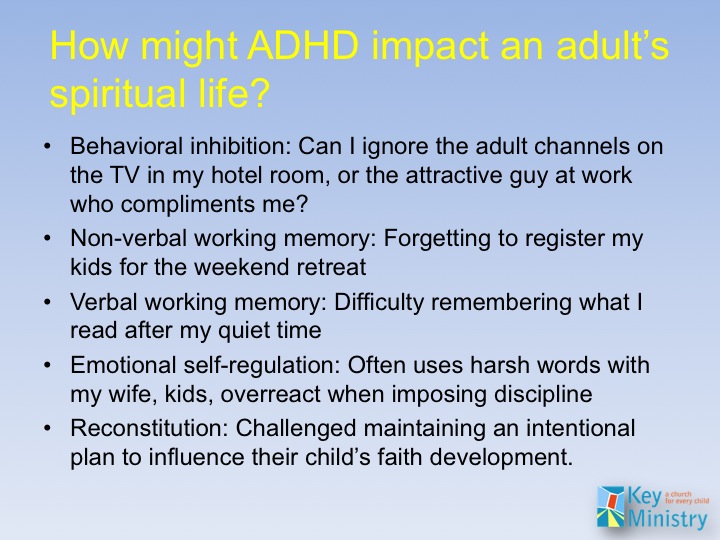
To illustrate the challenge at hand for the parent with ADHD raising the child with ADHD, let’s look at a summary slide below examining the executive functions we discussed in recent posts and consider the impact on spiritual growth in adults with ADHD:

I’m a big fan of the family ministry philosophy espoused by the guys at Orange Leaders, especially for families of kids with disabilities. That’s a teaching series for later in the fall or early in the winter. Here’s where there’s a parallel between what a children’s or family ministry pastor does and what I do in my day job…in many instances, we won’t be able to help the child until we first help the parents. Having a church community that can come around these families becomes a really important piece of the solution for kids with ADHD.

One more thought about how this plays out…last Fall, our team had the pleasure of doing some training at Northland Church in Orlando, where Debbie Blahnik is doing great things with the Children’s Ministry and Laura Lee Wright heads up the Access Ministry for persons with all types of disabilities. Debbie asked us to do a presentation on serving families of kids who are “irregular attenders,” because her team had theorized that their kids with hidden disabilities like ADHD have some relationship with the church, but the relationship is inconsistent. I had one of those moments when the light bulb went off over my head and our ministry team gets really scared. Most kids can’t get up and drive themselves to church! We can talk about ministry environments and curriculum all we want, but we’re not going to be able to help kids with ADHD to grow spiritually unless we can connect with and build influence with their parents.

***********************************************************************************************************

KM Logo UpdatedKey Ministry has assembled resources to help churches more effectively minister to children and adults with ADHD, anxiety disorders, Asperger’s Disorder, Bipolar Disorder, depression and trauma. Please share our resources with any pastors, church staff, volunteers or families looking to learn more about the influence these conditions can exert upon spiritual development in kids, and what churches can do to help!

Posted in ADHD, Families, Hidden Disabilities, Key Ministry, Mental Health, Strategies | Tagged , , , , , , , , , | 3 Comments

Can we do disability ministry across a theological chasm?

MallC_WeddingFrom the very beginning of Key Ministry, we’ve never had any theological “litmus test” churches had to pass before we would serve them. We’ve sought to come alongside all Christian churches. We’ve historically had Board members representing churches from a number of Christian traditions (churches attended by current Board members include Evangelical Presbyterian, Baptist, Roman Catholic and non-demoninational), and we have more than enough work to do fulfilling our primary mission.

The church from which our ministry was launched and the church I’ve attended for much of my adult life (until seeking dismissal from the PC-USA seven years ago) would fairly be described as “traditional” in its beliefs in the midst of a denomination that was becoming progressively more “liberal” in theology and its’ approach to social issues. From my perspective, one reason our church stayed in the denomination as long as it did was the importance leadership placed upon continuing relationships with congregations we disagreed with theologically in the hope we could continue to maintain some influence with them…and influence is generally impossible without relationship.

DSC00189_2We’ve held trainings in lots of different churches with very different theological perspectives than those held by a majority of our Board members (or my home church) and we’ve always been welcomed warmly. We had a great event at a church where the senior pastor at the time was openly critical of one of our Board members on his blog. Enthusiasm for the cause of helping kids and families connect with the church has (up to now) been enough to overcome differences in theology or teaching.

I’m concerned that the divisiveness we’ve seen over issues including the authority of the Bible, standards of personal conduct for church leaders and endorsement of same-sex marriage will very soon make it impossible for disability ministry leaders on one side of the divide to serve churches on the other side of the divide. Here’s a message that a disability ministry colleague shared with me last Friday…

What’s the church? I’m working with a United Church of Christ congreation on some disability issues. I think the denomination is pretty liberal across the board. They “get” disability ministry and one of the only ones open to my message. I know they are cheering today. What will happen to them? How do I as their brother in Christ work with them? I see fruits, but I also see judgments.

I’m hopeful of the best, bur preparing for the worst. Clearly, the fault lines have been emerging over the last five-plus years. Key Ministry’s volunteer accountant attends an Anglican church that conducts business and some worship services out of the church my family attends after they were evicted from their building by their previous denomination. The cause of the eviction as described by the local paper was “disputes regarding interpretation of the Bible and certain basic tenets, including details of Jesus’ resurrection.” The increasingly frequent news stories about denominations and churches ending up in court over property matters and demands for payment from churches seeking to be released from their denominations are a tragedy and a distraction from the work that desperately needs to be done in the culture. At the same time, the “liberal” pastor I made reference to above was very clearly hurt by the perception he was seen as a “heretic” by conservatives within his denomination.

I did a run on the data we at Key collect online when churches contact us for consultation. Here’s what we found in terms of the makeup of the churches that contacted us online in the last 2+ years…

Key Church referrals

I went through our consultation requests since the beginning of 2015…We’ve averaged a little over six requests/month this year and we’ve received one from a “mainline” church this year…and that request came from a volunteer as opposed to a church staff member.

It’s sad (unlike the experience of my ministry colleague) that we’ve received so few requests from churches on the liberal end of the theological spectrum. At the same time, we may have missed out on a major opportunity to expand the impact of our ministry because of having sponsored a blog that featured a few guest posts authored by a leader from a church with a theological perspective incompatible with the “conservative” organization that approached us.

If there’s anything that church leaders adhering to reformed/traditional theology and those with more “progressive” views ought to be able to agree upon is the importance of sharing the love of Christ with kids and families impacted by disability who are currently excluded from local congregations of ANY Christian tradition. But in response to the point raised by my colleague, have we reached the point where the distrust in the church for ministries and ministry leaders who routinely serve the “other side” is such that we in disability ministry will be forced to choose one side of the theological chasm or the other at the risk of losing the opportunity to minister altogether?

Photo courtesy of United Church of Christ General Synod.

***********************************************************************************************************

shutterstock_24510829Key Ministry is pleased to make available our FREE consultation service to pastors, church leaders and ministry volunteers. Got questions about launching a ministry that you can’t answer…here we are! Have a kid you’re struggling to serve? Contact us! Want to kick around a problem with someone who’s “been there and done that?” Click here to submit a request!

Posted in Advocacy, Controversies, Inclusion, Key Ministry | Tagged , , , , | 1 Comment

Mobilize the people…

BZTIn the final installment of our series, Ten Strategies for Promoting Mental Health Inclusion at Church, Steve examines the importance of engaging and mobilizing the people of your church to do the work of a thriving mental health ministry.

Mental health ministry isn’t a spectator sport. Everyone gets to play.

Your people are your greatest asset in reaching out to and building relationships with children, teens and adults with mental illness and their families. Given the statistics on the prevalence of mental illness among kids and adults in the U.S., it’s a fair statement that most of your attendees/members will know at least one person impacted by mental illness lacking a meaningful connection to a local church. Empowering them to be the “hands and feet of Jesus” can have a powerful impact in your local community.

Let’s look at the different ways your mental health inclusion team might empower the people of your church to own your church’s ministry…

Libby Key MinistryService: Often, the most meaningful ministry a church can offer takes place through the spontaneous action of individual Christians in responding to and meeting needs where God has placed them. Libby Peterson from our team did a fabulous job here describing the mindset with which your church’s people can approach the challenge…

Here is one small step. If the Lord has you in proximity to a family (impacted by mental illness) who does not know Jesus – in other words – if you encounter this family where you live, work or play – take a small step towards them. Begin to seek God’s help in building a relationship. Invite the mom for coffee, the dad to a sporting event, the child for a play date, offer to grab groceries on your next trip or just call some afternoon to say “Hi”. Trust the Lord will use that relationship for HIS glory – after all Jesus lives IN YOU and as this family grows in relationship with you – they will inevitably begin to see Jesus. Watch for opportunities to BRING them into a gathering of people who love Jesus. Be open to inviting them to belong – and know that it’s in the belonging that people often first come to believe!

Others will have more defined service roles…leading a small group, participating in your church’s respite ministry, serving as a Stephen Minister-but everyone has a place to serve on your team.

Evangelism: Everyone in your church who has come to faith in Jesus has the opportunity to share the Good News with the people God places in their path on a daily basis. How might your inclusion team keep this opportunity at the forefront of their minds?

During our discussion of online church and social media, we touched on the importance of making resources available to your church members in formats that can be shared easily through social media. Given that the average American adult now spends 5.6 hours/day consuming  digital media, your people are increasingly likely to encounter people God places along their digital path. How can your team empower and resource your teens and adults to share the Good News and invite those they encounter online into relationship with the people of your church, and ultimately, into a relationship with Jesus?

Presence: Our friend Jim Hukill discussed the importance of the ministry of presence in this talk from Inclusion Fusion 2012. Here’s how the folks at Fuller Youth Institute describe presence

Neil Holm defines this concept as “a faith presence that accompanies each person on the journey through life.” This presence in each of us reflects God’s presence, love, and peace. Central to this ministry philosophy is the idea of “being with.” The love and presence of God is embodied as we are with the other person in their moment of crisis. A ministry of presence can bring comfort and express care without words. Presence encompasses physical, emotional, and spiritual care. This is sacramental presence. It is a revelation of Jesus’ care and compassion through listening, being with, and affirming.

The church is everywhere the people of your church have been positioned. How will your team prepare your people to extend this ministry where they’ve been placed?

***********************************************************************************************************

shutterstock_24510829Key Ministry is pleased to make available our FREE consultation service to pastors, church leaders and ministry volunteers. Got questions about launching a ministry that you can’t answer…here we are! Have a kid you’re struggling to serve? Contact us! Want to kick around a problem with someone who’s “been there and done that?” Click here to submit a request!

Posted in Advocacy, Hidden Disabilities, Inclusion, Key Ministry, Mental Health, Strategies | Tagged , , , , , , , , | 1 Comment

Online community…component of a mental health inclusion strategy?

Online groupsIn the ninth installment of our series, Ten Strategies for Promoting Mental Health Inclusion at Church, Steve explores ways in which churches can creatively establish online communities and incorporate strategies to use these communities as part of an overall plan for building relationships with families impacted by mental illness.

“The key to this business is personal relationships.”

The sage advice given to Tom Cruise’s character by “the late, great Dicky Fox” in the movie Jerry Maguire is foundational to any intentional strategy to reach out to and include children and teens with mental illness and their families.

If I had it to do over again (and I might), I’d relabel Key Ministry’s Front Door initiative as “online community” as opposed to “online church.” When we put church services online, we weren’t trying to create an alternative experience of church so much as we were trying to create an additional pathway to relationship with the help of some cutting edge technology. The goal of any online ministry effort of ours is to create relationships that move families impacted by disability one step closer to an experience of “church” in the physical presence of other Christ followers.

More and more churches are live streaming services or establishing online campuses. Even more are diving into social media and for good reason…that’s where the people are!

99.9% of churches will enter into online expressions of ministry for reasons other than outreach to families with disabilities. As your church builds an online presence, I see several compelling reasons for your church’s mental health/disability ministries to go along for the ride…

  • It’s an easy way to lower the resistance to engaging church attendees and members in evangelism and outreach.
  • It levels the playing field for persons who struggle with social communication or social anxiety.
  • Technology allows you to inexpensively target underserved families (such as families impacted by mental illness) and increase the likelihood of connecting them with people in  your church who can help them take the next step toward worshiping in the physical presence of their brothers and sisters in Christ.

How might a mental health inclusion project use existing/developing resources for ministry online as part of a plan? Here are six ways that churches can use tools they’re already developing to reach…

  • Online Church 060115Worship services: As the cost of live streaming online video content continues to fall, more and more churches are making available online access to worship services in real time. Other churches are archiving the content of sermon messages on video hosting services like Vimeo. Facebook is now seeking to compete with YouTube for viewers (and advertising dollars) and at the time of this post allows page managers to upload videos of up to 45 minutes duration. If your church is producing video content, the mental health inclusion team might ask how that content could be used to help persons with mental illness and their families connect with the members and attendees of your church? How would use your video content to promote conversation and relationship?
  • Small group experiences: Videoconferencing technology has progressed to the point that interactive, online small groups represent a potentially effective strategy for including teens and adults in small groups when work or school demands or the lack of availability of child care would otherwise present insurmountable obstacles to group participation. We’ve seen the future and it works. How could you reach and include families your church isn’t currently serving (including families impacted by mental illness or trauma) through launching online groups?

Not every group needs to take place in real time. Private/closed online groups hosted on Facebook have been effective for our ministry in creating dialogues around topics of interest. As more churches offer adult education and Bible studies online through Facebook, blogs and other platforms, how would your church seek to engage and include families without a church home, including families impacted by mental illness?

  • Serving: Online ministry provides ample opportunity for “reverse inclusion.” How could your church’s volunteer team use people with a background in mental health or personal experience with mental illness through representing your church’s ministry online?
  • Prayer: Does your church have a prayer ministry? How could your inclusion team come alongside your church’s prayer ministry to extend themselves into the surrounding mental health community?

Our team realizes that thinking about mental health inclusion when online ministry technology is still in its’ infancy is more outside the experience of most church leaders than any other intervention we’ve discussed. We’re also convinced that online ministry offers the potential for contributing to an effective mental health ministry strategy where very few strategies exist. Here’s why…

  • Online ministry is outwardly-focused.
  • Online ministry provides an inexpensive opportunity for churches to overcome the relationship deficits common among many families impacted by mental illness.
  • Online ministry levels the playing field for persons who struggle with social anxiety or social communication.
  • Online ministry allows families to connect with church in a sensory environment of their choosing.
  • Online ministry eliminates the need for individuals and families to self-identify with a mental health disability in order to get the accommodations they might need to participate in a ministry event or activity.

***********************************************************************************************************

Steve NilsWe’ve developed a resource page on the topic of online ministry that contains several video presentations from Key Ministry including video from two of the church’s most prominent thought leaders in online ministry (Nils Smith from Community Bible Church and Jay Kranda from Saddleback Church) and helpful links to just about every resource a church might need to learn more of how technology may be applied to reach families impacted by disability.

Posted in Hidden Disabilities, Inclusion, Key Ministry, Mental Health, Strategies | Tagged , , , , , , , , , , , , , | 2 Comments

Promoting mental health inclusion at church? Respond to the family’s most immediate needs

shutterstock_165733445In the eighth installment of our series, Ten Strategies for Promoting Mental Health Inclusion at Church, Steve discusses how churches can be the hands and feet of Christ through responding to practical needs of families both inside and outside the church impacted by mental illness. 

If we’re to have an impact as the hands and feet of Jesus to those who are outside the church, we first have to get better at addressing the practical needs of families impacted by mental illness who are already part of the church or those who have some connection to the church. Imagine the reaction of someone desperate for care and support who feels overlooked while the church pours into others!

At the same time, our ministry colleague (and former Key Ministry Church Consultant) Mike Woods frequently reminds us of the importance of “outwardly-focused inclusion.” Because we’ve hypothesized that families of kids with mental illness and trauma are significantly less likely to attend church or participate in other activities offered to promote discipleship, we can’t wait for them to come to us…we need to be intentional about going to them.

We’re going to look at an inventory of ideas for churches seeking to serve kids, teens and adults with mental illness and their families. We’ll start this list with strategies primarily intended for those who already have a connection with the church and end with activities more likely to impact persons outside our congregations.

  • Intercessory prayer: How often have you heard your pastor or another pastor pray for people impacted by mental illness during a worship service? Regularly scheduled public prayer is a powerful strategy for affirming attendees struggling with mental illness and conveying a sense of welcome to visitors impacted by mental illness.
  • Casseroles: Every church that I’ve attended church in my adult life had some type of ministry to provide food to families following the birth of a baby or during an illness. Would your church make sure that a family with a child in the hospital has something to eat? What if their child is in a psychiatric hospital? During a segment on the crisis in children’s mental health that aired last year on 60 Minutes, one mother put it like this…

My daughter, when she was thirteen was hit by a car and fortunately was fine, except for a very bad broken leg. The church organized a brigade of casserole makers, the neighbors brought casseroles, friends, families, everybody. Six months before that, Christina had spent two months on a psychiatric ward, and we had no casseroles. And I’m not blaming the church or the neighbors or anything…because of the stigma, we didn’t tell people.

  • Hospital visits: In many churches a pastor or member of the pastoral care team will seek to visits members/attendees in the hospital or another extended or long-term care facility. Would a child or teen in a psychiatric or residential treatment facility get a visit from the children’s or student pastor? What about the adult child of a member in assisted housing?
  • Counseling: Many adults or kids who could very much benefit from counseling are unable to afford it. Since many seek help from the church already, the availability of high quality counseling services offered free of charge or at an affordable price through a local church helps address a very pressing need.
  • Referral services: Many families don’t know where to turn when mental illness strikes in the family. Churches provide a valuable service when they can help families identify appropriate practitioners/agencies for their mental health needs and help facilitate a connection.
  • Compassion: Many churches have a benevolence or “deacon’s fund” to provide financial assistance to members or attendees with pressing financial needs. Churches can communicate the availability of support when families have no other way of addressing a short-term mental health need…one-time consultations, prescription refills, transportation, child care for a parent receiving treatment.
  • Community: Persons with mental illness and their family members are frequently experiencing social isolation and a lack of support. Many churches offer Stephen Ministers or similar high-quality, confidential caregivers to support hurting people.
  • IMG_0751Mental health-focused worship services: Many churches will designate a specific weekend as a “Disability Ministry” or “Special Needs Ministry” Sunday. In our home area, we’re seeing churches host worship specifically for families with identified special needs. Why not host a worship service with a mental health-specific theme with appropriate worship music and teaching promoted to families of kids and adults with mental illness who lack a church home?
  • After school programming: Kids who struggle with mental illness are more likely to come from single-parent families, may benefit from structured environments and need opportunities to work on social skills in a nurturing and accepting environment. Have you ever considered offering ministry for kids and teens after school? Wanda Parker and her team at KidTrek have developed good models for after-school ministry. Because higher rates of mental illness are reported among kids with learning disabilities, after school tutoring programs provide churches opportunities to provide kids with adult mentors while meeting immediate needs.
  • Parent advocates: Many kids with mental illness will require special education services (covered under an IEP) or school-based accommodations (covered under a 504 plan). A church can provide an invaluable service to parents by providing trained advocates to accompany parents to educational planning meetings at schools. Advocates may also help families access needed services through the mental health system.
  • Prison/homeless ministry: You’ve probably never thought of your church’s homeless ministry or  prison ministry as mental health outreach. 26% of homeless persons are characterized by SAMHSA as having “severe mental illness.” According to the Bureau of Justice Statistics, approximately, 24% of jail inmates, 15% of state prisoners, and 10% of federal prisoners reported at least one symptom of a psychotic disorder. Local jail inmates had the highest rate of symptoms of a mental health disorder (60%), followed by State (49%), and Federal prisoners (40%). How can your church better support the mental health needs of those you serve through these ministries?

We’re always interested in learning of new ways in which churches have provided meaningful service to families impacted of mental illness. Know of a church doing great work in mental health ministry? Doing something innovative? Let us know by posting a comment or link below.

***********************************************************************************************************

KM Logo UpdatedKey Ministry has assembled resources to help churches more effectively minister to children and adults with ADHD, anxiety disorders, Asperger’s Disorder, Bipolar Disorder, depression and trauma. Please share our resources with any pastors, church staff, volunteers or families looking to learn more about the influence these conditions can exert upon spiritual development in kids, and what churches can do to help!

Posted in Families, Hidden Disabilities, Inclusion, Key Ministry, Mental Health, Strategies | Tagged , , , , , , , , , , | 1 Comment