Why it’s so hard to assess kids for the potential effects of trauma

shutterstock_52640113Welcome to the sixth installment of our Fall 2013 blog series: Trauma and Kids…A Primer for Pastors, Church Staff and Parents. Today, we’ll tackle the question of Why assessing kids for the potential effects of trauma is so difficult?

Last week, we looked at the Adverse Childhood Experiences (ACE) Study, examining the cumulative effects of trauma, abuse and neglect on measures of long-term mental and physical health. From my perspective as a child and adolescent psychiatrist, I like to know as much as I can about exposure to toxic substances in utero and traumatic experiences after birth because experience tells me that such exposure frequently impacts the effectiveness of the medications and psychosocial treatments I prescribe.

Here’s an example…for six years, my clinical time was evenly divided between work in an inner-city children’s mental health center in Canton, Ohio and what might be described as a “concierge-type” practice in one of the two most affluent counties in our state. I noticed that the average dose of medication I’d prescribe for kids in the inner-city clinic with ADHD was roughly double the dose necessary in my suburban practice, and the kids from the city generally weren’t experiencing the same quality of response as the kids in the suburbs. This observation was far from scientific and there were lots of confounding variables, including the quality of schools and availability of educational supports, but the biggest difference in the iner-city kids seemed to be exposure to toxic substances in utero and toxic environments at the time of referral.

Editor’s Note: That’s a big part of why I’m volunteering for Key Ministry as opposed to working in the inner city clinic. I thought many of the families I saw in the clinic needed a pastor more than they needed a psychiatrist, because the spiritual poverty among the families we served often led parents to make all manner of stupid, maladaptive choices in pursuit of filling the emptiness resulting from the God-shaped void in their lives… those choices all too frequently resulting in major life complications for their children.

Dad punching kidIn any event, accurately determining the extent to which a child has been exposed to trauma and abuse has been a major impediment to better research on the effects of adverse childhood experiences. Here are some of the reasons why it’s so difficult to get a good handle on the extent to which a child has been impacted by trauma…

  • The younger the child is at the time of the trauma, the more difficult it will be for the child to accurately communicate what they experienced. They may not have the expressive language skills to accurately describe their experiences. They may have a difficult time quantifying recurrent traumatic experiences. They may not understand the concept of time to accurately report the sequence of events.
  • Developmental regression (including loss of language skills) is not uncommon following traumatic exposure in children. Kids who may have been capable of accurately reporting their experiences prior to a traumatic event may struggle to do so in the aftermath of the event.
  • The traumatic experience itself may negatively impact the child’s memory/capacity for recall.
  • Avoidance of conversations that stimulate memories of frightening event(s) is a common coping mechanism among kids who’ve experienced trauma. Kids who have experienced trauma generally don’t want to talk about it. They may give brief, superficial answers to  questions in screening interviews in order to avoid the need to talk.
  • Recurrent, intrusive memories of traumatic events may not manifest as distressing. Kids may act out memories through their play activity with outwardly expressed emotions that don’t necessarily correspond to those expected from the trauma.
  • Parents and caregivers are often reluctant to be truthful when children may have been harmed resulting from their actions or inaction. Birth parents of children placed for adoption may be reluctant to disclose the extent to which they smoked, consumed alcohol or abused drugs during their pregnancies. Parents of kids who have been victims of physical or sexual abuse within the home may be reluctant to disclose because they wish to maintain a relationship with the perpetrator of the abuse, or fear that they themselves could be at risk of prosecution. They may hide abuse perpetrated by a sibling or extended family member out of fear of having a child taken away or upsetting the stability of dysfunctional family relationships. They may be ashamed to admit that they weren’t capable of adequately protecting their child from a harmful situation. Staff from orphanages/child care facilities may seek to minimize the extent to which a child experienced pathologic care out of fear that the truth would hinder the chances of a child finding an adoptive home.

Next: PTSD in kids

Photos courtesy of http://www.freedigitalphotos.net.
***********************************************************************************************************

cropped-key-ministry-door.pngOur Key Ministry website is a resource through which church staff, volunteers, family members and caregivers can register for upcoming training events, request access to our library of downloadable ministry resources, contact our staff with training or consultation requests, access the content of our official ministry blog, or contribute their time, talent and treasure to the expansion of God’s Kingdom through the work of Key Ministry. In addition to our downloadable resources, those who register for our resource kit can view any presentation from our Inclusion Fusion Disability Ministry Web Summits “on-demand”. All of these resources are made available free of charge. Check out our website today!
Posted in Controversies, Hidden Disabilities, Key Ministry, PTSD | Tagged , , , , , , , | 1 Comment

A cord of three strands…

Steve's 50th 5_2Though one may be overpowered,
two can defend themselves.
A cord of three strands is not quickly broken.

Ecclesiastes 4:12 (NIV)

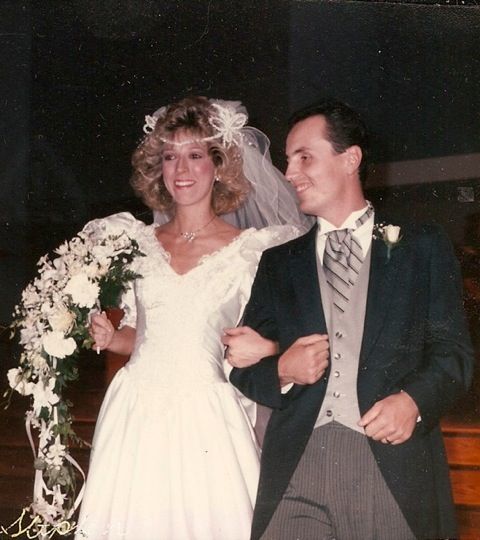
Twenty five years ago today, I left my father and mother (and my mother’s cleaning service via UPS) to join my wife Denise in marriage.

Short of what Jesus did on the cross for me and my family, my wife has been my greatest blessing.

While she was pretty impressive at the time we married…my friends who knew me from my high school days were more than a little surprised at how well I did with a very rudimentary set of social skills…she’s far more impressive now because of her willingness to allow God to work through her.

My ability to do the stuff I’ve been able to do in my work life and through Key Ministry has been grounded in the foundation she’s helped lay for our home. She does a fabulous job of modeling for our kids what it looks like to live out the Gospel gracefully. From the time they’ve been young enough to remember, they’ve seen her extending hospitality to those in need, serving in church, and volunteering for (and leading) organizations dedicated to serving the vulnerable in society. She was patient while I was away building my career or attending meetings of my own at church. She’s very patient now when I’m spending the evening with my laptop responding to e-mails from patients or developing content for the ministry. She’s made me better. I was struck by Proverbs 31:23…the verse certainly suggests the opportunities I have to lead are built upon her virtue…

Her husband is respected at the city gate,
where he takes his seat among the elders of the land

IMG_0352God’s way works. I believe that God’s intention for the family is for a man and a woman bound together by a common faith in Jesus Christ to be of one mind in raising up their children to honor God and serve His purposes, establishing a spiritual legacy through their influence upon their children and their faithfulness in using their gifts and talents to serve others. Our gifts are meant to compliment one another’s. My wife is patient where I’m impulsive…disciplined with her words when I lack a filter between my brain and my mouth, nurturing when I tend to have rough edges.

I can’t do any better than the author of Proverbs 31 in describing my wife…

An excellent wife who can find?
She is far more precious than jewels.
The heart of her husband trusts in her,
and he will have no lack of gain.
She does him good, and not harm,
all the days of her life.

She opens her arms to the poor
and extends her hands to the needy.

She is clothed with strength and dignity;
she can laugh at the days to come.
 She speaks with wisdom,
and faithful instruction is on her tongue.
She watches over the affairs of her household
and does not eat the bread of idleness.

Her children arise and call her blessed;
her husband also, and he praises her:
“Many women do noble things,
but you surpass them all.”
Charm is deceptive, and beauty is fleeting;
but a woman who fears the Lord is to be praised.
Honor her for all that her hands have done,
and let her works bring her praise at the city gate.

Posted in Families, Uncategorized | Tagged , , , , , , | 1 Comment

Some Assembly But No Expertise Required…Vangie Rodenbeck

IMG_6147colorWe’re pleased to introduce an increasingly prominent voice in the disability ministry field for this week’s segment in our ongoing Faces of the Movement series.

Vangie Rodenbeck wears a lot of different hats…she has a great message to share.

Some Assembly but No Expertise Required

About 18 months ago, a startling distinction began appearing after my name. Rather than letters confirming my degrees, or the title “Princess of All-She-Surveys,” the dreaded designation “expert” was added to my pedigree.

I first saw it when speaking at a national children’s pastor’s convention emblazoned in 60-pointe font on a placard advertising my workshop. After the nausea subsided, I negotiated with the management regarding their choice use of the term “expert.” As it turns out, when approaching some topics, the public cries out for an expert and nothing less; so, an “expert” I would soon become. Now I see it on the Internet and in print media as well: “Vangie Rodenbeck: Special Needs Expert.” Please know that this is not a reaction out of false modesty. I simply think it is ridiculous.

Why does the public cry out for an “expert” before they will listen? Even in our church culture we are designating more and more people as experts in fields of what was once practical ministry. Experts, not only different demographics of ministry, but also in leadership, administration, and marketing flood the Internet in wait for people who will utilize their authorized skills.

The upside of this is that we have access to people who have researched and networked widely, offering Godly counsel and guidance to churches just beginning their journey. The downside is that many churches perceive that since they do not possess that level of expertise, they cannot offer ministry to certain demographics such as children, teens and adults with disabilities. For many churches, unless they can bring an “expert” on staff or at least have a volunteer certified in special education services, they feel ill-equipped to minister at any level to the differently abled. Surely, this requires an expert!

Certification by Fire

I am the mother of a delightful 12-year old boy named Noah. He has a sweet, compassionate spirit that humbles me daily and drives me to full repentance fortnightly. But Noah was different from infancy. Many people regarded him as the sweetest tempered and easiest going baby imaginable. “You got a good one,” they would say with a smile.

And I did have a good one. But as Noah’s developmental milestones began to pass unmet, I began to suspect an underlying reason for his innate quietude. At 3 years of age, my suspicions were confirmed when Noah was diagnosed with autism. At that point in time, I had one objective only – to learn to understand Noah. I felt that if I could ascertain the fundamental aspects of autism that comprised Noah’s behavior and personality, he wouldn’t feel like such a little stranger.

And that was how I began my journey. I simply wanted to comprehend Noah’s differences and, thus, bridge the gap between his neurological deficits and my understanding. Let me say that during our diagnostic period, at no time was I ever offered a class that would certify me as an expert qualified in the development of special needs children. Nor, since then, have I accumulated course hours from any of the books or articles I have read in order to help Noah reach goals and make achievements.

I simply got to know him.

Time Imparts Expertise

One friend gently reminds me that it is all of my experience that lends me the credentials of “expert.” That is quite correct. Time has given me the educational qualifications required to minister to someone quite different than me. As I got to know not only Noah, but the dozen or so other children I began accumulating within our children’s ministry, I built a relationship with each one that led to a rapport which enabled me to appear like an expert in their midst. I looked like an expert, but in all honesty, all I did was love them and get to know each of them.

I am not alone in my fear that the designation of “expert in the field” has been a detractor for ministry. When seeking an interview with a local legend in the arena of respite ministry, I mistakenly reported that I was looking for experts in the area from which to learn. Her response was memorable.

“Honey, I don’t believe in being an expert in special needs children as a group. I believe you become an expert on one child by loving them and learning them. I can’t help you with the rest.”

Instead of citing her degree and 30 years of experience in the special education classroom before beginning a ministry to disabled children and adults, this saint renders expertise as the result of relationship. Instead of assuming the posture of an expert that knows, perhaps we should always be the friend that is in the process of learning.

Rather than experts who have familiarized themselves with a myriad of diagnostic qualities, maybe we should model friendship that takes an interest in people. As an expert, perhaps my best training could be teaching others how to learn that person. What is it like to be them? What do they enjoy doing? This is how to make an effort to identify with them. This is how to spend time with them.

Benjamin T. Conner, in Amplifying Our Witness, writes

“Friendship shows a way of relating to a person with developmental disabilities beyond the medical model of care – an etiology, signs and symptoms, or a technical solution to the ‘problem’ of disability. In the medical model, disability is often characterized in a way similar to an illness; a specific, definable pathology and an individual problem to be eliminated – this model does not address the human, as such…. Christian friendship – the affirming presence of another – transcends relational boundaries of likeness, instrumentality, or social exchange.”

I’m sure that the market for experts will not soon vanish. Maybe they are looking for someone to blame if things go wrong, then they can say, “Well, we called in this expert…”. Perhaps this is just another instance of culture’s influence on God’s people. Israel had a stellar track record of assimilating the values of its surrounding culture. Have we, too, have become a people that place more value in credentials and titles than in the relational message of the Gospel?

***********************************************************************************************************

mg_4469bwVangie Rodenbeck became involved with disability ministry when her son, Noah, was diagnosed with autism at age three.  Through efforts to create an environment where her son could learn about his relationship with God, her ministry and advocacy for children with special needs became intertwined. After completing her B.S. in Christian Ministry in 2008, she received a scholarship to seminary where she completed an M.A. in Contemporary Theology in 2013. Her thesis project, “Disability and The Image of God” continued her desire to meld theology, practical ministry and disability advocacy.

Vangie currently serves as Resource Director for PURE Ministries in Gainesville, GA, in addition to her work as a consultant for Standard Publishing. She speaks at ministry conferences nationally. She and her husband Jason currently share the worship and teaching ministry at Castle Christian Church in Cumming, GA.

Posted in Key Ministry | Tagged , , , , , , , , | 3 Comments

Holistically Serving the Adopted/Foster Child…Inclusion Fusion Library

bethMore and more churches are encouraging families to adopt children likely to have significant disabilities. Beth Guckenberger is one of the most prominent champions of adoption in the church and a fabulous resource to parents as they embark upon their adoption or foster care journey.

Beth and her husband, Todd, live with their family in Monterrey, Mexico where they serve with Back2Back Ministries, an international orphan care ministry headquartered in Cincinnati, Ohio. Both Beth and Todd graduated from Indiana University with degrees in education and between biological, foster, and adopted, are raising nine children. Currently the ministry has operations on three different continents (Mexico, India, and Nigeria). The Guckenberger’s have lived in Monterrey since 1997 and in that time have hosted thousands of guests on the ministry campus.

Beth is the author of Reckless Faith (Zondervan, 2008), Relentless Hope (Standard Publishing, 2010), and Tales of the Not Forgotten (Standard Publishing, 2012). She travels and speaks regularly at women’s and missions conferences, youth gatherings and church services. Her topics include, but are not limited to, orphan care, missions, parenting, marriage/intimacy, and general faith. Her style is story-telling and she draws from her field experience as a missionary and parent of nine children for illustrations to biblical concepts.

Beth contributed a video for Inclusion Fusion 2012…Holistically Serving the Adopted/Foster Child. In the video, she shares some of her experiences dealing with the emotional struggles of adopted and foster children as they adjust to the reality of becoming part of a new family. She did a great job of describing how the adverse childhood experiences of kids available for adoption and foster care contribute to difficulties “doing church” and shares helpful strategies for church staff and volunteers who interact with them at church.

Here’s Beth’s presentation…

Check out Beth’s website to learn more about the impact of her ministry.

***********************************************************************************************************

cropped-key-ministry-door.pngOur Key Ministry website is a resource through which church staff, volunteers, family members and caregivers can register for upcoming training events, request access to our library of downloadable ministry resources, contact our staff with training or consultation requests, access the content of our official ministry blog, or contribute their time, talent and treasure to the expansion of God’s Kingdom through the work of Key Ministry. In addition to our downloadable resources, those who register for our resource kit can view any presentation from our Inclusion Fusion Disability Ministry Web Summits “on-demand”. All of these resources are made available free of charge. Check out our website today!

Posted in Adoption, Advocacy, Families, Foster Care, Hidden Disabilities, Inclusion, Inclusion Fusion, Key Ministry, PTSD, Training Events | Tagged , , , , , , , , , , , | Leave a comment

The enduring effects of trauma and abuse in childhood

shutterstock_376342246Today, I’d like to direct our readers to a landmark study that’s received lots of attention in the larger medical community examining the lasting impact of childhood trauma and/or abuse well into adulthood.

The Adverse Childhood Experiences (ACE) Study was a large study (conducted with funding from the U.S. Centers for Disease Control) of 17,000+ adults who completed screening questionnaires as part of a health evaluation offered through their HMO in San Diego County, California. As part of the evaluation, a survey questionnaire was developed to screen for eight “adverse childhood experiences” (ACEs) including emotional, physical and sexual abuse, household dysfunction, exposure to violence and divorce. The number of ACEs was used as a measure of cumulative childhood stress to assess the impact of such stress on eighteen different health-related outcomes during adulthood. The study hypothesis was that a “dose-response” effect would be observed between exposure to toxic stress during childhood and health status in adulthood. The authors also hypothesized that the integrated nature of our neuroanatomic and physiologic regulatory systems would result in more “comorbid” outcomes…damage from toxic stress would lead to more negative health outcomes including a broader range of organ/body systems as the exposure to traumatic events increased.

The authors used adults with no exposure to toxic stress (0 ACEs) in childhood as the baseline, and compared health impacts associated with 1, 2, 3 or 4+ ACEs. Here’s what they found…

Mental health: For persons with ≥ 4 ACEs, the risk of panic reactions, depressed affect, anxiety, and hallucinations were increased 2.5-, 3.6-, 2.4 and 2.7-fold, respectively.

Somatic health disturbances (eating/sleeping):  The risk of sleep disturbance, severe obesity, and multiple somatic symptoms were increased 2.1-, 1.9-, and 2.7-fold, respectively, for persons with 4 or more ACEs.

Substance Use/Abuse: The risk of smoking, alcoholism, illicit drug use, and injected drug use were increased 1.8-, 7.2-, 4.5-, and 11.1-fold, respectively, for persons with ≥ 4 ACEs.

Sexual Behavior: The risk of early intercourse, promiscuity, and sexual dissatisfaction were increased 6.6-, 3.6-, and 2-fold, respectively, for persons with ≥ 4 ACEs.

Memory Impairment: The risk of impaired memory of childhood was increased 4.4-fold for persons with ≥ 4 ACEs. The number of age periods affected for memory disturbances increased in a graded fashion as the ACE score increased.

Stress, Anger Management, Violence: Adults who had experienced ≥ 4 ACEs were 2.2 times more likely to experience a high perceived stress level, four times more likely to experience difficulty controlling anger and 5.5 times more likely to perpetrate violence toward an intimate partner.

shutterstock_375181315The authors demonstrated (link to graph here) that the number of negative, comorbid health outcomes increased in linear fashion as the number of ACEs increased, and overall, the number of negative health outcomes tripled among adults who experienced 7-8 ACEs compared to adults with no ACEs.

So…what should we make of this?

  • The impacts of childhood trauma and abuse are multiple, and may not fully become manifest until later in adult life.
  • Christians…and the church can have an enormous impact through helping children to grow up in loving and supportive homes that offer protection (to the degree possible) from toxic stress. Aside from the spiritual benefits from growing up in a loving home where kids are exposed to the Gospel, members of the church provide a significant benefit to the public good through providing foster homes and adopting kids without families willing or capable  of providing a safe and nurturing environment.
  • The church also has an opportunity to provide relationships, encouragement and resources to parents who themselves were exposed to multiple ACEs so that they might break free of the multigenerational cycles of abuse and neglect that continue to imprison far too many adults and children in our culture.

Updated March 1, 2016

***********************************************************************************************************

shutterstock_24510829Key Ministry is pleased to make available our FREE consultation service to pastors, church leaders and ministry volunteers. Got questions about launching a ministry that you can’t answer…here we are! Have a kid you’re struggling to serve? Contact us! Want to kick around a problem with someone who’s “been there and done that?” Click here to submit a request!

Posted in Adoption, Advocacy, Families, Key Ministry, Mental Health, PTSD | Tagged , , , , , , , , , , , | 2 Comments

Rebecca Hamilton live on Thursday…CM Connect, Blog Talk Radio

Rebecca IF 2012We’re pleased to announce that our very own Rebecca Hamilton will be joining Vangie Rodenbeck tomorrow at 12:30 PM Eastern time as her guest on Vangie’s Shaping Special Hearts radio program at CM Connect. Rebecca and Vangie will be discussing the topic Training Volunteers in Special Needs Ministry.

Listen to Rebecca and Vangie as they dispel popular “myths” related to training volunteers for disability-related ministries and learn about two amazing resources you can use to train and organize volunteers today.

Rebecca currently serves as Director of Ministry Operations at Key Ministry.  Since joining us in 2006, she has enjoyed blending her Christianity and love for children with the training and experience she has had in the non-profit sector. Rebecca actively serves on the leadership team of the Breathe respite ministry at Fellowship Bible Church in Chagrin Falls, OH.

Click this link to listen in live with Rebecca and Vangie on Thursday, October 3rd at 12:30 PM Eastern time. Callers with questions for Rebecca or Vangie may call in at (424) 258-9286 during their radio program tomorrow.

Hope you and your friends can join Vangie and Rebecca on Thursday, October 3rd at 12:30 Eastern for a Kingdom-building discussion!

***********************************************************************************************************

cropped-key-ministry-door.pngOur Key Ministry website is a resource through which church staff, volunteers, family members and caregivers can register for upcoming training events, request access to our library of downloadable ministry resources, contact our staff with training or consultation requests, access the content of our official ministry blog, or contribute their time, talent and treasure to the expansion of God’s Kingdom through the work of Key Ministry. In addition to our downloadable resources, those who register for our resource kit can view any presentation from our Inclusion Fusion Disability Ministry Web Summits “on-demand”. All of these resources are made available free of charge. Check out our website today!
Posted in Inclusion, Key Ministry, Resources, Training Events | Tagged , , , , , , , , | Leave a comment

The impact of trauma on the developing brain

The potential effects of trauma and abuse on the developing brain and nervous system are powerful and incredibly complex.

shutterstock_189731987

HPA Axis 2Healthy brain development is highly contingent upon a number of highly interrelated neuroregulatory systems that are highly sensitive to the effects of environment and experience.  In some instances, environmental factors influence the expression of genes responsible for proteins affecting neurotransmitter sensitivity and function. In other instances, circulating hormones affect development of critical brain regions associated with learning, memory, impulse control, mood and emotional self-regulation.

The neuroregulatory systems that help us to manage stress throughout life are extremely malleable during the prenatal period and early childhood. Toxic levels of stress during this period affect the development of these neuroregulatory systems in ways that cause those systems to become overly responsive to shut down in response to a wide range of stressors in later life.

Let’s look at how toxic stress affects the development of different systems and structures in the brain…

HPA AxisThe hypothalamic-pituitary axis (HPA): The HPA plays a critical role in the body’s response to stress. The hypothalamus produces corticotropin-releasing hormone (CRH) which stimulates the pituitary gland to produce adrenocorticotropic hormone (ACTH). ACTH acts on the adrenal gland to increase levels of cortisol (see diagram at top of page). Cortisol is a steroid hormone produced in response to a wide variety of stressors. Cortisol mobilizes energy stores and suppresses immune response. Surgeons prefer to operate early in the morning when cortisol levels tend to be at their highest. Long-term elevation of cortisol levels in children (as seen in kids exposed to high levels of acute or chronic stress/abuse) can turn off the glucocorticoid receptor gene (involved with regulation of the long-term stress response of the brain to cortisol) and the myelin basic protein gene, producing the “insulation” of nerve cells that allows for efficient nerve signal transmission. Elevated cortisol levels also cause damage to the hippocampus (below).

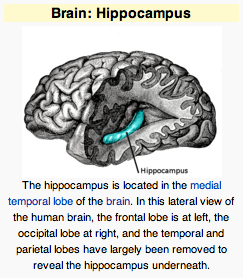
HippocampusThe hippocampus: The hippocampus is a structure that plays a key role in learning by consolidating information from short-term to long-term memory. The hippocampus is capable of growing new neurons in adulthood. Damage to the hippocampus from elevated cortisol levels in childhood leads to impairments in learning and memory.

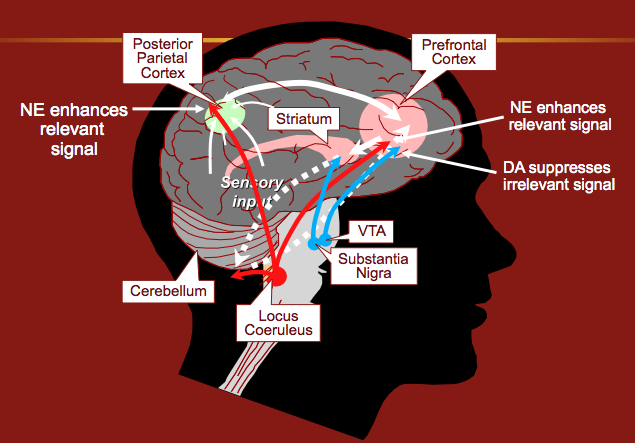
The locus coeruleus/noradrenergic brain systems: The locus coeruleus is a region located in the brainstem where the cell bodies of most noradrenergic neurons are located. This system is involved with regulating the overall level of arousal in the central nervous system. Exposure to stress/trauma early in life have been associated with lifelong increases in noradrenergic reactivity.

NA systemsThe noradrenergic system (along with the dopaminergic system) is the primary system associated with executive functioning. Tracts of neurons originating in the locus coeruleus project to the posterior attention center in the parietal cortex (responsible for scanning the environment for relevant stimuli) and the anterior fronto-striatal system, which is more involved with executive control and focusing attention. The posterior center is primarily under noradrenergic control, while the anterior center receives both dopaminergic and noradrenergic projections. Difficulties associated with weaknesses in executive functioning include poor impulse control, diminished capacity for emotional self-regulation, delaying gratification and problems with working memory. Editor’s note: This may help to explain the increased prevalence of ADHD among kids who have been traumatized or abused along with the observation they are frequently less responsive to medication than kids with ADHD lacking such exposure.

Dopaminergic systems: Numbing, decreased interest in pleasurable activities and difficulties with ability to maintain focus upon a task are associated with pathways mediated by dopamine. Dopamine pathways originating in the midbrain projecting to the medial prefrontal cortex may be especially vulnerable to the effects of acute and chronic stress. These pathways also play a role in selective information processing, working memory, and applying previously learned information to new experiences. Pathways from the medial prefrontal cortex to the amygdala are thought to play a role in mediating the response to fear.

Serotonergic/GABA systems: Alterations in these systems in response to stress/trauma contribute to difficultiess in social attachment and regulation of mood and affect following early stress.

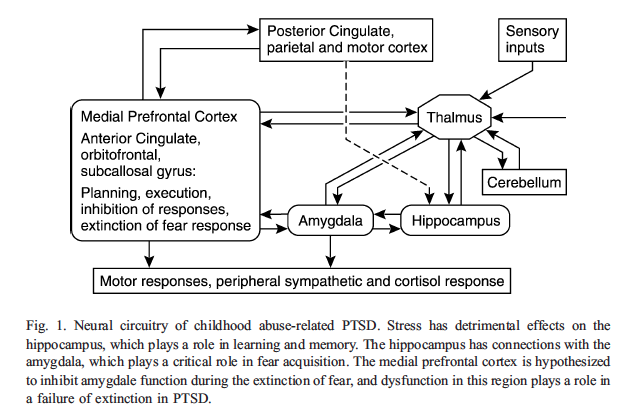
Here’s a diagram from an article in Child and Adolescent Psychiatric Clinics of North America that shows the interrelationship of the different neural circuits involved in childhood PTSD…

childhood abuse PTSD

Bottom line…The neuroendocrine changes that occur in response to trauma in children are widespread, long-lasting, and impact mood, learning, arousal, impulse control, memory, emotional self-regulation, and contribute greatly to future response to stress.

Updated March 4, 2016

***********************************************************************************************************

Causes shutterstock_217708963Check out this series from Jolene Philo on PTSD in children. In her series, Jolene looks at ten common myths about PTSD in kids and shares the most recent information on diagnosis and treatment. Her series is a helpful resource for families caring for kids who have been traumatized or neglected and those who minister to them. Check it out today!

Posted in Adoption, Foster Care, Key Ministry, Mental Health, PTSD, Resources | Tagged , , , , , , , , , , | Leave a comment

Belong to Believe…Libby Peterson

libbyp“We need a new paradigm to reach those families OUTSIDE the church whose lives are shaped by the special needs of their child. We must find ways to BUILD relationships, enter each other’s realities and BRING them into some expression of Christian community – inviting them to BELONG so that they might come to BELIEVE.”

Libby Peterson

The church growth experts of today tell us that 20 years ago most people came to believe central truths about the faith – and that it was that believing that gave them entry into the family of faith. Indeed, even today, mainline denominations are likely to require a confession of faith as part of their membership process. It used to be that one believed FIRST and was then invited to belong.

Today we see the opposite. Members of Generation X and Millennials are coming to believe, not as a prerequisite to belonging, but as a result of it. All over the country followers of Christ are waking up to this new reality. The missional church movement leaders remind us to begin by building relationships with those curious about the faith, to then bring them to some small group expression of community and invite them to belong – all the while trusting that the experience of belonging; of doing life with people who love Jesus will give rise to believing. People who have not professed Christ as Savior are, in effect, being “discipled” into the faith as a means of evangelism! It’s messy, but perhaps it’s a closer approximation to Jesus’s way.

Those first disciples knew very little about Jesus when they were invited to drop their nets and follow Him. And Peter’s bold profession of faith came only after he had spent the better part of 2 plus years with Jesus and that called- out community of brothers.

Belonging leads to believing.

What does all this mean to those of us ministering with families with children with special needs?

First – we can recognize that families with children with special needs – both those “inside” and “outside” of the church are – at best – on the fringe of most expressions of community. If community exists it is likely only to be exclusive – including only those who also have kids with special needs. The bus stop conversations, the pre-game parent gatherings, the first week of school rituals all leave most parents of kids with special needs feeling left out. One friend of mine who has teen and young adult with special needs has shared that she recognized that it’s just plain hard to maintain a friendship with her family – to include them as life moves along. But that does not mean she does not want it, or need it.

Second – we can sound the call:

CHURCH: We have much work to do INSIDE our current paradigm with those who are currently INSIDE our churches. We have work to do to move towards really including families with children with special needs. I don’t mean inclusion programs – the church has advanced significantly here – I mean inclusion in LIFE. Only when we share life – when we take our ministry outside the walls of the church building and practice real Biblical community that includes the parents of the child with autism, the single mom of the teen with bipolar disorder and the adoptive parents whose child suffered significant trauma early in life – will we taste and see some of the Kingdom realities Christ spoke so often about.

And…

Leah and MaryCHURCH: We need a new paradigm to reach those families OUTSIDE the church whose lives are shaped by the special needs of their child. We must find ways to BUILD relationships, enter each other’s realities and BRING them into some expression of Christian community – inviting them to BELONG so that they might come to BELIEVE.

Belonging comes first. Let’s work together and find new ways to build relationships with families with children with special needs who do not know Jesus. Let’s encourage each other to BRING them along to small group gatherings that are open and inviting. And let’s work to remove the barriers to belonging that exist.

The barriers are many – there are physical and environmental barriers that make it tough for a family with a child with special needs to get to church, much less get around in it and have a non-threatening experience. There is work to do here and many, like the folks at Key Ministry are coming up with creative solutions. But I suspect that the biggest barrier to building relationships with families with children with special needs, to bringing them with us and inviting them to belong lies within us and is not confined to the building of relationships with just these families.

Individualism keeps us from community. That cultural lie that tells us not to get involved, that we don’t need others, that we can do life ourselves, that it’s better to go it alone – is most likely our biggest barrier. The authors of The Tangible Kingdom, Hugh Halter and Matt Smay have said it this way: “Our individualism is destroying the powerful counter cultural witness of the church”.

So – Church – let’s keep this conversation going. And let’s go beyond the necessary dialogue. Let’s make this personal.

Here is one small step. If the Lord has you in proximity to a family with a child with special needs who does not know Jesus – in other words – if you encounter this family where you live, work or play – take a small step towards them. Begin to seek God’s help in building a relationship. Invite the mom for coffee, the dad to a sporting event, the child for a play date, offer to grab groceries on your next trip or just call some afternoon to say “Hi”. Trust the Lord will use that relationship for HIS glory – after all Jesus lives IN YOU and as this family grows in relationship with you – they will inevitably begin to see Jesus. Watch for opportunities to BRING them into a gathering of people who love Jesus. Be open to inviting them to belong – and know that it’s in the belonging that people often first come to believe!

If our heart’s desire is to see people come to believe in Christ as Lord and Savior – we must ask – how can we help these people belong? Belonging leads to believing.

***********************************************************************************************************

KM Logo UpdatedLibby Peterson has served Bay Presbyterian Church for 20 years – as Director of Children’s Ministry and most recently as Family Ministry Director. She was instrumental in helping begin the church’s Special Needs Ministry which serves over 30 children and their families. Libby also serves as Vice-President of Key Ministry, where her wisdom, patience and common sense are indispensable to our team.

Posted in Advocacy, Families, Inclusion, Key Ministry, Leadership, Strategies | Tagged , , , , , , , , | 3 Comments

Viewing Mental Illness Through the Eyes of Faith…Inclusion Fusion Library

Stanford_Color_HDIn the aftermath of Rick and Kay Warren’s highly publicized interview last week with Piers Morgan on CNN and the findings of recent research from Ed Stetzer and his team at Lifeway Christian Resources, the topic of mental illness in the church has been a hot topic  in the disability ministry field. For this week’s installment from our Inclusion Fusion Training Library, we’ll linger on the topic by sharing a presentation from Dr. Matthew Stanford of Baylor University and Mental Health Grace Alliance.

For last year’s Inclusion Fusion, Matt presented on the topic of Viewing Mental Illness Through the Eyes of Faith.

Matt’s presentation is designed for anyone interested in learning more about mental illness from a Biblical perspective. Topics covered in Matt’s video include:

  • What is a Biblical and clinical understanding/response to mental illness?
  • How to recognize mental illness
  • The essential role of the church in the recovery and treatment process
  • How to respond to families dealing with mental illness
  • How to create mental health related supportive care within the church
  • Resources to help families navigate the health care system and everyday life

The heart and vision of the Mental Health Grace Alliance is to see the works of God displayed in individuals and families affected by mental illness (John 9:1-3). Matt’s presentation will help equip you and your church to effectively minister and support those living with mental illness.

***********************************************************************************************************

cropped-key-ministry-door.pngOur Key Ministry website is a resource through which church staff, volunteers, family members and caregivers can register for upcoming training events, request access to our library of downloadable ministry resources, contact our staff with training or consultation requests, access the content of our official ministry blog, or contribute their time, talent and treasure to the expansion of God’s Kingdom through the work of Key Ministry. In addition to our downloadable resources, those who register for our resource kit can view any presentation from our Inclusion Fusion Disability Ministry Web Summits “on-demand”. All of these resources are made available free of charge. Check out our website today!

Posted in Inclusion Fusion, Key Ministry, Mental Health, Resources, Training Events | Tagged , , , , , , , , | Leave a comment

Trauma and Kids…a look at the numbers

PTSDWelcome to the third installment of our Fall 2013 blog series: Trauma and Kids…A Primer for Pastors, Church Staff and Parents. Today, we’ll look at the statistics pertaining to the  prevalence of trauma in children. 

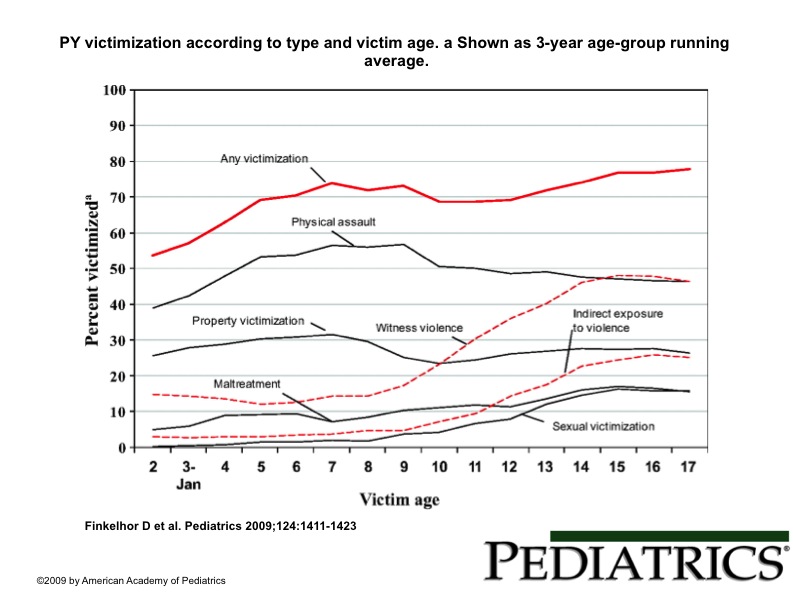
The National Survey of Children’s Exposure to Violence was a Federally-funded survey of 4,549 children between the ages of 0-17, conducted during 2008. Here are some of the key findings…

  • 60.6% of the children and youth in a nationally representative sample had experienced at least one direct or witnessed victimization in the previous year.
  • 46.3% had experienced a physical assault in the study year
  • 10.2% had experienced a form of child maltreatment
  • 6.1% had experienced a sexual victimization
  • 25.3% had been a witness to violence or experienced another form of indirect victimization in the year
  • 9.8% who had witnessed an intrafamily assault
  • 10.2% had experienced a victimization-related injury
  • 38.7% had been exposed to two or more direct victimizations, 10.9% had five or more and 2.4% had ten or more direct victimizations during the study year

Slide1


***********************************************************************************************************

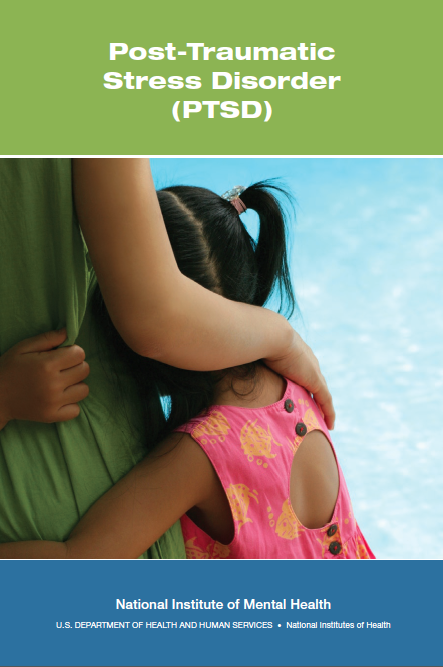
PTSD 2The National Institute of Mental Health has produced an excellent booklet on the topic of Post-Traumatic Stress Disorder (PTSD) in children and adults. The book includes a discussion of the symptoms of PTSD, reviews the use of psychotherapy and medication for the condition, and provides practical advice on where to find help and how to help others who may be suffering from PTSD. Download the book here.

Posted in Advocacy, Hidden Disabilities, Inclusion, PTSD | Tagged , , , , , , , , , | 1 Comment