TWO disability ministry training events in Northeast Ohio in February…

SNC_Form-01We’d like to invite our friends across the Midwest and Great Lakes region to join us on February 6-7 for TWO disability ministry training events in Northeast Ohio.

Emily Colson largeBeth Golik and her team at Bay Presbyterian Church asked us to help them put together a conference…and what a conference they’ve put together! On Saturday, February 7th, attendees will have the opportunity to experience worship together, check out featured presentations from myself and Barb Newman, along with a keynote presentation from Emily Colson (pictured at right) at BPC’s inaugural Special Needs Ministry Conference at Bay Presbyterian Church in Bay Village, OH.

Breakout sessions will offer content for teachers, volunteers, pastors, ministry leaders, and anyone who has a heart for learning more about the inclusive church and classroom. Attendees will have the opportunity to choose from sessions (tentative list…more may follow) led by…

Dr. Cara Daily (Inner Health Ministries) on communicating abstract spiritual principles with kids and teens with autism spectrum disorders

Beth Golik (BPC) and Libby Peterson (BPC/Key Ministry) on two different models of providing respite care to families of kids with disabilities.

Carrie Lupoli (Key Ministry)…topic to be announced

BarbNewman1April2011Barb Newman (CLC Network, pictured at right)…topics to be announced

Ryan Wolfe (First Christian Church, Canton, OH) on partnerships between churches and community agencies serving the disability ministry community.

Participants will have the opportunity over lunch to connect with table hosts involved with areas of disability ministry that most interest them.

The Northeast Ohio Special Needs Conference is being offered FREE of CHARGE thanks to the generosity of Bay Presbyterian Church, but registration is required. Click here for more information and to access the online registration form.

In addition to BPC’s Special Needs Ministry Conference, we at Key Ministry would like to extend an opportunity to attendees traveling to Greater Cleveland for the conference or those leading/planning to launch disability ministries in the coming year to join us at Bay Presbyterian Church on Friday, February 6th for a unique and more intimate event from 1:00 PM to 4:00 PM for a unique and more intimate event.

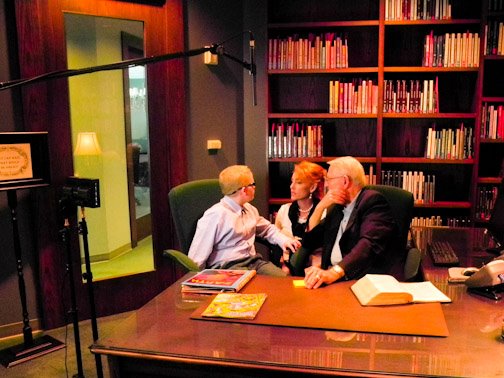
Key Talks Orange BlueBarb Newman is coming to town early for a live videotaping of training we plan to offer on our online platform in 2015 as part of our “Key Talks” disability ministry curriculum. In addition to talks we’ll be filming with Barb for our training curriculum on Including Kids with Sensory Processing Issues at Church and Including Kids Who Struggle with Social Communication at Church, Barb will also be filming a comprehensive presentation in which she discusses how to start an inclusive Sunday morning ministry from the ground up to be made available at a later date through CLC Network.

We anticipate some “down time” during the video shoot during which attendees will have opportunities to interact with Barb in a far more intimate environment than is usually available at the major ministry conferences where she’s invited to speak.

There’s a separate registration required for Key Ministry’s event with Barb Newman that you can complete hereregistration for Friday will be limited to the first 25 participants.

Hope to see as many of you as possible at Bay Presbyterian Church in Bay Village, OH on Friday, February 6th and Saturday, February 7th!

***********************************************************************************************************

Kindrid Instructional SlideKey Ministry depends upon financial support from individuals and churches to continue to provide FREE consultation, training, resources and support to churches seeking to minister with families impacted by disability. Giving to Key Ministry has never been easier! Just text the dollar amount you’d like to give to (440) 337-4338, and your donation will be made securely through software designed by the folks from lifechurch.tv who designed the “Bible” app you probably use on your smartphone or tablet.

Please consider a gift to Key Ministry as you consider your year-end giving!

Posted in Inclusion, Key Ministry, Resources, Training Events | Tagged , , , , , , , , , , , , , , | Leave a comment

Can God use our anxiety for good?

I’m honored that Rhett Smith, the author of a very timely and thoughtful new book, The Anxious Christian: Can God Use Your Anxiety for Good? agreed to be the subject of a guest interview that was featured on the blog from March 4-11, 2012.

Rhett is a Licensed Marriage and Family Therapist (MDiv, MSMFT, LMFT) at Auxano Counseling in Plano, TX and is on staff at The Hideaway Experience, a four-day marriage intensive in Amarillo, TX. He has been working in a variety of ministerial and counseling contexts since 1998 providing pastoral counseling and therapy to individuals, couples, families and groups. He served as the college pastor at Bel Air Presbyterian Church in Los Angeles from 2001-2008, and provided all the parenting classes for the parents of Highland Park Presbyterian Church in Dallas from 2008-2011. His areas of specialization include marriage and family, anxiety, adolescent & young adult transitions, social media and technology, spiritual direction, and pastors and their families.

In addition to being the author of The Anxious Christian, Rhett is a contributing online journalist to Youth Specialties and Fuller Youth Institute, as well as writing articles for Collide Magazine, Start Marriage Right, etc. He also co-authored Outspoken: Conversations on Church Communication and The New Media Frontier where he wrote on the topic of “New Media Ministry to the MySpace-Facebook Generation.

You can read his blog at www.rhettsmith.com.

Rhett earned his Master of Divinity and MS in Marital and Family Therapy degrees from Fuller Theological Seminary in Pasadena, CA. He is a member of the The American Association of Marriage and Family Therapists, The Texas Association for Marriage and Family Therapists, and The Dallas Association for Marriage and Family Therapy. He lives in Frisco, TX and enjoys traveling and spending time with his wife and two children. He is also an avid distance runner who is always training for the next race. Here’s Rhett…

SG: The title of your new book suggests you see ways in which God uses our anxiety for good. How do you address this concept with people who are prone to misinterpret ongoing anxiety symptoms as a reflection of inadequate faith or a lack of diligence in practicing spiritual disciplines, especially prayer?

shutterstock_129267833RS: This is such a great question, and I wish I had one answer for it. But I’ve found that because anxiety seems to be unique to each person (how it manifests itself), I have to pay real close attention to the individual and the context of the situation. But I believe that the most important place to start in cases like this is with the Bible since most people come with preconceived ideas or notions about what the Bible says about anxiety. They’ve been told that the Bible says don’t be anxious (and that is true, but there is more to that), and that they just need to pray more, or have more faith. So I like to begin by looking at stories in the Bible since everyone connects with stories in our narrative driven culture. And in therapy we may unpack the story of Abraham and Isaac for example and explore the anxiety that is implicit in the text. Interestingly enough, it was reading Soren Kierkegaard’s work Fear and Trembling for the first time at 23 that I began to rethink the idea of anxiety and how it plays out in our faith. Kierkegaard’s entire book talks about Abraham and Isaac and the role of anxiety in the the text. Or we might explore the story of Noah and the anxiety that it must have experienced trying to build an ark in faith. Or the anxiety that Jacob felt when he first encountered his brother Esau for the first time after betraying him. Or we look at the life and ministry of Jesus, especially his journey to the cross and the anxiety in those scenes. I believe the Bible is implicit with anxiety and that is part of our condition as not only humans, but especially as followers of Christ. So there is a sense that I first try to help someone normalize their feelings of anxiety.

shutterstock_158472119I also think that one of the things that keeps people mired in anxiety in an unhealthy way, and that keeps them from looking at it as an opportunity for growth is the idea of shame. When we judge someone’s faith or spiritual life because of their anxiety, we ultimately push them into a place of shame. Shame drives people into hiding and not seeking and getting the help they need. I have been most helped by a counselor friend of mine Todd Sandel (www.lifegatecenter.com) when he distinguished between shame and guilt for me. Guilt is the belief that I have done something wrong, but I can be forgiven for it. I can make amends. Shame is the idea that I have done something wrong, therefore something is wrong with me. I’m a bad person. I want to help clients see anxiety as not a shame issue, and not a judgment of their character or identity.

I also like to point out to people that there is no command in the Bible that our spiritual life has to consist of a 45 minute Evangelical quiet time each morning. Or that their prayer life has to look this way and use these exact words. Rather there are lots of examples in the Bible of how people connected with God. It might have been through worship, or prayer, or retreating to quiet space, or using a model of prayer like the Lord’s Prayer. I try to free people up to experiment with options. I like the word experiment because it doesn’t imply a certain formula that needs to be followed and if not done correctly, you are wrong. Experiment implies the idea of trying out different things and seeing what works and what doesn’t work. And then having the freedom to keep experimenting or sticking with something for a while.

This is hard work to help people overcome the shame they have felt over the anxiety they have been carrying for a long time. So it takes time, but I think we can make progress as a Christian community if we can continue to uphold a different model, or way of thinking about anxiety than one has always had. It’s a process in my mind of helping someone re-imagine their anxiety.

SG: In the book, you openly discussed your own personal struggles with anxiety as a child, following the loss of your mother. Looking back, how do you think your experience of anxiety hindered your spiritual development as an adolescent and as a young adult? How did your anxiety help you mature spiritually?

shutterstock_116109031RS: Yes, I’m very open about the loss of my mom from breast cancer when I was 11 years old. She was diagnosed when I was six years old, so it was quite a long and anxious journey before she died. Her death was proceeded by the death of her mom (my grandmother) to breast cancer, and was followed by the death of her sister (my aunt) to breast cancer. Breast cancer runs in our family and has created a lot of anxiety, and continues to cause a lot of anxiety for newer generations.

I think that the anxiety hindered my spiritual development in several ways. One way is that I set up God as this God who punished people for something they did wrong. And so the way to appease God was to make bets with him and make him happy. My mom didn’t do anything wrong, but I thought that perhaps I did, and so maybe she died because I didn’t do something right. So I kept God at arm’s length, fearful of him, but I also needed him so I could make bets with him and try to appease him. It was very confusing, and I didn’t feel safe with God in the way that I think He desired for me.

I think that it also hindered my spiritual development in terms of my identity. If God really created me for a purpose, than I thought he must have really screwed up with me since I was now stuttering and unable to read after my mom’s death. I didn’t learn this till later, but death can create such trauma that it can lead to issues like stuttering. So I felt less than. I felt like God really couldn’t use me to do great things for him. So spiritually speaking, I just really wondered if God could use my life and that hindered my ability to really open myself up to be used by him.

shutterstock_166070729Anxiety also hindered my spiritual development in that I was so anxious a lot, and fearful to stutter around others, that I tended to withdraw at times. That withdrawing left me feeling isolated, alone and abandoned. I don’t want to paint the wrong picture here. I had lots of friends and played sports and participated at church, but inside I felt alone and was in a withdrawn place mentally. So at a time in my life when I really needed to feel connected and invite people into that lonely space, I tended to keep people at a safe distance. That’s hard in adolescence, because that’s such an important time in life for connection and community.

Now here come the paradoxical shift for me. Anxiety helped me mature spiritually at some point because as I opened myself up to God I kept hearing him calling me to do things and participate in things that required me to face my own anxiety. So ultimately, the very anxiety that hindered me spiritually early in life, would later be the siren that beckoned me to follow hard after Him and face my fears. It came to me in several stages, but the real first moment was when I made a promise to God in prayer. I told him that if he gave me the opportunity to speak (face my greatest fear of stuttering in front of others), I would take it. And like two days later I got a call from my college chaplain’s office to preach at the Easter sunrise service. I immediately said no, but upon hanging up the phone, I realized that I had prayed for that opportunity earlier in the week. So on April 7, 1996, almost 20 years to the date after my mother’s death (April 20, 1986), I stood up in front of my college classmates and preached on resurrection. That was the day that God resurrected my anxiety. And that would continue after that and continues on today.

SG: You served for a number of years as a college pastor at Bel Air Presbyterian Church and more recently, you taught parenting classes at Highland Park Presbyterian Church. Do you see anxiety as a significant barrier to church attendance and participation for teens and young adults? What advice do you give parents when their kids struggle to attend worship services, participate in small groups or participate in retreats and special events because of anxiety? How would you help adults when anxiety becomes a barrier to them finding a church or becoming more involved at church?

shutterstock_203091910RS: I’m not sure if I have ever really seen anxiety as a significant barrier for teens and young adults. But as you asked this question and I have thought more on it, I think it has, but in not ways that are always that obvious. I think one can have anxiety, but still comes to church. But anxiety will keep them from maybe doing things like getting baptized for fear of being up front. Or from taking a mission trip because of fear of the unknowns. Or fear on coming to a small group for fear of being asked about their faith and not knowing what to say. So I think that anxiety doesn’t necessarily act as an initial barrier to going to church, but will act as a greater barrier as more and more opportunities arise for them in church. Then they are faced with the decision to face their anxiety or not. But I know there are more extreme cases of anxiety, things like panic attacks, where one maybe can’t even get to church. Also, I owe a lot to Adam McHugh and his book Introverts in the Church on this topic. Great, great book and a must read for anyone in church….especially leadership. But I wonder how many people are introverted in nature and have a mild anxiety about participating in a very extroverted culture like church. So something like raising hands in worship, doing a crazy high school skit, shaking hands with someone new before church, or being in a small group can raise anxiety and be huge barriers for people in Jr. High, High School…..and really, all ages.

I was asked by a parent last Sunday about what advice I had for a kid who didn’t want to go through confirmation. Ultimately I didn’t have great advice. But what I told them was this. And this mainly comes from my youth pastors friends who are more seasoned in youth ministry than I am. My friend Neil Gatten in particular from La Casa de Cristo Lutheran Church helped me with this. Give your kids some freedom in their choices spiritually. If you don’t empower kids to make choices in life, then you haven’t set them up for success when they leave the nest. So it might look something like, “We expect/want you to go to church with us on Sunday, but it’s up to you if you want to go on Wednesday nights, or attend events?” I think that’s real important to give choice and freedom here. Also, I think when it comes to anxiety (and let’s assume we don’t know if anxiety is at the heart), we need to talk to our kids. Ask them why they don’t want to attend? What’s going on with them? Get below the surface. Ask them about their fears of being at church, or what they worry about. I told the mom who asked me about confirmation this. I told her that if I was faced with confirmation as a kid, I would have wanted to get confirmed. But I would have had so much anxiety about having to read catechism stuff out loud in my class that I would have done anything…..even rebelled to the point of getting kicked out of the class….to avoid the fear of having to read out loud and being embarrassed when I couldn’t, or when I stuttered. So maybe there are anxious reasons under our kids’ reasons for not wanting to participate in church. We need to figure out creative ways to explore those. And if we can’t, help find someone who can.

Since I believe we ultimately grow by facing our anxieties, I think that I would help an adult by SLOWLY, moving them towards opportunities that they desired to participate in, but had anxiety about. I also think I would find 1-2 people that they could confide in that would be a helpful community for them at church. That connection goes a long way in helping people face anxiety. I also would explore whether or not the community they were in was the right community for them. Putting commentary aside on our church shopping and want driven church culture, not every church is the right “fit” for us. If I’m someone who is anxious a lot, or more introverted per se, I may not feel a sense of belonging in a more charismatic church. I might want to explore faith in an Anglican community for example, or a community that practices more solitude, space and has liturgical practices that are more communal driven than individually driven. This could be a whole other book, but our temperament and the way God wired us may have us exploring a different faith community than the one we are currently in.

Ultimately, adults can better face their anxieties when they know they aren’t going to be judged, the shame is removed, and they have a community of people around them who support them and walk through life with them. Maybe as leaders in the church, we as well have to rethink how we approach, work with, and welcome people into our midst who are struggling with anxiety. It’s a two-way street.

SG: What recommendations would you make to pastors and church staff members who want to create welcoming and inclusive ministry environments for kids and adults who struggle with anxiety?

Padilla Video ShotRS: I think this begins by first education pastors and church staff members. For example, I knew that I was somewhat introverted, but I didn’t realize the exclusion that many introverts feel in a church until I read Adam McHugh’s book. So that was an education for me. And I wish I had read that book before I began pastoring because I think I would have made more intentional space introverted type people than I did. So educating people because I thin there needs to be a paradigm shift in our thinking.  As we educate pastors and church staff members we have to help equip them to have hearts, eyes, ears, minds, souls, etc. to see people who are struggling with anxiety. Because we can educate all we want, but if we don’t help them see people differently, and get below the surface of what is going on, then all the reading won’t help.

I would train leaders to create spaces and groups and communities in churches where anxious people are welcome. To do this I might eliminate things that might make a person anxious. Like getting up front to give a testimony. I might not require small group participation. But here is the catch…..lots of people face their anxiety by getting up front at some point and sharing their testimony (perhaps about anxiety), and small group connection is a good source of help for people who are anxious. But I think we eliminate immediate barriers and as anxious people become more comfortable in a setting, we implement stuff that helps them grow and face their anxiousness.

I think it’s probably a lot to ask a church to change a lot of stuff to make an anxious person feel welcomed. So I think we have to rely on individuals and ministries to come alongside people and minister to them. I also think, as I said above, some faith communities probably lend themselves better to people who are anxious. And so we might have to help direct people to places and churches that aren’t ones we participate in and help them find a place where they can be all that God has created them to be.

One time when I was in grade school at VBS I was called upon to read. And I couldn’t read…I stuttered my way through it. Clearly the teacher knew this. Why didn’t they pull me aside to see what was going on? Why didn’t they ask if I wanted to read at all? I think there are some things we can do better like noticing a kid who is anxious, and coming alongside of them and just asking them how we can better help them navigate life, church community, etc.?

And as I ramble on this question I’m faced with the fact that this is a hard question to answer. I would start with just dealing with the stigma of anxiety in the faith community. The stigma that allows many people to judge other’s faith because they are anxious. So we as a Church have to eradicate the stigma of anxiety, and if we can make progress there, than perhaps we will find people in the faith communities we participate in, helping those with anxiety in ways that we could not imagine. If we can even have an open discussion about anxiety…and if we can even get a few people at a time to rethink their view of anxiety….that is a win in my opinion. It’s slow, tedious work, but I believe it will make an impact.

SG: You’ve written extensively about the use of new media in ministry. How do you foresee churches using electronic ministry to better serve the needs of youth and adults with anxiety?
STEP TWORS: This is a real interesting question because I haven’t really thought much of it from that perspective. I’ve done some ministry with LifeChurch.tv (www.lifechurch.tv) in the past, and they are essentially the leaders in the online space. My friend Tony Steward was their first online pastor, and the first person I know of to hold that position. Now lots of churches are starting to do that. I’m wrestling with how we live as an embodied community in the flesh, but also take advantage of all the online tools that are out there. I think that a person could perpetuate their anxiety in unhealthy ways by relying on online tools, or by only watching services online from their home. But again, that could be a great entry point to get connected to a faith community when a person may never step foot in a church. So maybe the new media tools are a good way to lower the initial carries and as we do that, we need to think of creative ways to use the tools that allow people to come out of hiding or the shame they feel, and enter not only to online community, but in person, face-to-face community. I see the tools helping aid people with anxiety, but not as the ends in and of themselves. They are rather the means to help us come alongside people with anxiety. This is a huge issue in the church, and I am at the point where I can be swayed in several different directions. I use tons of tools online and they are amazing. I met some of my best friends in Dallas on Twitter and FB and my blog when we moved here. But I desired to move offline and meet up with them for coffee and lunch. So the tools were the catalyst that helped me connect and face my anxiety and move towards a face to face in person connection. But they weren’t the ends in themselves. I still use the tools to connect with my friends online, but I also meet with them in person. They aid and benefit each other.

I could envision a scenario where a kid might be socially anxious and have a hard time coming to church or attending a more intimate setting like youth group. As the pastor, rather than trying to just get them to show up to events. I might begin a journey of chatting on FB with them because that is a much easier medium for people who are anxious to communicate on. The more and more I chat with that kid, the more and more they hopefully feel safe, and trusting of me. As we build that trust and relationship I may ask to meet him for lunch. And as we meet more regularly for lunch, I may ask him to meet me up at church one day, etc. etc. It’s a slow progression and we have to be patient. Discipleship doesn’t happen overnight, and neither does this.

On the flip side, I think it’s important that I also state that social media and technology use is also a great source of anxiety for many people. There is lots of research being done on the rewiring of our brains through the use of technology, and how our open lives on Facebook have created a sense of anxiety in kids as they look at their friend’s lives online, and wonder why their lives aren’t like that. I have worked with kids in counseling who become anxious because they aren’t invited to all the parties that their friends are invited to, and they see all the photos on Facebook. I know of girls who struggle with anxiety and eating disorders because they feel like their body image doesn’t match up with the ones they see online. So technology can create anxiety, and we can feel it when we aren’t constantly plugged in as well. So as we use technology to help people who are anxious, I think we have to ask the right questions regarding how we use it and why we use it.

I think that social media can be a great platform for people to talk about anxiety, and to have a more open discussion on the issue. My own hope is that my book, and the discussions that occur online can help open the topic, and help eliminate some of the stigmas we have about anxiety. So technology could be a great front line tool for us to look at the issue and discuss it.

SG: What’s the most important takeaway for church leaders seeking to minister more effectively with persons who struggle with anxiety?

The most important takeaway I believe is this. We are all anxious. We all will and do experience anxiety. Anxiety is part of our human condition. With that being said, I believe that God uses our anxiety as a tool to help us grow. It’s a catalyst that keeps us from getting stuck, as it propels us to continually follow God. I think church leaders could best help others by reframing anxiety as a positive aspect in our lives when we pay attention to it and respond properly to it. ‘What is God saying to you in your anxiety’ is a great question in my mind. As church leaders we just have to do a better job of pastorally caring for people…that takes time…that takes relationship. Something many church leaders don’t have or don’t make time for.

***********************************************************************************************************

Rhett’s new book, The Anxious Christian: Can God Use Your Anxiety for Good? is available in paperback and Kindle editions through Amazon.com. You can read his blog at www.rhettsmith.com.

Key Ministry’s blog series examining the impact of anxiety upon spiritual development in kids, along with additional resources to better understand the impact of anxiety disorders in children and adolescents may be accessed here.

Originally published in March, 2012

Posted in Anxiety Disorders, Families, Inclusion, Key Ministry, Mental Health | Tagged , , , , , , , , , , | 1 Comment

A journey of faith…Guest blogger Cathy Blatnik

Blatnik'sCathy Blatnik had contacted us following Inclusion Fusion wanting to share a wonderful story involving her ten year-old son (Dominic) with autism and ADHD. We thought Dominic’s story was very appropriate for Thanksgiving week. Here’s Cathy… 

At one time, having Dominic make his First Holy Communion was something that I could only dream about. On May the third, it became a reality.

Every few months, since Dominic was three, the hubby would ask me, “so, when are we going to sign Dominic up for religious education classes?” I kept putting it off, because at the back of my mind, I knew that a class geared towards children with special needs would be a better “fit’ for Dominic.

I was able to put the hubby off until about the middle of 2012. After talking with the director of religious education at our church, we registered Dominic for a class, so he could begin the process of making his First Holy Communion. As the day of the first class loomed closer, my anxiety was off the charts. I knew in my heart of hearts that Dominic really need to get started with classes, but I also knew that a class with more than five kids would be overwhelming for him.

About a week before that class was to start, I received an e-mail about a special needs religious education class starting up in a neighboring parish. The Saturday before the class at our church was supposed to start, I got an e-mail from the amazing woman that would be Dominic’s teacher. She told me the class would only have five kids and it would be two years of preparation and then they would make their First Holy Communion.

040His first class was at the very end of September where all the children and parents got to know each other. A lot of preparation went into getting all the children ready for their First Holy Communion. Just putting together a nice outfit for Dominic to wear was a challenge in itself 🙂

My husband and another dad each did a reading and the mom to two little girls in the class did the prayer petitions. I loved that each family could contribute special prayers. Dominic and his classmates brought the gifts up to the altar. He was responsible for handing a special cloth to Father L. Since we hadn’t practiced that with Dominic, he tossed it to Father L. and said, “here you go!” Father L. caught the cloth, said, “oh, thank you” and continued on without missing a beat! Dominic was the first of his classmates to receive Communion and we went up with him. We were so proud of him, he knew exactly what to do:

033After he was done, each child went up individually with their family members surrounding them. It was an incredibly moving experience. I’m sure Lauren and I weren’t the only ones holding back tears. Here is the hubby congratulating Dominic on a job well done!

Later, we had some delicious cupcakes that his teacher had made – they were really yummy!

So much credit goes to his teacher and her assistants. Mrs. W. is so loving, patient and kind. She truly has a “gift” for teaching!

I recently joined a group called, “Our Lady of Grace Special Families Ministry.” Many parents (including me) feel that it can be very overwhelming to take a child or adult with special challenges to a place of worship. A major thing on the agenda is having a once-a-month Mass for children and adults with special needs. I feel that it can be done – I have faith!

Cathy Blatnik grew up in Maryland, but moved to Michigan in December of 2001. She was raised a Catholic, then became Lutheran, then when she married her husband, she became a Catholic again. She currently attends St. Martha’s Catholic Church in Okemos, Michigan. She has a stepson (30), a daughter who is currently a college freshman and a 10-year old son (Dominic) with autism spectrum disorder and ADHD. Cathy is a co-chairperson of the Our Lady of Grace Special Families Ministry in the Diocese of Lansing. She feels blessed that she has been a stay-at-home mom since 1996. She blogs at Bountiful Plate.

***********************************************************************************************************

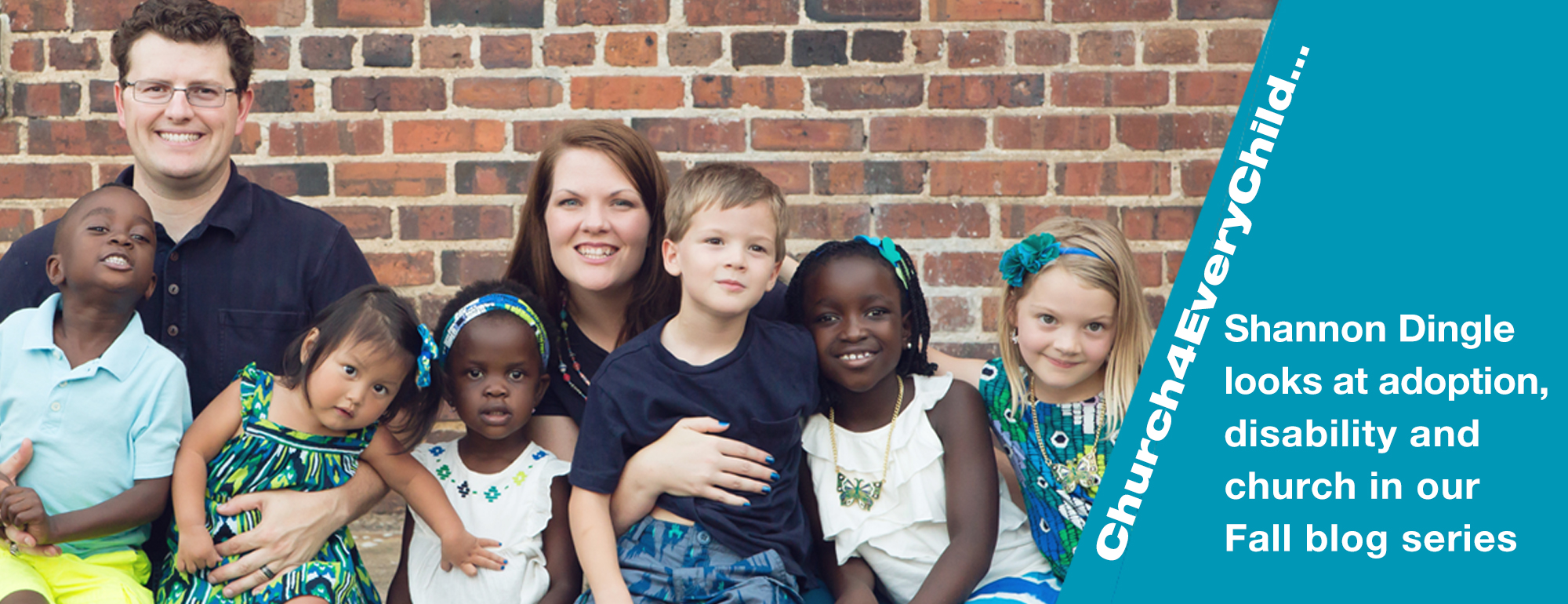
2000x770 S DINGLE CHRCH4EVCHILD 2Check out Shannon Dingle’s blog series on adoption, disability and the church. In the series, Shannon looked at the four different kinds of special needs in adoptive and foster families and shared five ways churches can love their adoptive and foster families. Shannon’s series is a must-read for any church considering adoption or foster care initiatives. Read it here.

Posted in Autism, Inclusion, Key Ministry, Stories | Tagged , , , , , , , , | Leave a comment

Time, talent and treasure

shutterstock_183315431My favorite memory from this year’s Inclusion Fusion Web Summit occurred on Wednesday evening. We were sending out personal invites to the worship service featuring Jeff Davidson’s message, and in going through my Facebook friends, I came across person after person who had made an essential contribution to the work of our ministry. It was overwhelming to remember the ways in which so many have contributed to the work of Key Ministry.

For us to do the ministry we do with a relatively limited budget, it’s absolutely essential for our supporters to contribute their time, talent and treasure in support of the mission. Next to the privilege to participate in God’s work, our greatest satisfaction comes from being able to do ministry with other people. We’re offering you the opportunity to honor God while having fun at the same time!

As we finalize our plans for next year, we invite our readers and supporters to “get in the game” by sharing your time…

KM Facebook Screen ShotYou can help us to make online church available for much more of the day by making yourself available as an online host for a designated one to three hour block of time each week, or by agreeing to host an online worship service each week to which you would invite friends and families you know who would be blessed by the opportunity to attend church through our online platform.

You can help us reach more people through serving as part of our social media team. Do you spend lots of time on Facebook? You can help us by “liking, sharing and commenting” on our Facebook posts…the more that followers share and comment on our posts, the more likely it is that that others will discover the resources we post. Spend too much time on Pinterest? Help us by “pinning” our posts.

Have a talent we can use? Do you have experience in fund development? Any experience with intellectual property law? Graphic design? Some other gift set or talent that can contribute to our ministry? We can use you!

shutterstock_60626458Finally, we do what we do literally on a “shoestring” budget. Your financial gifts help to cover the production costs for adding additional online church services for families impacted by disability, allow us to expand the availability of free consultation to more churches looking to serve kids with disabilities and allow us to put on events like Inclusion Fusion that serve hundreds of church leaders and families here in the U.S. and beyond.

Here’s how you can “get in the game.” Click here to let us know a little bit about yourself and how you sense you might be led to lend your time, talent and treasure to our ministry adventures in 2015 and beyond.

***********************************************************************************************************

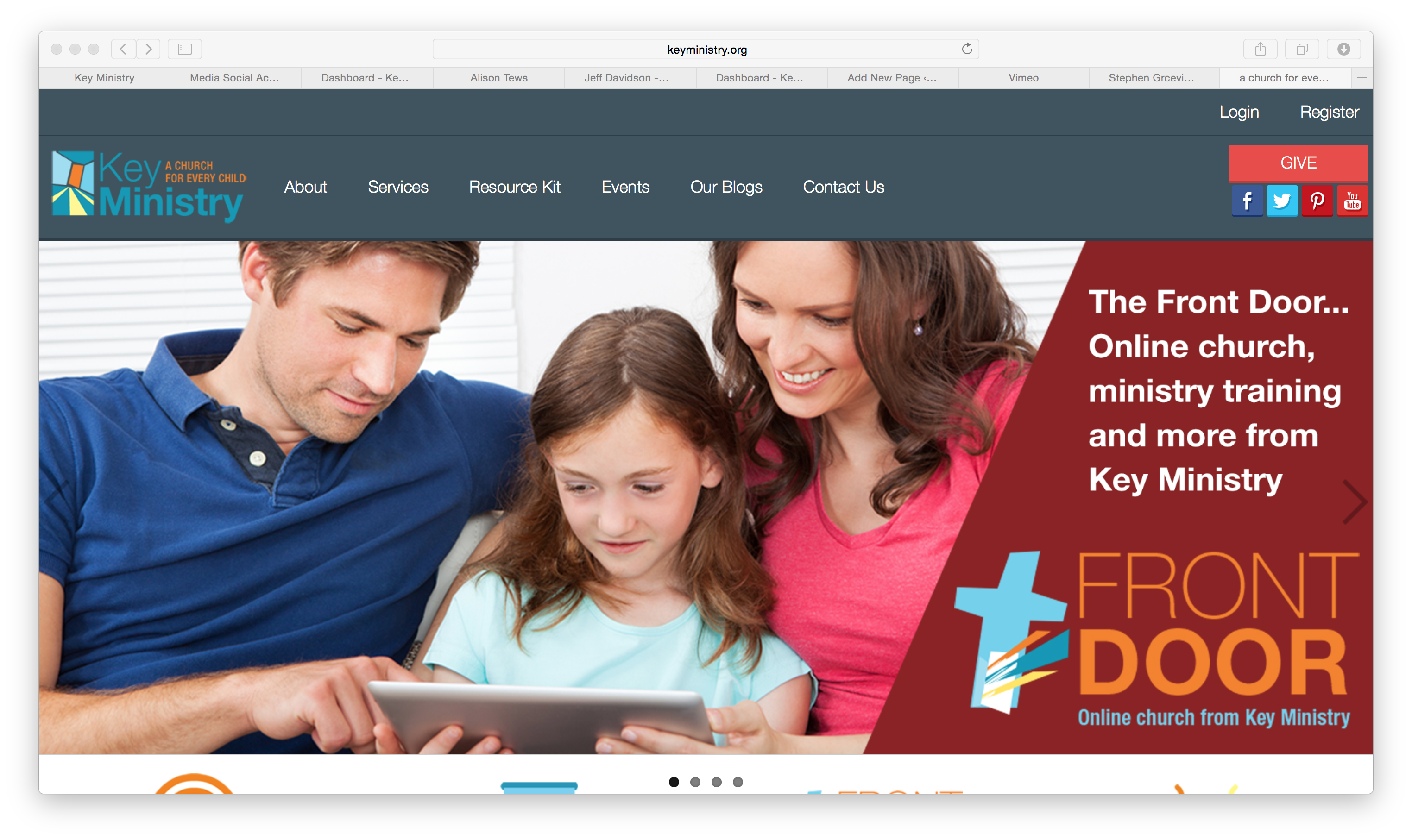
Website screen shotKey Ministry is pleased to invite you to check out our new website. Over 180 downloadable resources are available to pastors, church staff and volunteers seeking to serve kids with disabilities and their families, including all Inclusion Fusion presentations from our first two Web Summits are available with FREE registration. Check out keyministry.org today and share the link with others interested in welcoming kids with disabilities and their families at church.

Posted in Key Ministry | Tagged , , , , , , | Leave a comment

A shocking statistic…

When we were registering our 541 registered attendees for the Inclusion Fusion Web Summit, we included a series of questions to ascertain the interests and experiences of our attendees. I’ll share some interesting things we learned about the people who sign up to do an online disability ministry conference, but one statistic jumped off the page at me.

Among those who registered in advance, we asked the following question:

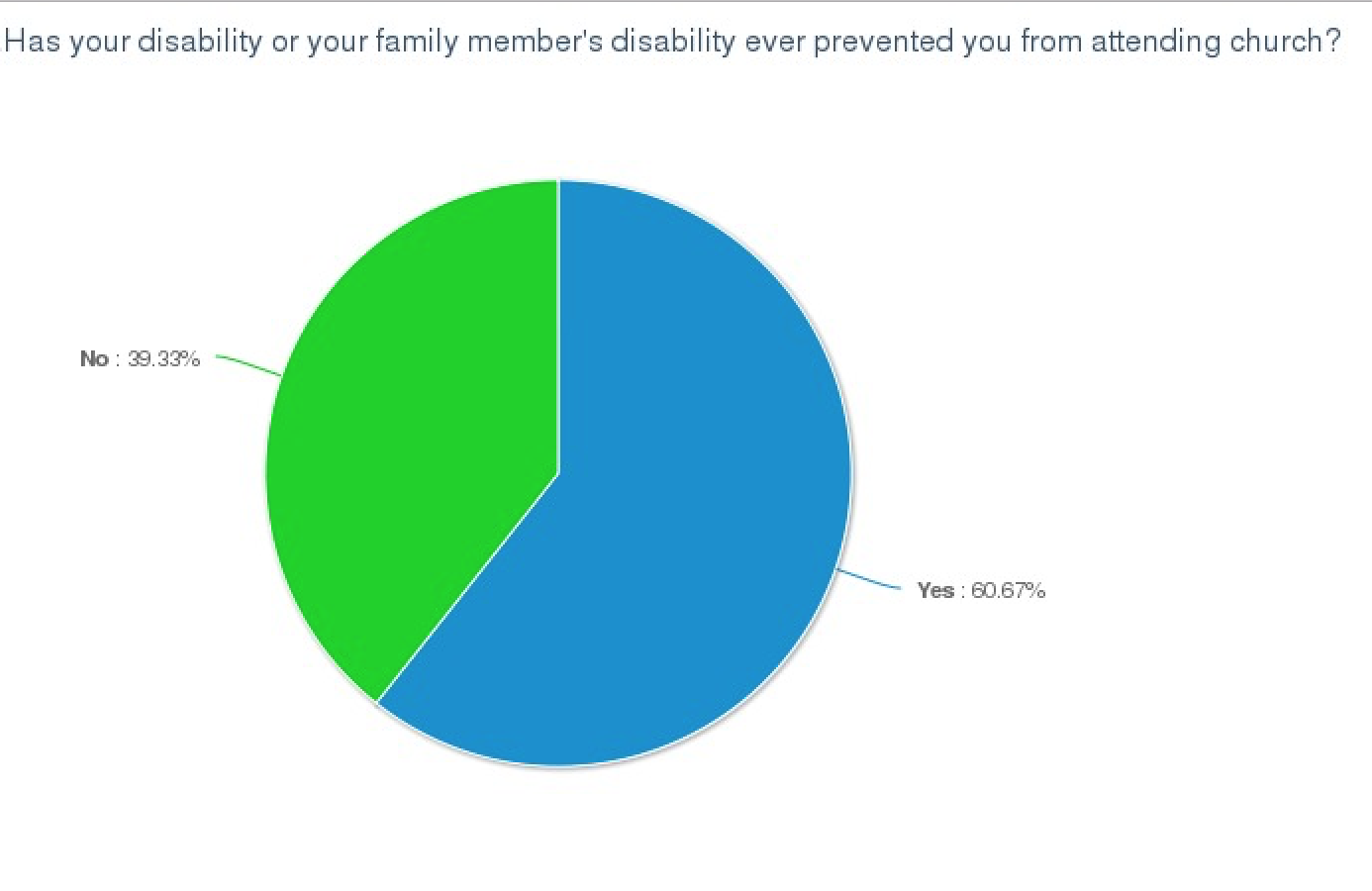
For persons with disabilities and their families…Has your disability or your family member’s disability ever prevented you from attending church?

Can't attend church?

Nearly 61% of our attendees with a disability or a family member with a disability reports the experience of being unable to attend church as a result of that disability.

Does that shock you? Does it bother you?

The people attending the Web Summit are likely a very unrepresentative group, and I wouldn’t consider the group a valid statistical sample, but the answer is especially interesting in light of this…

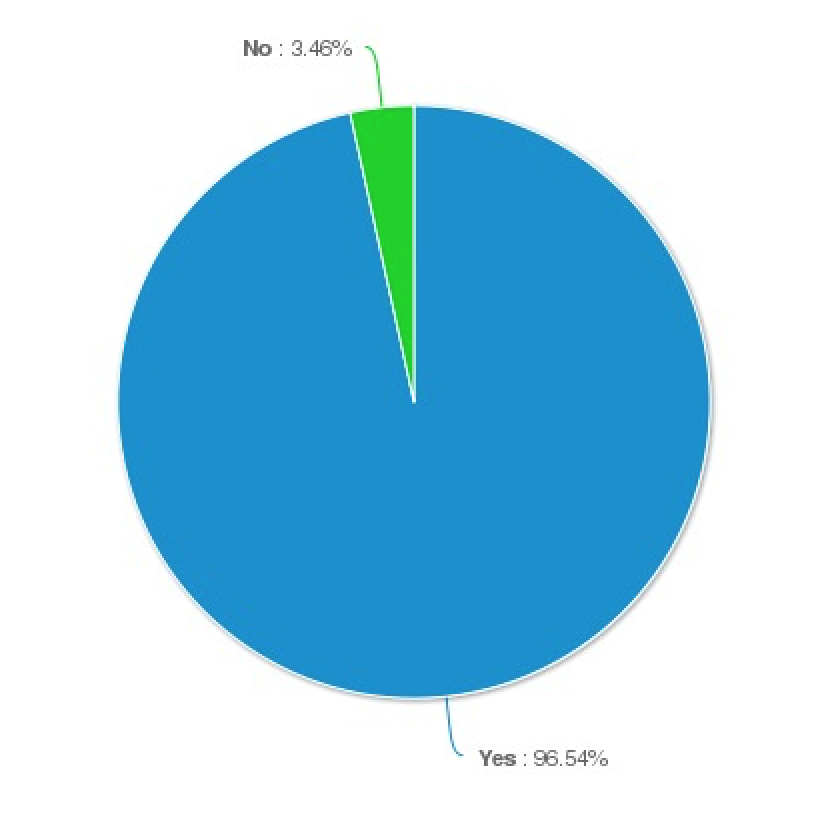
Regularly attend church?This is the response to the question… Do you regularly attend church? (at least once a month)

97% of our conference registrants attend church regularly-not a surprise for a ministry conference. It’s striking that in a group that appears to be highly motivated to attend church, a significant majority of attendees impacted by disability have experienced difficulty in doing so.

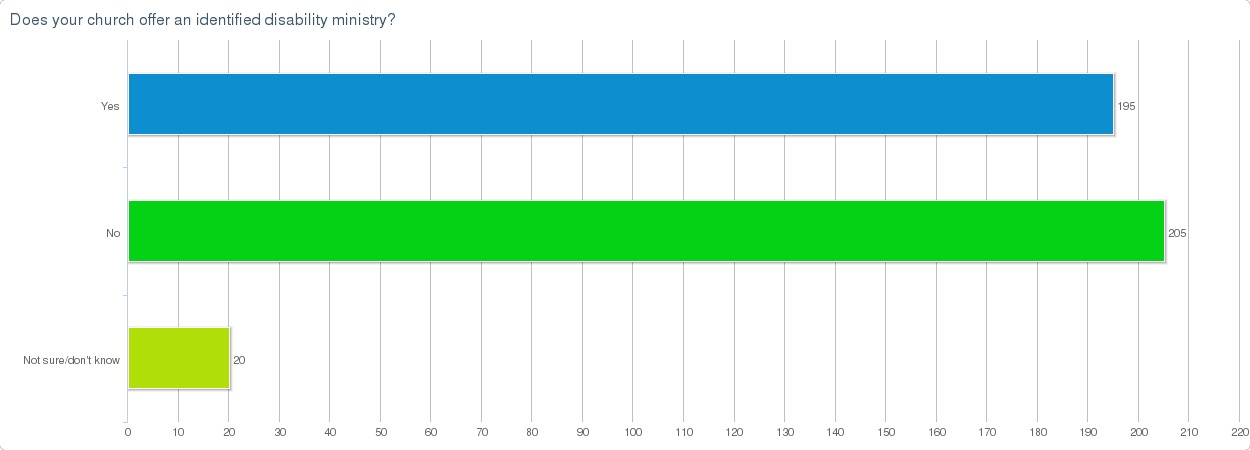
Is the reason why so many of our attendees able to be part of church related to the presence of identified disability ministries? Out of those who registered in advance, less than half of the 420 attendees who responded to the question reported the availability of a disability ministry at their identified church…

IF Identified Disability Ministry chart

So…if 61% of a large sample attending a disability ministry conference has experienced difficulty attending church, what would you hypothesize the rates might be among a less-invested group?

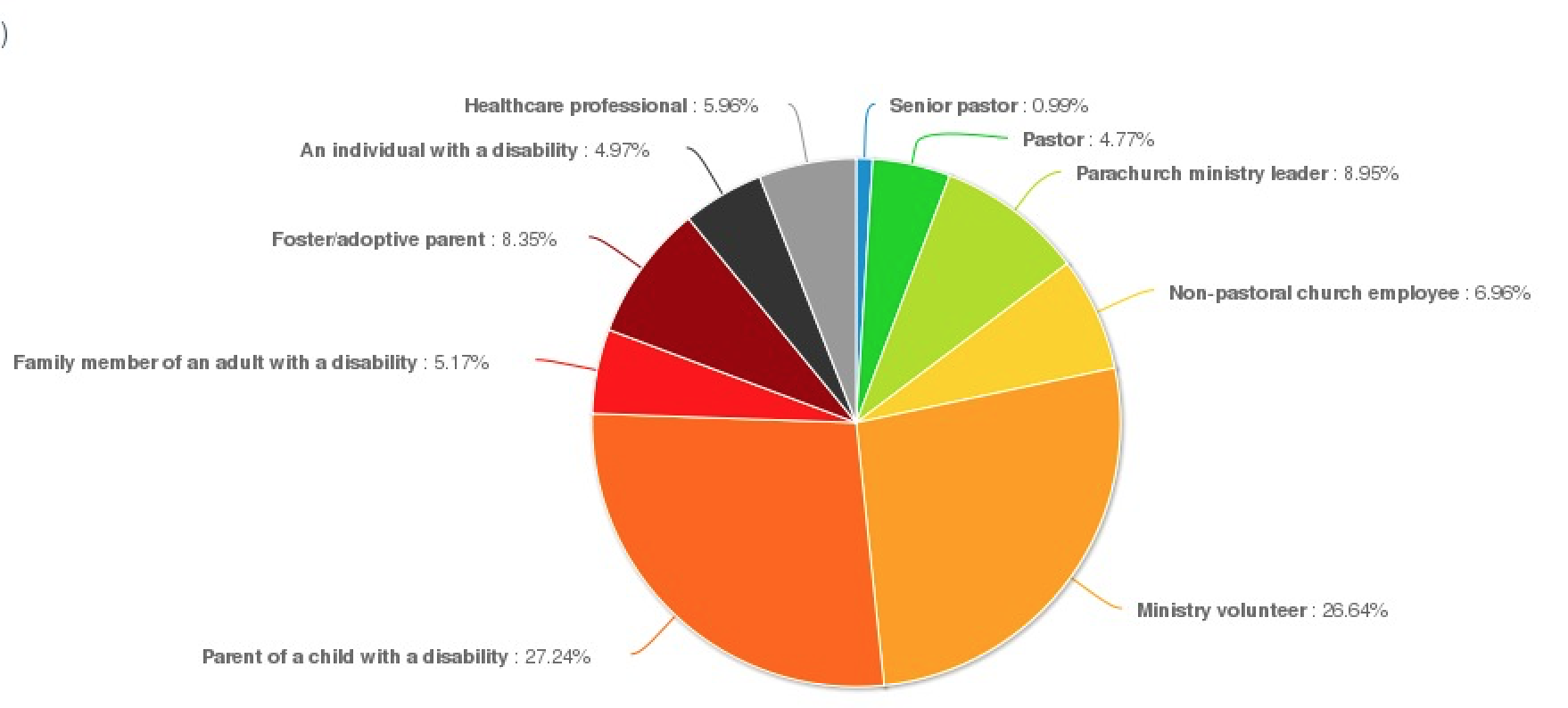
In terms of the makeup of the group, slightly more than half were parents of a child with a disability or ministry volunteers, but our attendees had great diversity in terms of their primary disability-related role…

Primary role

We can obtain viewership data for those who signed in for chats through Facebook. While women in general may be more likely to use Facebook, Jeff Davidson’s assertion that we need more dads in special needs ministry appears to be true…

Audience breakdownAmong attendees who used Facebook, the median number of presentations viewed during Inclusion Fusion was nine, while the average (skewed by a number of “power viewers” who watched most/all of the presentations was 14.5.

One last little nugget…here are some statistics on viewership of presentations on our “on-demand” site.

Top Five on-demand videos IF

It’s little surprise that Joni’s keynote presentation was most popular, but aside from our promotional video, the next three videos in popularity were Joe Butler’s talk on recreation as outreach in special needs ministry, Emily Colson’s talk and Beth Golik’s presentation on aligning teaching in special needs ministry with teaching in other areas of the church were most popular.

To summarize…in an admittedly skewed sample, 61% of those who themselves experienced disability or have an immediate family member with disability disclosed they had been unable to attend church at some time as a result of disability. 97% of the sample are currently regular attenders at church, even though fewer than half attend a church with an identified disability or special needs ministry.

***********************************************************************************************************

Website screen shotKey Ministry is pleased to invite you to check out our new website. Over 180 downloadable resources are available to pastors, church staff and volunteers seeking to serve kids with disabilities and their families, including all Inclusion Fusion presentations from our first two Web Summits are available with FREE registration. Check out keyministry.org today and share the link with others interested in welcoming kids with disabilities and their families at church.

Posted in Inclusion, Inclusion Fusion, Key Ministry | Tagged , , , , , , | Leave a comment

Goin’ to California…

Global Access Promo 640x360Joni Eareckson Tada did a fabulous job of setting the tone for this year’s Inclusion Fusion Web Summit in her keynote presentation. She cast a compelling vision for the disability ministry movement…one that transitions away from a “top-down, programmatic approach to ministry” to a grass-roots approach to ministry development.

Joni’s full vision for disability ministry will be on display at the Global Access Conference 2015, to be held this coming February 17-20 at Calvary Community Church in Westlake Village, CA.

The purpose of the Global Access Conference is to bring together disability leaders, ministers, educators and practitioners from around the world. It’s an unprecedented opportunity to share experiences, forge strong working relationships, and learn how to practically and effectively promote disability ministry in the Christian community. Attendees will learn how to create and pursue advanced disability initiatives within church and cultural communities, and will build lasting networks of support and education throughout the international disability community.

The three primary objectives of the conference are…

Equip leaders with practical knowledge and effective tools for disability ministry.

Engage attendees in a supportive global network of disability ministry leaders, advocates, and academics.

Encourage the body of Christ for ministry to and through people with disabilities.

GA-blog-ad-1-200x200By developing a common understanding around three central themes, the team at Joni and Friends seek to create a more unified understanding of the goals of global disability ministry…

Christ

Understand the person and work of Christ in His historical setting, and consider the implications of Christ’s ministry as it applies to evangelizing people affected by disability.

Church

Explore and identify the Christian church’s responsibilities in areas of disability ministry and leadership.

Community

Develop an understanding of the Christian church’s role as a leader for disability advocacy and empowerment in the wider cultural and social communities in which it operates.

I’m very much looking forward to attending the conference…and serving as a presenter. I’m honored to have the opportunity to lead a workshop…Including Kids and Teens With Mental Illness in the Church and Community. I’ll also be leading a roundtable discussion on the theme of why ministry to kids with mental illness is necessary and biblical.

In my talk, I plan to discuss how the church can do a better job reaching out to, and including kids and teens with mental illness and their families into the church. Mental illness represents (by far and away) the most common category of disabling conditions impacting kids and teens in the U.S. For many, the environments in which we “do church” present subtle, but very real barriers to participation and their families. Existing disability or “special needs” ministries typically don’t serve kids with mental illness in the absence of significant intellectual disability. I’ll discuss Key Ministry’s experiments with alternative ministry strategies and models to help churches effectively share the love of Christ with families of kids with “hidden disabilities.”

Followers of this blog and Key Ministry will recognize many familiar names on the program. In addition to Joni, speakers will include Jeff McNair, Amy Simpson, Emily Colson, Cameron Doolittle, Ryan Wolfe and Christen Morrow-Ara.

Recognizing that most leaders serving in the field of disability ministry have limited resources for training and travel, this is one event I’d very much encourage everyone to try to attend in person. Global Access is (by far and away) the most comprehensive conference I’ve ever come across. While we love to leverage technology to grow our capacity to impact the disability ministry movement, there’s something about the ability to worship, to learn and to enjoy fellowship in the physical presence of our brothers and sisters in Christ.

Online registration for Global Access is easy and convenient. I’d encourage all of you to check out the fabulous website the team at Joni and Friends assembled for the conference. I’m especially envious (in a good way) of the registry of speakers and attendees that greatly facilitates the ability of everyone attending Global Access to fully connect and interact with one another.

Here’s a sneak peek at what you might expect from Joni and some of her friends at Global Access. Click on Joni’s picture to go to the YouTube video…

Global Access You Tube link

I’m hopeful of meeting “in the flesh” many leaders in the field of disability ministry who I’ve only had the pleasure of experiencing “electronically,” along with many friends of Key Ministry this coming February 17-20 at Calvary Community Church in Westlake Village, CA. See you there!

***********************************************************************************************************

2000x770 INCLUSION CONSULTANTSKey Ministry is pleased to invite you to check out our new website. Over 180 downloadable resources are available to pastors, church staff and volunteers seeking to serve kids with disabilities and their families, including all Inclusion Fusion presentations from our first two Web Summits are available with FREE registration. Check out keyministry.org today and share the link with others interested in welcoming kids with disabilities and their families at church.

Posted in Key Ministry, Mental Health, Resources, Training Events | Tagged , , , , , , , , , , , , , , | Leave a comment

Leading online support groups…Lorna Bradley

Lorna_Bradley“Can you hear me now?” Leading online support groups at times may feel a bit like a Verizon commercial as you iron out the technical issues some may experience when videoconferencing for the first time. However, once the technology becomes familiar to everyone online support groups create pathways of connection and support for even the most isolated of special needs parents.

Recently Dr. Steve Grcevich at Key Ministry provided to me the opportunity to lead a seven-week special needs parent support group online using material I wrote that will be published in early 2015. The purpose of the book is threefold. First, I want to provide a solid theological understanding of God’s presence and love in the midst of the journey with special needs. Second, I want to provide practical strategies for coping with challenges faced by virtually every special needs parent: grief, guilt, patience, self-care, and relationships. Third, I want to create the opportunity for a small group experience where people could share and connect, forming meaningful and supportive relationships.

I’ve led support groups in a variety of settings over the past five years, but always in-person. The parents came to me or I went to them. Dr. Steve Grcevich and I talked about the importance of reaching families who are isolated, either due to a lack of faith communities in their area who offer special needs ministries or due to fragile health of children that makes it hard to leave the home. Online groups offered a way to reach into these homes. We wondered, would members of the group form meaningful connections?

The short answer is YES!

On more than one occasion I left the videoconference connection open after our meeting ended and several members of the group stayed up talking until the wee hours of the morning. It’s sort of like when an “in-person” small group breaks up for the evening and folks hang around to chat in the church parking lot. The pilot group was scheduled to run for seven weeks and by the third week parents were already asking what would happen at the end because they wanted to stay connected with each other. Several mentioned looking forward to the weekly opportunity to share and connect. Online groups work.

So what are some takeaway tips for folks wanting to try an online group?

  • Choose a good videoconferencing platform that has good resolution, stable connectivity, and is easily accessible. Key Ministry used Zoom.us, which I found easy to use a facilitator. Other options include Skype or Google Hangout.
  • Find a time that works best for your target audience. This may be during the day for stay at home parents, in the early evening for those who can tag team parent, or later in the evening after children have gone to bed. Our group chose the latter and it worked well for most, but some found it too late.
  • Limit class size. More than 6 in the conversation gets challenging in video format. However, not everyone who signs up can show up every week so allow for a few extra. The Key group had 14 register, with about 8 participating fairly regularly and core group of four signing in virtually every week.
  • Invite folks to sign in 15 minutes prior to the meeting to sort out technical issues prior to the meeting.
  • At the start of at least the first few meetings have one person to facilitate the group and another person to facilitate connection issues. It is challenging to give meaningful attention to a person sharing deep grief while simultaneously helping another find how to turn off “mute” while using the chat feature. Once everyone had used the online connection a few times the need for technical help disappeared.
  • Allow for a bit of delay in the conversation. There may be a slight lag between speaking and the message being received due to the online platform. At times folks may accidentally talk over each other. In the beginning it is especially helpful to have the facilitator call out folks by name. I typically asked if the person had something to share.

The online group ultimately ran like any other small group in a faith community. The novelty of videoconferencing quickly faded into the background and our time together became like typical conversations. The only hard part was when someone had tears we couldn’t reach out and give her a hug or hand her a tissue. We closed in prayer each week and a prayer list is sent out to all members on the roster so that those who may not have been able to login still remain connected to the group. The group has chosen to continue meeting after the seven-week pilot of my book was complete. They may do other book studies, but will always have a devotion, time for sharing, prayer and scripture. What a blessing it has been to get to know some incredible and inspiring parents.

For those who are interested in using my material in order to facilitate small groups for special needs parents, the book should be out February 2015 via Huff Publishing. For up to date information during the months prior to publication, visit specialneedsparenting.me or subscribe to my blog at that same address.

Blessings,

Lorna

Rev. Dr. Lorna Bradley is an ordained deacon in the United Methodist Church and serves at The Hope and Healing Institute as a Scholar in Residence. In addition to developing curriculum for special needs parent support, she has led parent support groups for five years and worked in welcoming ministries for ten years. She writes a weekly blog for parent support at specialneedsparenting.me. She and her husband have an adult son with Asperger’s. Lorna enjoys spending time with her family, entertaining, traveling, scuba diving, and running.

***********************************************************************************************************

KM Logo UpdatedKey Ministry has assembled resources to help churches more effectively minister to children and adults with ADHD, anxiety disorders, Asperger’s Disorder, Bipolar Disorder, depression and trauma. Please share our resources with any pastors, church staff, volunteers or families looking to learn more about the influence these conditions can exert upon spiritual development in kids, and what churches can do to help!

Posted in Families, Key Ministry, Resources, Strategies | Tagged , , , , , , , | 1 Comment

The FDA finally takes action on a problem with generic ADHD medication

shutterstock_68372575_2Editor’s Note: The FDA issued a statement on November 13, 2014 addressing concerns regarding the therapeutic equivalence of the two most recently approved generic versions of Concerta tablets. Excerpts from this week’s statement regarding the Mallinckroft and Kudco versions of generic Concerta are featured below in blue…

Based on an analysis of data, FDA has concerns about whether or not two approved generic versions of Concerta tablets (methylphenidate hydrochloride extended-release tablets), used to treat attention-deficit hyperactivity disorder in adults and children, are therapeutically equivalent to the brand-name drug. The two approved generic versions of Concerta are manufactured by Mallinckrodt Pharmaceuticals and Kudco Ireland Ltd…

An analysis of adverse event reports, an internal FDA re-examination of previously submitted data, and FDA laboratory tests of products manufactured by Mallinckrodt and Kudco have raised concerns that the products may not produce the same therapeutic benefits for some patients as the brand-name product, Concerta, manufactured by Janssen Pharmaceuticals, Inc. Janssen also manufactures an authorized Concerta generic, which is marketed by Actavis under a licensing agreement and is identical to Janssen’s Concerta. FDA included the authorized generic in its analysis and found it to be bioequivalent to, and substitutable for, Concerta. Apart from the Mallinckrodt, Kudco, and Actavis products, there are no other generics for Concerta.

Methylphenidate hydrochloride extended-release products approved as generics for Concerta are intended to release the drug in the body over a period of 10 to 12 hours. This should allow for a single-dose product that is consistent with the effect of a three times per day dose of immediate-release methylphenidate hydrochloride.

shutterstock_86980295_2In some individuals, the Mallinckrodt and Kudco products may deliver drug in the body at a slower rate during the 7- to 12-hour range. The diminished release rate may result in patients not having the desired effect.

As a result, the FDA has changed the therapeutic equivalence (TE) rating for the Mallinckrodt and Kudco products from AB to BX. This means the Mallinckrodt and Kudco products are still approved and can be prescribed, but are no longer recommended as automatically substitutable at the pharmacy (or by a pharmacist) for Concerta.

Consequently, FDA has revised its draft guidance for industry for bioequivalence testing for methylphenidate hydrochloride extended-release tablets (Concerta). FDA has asked that within six months, Mallinckrodt and Kudco confirm the bioequivalence of their products using the revised bioequivalence standards, or voluntarily withdraw their products from the market.

FDA will continue to evaluate its testing and approval standards and bioequivalence guidances for other generic methylphenidate hydrochloride extended-release products and revise as needed.

I’d ask our regular blog readers to allow me to digress today while I share some information about a medication issue that is greatly impacting many of the kids and families we serve.

ConcertaConcerta is the most commonly prescribed medication to teens in the United States. When  the product first hit the market in 2000, it revolutionized the treatment of ADHD because Concerta offered the first truly effective method for prolonging the effects of methylphenidate (the active ingredient in Ritalin and many other stimulant preparations) so that kids no longer needed to go to the principal’s office or nurses’ office in the middle of the school day. When Adderall XR followed in 2001 and Strattera in 2002, a vast increase ensued in the number of children and teens identified with and treated for ADHD. Out of the roughly 25 medications approved for ADHD, Concerta remained very popular because of the consistency of its’ effects throughout the school day into the time immediately following school. It is widely used in teenagers because of its’ beneficial effects on driving performance.

A basic principle in understanding how extended-release stimulant products work is that the manner in which the drug is released into the body (the drug delivery system) has profound effects on the pharmacodynamics (the observed benefits/response to the drug). We have quite a number of approved medications for ADHD in which methylphenidate is the active ingredient. In addition to Concerta, Ritalin LA, Metadate CD, Daytrana, Quillivant and Focalin XR are all extended-release methylphenidate products. The effects of the medication at specific times throughout the day result from the differences in how the medication is released and absorbed into the body with each unique delivery system, and form the basis of how we decide which product we choose for an individual child. Allow me to illustrate…

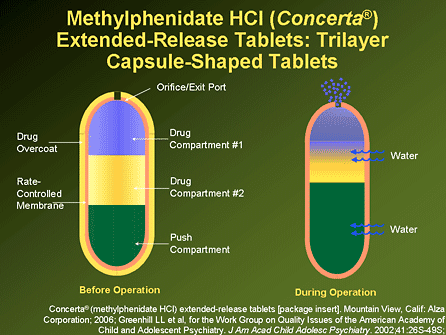
Concerta utilizes something called the OROS delivery system (see featured picture at the top of this blog post) to release methylphenidate into the body. It was developed by a team of scientists in California who observed a phenomena referred to as “tachyphylaxis” with earlier attempts to develop long-acting methylphenidate-based stimulants. Essentially, people taking stimulants develop some degree of tolerance to the drug acutely in response to an individual dose. While the absolute level of the drug in someone’s system matters, whether the blood level is rising or falling also matters, since a rising blood level contributes to the ability of a stimulant to sustain beneficial effects over the course of a school or work day.

Concerta was designed to release an initial dose of stimulant within the first two hours of ingestion…22% of the active drug is contained within the coating of the pill. After this overcoat dissolves, a laser-drilled hole in the end of pill is uncovered. As the pill passes through the stomach and the gastrointestinal track, water taken up into the pill results in changes in internal pressure that leads to a “pulse release” of small amounts of medication as it passes through the gut. The effects of Concerta were tested in a laboratory classroom setting, in which raters blinded to whether kids received active drug or placebo scored the observable behavior of kids throughout a twelve hour day, and an age-appropriate mini-math test (PERMP) was administered at intervals throughout the day to measure the effects of medication on cognitive performance. The results are pictured below. A significant benefit of Concerta is the consistency of improvement in cognitive performance throughout the day.

OROS Lab Classroom

In contrast, Focalin XR utilizes a “beaded” delivery system to release methylphenidate into the body. Focalin XR is a capsule containing two types of beads. The outer coating of the capsule dissolves very quickly (within ten minutes) upon ingestion. 50% of the beads inside Focalin XR release almost immediately after the coating of the outer capsule dissolve, while another 50% have a different coating designed to dissolve approximately four hours after the capsule is swallowed. One advantage of Focalin XR is that parents can crack open the capsule and sprinkle the contents in yogurt or applesauce when kids can’t swallow pills, whereas Concerta won’t work if the pill isn’t swallowed intact. Another advantage with 50% of the medication released immediately is that the medication kicks in very quickly in the morning with demonstrable benefits at 30 minutes (see below). In practice, Focalin XR has a pronounced peak effect in late morning and is very effective for most kids throughout the school day. At the same time, the cognitive effects of the drug fall off much more quickly during the latter part of the day compared to Concerta, and drug company marketing claims aside, I find in my patients that Focalin XR is a good choice for kids who need medication to cover the duration of their school day, but not much longer.

Focalin XR Lab Classroom

Daytrana is a patch worn on the hip in which methylphenidate is absorbed through the skin as a result of an osmotic gradient…the difference in the concentration of methylphenidate in the patch vs. the difference in the concentration of methylphenidate in the capillaries supplying blood to the skin. A unique benefit of Daytrana is that it will last longer than any of the other stimulant products on the market…it was originally developed to be a 16-18 hour drug. Because the testing required for approval by the FDA examined the effects of the product over a twelve hour period, the company that manufactures Daytrana isn’t permitted to share that information with prescribers. The cognitive effects of Daytrana also peak later in the day than with other products (see below), making Daytrana very helpful for many kids who struggle with homework after school. Comparing the laboratory classroom studies of Daytrana to Concerta and Focalin XR, an obvious downside to Daytrana is that it doesn’t work as well during the first half of the school day. Many parents resort to either putting the patch on their child very early in the morning while they’re still sleeping to overcome this effect, or give their child a small dose of immediate-release methylphenidate (Ritalin or immediate-release Focalin) when they first put the patch on in the morning.

Daytrana Lab Classroom

My point is that what makes Concerta work like Concerta is the OROS delivery system. The same drug (methylphenidate) released through a different delivery system produces a VERY different response.

The arrival of generic Concerta was delayed for a number of reasons…the makers of Concerta fought the lawsuits of the generic manufacturers aggressively, and pursued a legal strategy involving what’s referred to as a “Citizen’s Petition” requiring generic companies seeking to copy Concerta to demonstrate a similar pattern of ascending blood levels throughout the day. Because Johnson & Johnson (the parent company that owned the rights to Concerta) owned the patent on the OROS release system, companies seeking to make a generic version had to do so with a different delivery system.

Concerta 27Concerta 18Ultimately, Watson Pharmaceuticals (subsequently acquired by Actavis) was approved to manufacture a generic equivalent of Concerta. As often occurs in these situations, the lawyers for Johnson & Johnson  and Watson worked out a deal to avoid years of legal battles in Concerta 54Concerta 36which J & J would continue to manufacture Concerta through their Alza subsidiary that Watson would sell at a discount as an “authorized generic,” with the two companies splitting the profits. The brand Concerta and the Watson/Activis version of Concerta are equivalent…they are manufactured in the same factory, using the same equipment and the same drug delivery system as in the original Concerta. Pictures of the “authorized generic” using the OROS system are shown above:

The last two versions of versions of generic Concerta (manufactured by Mallinkcrodt and by Kudco) each use very different drug delivery systems (release mechanisms) in an effort to replicate the therapeutic effect of Concerta.

M54 M36 M27In the case of the Mallinkcrodt product (pictured at right), an overcoat containing immediate-release methylphenidate that dissolves within the first hour after ingestion. The core of the pill contains a diffusion-controlling membrane that releases methylphenidate as water in the gastrointestinal tract passes through the membrane. The membrane is designed to release methylphenidate over a period of time roughly corresponding to the release period resulting from the OROS delivery system in Concerta.

KU 27KU 18The Kudco generic (pictured at right) uses an extended-release bead technology to release methylphenidate at a controlled rate. The pill resembles a conventional tablet in appearance, featuring an overcoat containing immediate release stimulant that releases during the first hour as the tablet disintegrates and a core of extended-release stimulant beads operating with a similar mechanism as those in Focalin XR.

So, how do these products compare to the original Concerta? We don’t know! Here are links to the FDA-required product information or “labels” for Concerta, the Mallinkcrodt generic version and the Kudco generic version that are being substituted for Concerta. It appears that the FDA allowed the generic manufacturers to “cut and paste” the data from Concerta’s pharmacokinetic studies and clinical trials and present this information as if it represented trials each company conducted with their own unique product. It’s EXTREMELY UNLIKELY that different drug delivery systems would produce EXACTLY the same results in terms of drug metabolism (pharmacokinetics) and drug effects (pharmacodynamics) as the brand name drug.

The absorption of the original Concerta depends to some degree on an individual’s GI transit time…i.e., how long it takes for the pill to pass through the gut. Bead release systems (as in the Kudco version) typically depend upon the acidity of the contents of the stomach at the time the extended-release bolus of medicine is needed. One would anticipate an individual child or teen might absorb significantly more (or less) medicine at different times during the day when two products that on average deliver roughly the same amount of medication over the same time period depend upon different physiologic processes.

When the FDA requires generic companies to do studies demonstrating “equivalency” to a brand medication, the amount of medication taken up into the body (measured by what we refer to as the “area under the curve” or AUC) is required to be within 80-125% of that observed with brand name drug. With some types of medication, that variability makes little difference. With stimulants, small differences in either the rate at which the medicine is absorbed or the time at which the medicine is absorbed make a PROFOUND difference in the benefits or side effects experienced by an individual child or adult. The FDA doesn’t require generic companies to conduct comparison studies showing that the products work as well in practice as the brand name drugs they’re intended to replace. Neither Mallinkcrodt nor Kudco has been required by the FDA to conduct a study showing that their drug works as well in practice as the brand or authorized generic versions of Concerta.

Restating my earlier point, what makes Concerta work like Concerta is the OROS delivery system. The same drug (methylphenidate) released through a different delivery system produces a VERY different response.

In my mind, this is an utter and complete outrage when we’re talking about the most commonly prescribed drug for teenagers in the United States. I’d argue that this is a social justice issue. I’ve now had over ten kids come into my office for follow-up since the first of the year who have reported a significant decline in the effectiveness of their medication in the last couple of months. One nationwide drug store chain began ordering the Kudco product (the version many of my families have found to be less effective…the two main complaints being it doesn’t work as well or last as long as the original) in large quantities several months ago and substituting it for the authorized generic version of Concerta. What put me over the edge was an experience yesterday when I saw a mother and her daughter who reported problems with her medication since the appearance of her pill had changed. I sent them to the drugstore with new prescriptions for the brand Concerta or the authorized generic version. The mother was told by the pharmacy that it was illegal for them to fill the prescription for the original product even though she was willing to pay for the prescription “out of pocket” and that they would call the police if she insisted on having the prescription filled.

I’m at the end of my rope as a result of the administrative hassles involved with getting the kids in my practice the medications and educational support services they need to thrive in school, at home, with their friends and in community activities. I can’t even imagine what life must be like when parents have little money and need to depend upon our systems of care for support.

Here’s a link to the FDA’s Medwatch website, where health professionals and consumers can report problems with prescription drugs. If consumers experiencing problems with specific versions of generic medications inundate the FDA with reports of their experiences, there’s a greater chance action will be taken to further scrutinize the safety and effectiveness of those products. If you or your child are experiencing unanticipated effects from ADHD medication, please file reports with the FDA for the sake of others who may be experiencing similar effects.

Portions of this article were originally published on February 23, 2014

***********************************************************************************************************

ADHD Series LogoKey Ministry has assembled a helpful resource page for church leaders and parents addressing the topic of ADHD and spiritual development. This page includes our blog series on the topic and links to helpful videos and resources for pastors, church staff, volunteers and parents. Access the resource page here.

Posted in ADHD, Controversies, Mental Health | Tagged , , , , , , , , , , | Leave a comment

Winding down Inclusion Fusion…

IF magazine coverThanks so much to everyone who has contributed to making Inclusion Fusion 2014 such a smashing success! We’ll share some statistics with our readers about the Web Summit over the next week or two, but we’ll have had over 500 participants for the conference who were HIGHLY engaged!

Let me share some general information as we wind the conference down…

We’ll be finished with Inclusion Fusion around 10:00 PM tonight, but we’ll keep the “on-demand” video website open until 6:00 PM tomorrow (November 14). As a result, if you know a parent, caregiver, pastor, church staff member or volunteer who would benefit, encourage them to register before the end of the day Friday.

Everyone registered for the conference will receive an e-mail containing a link to an evaluation of their Inclusion Fusion experience. As a little added incentive, everyone who submits a completed evaluation will receive a code to continue to access the “on-demand” library through the end of November.

Magazine Cover largeWe encourage everyone who participated in Inclusion Fusion to use the opportunity to connect with the speakers and ministries featured during the Web Summit. We encourage all of you to download the Inclusion Fusion magazine, which contains biographies and contact information from our speakers and the organizations they represent.

We’re going to finish Inclusion Fusion with a “group chat” tonight at 8:00 PM Eastern that I’m co-hosting with Colleen Swindoll-Thompson of Insight for Living’s Special Needs Ministry. All of our speakers are invited to the group chat and we may have some folks from Joni and Friends joining us as well. We’ll be featuring Joni’s Keynote video, Colleen’s interview with Joni and Ken Tada that many registrants missed last night, and presentations from Mike Woods, Emily Colson and Beth Golik. If you have a question about special needs/disability ministry, bring it. If you’re a parent/caregiver and you want to chat about your experience of church, c’mon in. We’ll be hanging out until approximately 10 PM Eastern.

Video schedule for tonight:

8:00 PM:  Joni Eareckson Tada Keynote
8:15 PM: Colleen Swindoll-Thompson interview with Joni and Ken Tada
9:25 PM Mike Woods…Nine Innovative Outreach Ideas for Your Special Needs Ministry
9:35 PM Emily Colson…Dancing with Max
9:50 PM Beth Golik…How to Incorporate the Special Needs Classroom into a Churchwide Curriculum Alignment

Finally, we’re thrilled to be able to make Inclusion Fusion and other training events available to the worldwide church free of charge, but producing events like Inclusion Fusion doesn’t happen for free. Our team at Key Ministry very much appreciates (along with prayer) the financial support of like-minded churches and Christ-followers committed to the work of welcoming families impacted by disability into the life of the local church.

Kindrid Instructional SlideWe’ve come up with a simple solution for those willing and able to support the work of our ministry. We have a simple solution in Kindrid, developed by the team from lifechurch.tv who are responsible for the Bible app you likely carry on your smartphone or tablet. Any individual or church sending a financial gift to us at (440) 337-4338 through Kindrid during the month of November will receive an access code to view the entire video portfolio from Inclusion Fusion 2014, until such time as we make the entire collection available.

Thank you again for making Inclusion Fusion such a big success! We pray the end of the Web Summit tonight will be a beginning for many marvelous ministry adventures!

***********************************************************************************************************

Website screen shotKey Ministry is pleased to invite you to check out our new website. Over 180 downloadable resources are available to pastors, church staff and volunteers seeking to serve kids with disabilities and their families, including all Inclusion Fusion presentations from our first two Web Summits are available with FREE registration. Check out keyministry.org today and share the link with others interested in welcoming kids with disabilities and their families at church.

Posted in Inclusion Fusion, Key Ministry, Resources | Tagged , , , , , , , , , , , | 2 Comments

A special night ahead…

Colleen, Joni, KenOur team has been thrilled with the overwhelming response we received to the first day of Inclusion Fusion 2014! We’ve had nearly 500 pastors, church staff, volunteers and family members register thus far, with an entire evening and all day tomorrow yet to go! People are making connections and discovering some of the fabulous resources God is developing to respond to the needs of individuals and families impacted by disability.

Since our mission from the very beginning of our organization was to help families impacted by disability be part of church, we wanted an opportunity to worship together as part of this year’s Inclusion Fusion, and offer those attending the Web Summit an opportunity to invite those they know who have been unable to attend church to join us.

Tonight at 9:00 PM Eastern, we’ve created just such an opportunity!

We have a special service with music from our Key Ministry worship team and a fabulous message from Jeff Davidson, one of our speakers for this year’s conference. Here’s an introduction to Jeff’s message tonight…

Why is God silent when you so need to experience His presence? Do you wonder if God has turned his back on you forever?

Every person who God used to achieve great things in the Bible experienced times when they feared that God was absent and times when they were wounded deeply.

Jeff Davidson looks at six things we can do when our lives are a mess and it seems to us that God is silent in his message for tonight’s Front Door online church service.

For tonight’s worship service (and subsequent surprise), no password or registration will be required so that we can make it as easy as possible for families impacted by disability to attend!

305439_281913901831715_1114988045_nAs many of you are aware, we were actively promoting a special guest appearance by Chuck and Colleen Swindoll-Thompson as part of this year’s Web Summit. Chuck did a fabulous job as our first Keynote speaker and over the past few years, his daughter Colleen has built a remarkable ministry to families impacted by special needs through Insight for Living.

We received a MAGNIFICENT video last week from the folks at Insight for Living…so magnificent in fact that the size of the video file was greater than our software could support and greater than our video production team could manage.

Because of these unforeseen technical difficulties, everyone who registered for Inclusion Fusion 2014 will receive a special invitation to view the planned presentation from Chuck Swindoll, Colleen Swindoll-Thompson and Steve Fischer (accompanied by a chat hosted by Colleen) at a future date (anticipated: January-February 2015).

Chuck, Colleen and the folks at Insight have really gone the extra mile to help support Inclusion Fusion this year! We made arrangements for a special presentation tonight after our Front Door worship service with Jeff Davidson.

We’re going to be sharing (approximately 9:55 Eastern time) a video interview Colleen conducted recently with Joni and Ken Tada. In the interview, Colleen has the opportunity to ask in-depth questions of Joni and Ken about faith, disability, caregiving, marriage and the Beyond Suffering course developed by Joni and Friends to equip leaders of all backgrounds for disability ministry. Technology permitting, we may have additional surprises to share as well.

Please…invite any families you know who have been unable to “do church” to join us online for worship at 9:00 PM Eastern, 6:00 Pacific tonight for worship, immediately followed by Colleen Swindoll-Thompson’s interview of Joni and Ken Tada!

***********************************************************************************************************

Website screen shotKey Ministry is pleased to invite you to check out our new website. Over 180 downloadable resources are available to pastors, church staff and volunteers seeking to serve kids with disabilities and their families, including all Inclusion Fusion presentations from our first two Web Summits are available with FREE registration. Check out keyministry.org today and share the link with others interested in welcoming kids with disabilities and their families at church.

Posted in Inclusion Fusion, Key Ministry, Resources | Tagged , , , , , , , , , | Leave a comment