Why is trauma more traumatizing for some kids?

28cshootingto11-12294463jpg-3cc55792c3fdea4dWelcome to the second installment of our Fall 2013 blog series: Trauma and Kids…A Primer for Pastors, Church Staff and Parents. Today, we’ll examine why some kids are more vulnerable to experience lasting consequences in the aftermath of traumatic experiences.

One of the fascinating findings in the aftermath of September 11th was the observation that only 15% of survivors of the attacks on the World Trade Center developed Post-Traumatic Stress Disorder (PTSD). An obvious question arises…a question I often encounter in my office with parents of adopted kids who had been victims of abuse or neglect: Why is it that some kids who come from horrific circumstances thrive while others struggle?

Today, we’ll take a look at risk factors for PTSD in kids following a potentially traumatic event…

A prior history of exposure to traumatic events: The more frequently a child has been exposed to events with the potential for trauma, the more likely it is that any given traumatic event will produce lingering effects.

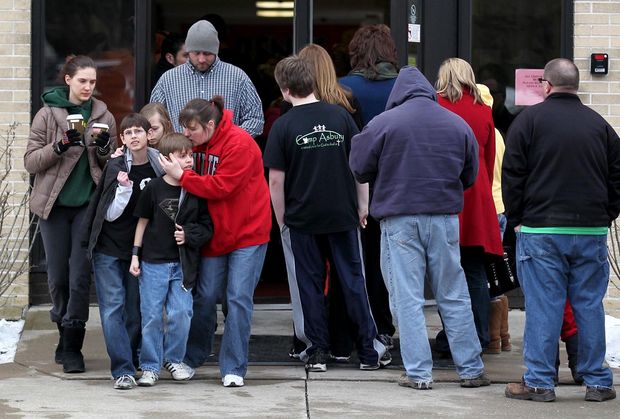
The nature of the traumatic event: Exposure to war appears to be especially traumatizing to children, as well as exposure to violent crime. The experience of witnessing a school shooting is very likely to lead to PTSD. One particularly traumatizing event for kids is the experience of witnessing the sexual assault of a parent. On the other hand, natural disasters appear less likely to produce lasting trauma symptoms, although the impact appears related to the severity of the disaster.
-26127a4477db07e0The reaction of parents and caregivers to the event: Levels of parental distress in the aftermath of a disaster or traumatic event are strongly correlated to the development of PTSD in children.

How close the child is to the perpetrator of the event: Sexual abuse perpetrated by a parent or relative is more likely to be traumatizing than abuse perpetrated by a stranger.

The child’s mental health history: Kids with pre-existing mental health conditions are at higher risk of developing PTSD. Anxiety disorders (especially OCD, in my experience) in particular appear to place kids at greater risk of developing PTSD following a potentially traumatic event. Kids with externalizing disorders (ADHD, Oppositional Defiant Disorder) are at greater risk for PTSD following trauma. Panic symptoms in the immediate aftermath of traumatic events is a predictor of future PTSD in children.

The child’s temperament: Difficult temperament and antisocial behavior in have been linked to increased risk of post-traumatic stress during adulthood.

The child’s age when the traumatic event occurred: Older children are more likely to have a broader range of coping skills for dealing with traumatic events, better developed capacity for emotional self-regulation and a more extensive social support network than younger children.

History of PTSD in a parent: Kids who have a parent with PTSD are more likely to develop PTSD following a traumatic event.

PSY StartCircumstances surrounding a disaster: Here’s a link to the screening tools used by the American Red Cross in the aftermath of a natural disaster. Kids for whom evacuation was delayed, kids who experience the destruction of a home, the loss of a pet, or the experience of having to be rescued were at higher risk of developing PTSD.

Genetics: We know that risk for post-traumatic stress is moderated by the specific allele one carries for the gene associated with the serotonin transporter (5-HTTLPR) protein. We also know gender comes into play. Girls are two times more likely than boys to develop PTSD following traumatic events. In a recent study from Emory University looking at differences in PTSD rates among men and women exposed to trauma, investigators looked at a hormone-like molecule (PACAP) involved with regulating the intracellular responses to stress. Women with PTSD were not only more likely to have high levels of PACAP, but were also more likely to have a variation to a gene for PAC1 that also responds to estrogen. The variation was found in an area subject to environmental influences involved with activation/deactivation of the gene. This finding helps to explain why the repeated experience of trauma among those who are not genetically predisposed to PTSD may eventually lead to PTSD symptoms.

Environmental Factors: Kids growing up in urban environments may be at higher risk as well as kids from families with lower socioeconomic status. One study of 18-45 year olds living in Detroit reported that 90% had been exposed to at least one traumatic event. In another study of kids growing up in a large mid-Atlantic city, the risk for assaultive violence among males and risk of PTSD among females appeared related to characteristics of their social environment.

Intellectual Disability: Lower IQ scores at age 5 were a significant predictor of future PTSD in one longitudinal study. The authors of the study suggested that greater difficulty putting traumatic experiences into a narrative for kids with intellectual disabilities, or the risk may be mediated through their increased risk for other mental health or externalizing disorders like ADHD.

Next…Some statistics on trauma and kids

Photos from Cleveland Plain Dealer coverage of our local school shooting in Chardon, Ohio, February 27, 2012.

***********************************************************************************************************

aacap_logoThe American Academy of Child and Adolescent Psychiatry has produced an excellent series of Facts for Families as a source of reliable information for parents and caregivers on a wide variety of mental-health-related topics related to children and teens. Here’s the Facts for Families download on Post-Traumatic Stress Disorder (PTSD).

Posted in Key Ministry, Mental Health, PTSD, Resources | Tagged , , , , , , , , , | 2 Comments

One Odd Duck…Introducing Carlyle King

Carlyle KingWe’re introducing our readers to different people God is lifting up as part of a larger movement within the church to welcome and include persons with disabilities in our weekend blog series Faces of the Movement. This week, it’s my pleasure to introduce you to one of the most interesting leaders you’ll meet anywhere in the church.

Carlyle King describes himself as a Christian with Asperger’s Syndrome. In his own words, Carlyle’s ministry seeks to “help other Christians better understand Asperger’s syndrome and welcome those who have it into their churches, their ministries, and especially their hearts”. Carlyle connected with our team a couple of years ago. As our staff partnered with Carlyle, I can truly say that no one else we’ve ever worked with has ever been held in higher esteem by our team than Carlyle.

I hadn’t heard from Carlyle in many months. He posted on my Facebook wall yesterday in response to my blog post earlier this week on Lifeway’s research related to attitudes about mental illness in the church. He’s been a tireless advocate for inclusion of everyone with special needs in the church. Here’s something Carlyle graciously allowed be to share from his ministry blog, One Odd Duck, which I very much encourage our readers to check out. This post was entitled A Confession and a Challenge to My Fellow Christians

I have a confession to make. I haven’t written anything here in quite a while, but not because of a lack of ideas. It’s because I’ve been struggling with some of the same junk I’ve struggled with my entire life. Like most aspies, I’m well aware that I’m different from most other people. Even if I were unable to observe for myself that there are differences, people often point them out to me. I have often thought that I simply do not fit anywhere, and because I do not fit, there is no place for me. Because there is no place for me, I should not exist. I have been thinking up ways to end my existence since before I was a teenager.

I have been wrong.

In 1 Corinthians 12:12-20, the Bible tells me:

12 For just as the body is one and has many members, and all the members of the body, though many, are one body, so it is with Christ. 13 For in one Spirit we were all baptized into one body— Jews or Greeks, slaves or free—and all were made to drink of one Spirit. 14 For the body does not consist of one member but of many. 15 If the foot should say, “Because I am not a hand, I do not belong to the body,” that would not make it any less a part of the body. 16 And if the ear should say, “Because I am not an eye, I do not belong to the body,” that would not make it any less a part of the body. 17 If the whole body were an eye, where would be the sense of hearing? If the whole body were an ear, where would be the sense of smell?18 But as it is, God arranged the members in the body, each one of them, as he chose. 19 If all were a single member, where would the body be? 20 As it is, there are many parts, yet one body.

It is true that I do not function like most of the people around me, but neither does the nose function like any other body part. The conclusion that I do not fit does not follow from the premise that I function differently. I confess that I was wrong to walk away from the body as a young man, but I realized that and I am back. However, I know that I’m not the only one that left because of feeling different. Many have even been asked to change or leave. Continuing in 1 Corinthians 12, we read:

21 The eye cannot say to the hand, “I have no need of you,” nor again the head to the feet, “I have no need of you.”22 On the contrary, the parts of the body that seem to be weaker are indispensable, 23 and on those parts of the body that we think less honorable we bestow the greater honor, and our unpresentable parts are treated with greater modesty, 24 which our more presentable parts do not require. But God has so composed the body, giving greater honor to the part that lacked it, 25 that there may be no division in the body, but that the members may have the same care for one another. 26 If one member suffers, all suffer together; if one member is honored, all rejoice together. 27 Now you are the body of Christ and individually members of it.

My challenge to my fellow Christians is this: Reach out and reconnect with our missing parts. Help them find that place where they honor God by functioning as they were made. Recognize that, if they don’t seem to fit, you may be the part needing adjustment. I invite you to learn more at http://www.keyministry.org/.

***********************************************************************************************************

Key Ministry’s mission is to help churches reach families affected by disability by providing FREE resources to pastors, volunteers, and individuals who wish to create an inclusive ministry environment. We have designed our Key Catalog to create fun opportunities for our ministry supporters to join in our mission through supporting a variety of gift options. Click here to check it out! For a sixty second summary of what Key Ministry does, watch the video below…

Posted in Autism, Hidden Disabilities, Inclusion, Resources | Tagged , , , , , , , , | 2 Comments

PTSD and Kids With Special Needs…Inclusion Fusion Library

Inclusion Fusion MagazineToday we’re sharing our second weekly installment from our Inclusion Fusion disability ministry training library. This week, we’re sharing a presentation from last year’s Web Summit from Jolene Philo on the topic of PTSD and kids with special needs.

Jolene is the author of two books for parents of children with special needs, A Different Dream for My Child and Different Dream Parenting. She is the parent of a child with special needs who developed PTSD due to early, frequent and invasive medical treatment. She also taught traumatized students at a correctional facility and collaborated with special education teachers to mainstream traumatized children in her classroom during public school teaching career. She’s conducted extensive interviews with trauma experts and is currently working on a book about PTSD in children. More information about PTSD and kids can be found at her website, http://www.DifferentDream.com.

Post-Traumatic Stress Disorder (PTSD) is a mental disorder most commonly associated with combat veterans that also affects children with special needs. Jolene will discuss six common myths and misconceptions about PTSD in children.

***********************************************************************************************************

cropped-key-ministry-door.pngOur Key Ministry website is a resource through which church staff, volunteers, family members and caregivers can register for upcoming training events, request access to our library of downloadable ministry resources, contact our staff with training or consultation requests, access the content of our official ministry blog, or contribute their time, talent and treasure to the expansion of God’s Kingdom through the work of Key Ministry. In addition to our downloadable resources, those who register for our resource kit can view any presentation from our Inclusion Fusion Disability Ministry Web Summits “on-demand”. All of these resources are made available free of charge. Check out our website today!

Posted in Inclusion Fusion, Key Ministry, PTSD, Resources, Training Events | Tagged , , , , , , , | Leave a comment

The unchurched…Churches don’t welcome people with mental illness

shutterstock_205691281Ed Stetzer and the crew at Lifeway Research released data yesterday from a research project intended to help churches best minister to persons with mental illness. Ed’s blog post with a preliminary look at the data is available here, while the news release from Lifeway is available here.

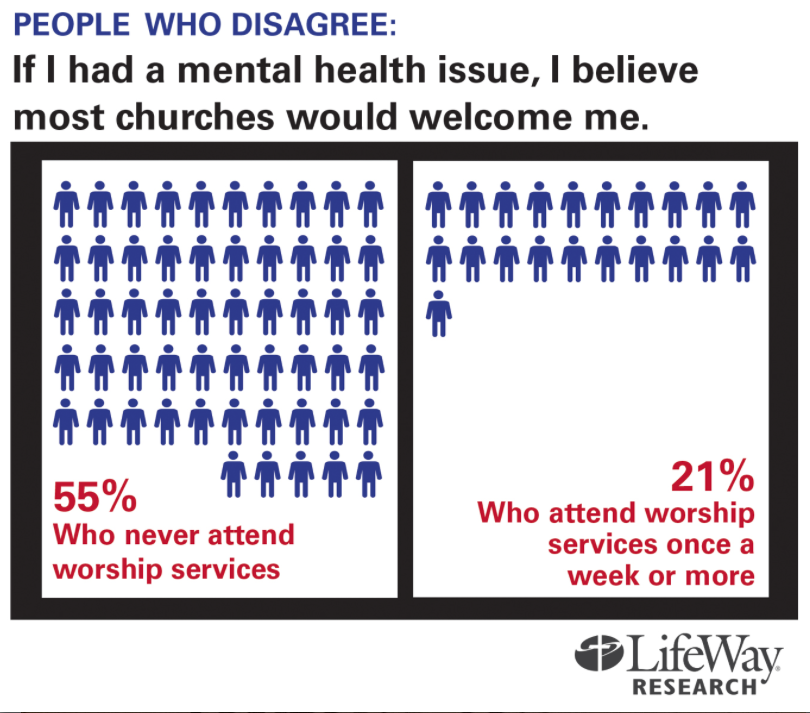
I found the most striking the differences in perceptions between adults who don’t attend church and adults who attend worship services once a week or more on the topic of how welcoming local churches are to people with mental health issues…

Lifeway 1

Fifty-five percent of adults who don’t regularly attend church disagreed with the statement that most churches would welcome them if they had mental health issues, compared to 21% of weekly churchgoers.

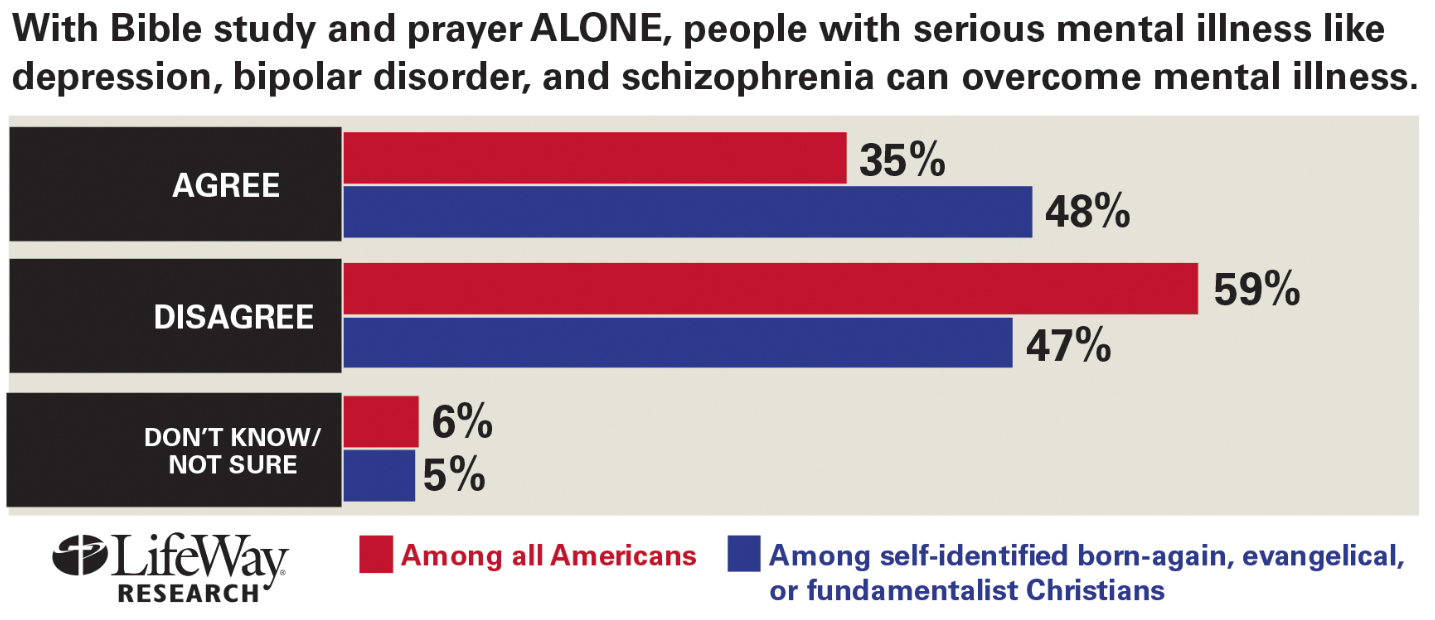
There were other interesting findings from the study (telephone survey of 1,001 adults, conducted from September 6-10, 2013). 48% of Evangelical, fundamentalist or “born again” Christians believe prayer and Bible study alone can overcome serious mental illness depression, bipolar, schizophrenia) compared to 27% of all Americans.

Lifeway 2

Ponder this…as a psychiatrist, I strongly suspect the vast majority of adults with mental illness have prayed repeatedly for relief from their condition regardless of whether they attend church or not. If they’re not involved with a church where they’re exposed to good teaching that provides a Biblical context for why a loving God might not relieve their pain and tangible encouragement and support through a caring church family, there’s a good possibility they’ll become embittered and turn away from God forever.

KM 2ChurchThink about this. 26% of the adult population in the U.S. has been diagnosed with mental illness…more than one in five adults and one in four women currently take medication for a mental health disorder. Over 20% of women take antidepressants. If we (conservatively) assume that half the U.S. population doesn’t attend church and a quarter of U.S. adults experience mental illness, we likely have a minimum of 25 million adults with mental illness who don’t attend church. If the majority of those 25 million adults believe they won’t be welcomed at church, WE HAVE A REALLY BIG PROBLEM.

Our crew at Key Ministry is here to help churches welcome families of kids with mental illness, trauma and developmental disabilities.

***********************************************************************************************************

cropped-key-ministry-door.pngOur Key Ministry website is a resource through which church staff, volunteers, family members and caregivers can register for upcoming training events, request access to our library of downloadable ministry resources, contact our staff with training or consultation requests, access the content of our official ministry blog, or contribute their time, talent and treasure to the expansion of God’s Kingdom. In addition to our downloadable resources, those who register for our resource kit can view any presentation from our Inclusion Fusion Disability Ministry Web Summits “on-demand”. All of these resources are made available free of charge. Check out our website today!

Posted in Controversies, Depression, Inclusion, Key Ministry, Mental Health | Tagged , , , , , , , , , , | 7 Comments

The many types of childhood trauma

Wounded_civilians_arrive_at_hospital_AleppoWelcome to our Fall 2013 blog series: Trauma and Kids…A Primer for Pastors, Church Staff and Parents. We begin today by reviewing the different types of trauma associated with development of Post-Traumatic Stress Disorder (PTSD).

As we launch into a series on trauma, a good place to start might be to define what exactly constitutes trauma? We all live in a world surrounded by potential dangers. Families living on the East Coast or the Gulf Coast live with a potential danger from hurricanes at this time of year. Kids in some neighborhoods in our country experience an increased risk of becoming a victim of gang violence. Little kids learn not to play with matches, or touch a hot stove, or ride their bikes into a busy street without looking. But danger can generally be managed.  People typically evacuate the beach when a hurricane warning is issued. If you can’t swim, you stay in the shallow end of the pool.

A traumatic event may occur when danger threatens serious injury or death in a situation in which the individual has little or no ability to protect themselves from witnessing or experiencing the event, or reversing the outcome of the event. Some traumatic events may be one-time events (people working in Lower Manhattan who witnessed the events on the morning of 9/11), while others may be recurrent (the child who is repeatedly molested by a parent or caregiver).

A recent study of adolescent trauma reported that over 61% of U.S. teens had been exposed to at least one potentially traumatic experience (PTE). 31% have experienced multiple PTEs, while 18.6% report experiencing three or more PTEs.

Kids who have been victims of trauma are among our most challenging to diagnose and treat. Fortunately, the majority of kids who experience a significant traumatic event demonstrate significant resiliency. Unfortunately, others may develop serious complications persisting for decades. On the surface, it may appear there’s little rhyme or reason to why individual kids react so differently to similar types of traumatic events and experiences. As we delve into this topic, readers will quickly appreciate that what we don’t know clearly exceeds what we know.

One challenge we face in teasing out the effects of trauma comes from the sheer variety of traumatic situations to which kids may be exposed. Research suggests the nature of the traumatic event has a profound effect upon the long-term outcome for the child. Let’s look at the different types of events known to produce the characteristic effects of trauma in kids…

  • Child abuse: physical, sexual, emotional
  • Violence: domestic, school-based, community-based
  • Traumatic loss: serious illness, death
  • Disruption in placement, living arrangements
  • Accidents: plane crashes, car accidents, athletic injuries, falls
  • Natural disasters: earthquakes, floods, storms, fires
  • War
  • Terrorism
  • Medical trauma: effects of repetitive, invasive medical treatments

In our next segment, we’ll look at specific factors that heighten the risk for PTEs to result in lasting negative effects. Here’s a preview-the highest risk is for kids with repeated exposure to interpersonal trauma involving physical or sexual violence.

***********************************************************************************************************

Caring for KidsThe National Child Traumatic Stress Network has excellent resources for parents and professionals on topics related to traumatic stress in children and teens. Here’s a downloadable book…Caring For Kids: What Parents Need to Know About Sexual Abuse.

Posted in Mental Health, PTSD, Resources | Tagged , , , , , , , , | 1 Comment

Sun Shine Down…An interview with Gillian Marchenko

sun shine down polly and momWe’re honored to have Gillian Marchenko with us as we kick off our new weekly feature, Faces of the Movement. Every Sunday night/ Monday morning we’ll be introducing our followers to a ministry leader or parent making a significant contribution to the disability ministry movement. Gillian has been gracious enough to lead off for us.

Gillian is an author and national speaker who lives in Chicago with her husband Sergei and four daughters. She writes and speaks about parenting kids with Down syndrome, faith, depression, imperfection, and adoption. Her work has appeared in numerous publications, including Chicago Parent, Thriving Family, Gifted for Leadership, Literary Mama, Today’s Christian Woman, MomSense Magazine, Charlottesville Family, EFCA Today, and the Tri-City Record. Her book, Sun Shine Down, a memoir, was published by T. S. Poetry Press earlier this month. Gillian says the world is full of people who seem to have it all together. She speaks for the rest of us.

Here’s our interview with Gillian…

C4ECWhat have you learned about God through your experience as a mom with two girls with Down syndrome that surprised you the most?

GM: I’ve really come to plead for and rely on this part of the Lord’s Prayer: Give us this day our daily bread. What I’ve learned through parenting kids with Down syndrome, what I think I probably knew cerebrally as a believer but now relay on concretely, is my daily need for God. There’s just no way I can parent without him. He shows up every day, with just the manna I need. The trick is not forgetting. He’s always there, but sometimes, sadly, I stand him up for other things. The good news is, he’s there again the next day, regardless of parenting fails or wins.

C4EC: If you could go back in time and have a conversation with yourself, what would you say now to comfort and encourage the Gillian who had just given birth to a child with a disability in a foreign country?

GM: I wrote a little bit about that in my memoir Sun Shine Down:

“I wished she’d (Polly) been cheered for, smiled at, and loved from the moment of her first breath. I wished for a do-over. I wanted to do her birth again. I would wake up the morning after her birth in Ukraine, thankful for the gift of a child. I would be more present and open-minded. I wouldn’t cringe when I heard about the possibility of Down syndrome. I wouldn’t make snap judgments that imagined a little girl standing off to the side of life staring blankly with her tongue sticking out, as if that defined the quality and pleasure of her life. Instead, I would imagine my daughter: an adorable girl with sassy, hot pink glasses, who loves music and has a keen sense of humor and the desire to be a good friend. If I were allowed a do-over for Polly’s birth, I wouldn’t run to my bed and curl up into a ball upon hearing her diagnosis. Instead, I’d bend down and place my hand on her chest and vow to love and protect her. I would thank God for her. I would assert that even though difficulties would arise, I would be privileged to be Polly’s mother.”

Sun Shine Down, page 124

Today, if I could go back in time and have a conversation with myself about having a child with a disability, I’d say this: “Give it time. It is OK to grieve. But love your child. Let the baby change you. And know that God has a plan to use you and your child that is beyond your comprehension or ability.”

C4EC: What do you say to mothers who are struggling with the challenges of parenting a child with a special need when they don’t have the faith you have to fall back on?

GM: I’d say let the baby change you. Find community. Talk openly with someone about your feelings. Care for your child. Don’t disconnect.

***********************************************************************************************************

Sun Shine DownWhat if? What if you dreamed of having a beautiful child and in your mind you saw the life you’d share with that child. First steps, little league (or ballet). Maybe the child would play piano or make you proud on the Honor Roll. There’d be eventual graduations, college, even marriage and grandchildren. You might dream it out that far. Or not. Every parent has hopes. No parents wish for pain—their own, or a child’s. Then you had a premature delivery in a foreign country. And the words swirling around you said a different kind of “what if.” What if something was wrong? The dream was at risk—or so it seemed. Would you be ready for that? Could you make peace? Or would it take you down? These are the questions author Gillian Marchenko faced as she woke up after an emergency C-section in Ukraine. Only her newborn child could answer them, in time. But first she had to find a way to hear more than the words “Down syndrome.”

Sun Shine Down: A Memoir, by Gillian Marchenko. Available in paperback and for Kindle at Amazon.

Posted in Families, Intellectual Disabilities, Key Ministry, Stories | Tagged , , , , , , | 1 Comment

Loss and Grief in Parenting Children with Special Needs…Inclusion Fusion Library

inclusionfusionfinalToday…and every Friday, we’ll be sharing videos from our Inclusion Fusion disability ministry training library of interest to our followers. All of the videos from Inclusion Fusion 2011 and 2012 are available “on-demand”, free of charge at any time for pastors, ministry staff or family members registered for the site.

We’ll start our series with a video from a well-known author…and our guest blogger for this weekend-Gillian Marchenko. Gillian spoke on the topic Loss and Grief in Parenting Children with Special Needs for Inclusion Fusion 2012.

Gillian Marchenko is attracting a rapidly growing following for her skills as a writer, speaker, and advocate for individuals with special needs. She writes and speaks about parenting kids with Down syndrome, faith, imperfection, and adoption. Her work has appeared in MomSense Magazine, EFCA TODAY, Four Cornered Universe, CHICAGO PARENT, Story Bleed, CHICAGO SPECIAL PARENT, and is forthcoming at Thriving Family, Literary Mama, and Connections Magazine. She speaks to Mothers of Preschool groups and teaches about inclusive church with Joni and Friends Chicago. Gillian’s new book Sun Shine Down: A Memoir is available in paperback and for Kindle at Amazon.

***********************************************************************************************************

cropped-key-ministry-door.pngOur Key Ministry website is a resource through which church staff, volunteers, family members and caregivers can register for upcoming training events, request access to our library of downloadable ministry resources, contact our staff with training or consultation requests, access the content of our official ministry blog, or contribute their time, talent and treasure to the expansion of God’s Kingdom through the work of Key Ministry. In addition to our downloadable resources, those who register for our resource kit can view any presentation from our Inclusion Fusion Disability Ministry Web Summits “on-demand”. All of these resources are made available free of charge. Check out our website today!

Posted in Families, Inclusion Fusion, Intellectual Disabilities, Key Ministry, Stories | Tagged , , , , , , , , | Leave a comment

What’s ahead for Inclusion Fusion?

inclusionfusionfinalFor the past two years, our team at Key Ministry has produced Inclusion Fusion, a free, worldwide, disability ministry Web Summit for pastors, church staff, volunteers and families. Inclusion Fusion has been very well-received, with the video presentations from 2011 and 2012 having received many thousands of views from Web Summit participants.

Given that we’re already into September, we’ve received a number of inquiries about our plans for this year’s conference.

Inclusion Fusion MagazineWe’re taking a break from Inclusion Fusion for 2013, assembling the resources for something more ambitious in 2014. Because of the time and resources devoted to other major projects we explored this year, our team was unable to assure our Board that Key Ministry could produce a Web Summit for the Fall of 2013 reflecting the level of excellence we expect of ourselves.  We’re exploring major upgrades in technology to support Inclusion Fusion along with other Key Ministry training.  We’ll also be considering ideas from participants for making Inclusion Fusion far more user-friendly in the future.

Instead of considering Inclusion Fusion as a once-yearly event, we’re exploring the development of an ongoing symposium throughout the year (monthly/quarterly) composed of “mini-conferences” on specific topics of interest to pastors, church staff, volunteers associated with the movement. We’re also considering a larger, two or three day Web Summit, similar to what we’ve done in the past, for the Fall of 2014. If feasible, we’d like to have at least one Inclusion Fusion event during the year conducted in the presence of a live audience where presenters and participants would have the opportunity to connect and build relationships “in-person”.

Those who have registered for the conference in the past will be receiving a survey link prior to the end of September seeking input from our team for how we can improve Inclusion Fusion going forward.

RK Inclusion Fusion IconIn the meantime, we’ve updated the Inclusion Fusion library available through the Key Ministry website to allow anyone who registers for our free resource kit to view any presentation from our previous conferences “on demand” at any time. Over 1,000 pastors, church staff, ministry leaders and family members have registered for our free resources. We’ll also be featuring presentations from past Inclusion Fusion Web Summits on a weekly basis on our ministry blog, and may have some special events this fall featuring past Inclusion Fusion speakers as we gear up for what 2014 has in store!

Thanks for your support of Inclusion Fusion, and for your ongoing support of the work of Key Ministry.

***********************************************************************************************************

cropped-key-ministry-door.pngOur Key Ministry website is a resource through which church staff, volunteers, family members and caregivers can register for upcoming training events, request access to our library of downloadable ministry resources, contact our staff with training or consultation requests, access the content of our official ministry blog, or contribute their time, talent and treasure to the expansion of God’s Kingdom through the work of Key Ministry. In addition to our downloadable resources, those who register for our resource kit can view any presentation from our Inclusion Fusion Disability Ministry Web Summits “on-demand”. All of these resources are made available free of charge. Check out our website today!

Posted in Inclusion Fusion, Key Ministry, Resources, Training Events | Tagged , , , , | 2 Comments

Key Ministry Fall Preview…

38015_1150887550010_1762281736_287637_5067815_nThe air is getting a little cooler, the kids are back at school, the leaves are starting to turn color and the Browns remind us through their play that we all live in a fallen world that needs to be redeemed. All are signals that it’s time to begin a new ministry year. Our crew at Key Ministry has been hard at work making preparations. Here’s what we have in store for you this Fall…

Faces 2First, the blog. Beginning next Tuesday, September 17th, we’re going to be launching a new blog series,  Trauma and Kids…A Primer for Pastors, Church Staff and Parents that will run on Tuesday and Thursday mornings in September and October. In this series, we’ll examine the types of trauma children are exposed to, risk factors for childhood trauma (genetic, familial, environmental), neurobiological changes that occur in response to childhood trauma, symptoms associated with trauma and treatment strategies for kids who’ve experienced trauma. In this series, we’ll also explore the impact of abandonment and neglect upon children and teens.

Beginning this coming Sunday, we’ll be launching a new feature…Faces of the Movement. Every Sunday evening through the Fall, we’ll be introducing you through a post or interview with a pastor, church leader or family member of a child with a disability with a unique perspective to share on topics related to disability and faith. We hope you’ll discover new leaders and new resources with a shared passion for including kids with disabilities and their families in the life of the local church.

Next…our crew will be making a number of live appearances this Fall…

Jam LogoRebecca Hamilton will be leading our team to Nashville for a JAM Session on Saturday, September 21st at Lakeshore Christian Church, 5434 Bell Forge Lane East, Antioch, TN. Our JAM sessions are regional trainings designed for children’s pastors, student pastors, church leaders and key volunteers. This J.A.M. session will provide participants with an intensive, one-day training experience that will prepare them to lead ministry to kids with hidden disabilities in their churches, including sessions on including kids with disabilities in age-appropriate children’s or student ministry activities. For more information, or to register for the Nashville JAM Session, click here!

fuse-banner-smallNext, Key Ministry Board member and best-selling author Rhonda Martin will be speaking at the F.U.S.E/One Accord Conference, sponsored by Joni and Friends Ohio. F.U.S.E. 2013 is the premier regional conference in Ohio dedicated to building bridges in disability ministry to churches, those working in the disability or mental health fields, and anyone touched by disability, with a special emphasis on African-American and other minority populations. F.U.S.E. is taking place on October 4th -5th (Friday and Saturday) at Gender Road Christian Church in Canal Winchester, Ohio (Columbus area). Click here for more information or to register for the conference.

katiewetherbee2Katie Wetherbee will be doing two, two hour “Half Track” presentations at the Group KidMin (Children’s Ministry) Conference in Columbus, Ohio on October 11th-14th. Half-Tracks offer two 2-hour sessions per topic for a total of four hours focused on learning, discussion, and application. They allow for depth and breadth–a mix between the exploration of Deeper Learning Tracks and the broader scope of workshops.

KidMin 2013Families affected by special needs are significantly less likely to attend church on a regular basis. Katie’s half-track will help you turn that around. In her half-track, you’ll discover how common disabilities affect faith development and cause obstacles for church attendance, delve into family dynamics and discuss ways to communicate effectively with parents of children with special needs, practice easy-to-implement strategies for welcoming and teaching kids with special needs and review behavior management, classroom culture and curriculum modifications. Click here for more information, or to register for the conference.

inclusionfusionfinalOne more thing…Inclusion Fusion. We’ll have an announcement about our plans for the Disability Ministry Web Summit in the next week or so, along with additional FREE resources available from last year’s conference.

***********************************************************************************************************

cropped-key-ministry-door.pngOur Key Ministry website is a resource through which church staff, volunteers, family members and caregivers can register for upcoming training events, request access to our library of downloadable ministry resources, contact our staff with training or consultation requests, access the content of any or all of our three official ministry blogs, or contribute their time, talent and treasure to the expansion of God’s Kingdom through the work of Key Ministry.

Posted in Key Ministry, Resources, Training Events | Tagged , , , , , , , , , , , | Leave a comment

Resources for Christian schools seeking to pursue inclusion

CLCToday, we’re concluding our discussion of inclusion of kids with special education needs in this miniseries with Barb Newman and Elizabeth Dombrowski of CLC Network.

In Part One of the series, we discussed how CLC became involved in serving kids with disabilities in Christian schools in their home region of Western Michigan, and the obstacles they face in getting other Christian schools to pursue inclusion. Last Thursday, we explored the topic of how parents can advocate for an inclusive Christian education for their children with special education needs. Today, we’ll conclude with a look at the resources available for schools committed to pursuing inclusion of kids with disabilities.

C4EC: Speaking of resources, we hear you have a new book available to help Christian schools include kids with special education needs, What can you tell us about the book?

CLC Network: We have several books and resources for schools. The newest one is called Nuts and Bolts of Inclusive Education. This book is the most comprehensive as it walks schools through very specific steps to set up opportunities for children with higher levels of need. If a family comes to the school, and one of the children has Down syndrome, this book would be the guide to use. Beginning with the importance of preparation – who needs it and what to do, moving into planning for the child – with needed forms and supports, and then into the actual day to day components of the program – from report cards to training paraeducators, this book is filled with the practical ideas the schools will need. Each portion of this book is rooted in Biblical principles and invites people to experience this blessing of God called inclusive education. Previous books include an overview of inclusive education called “Any Questions”, ideas to support friendships called “Circle of Friends Manual”, and “The School Welcome Story” which is a tool one can use to write an informational story for a child before entering a new setting. These were all written by Barb.

C4EC: Let’s say we could persuade one of our local Christian schools to partner with CLC Network as consultants in an initiative to serve kids with special education needs. What’s the nature of the service your group can provide to churches outside of your home base in Western Michigan?

CLC Network: We recognize that volunteers are the key to any church-wide effort, so we provide easily-accessible training in book and DVD form. Our G.L.U.E. (Giving, Loving, Understanding, Encouraging) process provides an overarching way for you to think about inclusion in a church setting. We believe so strongly that churches need this encouragement, we are giving away the DVD and Training Manual—four hours of training—to any church interested in putting some oomph behind that “Welcome” sign on the door. Once a church community has made a commitment to persons with disabilities, there are lots of ways to come alongside that person and receive their witness. Our background in education helps churches overcome some of the biggest hurdles to inclusion – how to conduct inclusive Sunday School, youth group, and adult bible study. Depending on your church’s gifts and needs, resources from Friendship Ministries and Joni & Friends can also become important supports to sustain a purposeful inclusion program.

C4EC: One last question…with all of the funding challenges that the typical Christian school faces, why should Christian school administrators make inclusion of kids with learning differences a priority?

CLC Network: There are many reasons, so let me begin with the practical and then end with the spiritual. Practical…I was visiting a school because they did not have an inclusion program and the school felt they were no longer able to meet the needs of some of the children already enrolled. I was doing an observation as part of our intake process, and realized the number of enrollments they were losing. With siblings, 4 children would be leaving this school. For this school, that would have been tuition of about $6,000 per child per year. I asked the administrator if he would like to keep that $24,000 in his school or send it somewhere else. For that money, he chose to hire CLC Network as well as an on-site assistant whose day would be divided among the children needing support. There was even money left over. What schools don’t realize is that inclusion can increase enrollment as families enroll all of their children. When families leave, schools lose money. At the school where I work, we have about 50 children who have more significant needs. Each of these children has 1-3 siblings who are also part of our school. You do the math. Money aside, I believe the most important reason has to do with God’s intended community. I often ask a group of parents “when your children graduate from high school, what do you want them to have learned?” While the discussion often begins with math or reading or government, the conversation quickly turns to character qualities such responsibility, caring, respect, and more. One of the greatest benefits we see for inclusion is that it truly is a program for all. Every student enters into a community of care that allows teachers to highlight relationships and living with one another in ways they could never have achieved without a child like Isaac. Inclusion forms the habits and hearts of each child present. It’s little wonder, however, because as you read Scripture, God clearly shows us these types of communities where “the eye cannot say to the hand ‘I don’t need you’”. Each part is important to the whole. In some ways, excluding the child with the disability handicaps an entire student body.

***********************************************************************************************************

logoCLC Network is a nonprofit educational consulting firm helping schools and churches support people at all levels of ability and disability.  To contact CLC Network for a consultation, evaluation, or resources, call 616-245-8388 or visit www.clcnetwork.org.

Posted in Advocacy, Families, Hidden Disabilities, Inclusion, Resources | Tagged , , , , , , , , | Leave a comment