Including kids and teens with mental illness at church…What are the barriers?

Kids running in field-ShutterstockWe as the church do a lousy job of welcoming and including families of children and teens with mental illness or trauma histories. I’d argue that a major reason why we struggle is the absence of an agreed-upon model for a mental health inclusion ministry for kids.

A couple of weeks ago, I shared a post on the topic Is Mental Illness a Disability? in which I quoted from a message I received from a highly respected ministry colleague…

Would I expect to find a person with mental health struggles (depression, bipolar, schizophrenia) to be a part of our disability ministry at XXXXXXX Church?  No.  For me, mental illness is a separate…and much needed…ministry within the church. Is this a topic that the special needs community would expect Key Ministry to address? 

I’ve come to the conclusion that our team at Key Ministry needs to, at the very least, put forth a conceptual model for a mental health/trauma inclusion ministry that could be implemented by churches of all sizes, denominations and organizational styles. This model would be continually tested and refined through the experiences of ministry partners everywhere seeking to include kids and teens with ADHD, anxiety, attachment issues, mood disorders, post-traumatic stress and difficulties with social communication and interaction.

This post is going to kick off a series exploring what a inclusion ministry model for kids with mental illness might look like in practice. In order to design such a model, we must start by identifying as specifically as possible the problem(s) we seek to solve. Today, we’ll start by identifying seven barriers to regular church attendance/participation for kids with the conditions outlined above and their families. As our series progresses, we’ll delve into  the barriers in depth and propose strategies for overcoming each barrier.

Barrier #1. Social isolation

Families of kids with many of the common mental health conditions described above are less likely to have as many opportunities for interaction with other families/children that produce invitations to church.

Barrier #2. Social communication

Churches are intensely social places. Consider the challenges that a child or teen faces in an environment surrounded by same-age peers who has difficulty processing body language/body space, tone/inflection of speech, common rules of social behavior or  struggles to effectively use words to express thoughts or feelings in unfamiliar or stressful situations!

Barrier #3. Executive functioning

Kids with common mental disorders frequently experience difficulties with impulse control, problem-solving, learning from experience, managing time, delaying gratification and self-regulating emotions…all of which are common expectations in the environments in which we do much of our children’s and youth ministry.

Barrier #4. Sensory processing

Sensory processing differences are common among children with autism spectrum disorders, ADHD and anxiety disorders. Many respond differently to sound, light, touch and taste than their same-age peers, and ministry environments that some kids find engaging may be experienced as noxious by children with heightened sensitivity to sensory stimulation.

Barrier #5. Recognizing the child/teen’s need for support

Kids who are served (and served well) by our existing disability ministries typically experience an easily recognizable physical disability, or weaknesses in adaptive functioning such that they are readily identified by church staff or volunteers with no special training. Parents of kids with mental illness or learning disorders may not be aware that their child has a disability, recognize that their children would benefit from simple accommodations or supports at church, or may be reluctant to disclose their child’s condition to church staff/volunteers.

Barrier #6. The desire of kids to not be seen as “different”

Kids and teens with the conditions we’re discussing often express their desperation at wanting to “belong.” Older children and teens are often very reluctant to accept any help that might result in their peers viewing them as “different” in any way. The vast majority of kids I serve in my practice would be horrified by the prospect of having to be part of a “special needs ministry.”

Barrier #7. Parents with mental illness

The apple doesn’t fall far from the tree. Many common mental illnesses are highly heritable. Kids generally don’t drive themselves to church. Any effective strategy to include kids with mental illness or trauma histories at church needs to take into consideration the barriers that have excluded their parents or caregivers from church.

What do you think of this list? Are there any significant barriers you’d ADD to the list? Any barriers listed here that don’t belong on the list?

Next: Overcoming the Relationship Barrier

***********************************************************************************************************

Square Peg Round HoleKey Ministry has assembled a helpful resource on the topic of Asperger’s Disorder and Spiritual Development. This page includes the blog series Dr. Grcevich and Mike Woods developed for Key Ministry, links to lots of helpful resources from other like-minded organizations, and Dr. Grcevich’s presentation on the topic from the 2012 Children’s Ministry Web Summit. Click here to access the page!
Posted in ADHD, Anxiety Disorders, Autism, Bipolar Disorder, Hidden Disabilities, Key Ministry, Mental Health, Strategies | Tagged , , , , , , , , , | 9 Comments

Mike Pitts…Hidden Disabilities in Middle School Ministry

Mike PittsMike Pitts is a decade + youth worker from the southeastern United States who made his way north to the Midwest. Along his journey, this southern transplant developed a passion for middle school students and for engaging students with hidden disabilities. Mike is an ambassador for Key Ministry (keyministry.org) challenging youth workers to discover the context of ministering to students with hidden disabilities. Mike and his wife Hope have been married for four years and live with their two young children (Emery & Phoebe) in Cleveland, Ohio. 

Mike will be doing a series of guest blogs for us in 2014 on including kids with mental illness, trauma or developmental disabilities in youth ministry environments. Here’s an overview from Mike…

“That’s not fair! The girls didn’t win! You gave them an extra point so the guys would lose!” exclaimed Kevin after the final round. As youth workers we understand the unwritten concept that unless the guys blatantly win we always give the “W” to the ladies if the game has a messy and/or consequence of awkwardness to it. The problem was, for the entire evening Kevin wouldn’t let me live it down. He explained the scenario from every angle, which always led to the guys winning. Many youth workers would have found this annoying and tried to ditch the student in the crowd. However, I knew something about Kevin that allowed me to extend grace to the annoyance in my ear (beside the fact that he was right). Kevin is on the autism spectrum, which gives him an enhanced/passionate sense of justice. In his mind there is right and wrong, black and white, rules and guidelines to be followed, and a definite winner and loser. He knew I fudged and told a little white lie and his brain couldn’t wrap around the idea of letting it go.

KEVIN LOOKED JUST LIKE EVERY OTHER MIDDLE SCHOOL GUY IN MY GROUP: MESSY HAIR, BLUE JEANS, NIKE SHOES, RANDOM T-SHIRT, AND A NORTH FACE JACKET.

There was nothing about him physically that would set him apart from any other student. In fact there wasn’t anything obvious that would necessarily set him apart from other students either. And that’s the thing about hidden disabilities – there are no outward identifying factors. By definition a hidden disability is a serious emotional, behavioral, or developmental disorder with no outward apparent physical symptoms.

Everything I know about hidden disabilities from personal study and conversations with mental/behavior health professionals tells me that Kevin is an exception to the rule. He’s an exception because most students with hidden disabilities aren’t actively involved in youth ministries. Why is that? Most students find everything about our ministry environments both large and small to be unnerving and unsettling so they don’t attend period. Students with ADHD are one exception to this pattern because they thrive on stimulation and those who have learning disabilities (you know, the ones who never want to read aloud or give you there thoughts on what they just read) are the other exception.

Somewhere along the line we have unintentionally and unknowing catered our ministries to the “typical” students. This is somewhat understandable because they are the ones who keep our attendance numbers up and bring friends. But what we have done without ever using words is hindered children from coming to Jesus through our ministries. Remember in Mark 10:13-16 where Jesus rebuked his disciples, the ones who loved him and had a heart for ministry, for trying to keep children from coming to him. No youth worker sets out to say I’m going to design my ministry and exclude these types of students…it happens unintentionally.

IT HAPPENS BECAUSE WE ARE UNINTENTIONAL AND UNDEREDUCATED ON THE IMPACT HIDDEN DISABILITIES HAVE ON STUDENTS, THEIR FAITH, AND THE LOCAL CHURCH.

Hidden disabilities are very much part of my family as I have been diagnosed ADD/OCD. Most youth workers joke that they have it but I clinically do. In addition to that, my wife is dyslexic. We have personally experienced the barriers our disorders can present to being involved in church life both as attendees and youth workers. Think about it: for my wife, she doesn’t do well in small group environments where she is expected to read, immediately comprehend what she read, and thoughtfully respond to it. For me, I hate long sermons, worship sets that go beyond 3 songs, altar calls that drag out, and pretty much anything that isn’t fast paced or experiential. My personal experience has actually taught me how to build a ministry that is sensitive and aware to the diverse needs students have.

THE KEY TO MINISTERING TO STUDENTS WITH HIDDEN DISABILITIES IS A WILLINGNESS TO BE FLEXIBLE BOTH IN CREATING ENVIRONMENTS AND PROGRAMMING, AND ALSO IN CATERING TO THE EMOTIONAL AND PHYSICAL HANG-UPS FOR STUDENTS.

Here are just a few ministry tips for a few common hidden disabilities to get you thinking about your ministry and your students. Students with

Anxiety disorders – do better when they are familiar with and know all the variables.

ADHD – do better when they are involved in meaningful service roles.

Aspergers disorder – do better with individualized attention from an adult/upperclassmen friend to help them navigate social culture in youth ministry.

Attachment disorders – do better when they have meaningful relationships with 4-5 adult youth workers rather just 1 or 2.

You see it’s not big changes to our ministry, just a few small tweaks to truly create unconditional and unhindered access for all students. Start the conversation. Get educated. Reach out.

Originally published at middleschoolministry.com

***********************************************************************************************************

Square Peg Round HoleKey Ministry has assembled a helpful resource on the topic of Asperger’s Disorder and Spiritual Development. This page includes the blog series Dr. Grcevich and Mike Woods developed for Key Ministry, links to lots of helpful resources from other like-minded organizations, and Dr. Grcevich’s presentation on the topic from the 2012 Children’s Ministry Web Summit. Click here to access the page!

Posted in Advocacy, Hidden Disabilities, Inclusion, Key Ministry | Tagged , , , , , , , , , | 2 Comments

Key Ministry Training Survey

DSC00179Help our Key Ministry team plan for 2014…we’re putting together our training offerings for the coming year, and want to know how we can be most helpful to your church’s staff and volunteers as you serve families impacted by disabilities.

Thanks for taking this brief, five question survey. If you have additional training needs pertaining to disability ministry training, feel free to leave comments below or contact us at steve@keyministry.org or rebecca@keyministry.org

Thanks for your feedback! We hope to make available lots of great training in 2014, featuring Key Ministry staff and other disability ministry leaders.

***********************************************************************************************************

ID-10072756Key Ministry has put together a resource page for pastors, church staff, volunteers and parents with interest in the subject of depression and teens. Available on the resource page are…

  • Links to all the posts from our recent blog series on depression
  • Links to other outstanding blog posts on the topic from leaders in the disability ministry community
  • Links to educational resources on the web, including excellent resources from the American Academy of Child and Adolescent Psychiatry (AACAP), a parent medication guide, and excellent information from Mental Health Grace Alliance.

Photos courtesy of  freedigitalphotos.net

Posted in Key Ministry, Training Events | Tagged , , , , , , , , , , | 3 Comments

Help Wanted…for two “Key” jobs

large door final.inddKey Ministry has big plans for 2014. Our ministry team needs to grow. We appreciate your help in connecting us to the right people who may be called to help implement God’s plans for our ministry in supporting individual churches and the disability ministry movement in the years ahead.

We’re looking for a couple of good men…or women. We have two paid positions we’re seeking to fill.

We’re looking for a Director of Communications/Community Manager who will be responsible for advancing the overall work of Key Ministry through the creation of an online communications system that maximizes the availability of online tools, training, and resources.

Their responsibilities will include..

  • Preparation of a promotion/communication strategy for Key Ministry in consultation with the Director of Strategic Initiatives and the Staff Coordinator.
  • Targeting and cultivation of strategic ministry partnerships, together with Key Ministry staff and Board members.
  • Updates and monitors Key Ministry social media platforms.
  • Coordination of our Inclusion Fusion Web Symposium/Summit with the Director of Strategic Initiatives and the Inclusion Fusion Program Committee.
  • Joining with the Director of Strategic Initiatives in the visioning and development of Key Ministry’s online church platform
  • Provide training and feedback for staff and volunteers serving as online worship hosts and/or group leaders at partner churches
  • Pursuing sponsorships for Key Ministry’s online church platform, Inclusion Fusion, Key Ministry training events and training events offered by like-minded ministry organizations on Key Ministry platforms.
  • Oversee all online advertising (Google Ads and Facebook Ads), regularly reviewing and reporting on the effectiveness of advertising for our online church platform, Inclusion Fusion and Key Ministry training events

We anticipate this position will require an average of 24 hours/week in 2014, contingent upon the growth of our ministry offerings. Interested candidates may download the job description here.

401px-Computers_&_GeeksWe’re also looking for a Director of Media/Technology who will assume responsibility for advancing the overall work of Key Ministry through the management of all technology platforms and through provision of basic graphic design and video production.

This individual will be responsible for managing all of our technology platforms, including

  • Key Ministry platforms for ministry training, Inclusion Fusion and online church.
  • Uploading new materials and resources to our Key Ministry website     
  • Key Ministry e-mail lists
  • Exchange of electronic ministry resources with partner churches and ministry organizations

This individual will also be responsible for post-production tasks associated with video resources featured on Key Ministry platforms along with cultivation of volunteers to assist in meeting video production/technology needs of the ministry. In addition, they will be available as needed to provide technical assistance to Key Ministry partner churches, ministries and speakers as they share electronic ministry resources for use in training events, Inclusion Fusion or Key’s online church platform.

We anticipate this position will require an average of 20 hours/week in 2014, contingent upon the growth of our ministry offerings. Interested candidates may download the job description here.

Candidates who either reside in, or can easily and inexpensively travel to Northeast Ohio are preferred, but we will consider superior candidates for either position who reside in the U.S.

We encourage our readers and colleagues in ministry to forward this post to individuals with interest in joining Key Ministry’s staff. Interested parties are encouraged to send a cover letter and resume ASAP to Rebecca Hamilton at rebecca@keyministry.org.

***********************************************************************************************************

2014Thanks to all of our readers for making this blog such a success in 2013! Our team at Key Ministry very much appreciates your willingness to share our resources with others interested in the things we care about. Here are our ten most popular blog posts in 2013…help us get the word out to churches interested in sharing Christ’s love with families of children with mental illness, trauma or developmental disabilities in 2014!

Photo courtesy of http://www.freedigitalphotos.net

Posted in Key Ministry | Tagged , , , , , , , | Leave a comment

Is mental illness a disability?

shutterstock_364686716Today’s blog post is an open response to a question I received in an e-mail a couple of days before Christmas from a highly respected and valued ministry colleague and friend.

Is mental illness a disability? Many of the definitions (NAMI, etc.) for mental illness that I find do not include the word “disability.”  Would I expect to find a person with mental health struggles (depression, bipolar, schizophrenia) to be a part of our disability ministry at XXXXXXX Church?  No.  For me, mental illness is a separate…and much needed…ministry within the church. Is this a topic that the special needs community would expect Key Ministry to address? 

How do you define “disability?”

Webster’s Dictionary defines disability as a condition (such as an illness or an injury) that damages or limits a person’s physical or mental abilities.

Under the Americans With Disabilities Act, an individual with a disability is a person who: (1) has a physical or mental impairment that substantially limits one or more major life activities; OR (2) has a record of such an impairment; OR (3) is regarded as having such an impairment.

The World Health Organization defines disability as an umbrella term for impairments, activity limitations and participation restrictions. Disability is the interaction between individuals with a health condition (e.g. cerebral palsy, Down syndrome and depression) and personal and environmental factors (e.g. negative attitudes, inaccessible transportation and public buildings, and limited social supports).

How do you define mental illness?

502px-DelacroixTassoThe National Alliance for Mental Illness (NAMI) states that a mental illness is a medical condition that disrupts a person’s thinking, feeling, mood, ability to relate to others and daily functioning.

The U.S. Centers for Disease Control defines mental illnesses as disorders generally characterized by dysregulation of mood, thought, and/or behavior, as recognized by the Diagnostic and Statistical Manual, 5th edition, of the American Psychiatric Association (DSM-5).

I’ve been pondering this e-mail for several weeks…because of the person who sent it and the questions they raised …questions that are absolutely fundamental to the future direction of the disability ministry movement and fundamental to the future mission of Key Ministry.

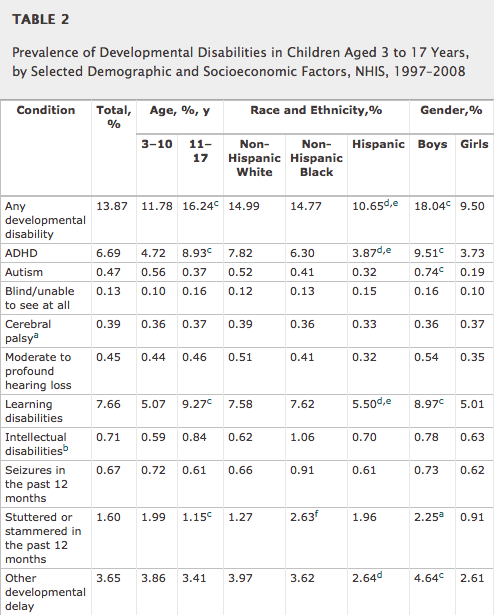
I was very surprised by my friend’s first question, because in my mind, the answer is so clearcut. Is mental illness a disability? ABSOLUTELY. The answer is so obvious that the question seems absurd. Here’s a 2011 article in Pediatrics examining trends in the prevalence of developmental disabilities in the U.S. from data obtained from the National Health Information Survey…for the purpose of this survey, developmental disabilities are defined as lifelong conditions arising in early childhood as a result of cognitive or physical impairment or a combination of the 2.

DD prevalence

Note that ADHD is listed as the most common developmental disability. Autism is, by the definitions above, a mental illness. Remember the controversy when then diagnostic criteria for autism were revised last year by the American Psychiatric Association?

The National Institute on Mental Illness (NIMH) makes the following statement, based upon data compiled by the World Health Organization (WHO):

Mental disorders are common in the United States and internationally. An estimated 26.2 percent of Americans ages 18 and older — about one in four adults — suffer from a diagnosable mental disorder in a given year. When applied to the 2004 U.S. Census residential population estimate for ages 18 and older, this figure translates to 57.7 million people. Even though mental disorders are widespread in the population, the main burden of illness is concentrated in a much smaller proportion — about 6 percent, or 1 in 17 — who suffer from a serious mental illness. In addition, mental disorders are the leading cause of disability in the U.S. and Canada.

My colleague’s next question is far more interesting…and the subject of our next post.

Would I expect to find a person with mental health struggles (depression, bipolar, schizophrenia) to be a part of our disability ministry at XXXXXX Church?  No.

Why wouldn’t we expect people with the most common cause of disability in the U.S. to be served by our existing disability ministries? My colleague is absolutely right…they’re NOT currently being served. Why not? Is that a good thing or a bad thing?

I very much encourage or readers to add their thoughts and comments.

Pictured: Tasso in the Madhouse by Eugene Delacroix 

***********************************************************************************************************

600817_10200479396001791_905419060_nConfused about all the changes in diagnostic terminology for kids with mental heath disorders? Key Ministry has a resource page summarizing our recent blog series examining the impact of the DSM-5 on kids. Click this link for summary articles describing the changes in diagnostic criteria for conditions common among children and teens, along with links to other helpful resources!

Posted in Adoption, Controversies, Hidden Disabilities, Mental Health | Tagged , , , , , , , , | 6 Comments

Why “snow days” are rough on many kids with disabilities

640px-SnowAngel-5644When my girls were younger, an atmosphere of hopeful anticipation would frequently descend upon our household when severe winter weather was predicted. Our home (and Key Ministry) is located in the snowiest of Ohio’s 88 counties…in our part of the county, we average around 100 inches of snow per year, and despite our remarkably efficient road crews, the local geography and our vulnerability to power outages typically leads to several weather-related school closings each year.

While my girls would wear their pajamas inside out and look forward to a potential snow day, unscheduled days off from school provoke dread among families of kids with conditions we frequently see in our practice…kids with obsessive-compulsive disorder (OCD), kids on the autism spectrum and kids with ADHD. Well-meaning school officials who cancel classes in severe winter weather because of concern for the safe transport of kids and teachers to and from school often cause unintentional hardships for families of kids with disabilities.

The kids most likely to be negatively impacted among those we routinely serve in our practice are kids who don’t do well with down time. Children and teens prone to obsessive thinking use the busyness of their routine to distract themselves from intrusive and bothersome thoughts. When school is closed and extracurricular activities are canceled, it’s not at all uncommon for us to experience more emergency calls from parents of kids with obsessive anxiety with spikes in depressed mood, meltdowns and aggressive behavior. We’ve observed a seasonal pattern in their office visits…Christmas break and the first two weeks after school lets out for summer (before many day camps and overnight camps open for the season) are the worst.

We also see challenges on snow days among kids who do poorly with changes in routine, including many kids we serve with autism spectrum disorders. Working parents often find themselves scrambling for child care on very short notice when school is called off at the last minute…our kids on the spectrum don’t do well in unfamiliar environments with unfamiliar caregivers. One striking example I remember (not weather-related) involved a kid with autism treated by one of our associates who came in crisis on the Fourth of July. He demonstrated a very striking pattern of aggressive behavior requiring police intervention or hospitalization on the days when his day treatment program was closed.

One last group of kids who struggle on weather days are those who don’t do well without physical activity. There’s some interesting research on the benefits of vigorous physical activity in helping to improve self-control and reduce aggressive behavior in kids with ADHD. “Cabin fever” becomes a significant issue for some of our kids when they’re not able to get their time in the gym or on the playground in school.

From the standpoint of the church, I’m not aware of any place that has a formal program or initiative to help families through weather-related school closings. Any help churches might offer in these circumstances would more likely be relationship-based as opposed to programmatic. Here are a few ideas that would be helpful in serving families with the types of issues we see in our practice…

  • “Buddies” familiar to individual children with disabilities from respite events or weekend worship inclusion could offer to make themselves available to families to assist with child care when school closes unexpectedly.
  • Churches with gymnasiums could open those spaces and make them available during the day to families of kids who need the exercise.
  • Families with at least one parent at home during the day who pursue activities on “snow days” can invite other kids who benefit from being busy to join them when they visit museums, indoor play areas or water parks.

Photo courtesy of http://www.freedigitalphotos.net
***********************************************************************************************************

Not Alone logoKey Ministry is delighted to partner with Not Alone, one of the top resources available for parents of kids with disabilities. Not Alone was developed by a group of special-needs parents who know the heartache of getting a diagnosis and the joy found in the smallest of accomplishments. We speak the same language. We’ve sat in IEPs, hospital waiting rooms, and in the hall during the church service. We push wheelchairs, prepare GF/CF foods, calm night terrors, and plan for our children’s futures. We’re here to help parents find faith and friendship for the special needs journey. Check out Not Alone today!

Posted in ADHD, Anxiety Disorders, Autism, Key Ministry, Mental Health | Tagged , , , , , , | Leave a comment

My one word…REST

My One WordAcross the blogosphere, a number of Christian writers have seized upon an idea at the beginning of the New Year set forth several years ago by Mike Ashcraft and Rachel Olsen in their book, My One Word.

Mike and Rachel suggest an alternative to New Year’s resolutions…Choose just one word that represents what you most hope God will do in you, and focus on it for an entire year.

I’ve been pondering the challenge for the better part of the last week. Admittedly, I’m pretty excited about some of the ministry adventures we have on tap for this upcoming year. I had wanted my one word to be “unleash“…but I continue to be drawn to a very different word…rest.

Come to me, all who labor and are heavy laden, and I will give you rest. Take my yoke upon you, and learn from me, for I am gentle and lowly in heart, and you will find rest for your souls. For my yoke is easy, and my burden is light.

Matthew 11:28-30 (ESV)

I don’t think I chose my word as much as it was chosen for me. As Christians, we say that everything depends upon God, but yet we often live like everything depends on us. Jesus promises us rest when we trust and rely on Him. I need to take Him up on His promise this year.

Speaking from the perspective of a person who has been blessed with the gifts to become reasonably accomplished in my profession, I’ve found it very easy to slide into a mindset in which I find myself depending on my energy, my talents and my resources in the course of my day job and ministry adventures. I’m working much longer and harder…and reaching the end of my mental and emotional reserves with alarming regularity.

I can rationalize my behavior with the thought that my work is my worship and I’m simply pursuing my vocational and ministry callings with reckless abandon and there’s clearly some truth to that. But if I’m going to be totally honest with myself, I must admit that there’s an element of mistrust in God’s promises that fuels my propensity to push way too hard. Sabbath? For me? Are you kidding? That applies to other people.

Unhealthy spiritual pride is part of the mix. At a certain level, I’m probably trying to earn God’s favor…or reassure myself that I’m truly a follower of Christ and in His good graces. Not all that different from the religious leaders of Jesus’ day who continued to try to earn God’s favor through rigid adherence to an incredibly complex array of laws and religious practices while rejecting God’s grace, freely given.

In my work life, I’ve taken great pride in the knowledge that I’m among the very best at what I do. In the last year, I’ve had a much more difficult time maintaining the level of excellence I expect of myself, largely because of increases in the volume of daily communications I need to track and respond to and enormous changes in what we’re required to document in the course of patient visits so that we might recoup reimbursement for our families from their insurance companies without being accused of fraud. On too many nights, I’m coming home way too tired to think or talk. I worry about making mistakes. And none of the alternatives for fixing the problem seem acceptable.

Hu and I were meeting this past week with a wise and experienced leader in the Catholic community with more opportunity to do good than hours in the day. He explained that he made a conscious decision to work fifty hours a week and goes to bed totally at peace, knowing that some work would go unfinished. I was envious.

In ministry world, I’m looking at projects that should have been completed but haven’t been completed and wondering why. I’m reminded that we have several initiatives in the works that we won’t be able to execute without His active intervention. I suspect I need more frequent reminders than most from God that it’s His power (and not my ability, or the ability of my teammates) that fuels our efforts. I find myself thinking about so much stuff that I can’t shut my brain down to pray or meditate for fifteen minutes while the worship music is playing at church. At times, I have so many thoughts or ideas that it feels tortuous.

I need rest.

So, what’s involved in claiming the rest Jesus promises?

Trust…Believing that God is who He says He is, believing He’ll be faithful to His promises and believing that the good that I do is because of Him and not because of me. Believing I’m not irreplaceable anywhere outside my home…that He’ll find a way to advance Key Ministry if I write fewer blog posts or kick back on Sunday. That he’ll give me time to do my job if I’m not compulsively checking my e-mails early in the morning or late at night.

Submission…Letting go of the need to be in control ALL the time. Struggling with the daily need to recognize that I’m not the center of the universe.

This will be hard. It’s very easy to snatch the heavy burden beck from Jesus when pride takes over following a few days of belief. Old habits…and human nature die hard. It’s a struggle many contend with…a struggle described by the author of Hebrews…

Therefore, while the promise of entering his rest still stands, let us fear lest any of you should seem to have failed to reach it. For good news came to us just as to them, but the message they heard did not benefit them, because they were not united by faith with those who listened. For we who have believed enter that rest, as he has said,

“As I swore in my wrath,
‘They shall not enter my rest,’”

although his works were finished from the foundation of the world. For he has somewhere spoken of the seventh day in this way: “And God rested on the seventh day from all his works.” And again in this passage he said,

“They shall not enter my rest.”

Since therefore it remains for some to enter it, and those who formerly received the good news failed to enter because of disobedience, again he appoints a certain day, “Today,” saying through David so long afterward, in the words already quoted,

“Today, if you hear his voice,
do not harden your hearts.”

For if Joshua had given them rest, God would not have spoken of another day later on. So then, there remains a Sabbath rest for the people of God, for whoever has entered God’s rest has also rested from his works as God did from his.

Let us therefore strive to enter that rest, so that no one may fall by the same sort of disobedience.

Hebrews 4:1-11 (ESV)

What’s your “one word” for 2014?

Posted in Key Ministry, Leadership, Spiritual Development | Tagged , , , , | Leave a comment

One family’s Christmas at the movies…and our culture?

481-EmilyColsonMax.jpgI had the honor of meeting Emily Colson at last year’s Accessibility Summit at McLean Bible Church, where she was serving as the keynote speaker.

Emily is an author, speaker, and mother to Max, her 23 year-old son with autism. She wrote an award-winning book, Dancing With Max, in which she and her father (Chuck Colson) shared the struggle and beauty of life with Max. Emily is an extraordinarily gracious and passionate advocate for families impacted by disability within both the church and the larger culture, a valued colleague, and someone with whom we hope to collaborate in the future.

I’m not often shocked by the level of depravity in our culture. I’ve treated kids who have murdered other children, kids who are adjudicated sex offenders and kids who have been victims of truly unimaginable abuse. I was shocked by the story Emily related this past week in a blog post circulating the Internet about her experience at the movies on Christmas Day with her stepmother and Max.

I strongly encourage you to read Emily’s post, if you haven’t already. Max became increasingly distressed by the sensory stimulation during the movie and his request to leave was overheard by many in the theater. Here’s an excerpt…

After a minute of dust-flinging commotion, Max stood up beside me, with Patty soon to follow.

And the thunder grew louder.

It was applause for our exit. It was the sound of an angry mob chasing us away with their jeers and taunts.

“And don’t come back,” I heard as we slowly made our way down the stairs in the dark.

I tried to block Max from the view of the crowd, my every step labored, detached, brittle. I wanted to throw my arms around Max to remind him, and everyone else, of just how deeply he is loved. But I couldn’t make my arms work. As we neared the exit, passing center stage, I heard a voice from the back of the theater. It was a man shouting over the thunder of the crowd like a crack of lightning.

“He’s retarded.”

I work with kids and families every day with “hidden disabilities” like autism…kids who struggle with sensory processing, with self-control…kids who are bullied on a daily basis, families who live in isolation because they fear the judgment of others if they try as a family to engage in the types of activities and experiences (like church) that are part of the rhythm of life for other families.

I had no idea it was this bad.

We have so far to go as a culture in demonstrating grace to one another. We have so far to go in our understanding of the experience of families impacted by autism, trauma, mental illness and other developmental disabilities. We have so far to go as a culture in recognizing the extent of our depravity and sinfulness. Emily and Max were at the movies on Christmas. It’s more than a little unsettling that my kids are growing up in a culture like this one. All the more remarkable that Jesus chose to come and live among us for the purpose of redeeming us and this messed up world.

Several questions entered my mind…

I wonder how many people sitting in the theater that day had been in church at some time during the preceding 24 hours?

I wonder if any of the people applauding in the theater had been in church that day or the day before?

I wonder how people from my church would have reacted had they been sitting in the theater on Christmas?

I wonder how I would have reacted if I was in the theater with my family that day?

And we know that for those who love God all things work together for good, for those who are called according to his purpose.

Romans 8:28 (ESV)

I would hope and pray God would see fit to use the Colson’s experience to open the eyes and hearts of many in our culture to the needs of families impacted by autism and other disabilities. I’m sure Emily and Max would be honored if everyone who hears of their story would demonstrate Christ’s love to someone experiencing the effects of disability at their next opportunity.

***********************************************************************************************************

2014Thanks to all of our readers for making this blog such a success in 2013! Our team at Key Ministry very much appreciates your willingness to share our resources with others interested in the things we care about. Here are our ten most popular blog posts in 2013…help us get the word out to churches interested in sharing Christ’s love with families of children with mental illness, trauma or developmental disabilities in 2014!

Photo courtesy of http://www.freedigitalphotos.net

Posted in Advocacy, Autism, Families, Inclusion, Stories | Tagged , , , , , , , , , , , | 3 Comments

My new job…

Steve November 2013On behalf of the Board of Directors and staff of Key Ministry, I’d like to extend our Best Wishes to all of our friends and supporters for a Blessed and Joyous New Year! We’re looking forward to a year of unprecedented movement toward our vision of a future in which every church is intentional and effective in efforts to connect with and include families of children impacted by mental illness, trauma or developmental disabilities in their local communities.

I’m honored to announce that our Board has offered me the opportunity to serve the ministry in a 25 hour/week volunteer staff position as Director of Strategic Initiatives in the year ahead, while maintaining my current role as Board Chairman of Key Ministry.

Exactly one month ago, I shared four “Key Initiatives” identified by our Board that will shape our work in 2014 and the years ahead. Our Board has graciously allowed me the opportunity to join with our staff in the “hands-on” implementation of what I believe will be an incredibly impactful strategy for connecting churches to families of kids with disabilities.

In my new position, I’ll be responsible for overseeing the development of new ministry content. Our Board has discerned that we have a unique knowledge base to offer to churches and other like-minded organizations within the overall disability ministry movement as an outgrowth of the professionals who have been drawn to our team. The content I’ll be responsible for will include…

  • Inclusion Fusion…stay tuned for an announcement in the next two to three weeks.
  • This blog
  • Online ministry training events and resources…offered by Key Ministry and other like-minded organizations
  • New Products (including books and videos)

I’ll also be responsible for initiating and developing strategic relationships with other leaders and organizations inside and beyond the church. Specifically, I’ve been charged with…

  • Establishing and nurturing relationships within the mental health field
  • Initiating new relationships and growing existing relationships within the disability ministry community

Finally, I’ll be responsible for overseeing the launch of our online ministry presence in 2014. In addition to Inclusion Fusion, there will be two new components to our online presence…

  • An online platform to greatly expand the ability of church staff and volunteers to participate in Key Ministry training events…as well as training from other like-minded ministries.
  • An online church platform. Here’s an idea of what an online church platform serving families of kids with disabilities might look like.

Hu I’m thankful to be joining a very wise and experienced team. Hu Auburn will be serving as our Staff Director. Hu brings 33 years of experience as Senior Pastor of one of the largest evangelical churches in greater Cleveland to his new role. Hu served as one of our founding Board members and has been an incredible advocate for inclusion of families of special needs.

RebeccaRebecca Hamilton will be entering her eighth year with our team as our ministry’s Operations Director. Rebecca is overseeing the development of our Free Respite network, serving as our “first responder” to requests for assistance from local churches, managing the logistics of our live training events and continuing to serve as a conference speaker. Rebecca will also be managing communications with individuals and churches who support our ministry.

We anticipate more additions to our ministry team in the first quarter of 2014.

I very much appreciate your prayers and support as our team embarks upon these new ministry adventures. I’m strangely reassured that I don’t have all the answers to the challenges we’re going to face in the months and years ahead, and I’m not at all certain how I’m going to manage this commitment while maintaining the level of excellence I expect from myself in my child and adolescent psychiatry practice. After all there are a few changes going into effect today that might have a slight impact upon the medical field. Your  ideas, support, encouragement and friendship are much appreciated.

GAME ON!

***********************************************************************************************************

2014Thanks to all of our readers for making this blog such a success in 2013! Our team at Key Ministry very much appreciates your willingness to share our resources with others interested in the things we care about. Here are our ten most popular blog posts in 2013…help us get the word out to churches interested in sharing Christ’s love with families of children with mental illness, trauma or developmental disabilities in 2014!

Photo courtesy of http://www.freedigitalphotos.net

Posted in Inclusion Fusion, Key Ministry, Strategies | Tagged , , , , , , , | 1 Comment