Psych meds don’t turn kids into mass murderers

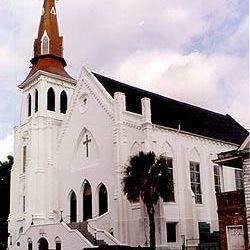
IMG_0905In society’s never-ending quest to deflect attention from the real problems that contribute to events such as took place last Wednesday night in Charleston, I found myself with a message from a frightened parent reading articles reading articles in her Facebook news feed like this one from the left end of our cultural spectrum or this one from the right suggesting a link between mass murder and treatment with ADHD medication, antidepressants or anxiolytics. Here’s what she said at the end of her message…

This makes me sad…,the stigma is so pervasive. My family has a history of stuff where SSRI’s have helped. Stuff like this? This doesn’t help.

As many of you are aware, I’m a physician (child psychiatrist) from a group practice that participated in a government-funded research network conducting studies designed to look at safety issues with psychiatric medications commonly prescribed to children and teens.

This statement won’t come as a surprise to any parent or caregiver who has ever tried to take their child to a specialist such as myself, but we’re plenty busy without having to go out and snatch kids from the mall in order to find enough patients to treat. Over the last 10-15 years, more and more kids who struggle with impulse control or anger management are brought to practices like mine, pediatric clinics or publicly-funded mental health centers because counseling, therapy or medicine has helped lots of kids. Treatment doesn’t help everybody and in the vast majority of cases, medication doesn’t completely eliminate the child or teen’s presenting problems, but why would we be surprised that kids on developmental trajectories marked by struggles with anger management or self-control would have been referred for mental health treatment?

Here are some facts…we have 6.4 million kids between the ages of 5 and 17 in the U.S. who have been diagnosed with ADHD. Between 50-60% are actively being treated with ADHD medication. 3.7% of kids ages 12-17 and 11% of Americans ages 12 and over are being treated with antidepressant medication (also used to treat anxiety). If a history of mental illness or mental health treatment were responsible for the mass shootings, we would literally have blood running in the streets.

Medication (or prior mental health treatment) hasn’t been shown to have caused ANY of these events. Each of the recent mass murders is unique…the theater shooter in Colorado as well as the gunman who shot Congresswoman Gabi Giffords had schizophrenia, the kid in California had high-functioning autism, the Sandy Hook shooter probably had more severe autism, and the Virginia Tech shooter had social anxiety.

There’s no evidence that the Charleston shooter had any mental health treatment, but he was arrested for possession of narcotics without a prescription. He planned and committed racially-motivated mass murder.

As Christians, we see ourselves as part of a larger story-good on the one side, evil on the other. Reading the accounts of what took place during the hour between the time the shooter entered and exited the church, I can’t help but observe a microcosm of the eternal battle between God and the evil one for the souls of men. From the Washington Post

Law enforcement officials said he had confessed, and that during the confession, expressed strong anti-black views. Officials characterized him as unrepentant and unashamed.

Roof told officers that he wanted word of his actions to spread, said the officials, who spoke on the condition of anonymity because the investigation is ongoing.

Yet Roof also acknowledged to authorities that he had briefly reconsidered his plan during the time he spent watching the Bible study group after entering the church, two people briefed on the investigation said.

Roof said he “almost didn’t go through with it because they were so nice to him,” one of the people said, before he concluded that “I had to complete my mission.”

As he methodically fired and reloaded several times, the person said, Roof called out: “You all are taking over our country. Y’all want something to pray about? I’ll give you something to pray about.”

Charleston isn’t about a mental health problem…it’s about an problem with evil. Evil may have won the battle on Wednesday but the Bible is very clear that evil will not win the war. And for reasons discussed at length here this past Friday, our culture is very reticent to acknowledge the existence of evil.
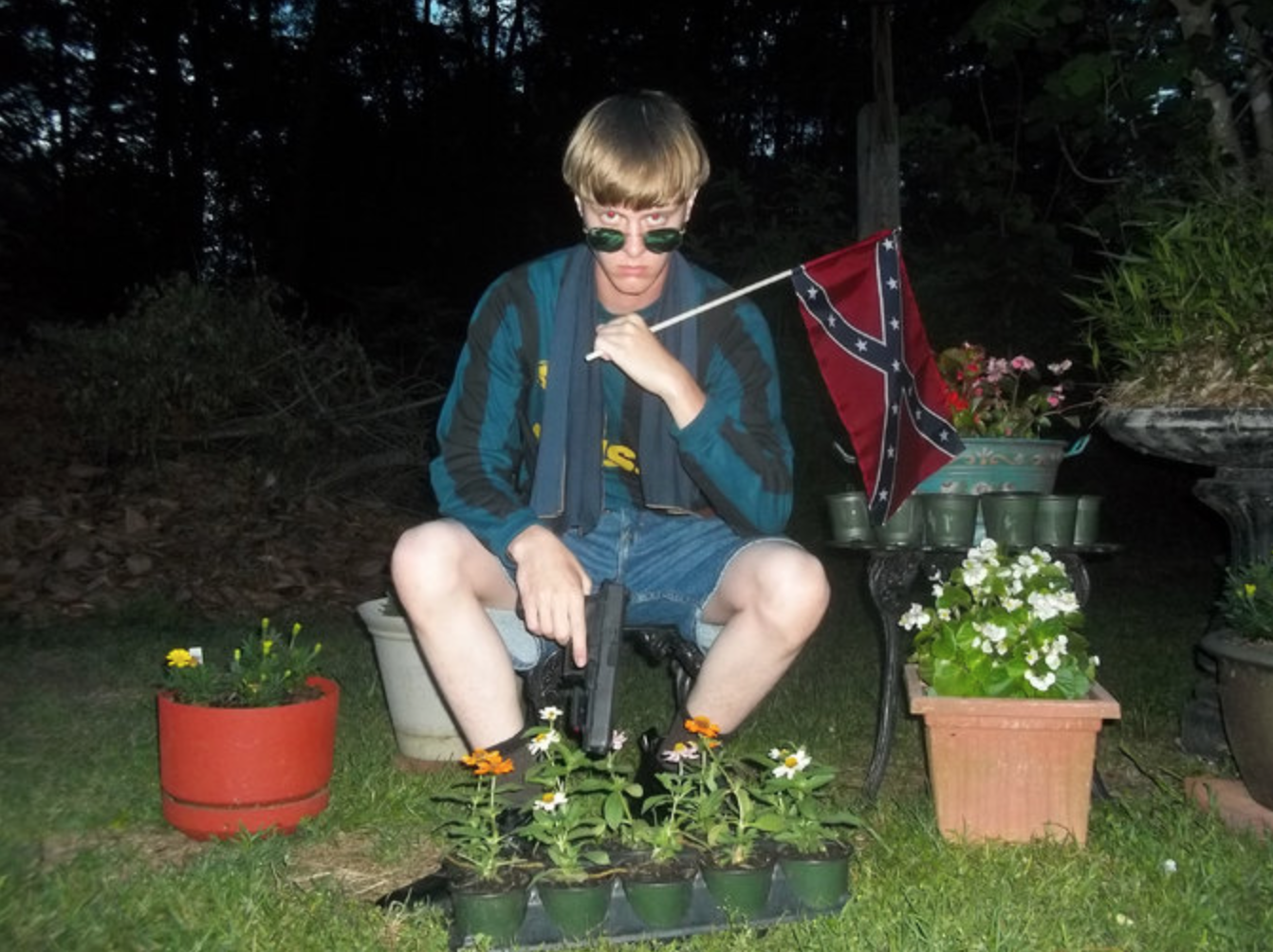
Hate Crime

Woe to those who call evil good and good evil, who put darkness for light and light for darkness, who put bitter for sweet and sweet for bitter!

Isaiah 5:20 (ESV)

Seek good, and not evil, that you may live; and so the Lord, the God of hosts, will be with you, as you have said.

Amos 5:14 (ESV)

Do not be overcome by evil, but overcome evil with good.

Romans 12:21 (ESV)

Let him turn away from evil and do good; let him seek peace and pursue it. For the eyes of the Lord are on the righteous, and his ears are open to their prayer. But the face of the Lord is against those who do evil.

1 Peter 3:11-12 (ESV)

I’d say to parents of kids on medication…Don’t let your hearts be troubled. For every kid who took medicine and went on to become a mass murderer, there are literally millions of who never hurt anybody and were able to live happier, more productive lives and grow up to be the people God intended them to be.

For those interested in reading more on the subject, here’s an earlier post we did looking specifically at the topic of medication safety in kids and teens.

***********************************************************************************************************

KM Logo UpdatedKey Ministry has assembled resources to help churches more effectively minister to children and adults with ADHD, anxiety disorders, Asperger’s Disorder, Bipolar Disorder, depression and trauma. Please share our resources with any pastors, church staff, volunteers or families looking to learn more about the influence these conditions can exert upon spiritual development in kids, and what churches can do to help!

Posted in Advocacy, Controversies, Key Ministry, Mental Health | Tagged , , , , , , , , , , , , , , | 1 Comment

#CharlestonShooting… Evil or mental illness?

156x195-keith-ablow2In the aftermath of the tragic shooting in Charleston, our culture is yet again engaged in a conversation as to why events like this continue to occur. While watching the coverage of the shooting on Fox News last night, Dr. Keith Ablow (the psychiatrist who serves as a Fox News contributor) made what struck me as a jaw-dropping statement…

“Most evil is mental illness.”

As a physician trained in child/adult psychiatry, I’m struck by the accuracy with which the Bible explains the human condition. NONE of us are good. Some of us who choose to reject God lose the benefit of conscience and are given over to a “debased mind”

And since they did not see fit to acknowledge God, God gave them up to a debased mind to do what ought not to be done.  They were filled with all manner of unrighteousness, evil, covetousness, malice. They are full of envy, murder, strife, deceit, maliciousness. They are gossips, slanderers, haters of God, insolent, haughty, boastful, inventors of evil, disobedient to parents, foolish, faithless, heartless, ruthless. Though they know God’s righteous decree that those who practice such things deserve to die, they not only do them but give approval to those who practice them.

Romans 1:28-32 (ESV)

Modern society struggles to acknowledge the presence of evil. Some have attempted to use the new tools we have available to us in neuroscience to point to differences in brain structure or chemistry to explain why certain individuals commit heinous acts such as the slaughter that took place Wednesday night at the Emanuel AME church. Many of my colleagues openly reject the notion of any spiritual reality that we’re unable to measure or quantify. If you can’t image a soul on a fMRI scan, it must not exist. As a result, we’re left with observations such as this from Ron Rosenbaum

Of course, people still commit innumerable bad actions, but the idea that people make conscious decisions to hurt or harm is no longer sustainable, say the new brain scientists. For one thing, there is no such thing as “free will” with which to decide to commit evil. (Like evil, free will is an antiquated concept for most.) Autonomous, conscious decision-making itself may well be an illusion. And thus intentional evil is impossible.

1920430_10153112930588073_9051393141878408641_nAs a society, we seek to minimize the existence of evil because recognition of evil threatens our shared delusion that any absolute standard of right and wrong exists. We want to be masters of our own universe. To acknowledge the presence of right and wrong would require us to acknowledge the Creator of the universe who established the standards.

How do we make sense of the observation that many mass murderers in recent years were receiving treatment or manifesting symptoms of mental illness, and how do we make sense of the rates of mental illness cited among those incarcerated for serious crimes?

What mental illness does is that it makes it harder for some to continue to hide from the world the evil that exists within their hearts. Some struggle with conditions that make it more difficult for them to manage impulses or self-regulate emotions. Others may struggle to let go of obsessive thoughts that build over hours, days or months into violent rage, as with some of the “loners” who have committed mass murder. Sometimes, professionals can help treat the mental illness that predisposes some to act violently, but in doing so we’re treating symptoms and not the root cause of the problem. In most instances, mental illness doesn’t interfere with a person’s capacity to distinguish right from wrong and the Bible is very clear that we all bear moral accountability regardless of any condition that causes us more difficulty with controlling our thoughts, words and actions.

We can’t have the conversation we should have as a culture because most of us are far too uncomfortable with the prospect of examining our own hearts and the recognition that under the right circumstances, we’re all capable of acting in unspeakable ways. We have the example of the churchgoers in Nazi Germany who were complicit in the Holocaust. Dr. Kermit Gosnell was able to operate for over three decades because the attitudes prevalent in our culture blinded regulatory authorities to the realities of what was taking place inside his abortion clinic. Within the culture of academia, a professor of ethics at Princeton (Peter Singer) can be applauded for his advocacy of infanticide for severely disabled children and papers on the subject of “after-birth abortion” get published in the Journal of Medical Ethics. An argument can be made that the young man who confessed to the massacre in Charleston may have in some ways been a product of his environment.

The elites in academia, politics, entertainment and the media have perpetrated cultural delusions to rationalize their evil…and the evil of tens of millions of our fellow citizens. Increasingly, our politics is about preserving our cultural delusions around right and wrong.

shutterstock_139126682We’d like to maintain the delusion there’s a human fix to the problem…taking away guns, spending more money on mental health, providing more workshops on “diversity” or cultural sensitivity. But human fixes can’t work for spiritual problems. And the sinfulness (evil) within human hearts is the ultimate spiritual problem.

Evil is not mental illness. But mental illness sometimes makes it more difficult for men and women to keep the evil within them hidden.

Updated June 13, 2016

***********************************************************************************************************

KM Logo UpdatedKey Ministry has assembled resources to help churches more effectively minister to children and adults with ADHD, anxiety disorders, Asperger’s Disorder, Bipolar Disorder, depression and trauma. Please share our resources with any pastors, church staff, volunteers or families looking to learn more about the influence these conditions can exert upon spiritual development in kids, and what churches can do to help!

Posted in Controversies, Key Ministry, Mental Health | Tagged , , , , , , , , , , , , , , , | 2 Comments

Leading a spiritually disciplined life as a person with ADHD…

shutterstock_123414757All good Christians get up early in the morning to pray, read the Bible and quietly reflect upon God, don’t they? On the other hand, is it possible that there are kids and adults out there who truly have a heart for God even though they don’t engage in the central spiritual practices of the Christian faith as frequently or consistently as some in the church would think is optimal?

Persons with ADHD will expend more mental effort and energy to maintain a spiritually disciplined life. In an earlier post, we discussed some of the difficulties kids and adults with ADHD have with maintaining focus, delaying gratification, setting priorities, managing time and exhibiting self-control because of weaknesses in executive functioning. Let’s consider how those weaknesses might come into play when attempting to use some of the disciplines…

Prayer: Kids and adults with ADHD are more likely to struggle in setting aside time to pray consistently. They may have difficulty remembering what they wanted or needed to pray about when they make time to pray. Prayer logs and journals may be as important for the Christian with ADHD as daily planners and organizers are for the kid in school with ADHD. More importantly, persons with ADHD may have a more difficult time listening for God’s responses to prayer. The ability to “Be still and know that I am God” is a challenge for all of us in our modern society, but even more so for kids and adults with brains wired to notice the trivial and mundane.

BibleBible study: Kids and adults with ADHD are more prone to give up on Bible study when it becomes tedious. Many start off each year with good intentions to read through the Bible. They do OK through Genesis and Exodus, but the person with ADHD is going to struggle with Leviticus and has likely lost their resolve by the time they get to Numbers or Deuteronomy. Many kids with ADHD tell me they get distracted by other words on the page. I know lots of folks with ADHD who require highlighters while reading to focus on the main points. I don’t think God minds the Bible being all marked up if it helps the reader absorb more content. It’s important to remember (to paraphrase Reggie Joiner) that while all Scripture may be equally true, not all Scripture is equally important. One place where the church can help is by presenting the most important truths of Christianity in ways that are relevant, engaging and interesting. If kids with ADHD and their parents can’t stay focused long enough to get all the way through the Bible, let’s make sure they get the most important parts.

Meditation: Reflecting quietly upon a passage of Scripture or upon some attribute of God will be more challenging for kids and adults who have more difficulty holding words or images in their minds. The shorter the time spent in meditation and the more direction given to meditation, the more likely the exercise will be in facilitating spiritual growth.

Service: Kids with ADHD may have a difficult time remembering and getting started on uninteresting tasks. Just ask one to take out the garbage or clean his room if you need an illustration. On the other hand, serving can be a powerful experience if the act is meaningful and the skill set required fits within the giftedness of the person with ADHD. The kid or adult who has to be dragged to a Bible Study kicking and screaming may be all charged up about working on a Habitat crew, renovating houses for single moms in the city, or digging wells for villages in Africa.

Worship: Many kids and adults with ADHD may do better with worship events as participants as opposed to spectators. One of the churches we serve through Key Ministry offers monthly family worship experiences that parents attend with their elementary-age kids emphasizing Biblical virtues. The director told me every kid who performed on stage in their family worship was being treated for ADHD.

Evangelism: Evangelism is one spiritual discipline in which having some ADHD traits might be advantageous. Kids and adults with ADHD may have an easier time acting on the impulse to share their faith with others instead of pondering all the reasons why saying nothing might be a good idea. One observation I’ve made in working with lots of churches through Key Ministry is that a disproportionate number of senior pastors probably have ADHD, in part for the reason described above.

Bottom line…If God wanted cookie-cutter Christians, that’s what He would have made! We have a palette of spiritual disciplines because we won’t all grow closer to God in exactly the same way. The key for church leaders, parents and those who care for kids with ADHD is helping them identify those disciplines that excite them about God and help them grow closer to Him.

***********************************************************************************************************

shutterstock_24510829Key Ministry is pleased to make available our FREE consultation service to pastors, church leaders and ministry volunteers. Got questions about launching a ministry that you can’t answer…here we are! Have a kid you’re struggling to serve? Contact us! Want to kick around a problem with someone who’s “been there and done that?” Click here to submit a request!

Posted in ADHD, Key Ministry, Spiritual Development | Tagged , , , , , , , , | 5 Comments

Mitzi VanCleve…Help My Unbelief: “Religious OCD”

shutterstock_168659081Having lived with OCD for quite some time and experienced a lot of diverse obsessional themes, I can tell you that any persistent or long-held obsession is going to create a painful and debilitating level of anxiety, often accompanied by depression.

In order to demonstrate a level of respect and empathy for others, it is important for those of us with OCD to recognize that while our obsessional themes may differ, this doesn’t mean that our experience is more legitimate or painful than that of others.

“Religious OCD” or scrupulosity may not seem like a big deal to a person with OCD who isn’t a Christian but to those of us who have struggled with it, it is a very big deal. It might not even seem to be all that big of a deal to a psychologist who isn’t a Christian, because they cannot relate to the experience of being a Christian in comparison to the things which they deem to be real/legitimate to their own experiences. And, conversely; it might seem like a really big deal to a pastor who is trying to help someone who is suffering from religious OCD, but this may be because he might misunderstand it to be a spiritual problem instead of seeing it as a disorder.

These types of errant views about religious OCD can make the person who is afflicted feel even more isolated in their suffering. The isolation might go on for a very long time until they encounter other Christians who are going through the same thing or happen upon a Christian psychologist who specializes in the treatment of OCD.

The truth of the matter is that for the person with OCD who struggles with blasphemous thoughts or unrelenting questions and doubts concerning their relationship to God, it’s sheer torture. John Bunyan in describing how this form of OCD impacted him said: “Of all the temptations that ever I met with in my life, to question the being of God, and the truth of His gospel, is the worst, and the worst to be borne; when this temptation comes, it takes away my girdle from me, and removeth the foundation from under me.” (1)

While it may be true that most genuine believers will likely experience doubt at some point in their lives, most often it is of the fleeting sort and most definitely the sort which is laid to rest by the reassurance and truth’ of the Word of God. C.S. Lewis seemed to believe this to be the case when he wrote: “The soul that has once been waked, or stung, or uplifted by the desire for God, will inevitably (I think) awake to the fear of losing Him.” (2)

The experience of religious OCD is, however, entirely different; in cause, in duration and in the level of suffering it creates in the person who is afflicted.

The reason I wanted to address this form of OCD is that recently I’ve encountered a mindset on several OCD forums which either minimizes it in comparison to other obsessional themes or suggests that deep down the person who is experiencing it doesn’t really believe in God and therefore, should just let go of any or all efforts to know God or pursue religion of any sort.

Both of these attitudes err in regard to what it’s really like for the genuine believer to suffer from religious OCD and also in regard to what to do about it.

The first mindset suggests that the experience of Religious OCD cannot compare to the pain of other obsessions because to those who are making this assertion, religion is just a point of view rather than the foundation and underpinnings of a persons life. But, for the true Christian, religion isn’t just a point of view. Their “religion” is based in a very real and very meaningful relationship with the person of Jesus Christ. For those of us who have entered into this relationship, it is the central and most important aspect of what being fully human is. Our experience is different from the unbeliever because, “in Him, we live and move and have our being.” (3)

The second mindset completely dismisses the experience of religious OCD as being legitimate because the persons who are making this assertion feel that any belief in God is utterly nonsensical. To them, being anxious over the loss of a relationship with Christ would be akin to an adult falling apart because they weren’t sure that Santa Claus was real.

I have had several online conversations with people on OCD forums who have suggested to me that my “religious” obsessions could be easily overcome just by my admitting that deep down I didn’t really believe in God at all. These same people are quick to acknowledge the legitimacy of, as well as the agony that obsessions about contamination, health, sexual orientation, harming themes and themes which threaten their closest human relationships create. And yet, they remain dismissive of my experience of religious OCD.

Several of them have said things like; ” Yeah, I used to struggle with fears about God, but I finally realized that there isn’t any God, so I stopped going to church and now I’m not bothered by it any more.” Their solution to religious OCD is to suggest avoidance. Little do they realize that avoidance won’t work for a person who truly loves Christ any more than it would work for the person who is struggling with harming themes or relationship themes in regard to a close family member. The only thing that avoidance accomplishes in all these forms of OCD is to validate the obsessional fear and thereby bring even more distress and anxiety to the sufferer. These individuals would never suggest that the person who is suffering from harming obsessions or relationship OCD should avoid their child or their spouse, so why would they suggest that the Christian avoid Christ? The only answer I can come up with, is that they aren’t or never really were true believers and followers of Christ. They’ve never really understood what it means to have a relationship with Christ. They have never had the opportunity to actually; “taste and see that the Lord is good”, in the way that I have. (4)

My goal in sharing about my religious OCD is to reach out to those who are struggling and feeling isolated and alone in their experience. I want them to know that there are others out there who truly “get” what they are going through and therefore, can empathize and offer up encouragement and hope.

Religious OCD, while it has it’s roots in an actual disorder of the brain, also has it’s roots in the fact that OCD can only create obsessional themes about that which is nearest and dearest to the sufferer. And, for the Christian who is afflicted with OCD, it is, just as CS Lewis suggested, only natural that it would eventually pick on the most important relationship in one’s life.

To read more about my experiences with OCD please check out my E-book on Amazon at the following link:

(1)”Grace Abounding to the Chief of Sinners”: John Bunyan, Penguin Books Ltd.

(2) “Letters to Malcolm, Chiefly on Prayer”, CS Lewis, Harcourt, Inc., Chapter Fourteen, Page 76.

(3) Acts 17:28 NIV Bible

(4) Psalm 34:8 NIV Bible

***********************************************************************************************************
10947709_612305872234627_941507695_nMitzi VanCleve is a mother and an author with a very powerful witness of how God has provided her with grace and strength through her personal experience with OCD and Social Anxiety Disorder. She’s recently launched a new blog, The OCD Christian to offer hope and encouragement to others experiencing similar struggles. Her book, Strivings Within-The OCD Christian is available at Amazon.

Posted in Anxiety Disorders, Mental Health | Tagged , , , , , , , , , | 6 Comments

The front door of your church…

FullSizeRenderIn the seventh installment of our series, Ten Strategies for Promoting Mental Health Inclusion at Church, Steve discusses how churches can enhance their ability to attract families impacted by mental illness through their website and social media sites.

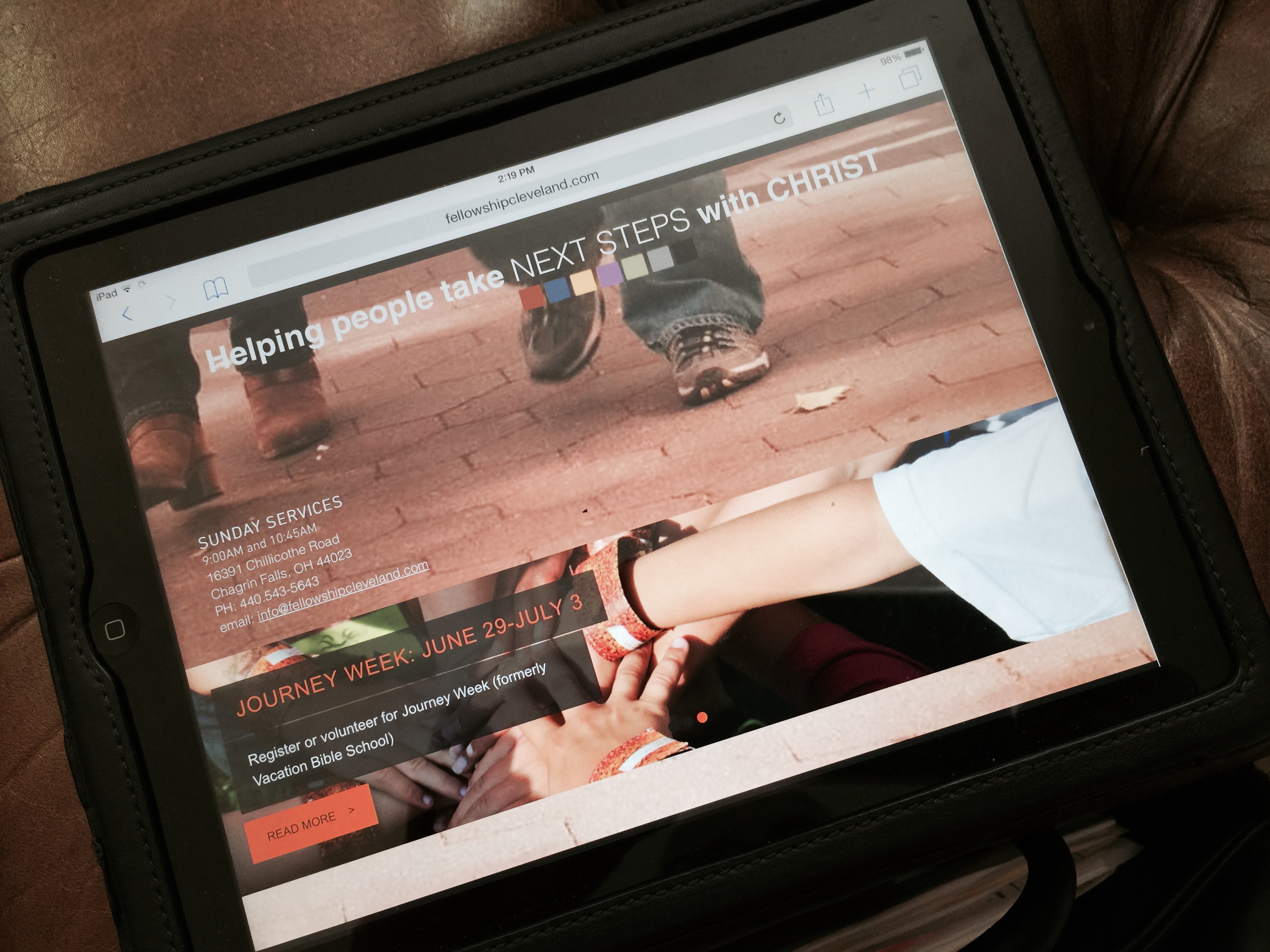
Websites increasingly serve as the front door to our churches…a tool for introducing the church to first-time visitors and a strategy for communicating information about ministry opportunities and events to a population more likely to attend to their smartphones and tablets than to a traditional church bulletin. Websites and social media platforms will often represent the initial impression a family on the outside will form of your church…and may be especially important to families dealing with the social isolation frequently associated with mental illness.

This post has been the most challenging of the series for me to write because I’ve had a difficult time finding a prototype of a website I really liked, and readers view these posts months and years after they’re initially published…any links I post may be hopelessly dated. One of our ministry colleagues suggested The Village Church in the Dallas-Fort Worth metroplex as an excellent church website…I’ll borrow a few examples from there.

I’d prefer to share three general concepts for teams to consider in evaluating their church’s web presence as part of an overall inclusion plan for kids, teens and adults with mental illnesses and their families…

  • The more people can see, hear and experience of your ministry environments online, the better.

Anxiety disorders are the most common form of mental illness experienced by children, teens and adults in the U.S. When I’m asked questions regarding the causes/treatment of  anxiety, the most important idea I seek to communicate is the observation that many people with anxiety have brains that come “hard-wired” to overestimate the level of danger or risk in a new setting or experience. The more they can discover in advance about a new situation, the easier it will be for them to enter into the situation.

Let’s consider this concept when it comes to church. One common fear many experience when visiting a new church is of being inappropriately dressed…too formal or too casual. Without communicating anything specific about the style of dress, this website includes pictures that help tell a story.

Village Church Worship Service

Village Kids

Village High School

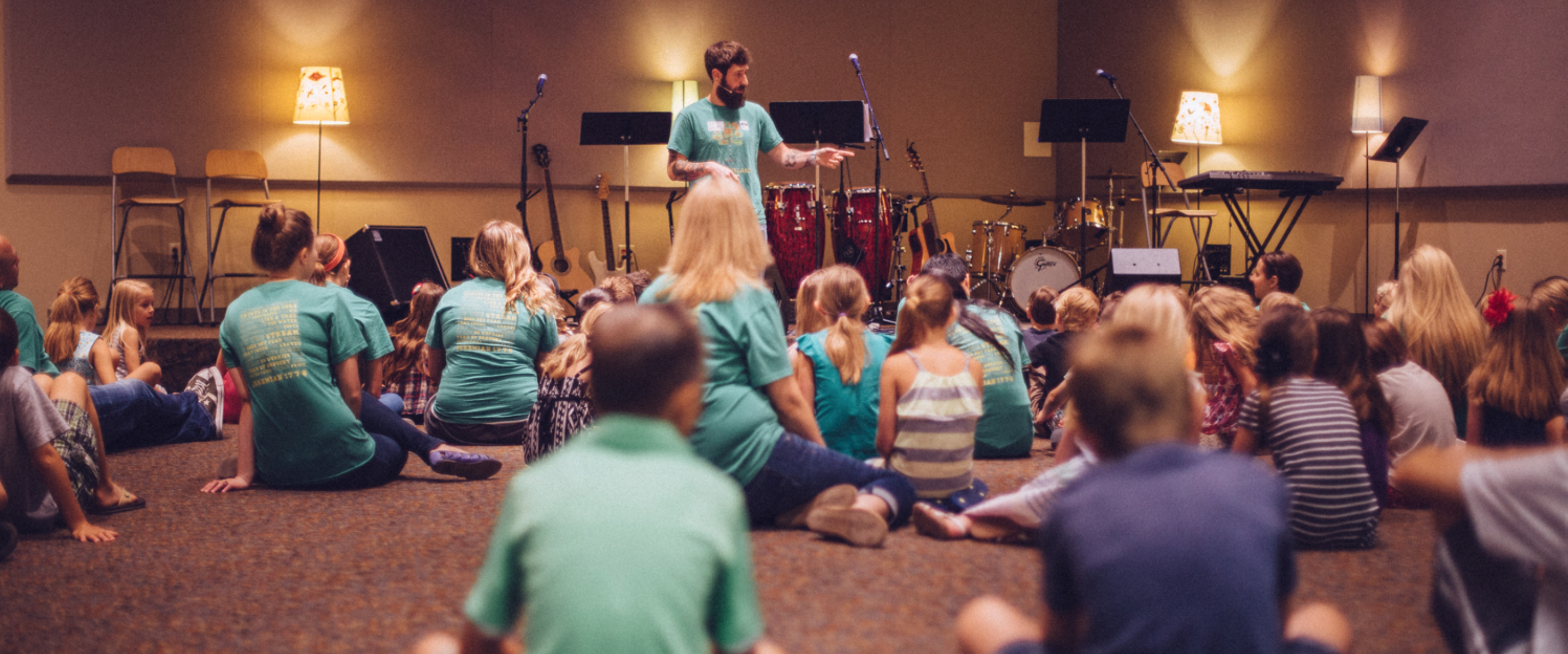
It’s casual, contemporary and kids/students can expect to hear someone teach while being seated comfortably on the floor. Parents can see a number of “official-looking” volunteers in green t-shirts intermingled with their kids in an open environment.

Many churches emphasize involvement in small groups. Some might fear what to expect in a typical small group environment…Here’s a group that meets in homes where kids appear to be welcome.

Village small group

They also offer recovery groups at their “bricks and mortar” campuses, list the scope of the groups they offer, and offer this picture that may reflect upon the size of a typical group and the privacy of the group (held in a room with a closed door)…

Village Recovery Groups

The Village Church clearly endorses Biblical Counseling on a prominent page containing links to eight counseling groups based in the surrounding community endorsed by the church, and has links to specific books they’ve found helpful, including a book on overcoming fear, worry and anxiety.

They also offer some video to help parents of preschool-age kids anticipate what to expect when they come to visit…

If I were serving on staff at a church seeking to welcome kids, teens and adults with mental illness into the full scope of the church’s ministry activities, I’d have LOTS of video on my webpages and social media…

  • Video of worship services
  • Video of small groups
  • Video of mission trips/service activities
  • Video of weekend activities in age-appropriate ministry activities
  • Video of special events…VBS, retreats, picnics, gatherings, outreach, camping trips
  • Consider creating an obvious link/portal on your homepage to help families plan their initial visit(s) to your church or connect with an “inclusion concierge.”

People with common mental illnesses and many high functioning adults with autism spectrum disorders struggle greatly with social communication. I’ve mentioned before in our blog series on anxiety that many of the kids and families we serve are very dependent upon electronic communication (e-mail and text) and struggle greatly to use the phone. I started using the ratio of texting to talking as a screening question for social anxiety in teens.

We had routinely made use of electronic registration for families signing up for respite events in churches where we trained. Why not offer families the opportunity to e-mail a church they plan to visit where someone from the appropriate ministry areas could help arrange for an advance visit/tour for kids or adults who struggle in unfamiliar environments, preregister families for appropriate programming and (perhaps) connect them with an “inclusion concierge” to quietly arrange for appropriate accommodations…a seat on an aisle near the door for an adult prone to panic attacks and agoraphobia, preferential entrances for kids and adults with sensory processing issues, hand sanitizer  for persons with OCD, etc. Here’s a download from our resource kit your church could modify if putting together an online registration form for advance visits.

  • Use your church’s social media platforms to share links/posts with resources your attendees can share with families with mental health needs.

Earlier in the series, we discussed the importance of the messages teaching pastors communicate about mental health from the pulpit or stage to attendees or guests within the church. Your church’s blogs, Facebook pages, Twitter and Instagram accounts all play a vital role in communicating a sense of welcome to families outside the church. They are also tools that leaders place in the hands of church attendees to share with families within their social networks in need of a church home.

Where can churches get quality content to share from a Christian perspective on mental health-related topics? I’d hope this blog would offer more than enough resources to keep any social media director busy for a long time…just kidding! 

If I were putting together a short Twitter list of people/organizations to follow for mental health resources with a Christian worldview, I’d include…

  • My personal account @drgrcevich (I share lots of mental health related articles and studies that aren’t necessarily shared by Key Ministry)
  • Mental Health Grace Alliance @mhgracealliance
  • Jolene Philo @jolenephilo (co-author of Every Child Welcome, upcoming book on PTSD)
  • Amy Simpson @aresimpson (author of Troubled Minds, with Christianity Today)
  • Rhett Smith @rhetter (author of The Anxious Christian)

In summary, your church’s website and social media platforms are powerful tools in any mental health inclusion strategy…be strategic in making the most of them in any plan!

Next…Identify and respond to practical needs.

***********************************************************************************************************

VangieMissed the interview Vangie Rodenbeck did with Steve on Mental Illness and the Church? Check out their entire interview here. Vangie and Steve discussed…

  • The biggest obstacles children and adults with mental illness face in attending church
  • Why family ministry approaches make sense in implementing intentional mental health inclusion in your church
  • The available research on how churches are doing in supporting families impacted by mental illness
  • Helpful resources for those involved in children’s ministry, youth ministry and family ministry in better serving families in your church and your surrounding community impacted by mental illness.
Posted in Hidden Disabilities, Inclusion, Key Ministry, Mental Health, Strategies | Tagged , , , , , , , , , , , , , , , | 1 Comment

What parents are most afraid to hear…

shutterstock_211263451One of the benefits I experienced during my days on the lecture circuit was the opportunity to meet wise and learned senior colleagues who shared pearls of knowledge that helped me see clinical situations in a new light. One such colleague is Dennis Rosen, a developmental pediatrician in Western Massachusetts well-known for treating kids with a variety of emotional or behavioral problems. He shared the anecdote below after an evening lecture:

Before he finishes a consultation, Dr. Rosen regularly asks parents “Deep down inside, is there anything you were afraid you’d find out as a result of our meeting today?” By far and away, the most common answer he receives is “I was afraid that I did something to cause my child’s problems.”

I suspect the fear of being told that their parenting strategies, family values or choices are the cause of their child’s emotional or behavioral problems presents a major obstacle to families becoming actively involved with a local church.

I came across a post from a pastor discussing signs suggesting a child may be unnecessarily provoked to anger by their parents. I suspect the pastor’s intent was to show that children posing behavior challenges may be the product of scripturally unsound parenting…five specific examples he used in his outline are shown below:

Signs of parent provocation in a child:

  • When you see kids pulling away from their parents
  • Angry outbursts from a child
  • Lack of joy in a child, seldom smile
  • Rebellion against authority
  • A child who says mean things to their parents or others

shutterstock_116109031When you see kids pulling away from their parents: A common sign seen in kids suffering from depression is the propensity to isolate oneself from friends and family members. Kids who have been adopted or kids in foster homes often pull away from parents in response to difficulty processing attachment issues related to early trauma, abuse or neglect.

Angry outbursts from a child: Kids with ADHD very frequently exhibit difficulties with the ability to regulate emotions. Kids with Bipolar Disorder often experience marked increases in anger and irritability during mood episodes. Kids with obsessive anxiety are prone to anger outbursts during transitions or when they’re perseverating on intrusive thoughts.

Lack of joy in a child, seldom smile: Common symptoms of depression

Rebellion against authority: This is pretty much the definition of Oppositional Defiant Disorder. A propensity to disrespect authority is seen in conditions associated with poor executive functioning and a lack of capacity to delay gratification.

A child who says mean things to their parents or others: This behavior can be attributed to pretty much any condition in the DSM-IV.

Getting to the root cause when kids experience the behaviors listed above can be pretty challenging. That’s why I had to do four years of med school, three years of general psychiatry residency and a two year child psychiatry fellowship in preparation for my job. There are all kinds of developmental, environmental, biological, genetic, psychosocial and spiritual issues at play in kids with issues. Is it possible that “scripturally unsound parenting” could contribute to the behaviors listed above? Absolutely. How might a parent of a child being treated for ADHD, depression, Bipolar Disorder or Reactive Attachment Disorder hear the message described in the post? If that parent is exploring Christianity, would they experience grace in the teaching they experienced?

There are topics that are very difficult to discuss outside the context of a relationship. After I’ve gotten to know parents for a while, I can talk about “scripturally unsound parenting” because I’ve taken the time to understand all facets of their child’s situation. There may be parents who are trying their best visiting your church with kids who have bad genes, kids who experienced trauma or abuse, or kids who haven’t yet developed the skills to effectively self-regulate their emotions and behavior.  How do we welcome them and share with them the unconditional love Christ has for them? How do we as the church best communicate so we build the relationships necessary to cast influence in their family?

There’s a lot to say about how churches handle this issue.

***********************************************************************************************************

KM Logo UpdatedKey Ministry has assembled resources to help churches more effectively minister to children and adults with ADHD, anxiety disorders, Asperger’s Disorder, Bipolar Disorder, depression and trauma. Please share our resources with any pastors, church staff, volunteers or families looking to learn more about the influence these conditions can exert upon spiritual development in kids, and what churches can do to help!

Posted in Families, Hidden Disabilities, Inclusion, Key Ministry, Mental Health | Tagged , , , , , , | 2 Comments

Update…Our Front Door online church initiatives…

Front Door CrossUpdate: Because of technical issues, some readers who follow the blog through our Facebook page were unable to access today’s post. Apologies to anyone following by e-mail… we don’t mean to spam your inbox!

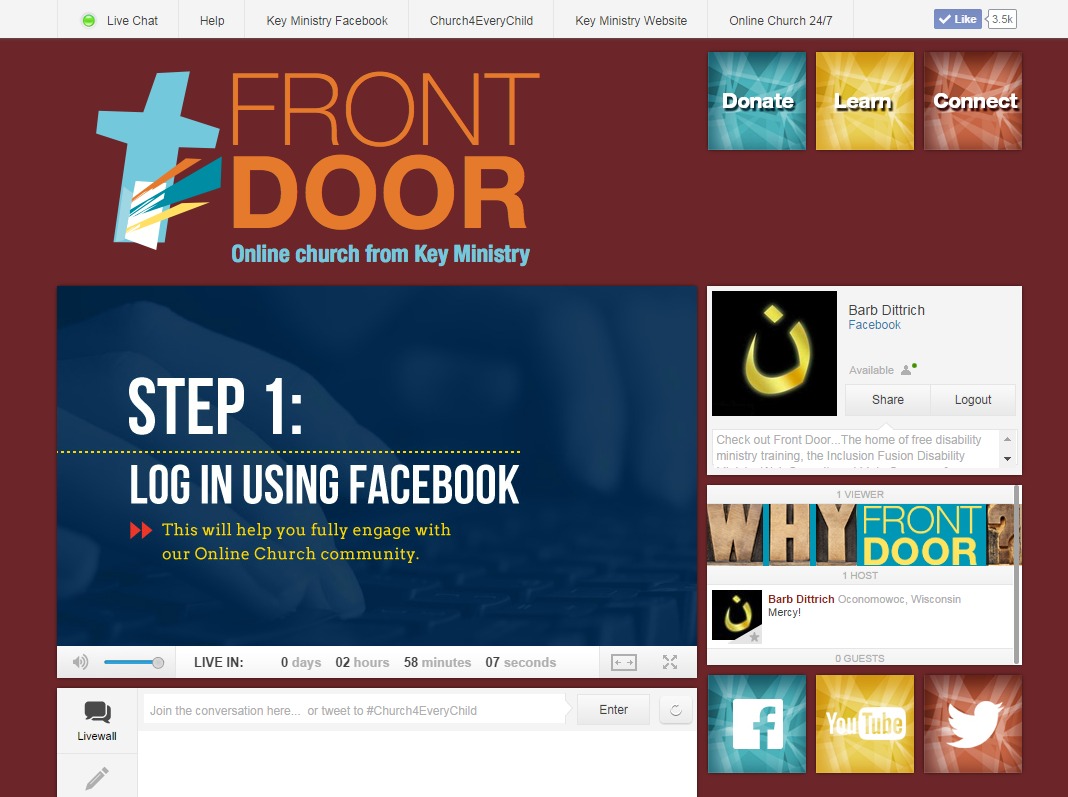
We’d like to update you on the progress of our Front Door initiative to use online church services as a strategy for ministering to families impacted by disability.

The Front Door project is an ongoing experiment…exploring a variety of technology applications to help connect families to churches and help churches develop innovative ways of overcoming the barriers that impede families of kids with mental illness, trauma and developmental disabilities…barriers that prevent them from attending worship services and participating in all the activities offered by local churches to promote spiritual growth. Sometimes we’ll try stuff that works great…sometimes it doesn’t.

One experiment that worked extraordinarily well was an online small group for families impacted by disability with the support of Dr. Lorna Bradley. We’re hoping to offer training for church leaders seeking to launch online, interactive small groups as part of their disability ministry outreach later this summer.

One experiment that didn’t go as well as we would’ve liked was offering sermons from different churches on an online platform. We heard that too many people were challenged by difficulties connecting to the platform. The vast majority of the folks who read this blog already have a church and didn’t sense a need to watch…or to invite others. We learned Facebook advertising doesn’t work all that well for targeting the one hour windows of time when we were hosting the services. We were consistently being outbid for disability-related keywords with our Google Grant (the amount of money we can bid for viewers to click on the site with a grant is capped). So…we’re going to try something else.

Chris EmmittTwo of our online worship services offered through Community Bible Church (CBC) in San Antonio…our Sunday night service led by Barb Dittrich and our Monday night service led by Ann Holmes developed steady followings and meaningful online community. Thanks to the graciousness of our friends at CBC, we’ll be continuing services on their onlinechurch.com platform led by worship hosts with great training and experience in ministry to families impacted by disability at their regularly scheduled times, beginning this Sunday, June 14th.

Worship hosted by Barb Dittrich…every Sunday at 8:00 PM Eastern (7:00 PM Central)

Worship hosted by Ann Holmes…every Monday at 9:00 PM Eastern (8:00 PM Central)

Online Church 060115In addition, we’d like to welcome families impacted by disability to LIVE worship experiences every Sunday hosted by the Online Church team with our team available to support them with any disability-related ministry needs that arise. Live services will be available every Sunday at…

  • 11:00 AM Eastern (10:00 AM Central)
  • 12:30 PM Eastern (11:30 AM Central)
  • 2:00 PM Eastern (1:00 PM Central)

We’ll continue to have five services available each week for families at onlinechurch.com…three services during the daytime on Sunday conducted in a true “inclusion” model (families impacted by disability joining services for the general onlinechurch.com community) and evening services on Sunday and Monday in a “reverse inclusion” model (hosted and promoted by disability ministry leaders with the worldwide onlinechurch.com community invited to join). We’re grateful to the crew at CBC for their continued involvement and support with our Front Door initiative, and looking forward to offering families impacted by disability an enhanced experience of online community!

Ryan 052415Another experiment involves posting teaching from First Christian Church in Canton, Ohio directly onto our Front Door Facebook page. Messages are available “on-demand, can easily be shared with families impacted by disability who are unable to attend church, and folks can comment online at their leisure. We’re using targeted advertising to share the messages with families in the Canton-Akron area in need of a home church. Facebook is placing an enhanced emphasis on video…we’re featuring teaching from services that meets the requirement for video to be under 45 minutes duration.

Our Board has approved a plan in which Key Ministry will develop online teaching and devotional resources around Biblical topics of special interest to persons impacted by disability and their family members. Stay tuned for more information in the coming months…

We continue to be very interested in coming alongside churches seeking to use online ministry to reach kids impacted by disability and their families. If your church is interested, go to our website and complete the “contact us” form through the link on our consultation page. With this change in strategy, we’re getting back to what we’ve always done as a ministry…helping individual churches welcome and include kids with disabilities in the context of their church culture.

***********************************************************************************************************

Livewall BlankKey Ministry is pleased to feature a new resource page on Online Church in Disability Ministry. The resource page contains video features on how online church may be incorporated into disability ministry outreach, and links to lots of helpful resources for churches seeking to extend their ministry into cyberspace. Check it out today!

Posted in Inclusion, Key Ministry | Tagged , , , , , , , , , , , | 1 Comment

Update…Our Front Door online church initiative for families impacted by disability

Front Door CrossWe’d like to update you on the progress of our Front Door initiative to use online church services as a strategy for ministering to families impacted by disability.

The Front Door project is an ongoing experiment…exploring a variety of different uses of technology to help connect families to churches and help churches develop innovative ways of overcoming the barriers that impede families of kids with mental illness, trauma and developmental disabilities from attending worship services and participating in all of the other activities offered by local churches to promote spiritual growth. Sometimes we’ll try stuff that works great…sometimes it doesn’t.

One experiment that worked extraordinarily well was an online small group for families impacted by disability with the support of Dr. Lorna Bradley. We’re hoping to offer training for church leaders seeking to launch online, interactive small groups as part of their disability ministry outreach later this summer.

One experiment that didn’t go as well as we would’ve liked was offering sermons from different churches on an online platform. We heard that too many people were challenged by difficulties connecting to the platform. The vast majority of the folks who read this blog already have a church and didn’t sense a need to watch…or to invite others. We learned Facebook advertising doesn’t work all that well for targeting the one hour windows of time when we were hosting the services. We were consistently being outbid for disability-related keywords with our Google Grant (the amount of money we can bid for viewers to click on the site with a grant is capped). So…we’re going to try something else.

Chris EmmittTwo of our online worship services offered through Community Bible Church (CBC) in San Antonio…our Sunday night service led by Barb Dittrich and our Monday night service led by Ann Holmes developed steady followings and meaningful online community. Thanks to the graciousness of our friends at CBC, we’ll be continuing services on their onlinechurch.com platform led by worship hosts with great training and experience in ministry to families impacted by disability at their regularly scheduled times, beginning this Sunday, June 14th.

Worship hosted by Barb Dittrich…every Sunday at 8:00 PM Eastern (7:00 PM Central)

Worship hosted by Ann Holmes…every Monday at 9:00 PM Eastern (8:00 PM Central)

Online Church 060115In addition, we’d like to welcome families impacted by disability to LIVE worship experiences every Sunday hosted by the Online Church team with our team available to support them with any disability-related ministry needs that arise. Live services will be available every Sunday at…

  • 11:00 AM Eastern (10:00 AM Central)
  • 12:30 PM Eastern (11:30 AM Central)
  • 2:00 PM Eastern (1:00 PM Central)

We’ll continue to have five services available each week for families at onlinechurch.com…three services during the daytime on Sunday conducted in a true “inclusion” model (families impacted by disability joining services for the general onlinechurch.com community) and evening services on Sunday and Monday in a “reverse inclusion” model (hosted and promoted by disability ministry leaders with the worldwide onlinechurch.com community invited to join). We’re grateful to the crew at CBC for their continued involvement and support with our Front Door initiative, and looking forward to offering families impacted by disability an enhanced experience of online community!

Ryan 052415Another experiment involves posting teaching from First Christian Church in Canton, Ohio directly onto our Front Door Facebook page. Messages are available “on-demand, can easily be shared with families impacted by disability who are unable to attend church, and folks can comment online at their leisure. We’re using targeted advertising to share the messages with families in the Canton-Akron area in need of a home church. Facebook is placing an enhanced emphasis on video…we’re featuring teaching from services that meets the requirement for video to be under 45 minutes duration.

Our Board has approved a plan in which Key Ministry will develop online teaching and devotional resources around Biblical topics of special interest to persons impacted by disability and their family members. Stay tuned for more information in the coming months…

We continue to be very interested in coming alongside churches seeking to use online ministry to reach kids impacted by disability and their families. If your church is interested, go to our website and complete the “contact us” form through the link on our consultation page. With this change in strategy, we’re getting back to what we’ve always done as a ministry…helping individual churches welcome and include kids with disabilities in the context of their church culture.

***********************************************************************************************************

Livewall BlankKey Ministry is pleased to feature a new resource page on Online Church in Disability Ministry. The resource page contains video features on how online church may be incorporated into disability ministry outreach, and links to lots of helpful resources for churches seeking to extend their ministry into cyberspace. Check it out today!

Posted in Inclusion, Key Ministry, Strategies | Tagged , , , , , , , , , , , , , | Leave a comment

Churches, mental health inclusion and respite care…

BPC respite teamIn the sixth installment of our series, Ten Strategies for Promoting Mental Health Inclusion at Church, Steve discusses respite care as a practical strategy for churches seeking to connect with families of kids with significant mental illness.

Raising a child with a significant mental illness can be physically, emotionally, and financially draining. A limited amount of respite care may be available from government-funded agencies, but care is expensive, waiting lists are often long, the quality of care can be very inconsistent, and middle-class families can have great difficulty accessing care.

shutterstock_174158831According to information compiled by the National Resource Center for Community Based Child Abuse and Neglect Prevention Grants (CBCAP), 75% of families with children ages 0-17 receiving support from the Supplemental Security Income (SSI) program because of a disability had unmet respite needs, but only 8% were accessing respite care. Very little research has been done examining the respite care needs of families impacted by mental illness, but when I was actively serving in a respite ministry offered by a nearby church, the majority of kids served had a primary mental health concern as opposed to a more traditional “special need.”

Through providing respite care, churches can step in the gap to meet an immediate need for parents of kids with mental illness while providing an opportunity for members and attendees to serve others in a practical way and connect with families who likely lack a meaningful connection with a local church. A growing number of churches are offering respite events to kids and families through special needs ministries. The “invite list” may be easily expanded to reach families of kids with primary mental health concerns.

Churches can host respite events without stigmatizing kids with mental health disabilities while serving kids with physical and intellectual disabilities is by providing a “buddy” to everyone, including “typical” siblings of kids attending the event.

What do respite events look like? They generally look like a party! Respite events are typically held on weekend nights for approximately three or four hours. Each guest with a disability, (as well as their typically developing siblings) is assigned a volunteer buddy. The volunteer and the guest spend time doing fun activities throughout the church while the guest’s parent(s) or caregivers enjoy the evening out for some well-deserved time off. This might mean a romantic dinner and a movie, a nap, a trip to the spa, or time to complete errands…whatever the parent/caregiver desires.

Smaller churches without the facilities or volunteer resources to consider hosting respite events might consider a “relational respite” service model, described here by Libby Peterson, in which a family or a small group in a church takes turns providing respite in the home of the family receiving respite.

Both of our ministry consultants (Shannon and Ryan) serve at churches offering respite and are available to respond to specific questions or inquiries about starting respite or serving kids with mental health concerns through existing respite programs. I’d also direct church staff/volunteers seeking to launch respite ministries to two outstanding organizations supporting rapidly expanding respite networks across the U.S…

Buddy BreakBuddy Break is the respite ministry of Nathaniel’s Hope, with 75 churches currently offering respite in 12 states and another 27 churches trained and in the pipeline. Churches participating in Buddy Break get training for their leadership team and volunteer buddies, tools for building a safe and sustainable ministry, promotional materials, ongoing coaching and support and membership in a national Buddy Break network.

rEcessrEcess is the respite ministry of 99 Balloons, with 21 active sites operating in 11 states and Canada. rEcess operates under an open source model, which is implemented and run by the host church and local rEcess leadership team after agreeing to several “non-negotiables” (a ministry team, an established location accessible to persons with disabilities and a completed program agreement) in exchange for the tools to support your ministry and the right to use the rEcess name.

Respite ministry is an incredibly practical strategy for connecting with families of kids with mental illness in your local community that meets an immediate need through demonstrating the love of Christ!

Photo: Respite volunteers of Bay Presbyterian Church in prayer, February 6, 2015

***********************************************************************************************************

KM Logo UpdatedKey Ministry has assembled resources to help churches more effectively minister to children and adults with ADHD, anxiety disorders, Asperger’s Disorder, Bipolar Disorder, depression and trauma. Please share our resources with any pastors, church staff, volunteers or families looking to learn more about the influence these conditions can exert upon spiritual development in kids, and what churches can do to help!

Posted in Families, Inclusion, Key Ministry, Mental Health, Resources, Strategies | Tagged , , , , , , , , , , , | 4 Comments

How would your church respond to Caitlyn Jenner?

Caitlyn JennerI have a friend who served for a time as a pastor in the Midwest before transitioning into a medically-related field, because his job as a pastor didn’t pay enough to cover the bills after he and his wife adopted several children, with at least one having some special needs. During a conversation a few years ago, he volunteered that he serving part-time as a volunteer pastor at a growing church plant near his home.

My friend was enthusiastic about his church. To illustrate, he shared that one of their attendees was a man who came to church every Sunday morning in a wig, makeup and women’s clothing. My friend was very pleased that the stuff going on in his new church was compelling enough to draw this person into what was likely a very uncomfortable situation for someone of his appearance, but was more pleased by the way the people of his church welcomed him, accepted him into the congregation and treated him with respect.

It’s easy for those of us in Christian culture to lump people who fall under the “LGBTQ” designation into one big category in how we think about their lifestyle and behavior, but in my experience as a psychiatrist, there’s something qualitatively different about the complexity of mental health issues in people who struggle with gender dysphoria. For all the media attention Bruce Jenner received for pursuing medical and surgical treatment to change his anatomy and appearance to resemble a woman, the percentage of people in society who struggle with gender identity is very small. The handful of kids and adults with gender dysphoria I’ve come across entering my thirtieth year in psychiatry have experienced quite a bit of mental anguish. As part of our mission to build bridges between the church and families served by the mental health system, I thought I’d review the research literature to see what we know about adults who struggle with gender dysphoria…I’ll tackle the research on children and teens in an upcoming post.

The American Psychiatric Association very publicly removed  “Gender Identity Disorder” from the DSM-5 in 2013, in exchange for the term “Gender Dysphoria,” which merits its’ own chapter in the new diagnostic guidelines. You can read more about their rationale here. The APA is careful to emphasize that gender dysphoria doesn’t represent a mental disorder. At the same time, adults with gender dysphoria experience symptoms of mental illness at much higher rates than the general population.

Here’s a 2010 study from the National Center for Transgender Equality and the National Gay and Lesbian Task Force examining healthcare access issues in a sample of over 7,000 adults who self-identified as either transgendered or gender non-conforming. I found the survey very helpful in understanding the continuum of medical and surgical treatment in this population…the majority of adults have received hormonal therapy, a minority have received some surgical treatment, but relatively few have complete the entire series of procedures involved with the gender reassignment surgery that Bruce/Caitlyn experienced. I’ll share some highlights…

  • 75% of respondents reported having received counseling associated with their gender dysphoria…an additional 14% hoped to receive counseling someday.
  • Participants reported rates of cigarette smoking around 50% higher than rates in the general population.
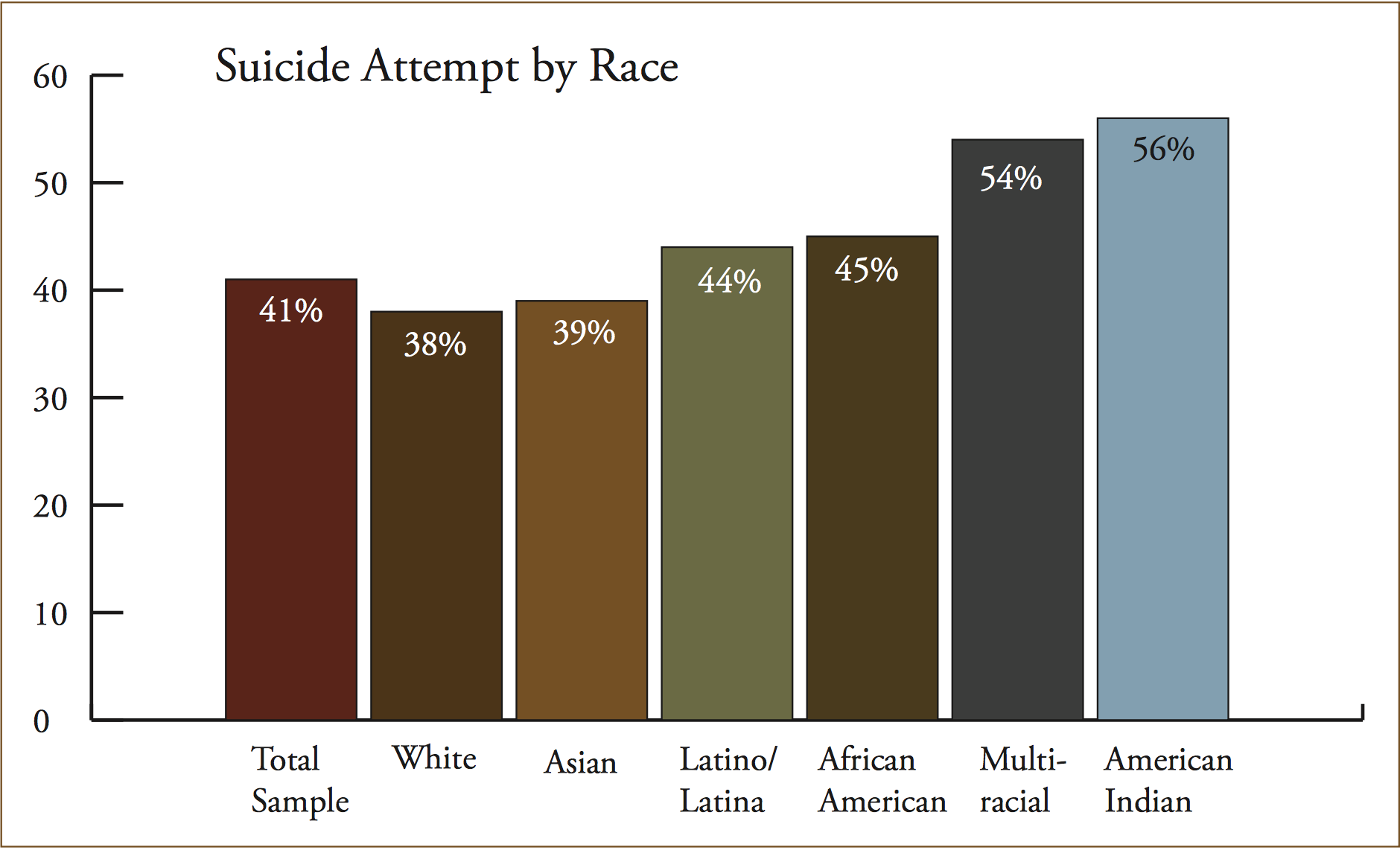
  • 41% of the overall sample reported having made a suicide attempt in their lifetime- the rate in the U.S.  adult population is 1.6%
  • Suicide attempts...transgenderedIn contrast to the general adult population, lifetime rates of suicide attempts are higher among members of ethnic minorities identifying as transgendered or gender dysphoric (see graphic at right)
  • Despite many studies reporting improved self-esteem and sense of well-being following medical and/or surgical treatment, rates of attempted suicide were higher among adults who had medically (45%) or surgically (43%) transitioned, compared to adults who had not transitioned (34% and 39%, respectively.

One big red flag in the data describing outcomes among adults who undergo gender reassignment surgery is the data surrounding suicidal behavior following surgery. A review of the research literature produces lots of papers containing radically different claims about mental health outcomes in patients who undergo gender reassignment. For example, this long-term study reports very positive outcomes in 71 patients when compared to their status at the time of intake. I was struck by this study of patients who underwent gender reassignment surgery in Sweden over a 30 year period. Some key findings…

  • Following surgery, patients were four more likely to have been hospitalized psychiatrically for a condition other than gender dysphoria. The increased risk for psychiatric hospitalization persisted even after adjusting for psychiatric hospitalisation prior to sex reassignment.
  • Rates of death by suicide soared ten years or more following surgery. The rate of completed suicide in this study following gender reassignment surgery was NINETEEN TIMES HIGHER than the rate in the general population.

Dr. Paul McHugh, the former chairman of psychiatry at Johns Hopkins University Medical School…the academic center where many of the techniques used in gender reassignment surgery may be among the most outspoken (and controversial) figures in the debate about treatment of gender dysphoria. Here’s a link to an article he authored in First Things and a more recent article in the Wall Street Journal. From the First Things article…

The psychiatrist and psychoanalyst Jon Meyer was already developing a means of following up with adults who received sex-change operations at Hopkins in order to see how much the surgery had helped them. He found that most of the patients he tracked down some years after their surgery were contented with what they had done and that only a few regretted it. But in every other respect, they were little changed in their psychological condition. They had much the same problems with relationships, work, and emotions as before. The hope that they would emerge now from their emotional difficulties to flourish psychologically had not been fulfilled.

We saw the results as demonstrating that just as these men enjoyed cross-dressing as women before the operation so they enjoyed cross-living after it. But they were no better in their psychological integration or any easier to live with. With these facts in hand I concluded that Hopkins was fundamentally cooperating with a mental illness. We psychiatrists, I thought, would do better to concentrate on trying to fix their minds and not their genitalia.

It’s important to keep in mind that Dr. McHugh’s opinion is an outlier in the medical field, and the current accepted standard of care is medical (hormonal) or surgical treatment. Most patients who undergo treatment appear to be satisfied with the results, but based upon the statistics, an extraordinarily (and unacceptably) high percentage of patients experience sufficient emotional distress to attempt to take their lives. The suicide rates before and after treatment are scandalous. I worry that people with gender dysphoria and mental illness will be victims of an environment of political correctness, in which advocates for transgendered individuals will want to sweep very serious mental health concerns under the table because of fear of stigma from being diagnosed with mental illness.

Experts understand little of the causes of gender dysphoria. One theory suggests that prenatal exposure to high levels of androgens may be a factor. Other associations include later  birth order, left-handedness, low birth weight and a higher number of male siblings. Some of the research being conducted into linkages between gender dysphoria and specific mental health conditions is fascinating, including higher than expected rates of schizophrenia, obsessional interests and autism.

In my experience, people with gender dysphoria are frequently intensely unhappy and battling serious mental illness. One of my patients asked me about Bruce/Caitlyn yesterday and I told him he would NOT want to experience what Bruce experienced.

I would certainly hope that my church would be a place where Caitlyn and others with similar issues would experience community and feel accepted. Despite their efforts through hormonal therapy and/or gender reassignment surgery to radically alter their God-given bodies, they’re still image bearers. I’d hope church would be a place where they could explore the claims of Jesus and experience peace. An unacceptably high percentage of those with gender dysphoria experience true “hidden disability” related to mental illness.

My friend’s church “gets it.” I’m pretty sure mine “gets it” too. I’m not sure most churches do.

Photo of Caitlyn Jenner from Vanity Fair.

Posted in Controversies, Hidden Disabilities, Key Ministry, Mental Health | Tagged , , , , , , , , , , , , | 12 Comments